
JMJ Plumbing helps protect the public water supply and keep your site in good standing with professional backflow compliance services. We test backflow preventers, document results, and handle repairs or replacements when units fail. You get properly functioning protection, completed paperwork, and less risk of violations, fines, or service interruptions.
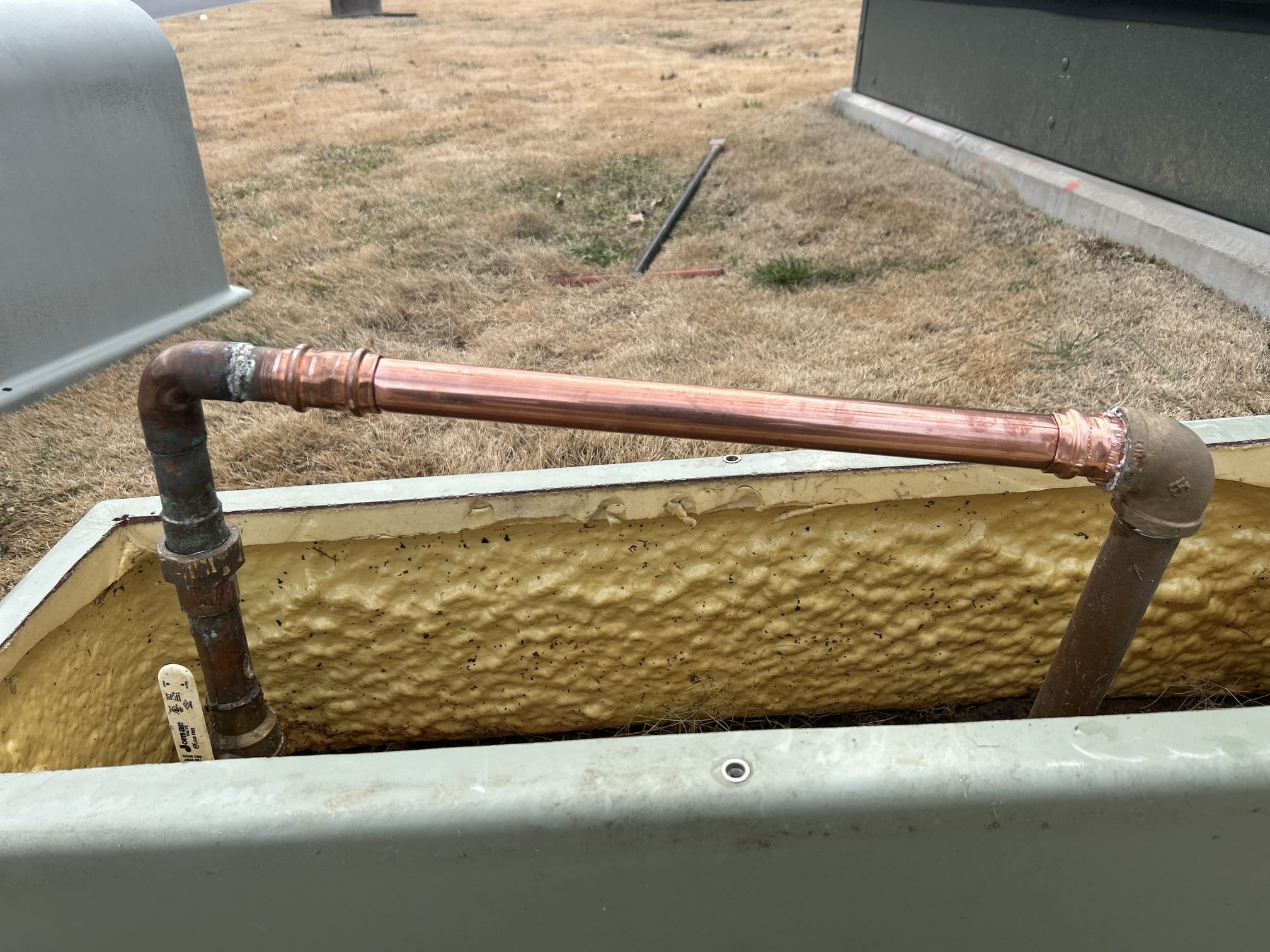
Signs Your Backflow Assembly Needs Testing or Repair
Backflow prevention is the one plumbing system on a commercial property that is usually driven by a deadline rather than a symptom. Both matter, and here is what to watch for.
- You received an annual test notice from your water purveyor — most Georgia water authorities require backflow assemblies to be tested every year by a certified tester, with the report submitted to them
- The relief valve on an RPZ is discharging continuously — fouled check valves, debris on a seat, a failed relief valve, or fluctuating supply pressure — a steady discharge is a failure, not a normal condition
- The assembly failed its last test — the internal rubber parts have worn or debris is holding a check open, and the assembly is no longer providing the protection it is installed to provide
- You have no record of when the assembly was last tested — missing documentation is treated the same as an untested assembly by most water authorities
- Discolored, cloudy, or odd-tasting water at fixtures — a possible cross-connection issue, which is exactly the condition backflow prevention exists to stop
- Visible leaking, corrosion, or freeze damage on the assembly body — outdoor and irrigation assemblies are the most common freeze casualties, and a cracked body cannot be repaired with a rebuild kit
- Building or irrigation work was done recently — any change to the water service, a new connection, or a new irrigation system can affect backflow protection and usually requires a test
Why Backflow Prevention Matters on a Commercial Property
Backflow is what happens when water reverses direction and non-potable water is pulled or pushed back into the potable supply. It happens two ways. Backsiphonage occurs when supply pressure drops — a main break, a hydrant flowing, heavy demand — and the vacuum draws water backward out of a boiler, an irrigation line, a mop sink, or a process tank. Backpressure occurs when a system downstream operates at higher pressure than the supply and pushes its water back into the line. A backflow prevention assembly is the mechanical barrier between those events and the drinking water in your building and your neighbors’ buildings.
Because the assembly is mechanical, it wears. Springs weaken, rubber seats harden, debris lodges on a check, and freeze damage cracks bodies. That is why most water purveyors in Georgia require annual testing by a certified backflow tester, with the test report submitted to the water authority. Specific requirements, forms, and schedules are set by each local authority, so the practical answer for your property depends on who supplies your water.
Different hazards call for different assemblies. A reduced pressure zone (RPZ) assembly is used for high-hazard connections and is the only common type with an atmospheric relief between its checks. A double check valve assembly is used on lower-hazard connections. Pressure vacuum breakers are common on irrigation. Which one your property needs is determined by the degree of hazard and by local requirements, not by preference.
Our Backflow Testing, Repair, and Replacement Process
- Inventory the assemblies on the property — many buildings have more than one — domestic service, irrigation, fire line, boiler make-up, and process connections are all common, and each one is tested separately
- Test with calibrated equipment — the assembly is run through its required test sequence by a tester certified to perform it, using a calibrated differential gauge, and the actual readings are recorded on the report form your water authority accepts
- Repair on the spot where we can — many failures are worn rubber parts, springs, or debris on a seat, and a rebuild kit restores the assembly during the same visit
- Replace when a rebuild will not hold — cracked or freeze-damaged bodies, obsolete assemblies with no available parts, and units that no longer match the hazard classification get replaced
- Retest and document — the assembly is retested after any repair or replacement, and the passing report is completed with the readings, the assembly data, and the tester information
- File the report and set next year’s reminder — we submit the report to the water authority as required and put the property on a schedule so the next annual test is not a surprise
Backflow Testing Across North Metro Atlanta
JMJ Plumbing has tested, repaired, and replaced backflow prevention assemblies for commercial properties across North Metro Atlanta since 1996, including retail centers, restaurants, offices, medical buildings, and irrigation systems on managed properties. We serve Acworth, Alpharetta, Canton, Cumming, Dunwoody, Hickory Flat, Holly Springs, Johns Creek, Kennesaw, Marietta, Milton, Roswell, Sandy Springs, Smyrna, Woodstock, and the surrounding communities. Because backflow protection sits on the water service, work on either usually affects the other — see our commercial water line repair page. Properties with multiple assemblies and recurring deadlines are best handled through our preventative maintenance program, and our 24/7 emergency service covers an assembly that fails and floods.
Backflow Testing, Repair and Replacement FAQs
How often does a backflow preventer need to be tested?
Annually, in most cases. Water purveyors across Georgia generally require backflow prevention assemblies to be tested once a year by a certified tester, and the test report is submitted to the water authority. Testing is also typically required after an assembly is installed, repaired, relocated, or replaced. The exact schedule and forms are set by your local authority.
Who is allowed to test a backflow preventer in Georgia?
A certified backflow tester using calibrated test equipment. Water purveyors accept reports only from certified testers, and the gauge itself has to be kept in calibration. This is not something building maintenance can sign off on internally, even when the staff is experienced, because the certification and the calibration record are part of what the authority is accepting.
What happens if our backflow assembly fails the test?
It has to be repaired or replaced and then retested before a passing report can be filed. Many failures are worn rubber parts, weak springs, or debris holding a check open, and those are repairable with a rebuild kit, often during the same visit. Cracked or obsolete assemblies have to be replaced instead.
Why is water dripping from our RPZ?
The relief valve is discharging, which means the assembly is doing its job or the assembly has failed. Common causes are debris on a check seat, worn internal parts, a failing relief valve, or supply pressure fluctuations. Occasional brief discharge can be normal; continuous discharge is not, and it needs to be diagnosed rather than plugged or piped away.
Do we have to shut the water off during backflow testing?
Yes, briefly. Testing requires closing the assembly’s shutoff valves for a few minutes, so water to whatever the assembly serves is interrupted. For restaurants, medical offices, and other operations where that matters, we schedule the test before opening or during a slow period so the interruption lands where it causes the least trouble.
What is the difference between an RPZ and a double check valve assembly?
An RPZ has two checks plus a relief valve that dumps to atmosphere if either check fails, which is why it is used on high-hazard connections. A double check assembly has two checks and no relief, and it is used on lower-hazard connections. The degree of hazard and local requirements determine which one your connection needs.
Does our irrigation system need its own backflow device?
Almost always, yes. Irrigation is treated as a hazard because water sits in lines with fertilizer, pesticide, and soil contact, and it is typically protected by its own assembly separate from the domestic service. Irrigation assemblies are also the ones most often damaged by freezing, so they need seasonal attention as well as annual testing.
Can a backflow assembly be repaired instead of replaced?
Usually. Most assemblies are designed to be rebuilt, and manufacturers make repair kits with the rubber parts, springs, and seats that wear out. Replacement is necessary when the body is cracked or freeze damaged, when the assembly is obsolete and parts are no longer available, or when the installed type no longer matches the hazard.
Annual test due, or an assembly that failed? Book backflow testing, repair, or replacement online, or call JMJ Plumbing at (770) 966-9654. We are a Georgia Master Plumber licensed and insured company (MP210296) serving North Metro Atlanta commercial properties since 1996, with 24/7 emergency service when an assembly fails or floods. Financing is available through GreenSky.