
JMJ Plumbing provides commercial water heater repair and replacement services to keep your facility running smoothly. Hot water is mission-critical for food service, healthcare, and facilities with high restroom traffic. We diagnose performance issues, repair units when viable, or replace them with properly sized commercial systems, including correct shutoffs, expansion control, gas or electric provisions, venting, and temperature settings. You get dependable recovery rates and fewer “no hot water” emergencies.
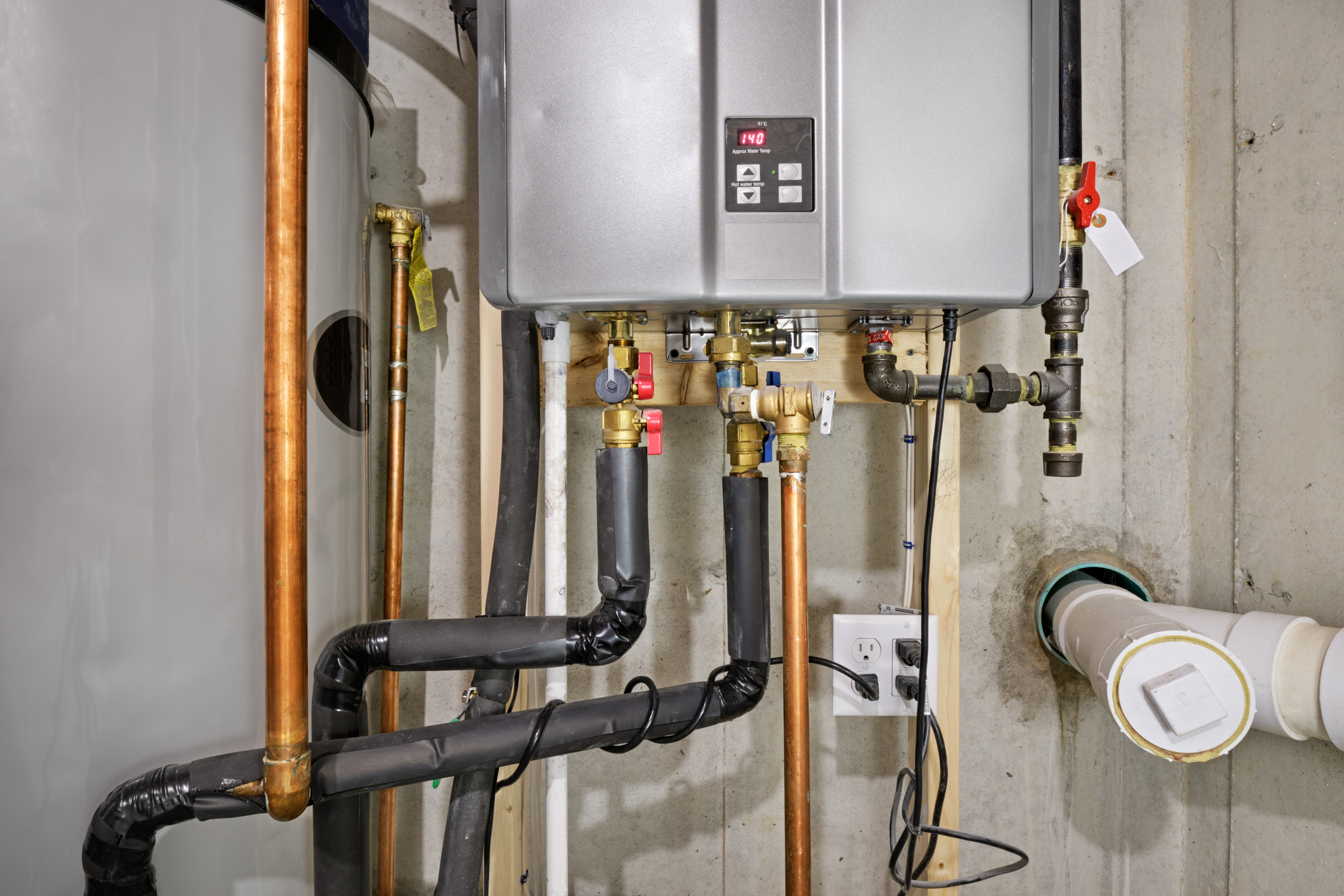
Signs You Need Commercial Water Heater Service
Commercial water heaters rarely quit without warning. Catching these signs early is the difference between a scheduled replacement and a closed kitchen.
- Hot water runs out during your busiest hours — the heater is undersized for current demand or has lost capacity to sediment. A three-compartment sink, a dish machine, and a restroom block hitting at once will expose a heater that was fine two years ago.
- Recovery has slowed noticeably — scale on the burner surface or the heat exchanger is insulating it from the water. The unit fires normally but takes far longer to bring the tank back up to temperature.
- Rumbling, popping, or kettling from the tank — water is flashing to steam under a sediment layer on the tank bottom. That layer also drives up gas use and shortens the life of the tank.
- The temperature and pressure relief valve is discharging — either the valve has failed or the system is genuinely over temperature or over pressure. It is a safety device and a discharging T and P is never something to cap or ignore.
- Rusty or discolored hot water at multiple fixtures — the anode rod is spent and the tank lining is corroding. Once the tank itself is rusting through, there is no repair that puts it back.
- Water pooling around the base or at the connections — a fitting, a valve, or the tank seam is leaking. A leak from the tank body means replacement, and in a mechanical room over occupied space it needs attention immediately.
- Soot, scorching, or a burner that will not stay lit — a venting or combustion air problem. This is a life-safety issue as much as a plumbing one and should be looked at before the unit is put back in service.
Repair or Replace?
On a commercial unit the decision turns on the condition of the tank or heat exchanger, the age of the equipment relative to the duty it sees, and whether the current configuration still matches the building’s demand. A heater sized for the previous tenant is a common problem in leased restaurant space. Here is how we generally approach the call.
| Situation | Typical recommendation | Why |
|---|---|---|
| Failed thermostat, gas valve, igniter, or thermocouple | Repair | These are wear parts on an otherwise sound unit and are usually available for common commercial models. |
| Leak from the tank body or a weeping seam | Replace | A leaking tank cannot be repaired. Once the lining fails, the steel is the only thing left holding the water. |
| Heavy scale, slow recovery, unit still within service life | Repair and descale | Flushing and descaling often restores most of the lost recovery, particularly on units that have never been serviced. |
| Hot water shortfall at peak with a healthy heater | Re-evaluate sizing or storage | The fix may be added storage, a second unit, or a change in the recirculation setup rather than a new heater. |
| Repeat service calls on the same unit | Replace | Repeat failures usually mean the equipment is at the end of its useful life, and every failure lands during business hours. |
| Vent, combustion air, or clearance problems | Correct before anything else | Venting deficiencies are a safety issue and will need to be brought into compliance whether the heater is repaired or replaced. |
Our Commercial Water Heater Process
- Assess the real demand — we look at your fixtures, your peak hours, and how the building actually uses hot water, not just the nameplate on the existing unit. That is what determines whether the current equipment is the problem.
- Inspect and test the existing equipment — we check the burner or elements, thermostats and controls, the T and P valve, the anode where accessible, venting and combustion air, and the condition of the connections and expansion control.
- Present the options plainly — repair, replace in kind, resize, or move to a different configuration such as multiple units or tankless. We explain what each one means for your recovery rate, your mechanical room, and your utility use.
- Handle permits and code requirements — commercial water heater work commonly requires a permit and inspection, and the specifics for venting, seismic or structural restraint, expansion control, mixing valves, and pan and drain requirements vary by jurisdiction. We confirm what your county or city requires before installation.
- Install and commission — we set the unit, complete the gas or electrical, water, venting, and drain connections, purge and fill, verify combustion and delivery temperature, and check for leaks under full operating conditions.
- Schedule the follow-up — we set a flushing and inspection interval appropriate to your water quality and duty cycle, because scale is what kills commercial heaters early in this part of Georgia.
Commercial Water Heater Service Across North Metro Atlanta
JMJ Plumbing has been installing and servicing commercial water heaters across North Metro Atlanta since 1996, in restaurants, salons, schools, churches, medical offices, and multi-tenant buildings. We serve Acworth, Alpharetta, Canton, Cumming, Dunwoody, Hickory Flat, Holly Springs, Johns Creek, Kennesaw, Marietta, Milton, Roswell, Sandy Springs, Smyrna, and Woodstock, plus the surrounding communities. If your complaint is a long wait for hot water at fixtures far from the heater rather than a shortage of it, the issue is often the loop, so see our recirculation pump page. Regular preventative maintenance keeps scale from stealing your recovery, and if a unit fails outside business hours, our commercial emergency service crews can get you running.
Commercial Water Heater FAQs
How long does a commercial water heater last?
A commercial water heater generally lasts less than a residential one because it works harder, and the biggest variable is water quality and whether it has been flushed. Hard water and heavy duty cycles shorten life considerably. A unit that has been descaled and inspected on a schedule will usually outlast an identical one that was installed and forgotten.
Why does our restaurant run out of hot water at peak?
Usually because recovery cannot keep up with simultaneous demand, not because the tank is too small on paper. A dish machine, a three-compartment sink, and restrooms drawing at once will drain a heater that seems adequate the rest of the day. Sediment buildup makes it worse by slowing recovery further. The fix may be descaling, added storage, or a second unit.
Do we need a permit to replace a commercial water heater?
In most cases yes. Commercial water heater replacement typically requires a permit and inspection, and requirements for venting, expansion control, mixing valves, drain pans, and restraint vary by city and county. We confirm what your jurisdiction requires and handle the permitting rather than leaving you to discover a problem at your next inspection.
Can you replace a water heater outside our business hours?
Yes. Most commercial water heater replacements are scheduled overnight, before opening, or on a closed day so the building has hot water when staff arrive. Because the water has to be off for part of the job, doing it outside operating hours is usually the only practical option for a restaurant or a busy office.
How often should a commercial water heater be flushed?
More often than most buildings do it. Flushing intervals depend on water hardness and how hard the unit works, and heaters serving a commercial kitchen typically need service several times more often than a light-duty office unit. We set an interval based on what we find in your tank on the first visit rather than applying a generic number.
Is tankless a good option for a commercial building?
It can be, particularly where mechanical room space is tight or demand is spread through the day. Tankless units deliver continuous flow but are sized by flow rate rather than storage, so a facility with sharp simultaneous peaks may need several units in a bank. Gas supply, venting, and water quality all factor into whether it fits your building.
What is a mixing valve and do we need one?
A thermostatic mixing valve blends hot and cold to deliver a controlled temperature at fixtures while allowing the tank to store hotter water. Many commercial applications require one so that storage temperature and delivery temperature can be set independently. Whether it is mandatory for your building depends on the fixture type and local code, which we verify before installation.
What does a discharging relief valve mean?
It means the system has exceeded a safe temperature or pressure, or the valve itself has failed. Either way it needs attention now, and the valve should never be plugged or capped. Common causes include a failed thermostat, thermal expansion with no expansion tank, or a high incoming pressure that also needs a pressure reducing valve.
Need commercial water heater work? Book commercial water heater service online, or call JMJ Plumbing at (770) 966-9654. We are a Georgia Master Plumber licensed and insured company (MP210296) serving North Metro Atlanta since 1996, with 24/7 emergency service when a heater fails mid-shift and financing available through GreenSky.