
JMJ Plumbing provides commercial sump pump and ejector pump repair services to help protect your property from flooding, water damage, and sewage backups. When these systems fail, you’re often one storm or one busy shift away from a major disruption. We troubleshoot power supplies, float switches, check valves, alarms, and pump performance to identify the root cause of the problem, then repair or replace components as needed. We also verify discharge routing and basin condition to ensure the entire system is functioning as intended and providing reliable protection for your building.
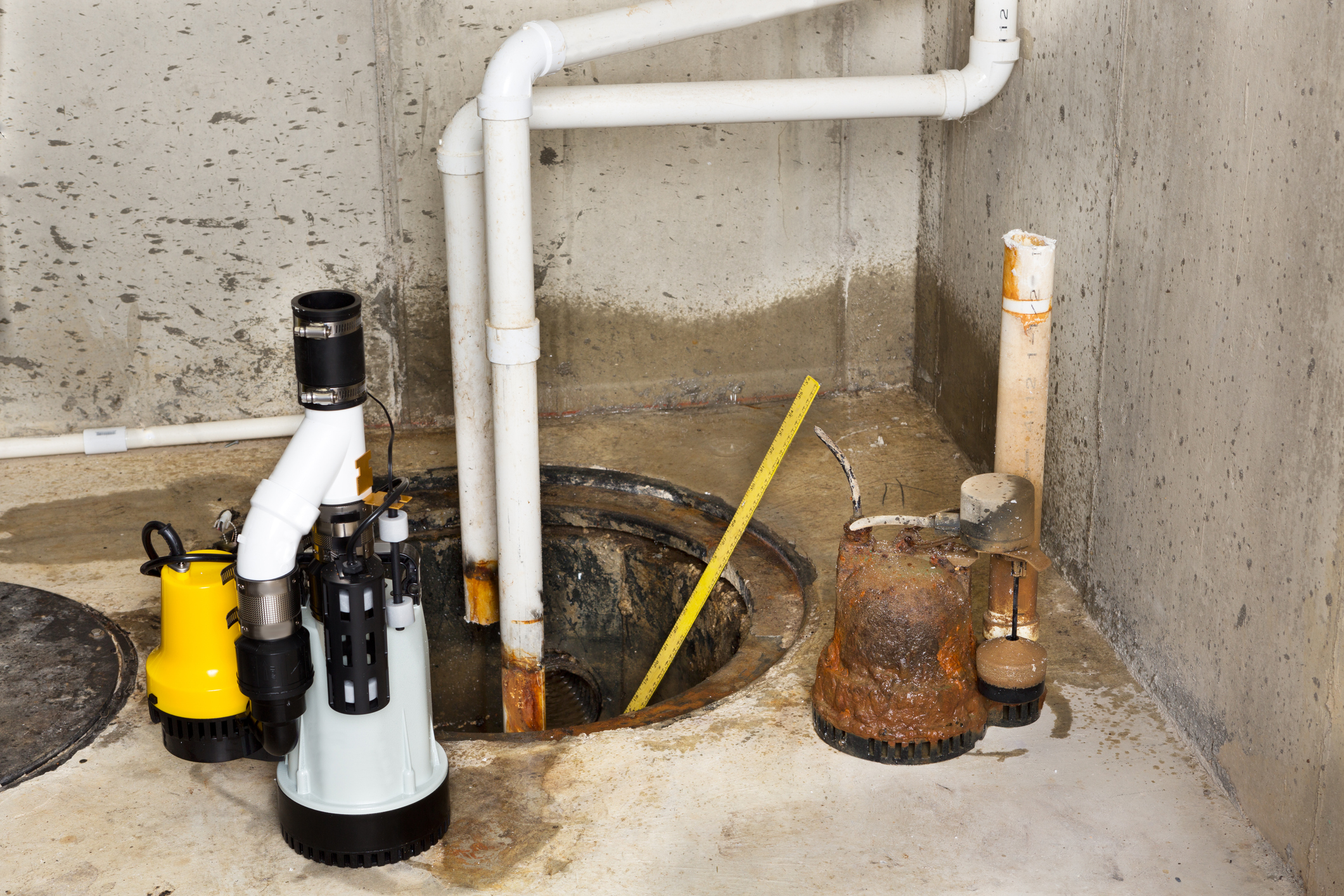
Signs Your Commercial Sump or Ejector Pump Needs Service
Pumps live in a pit with the lid closed, so most buildings do not think about them until water is already on the floor. These are the warnings that show up first.
- The pump runs constantly or cycles on and off every few seconds — the float switch is stuck or out of adjustment, or a failed check valve is letting discharged water fall straight back into the basin
- Standing water around the basin or a sewage odor in the mechanical room — the pump is not keeping up with inflow, or the basin lid gasket and vent connection are no longer sealing gases inside
- Grinding, rattling, or a loud hum with no water moving — the impeller is worn or jammed with debris, the bearings are failing, or the motor is energized but seized
- The circuit breaker trips or the pump keeps dropping out — moisture has reached the motor windings or the seal has failed, which is a shock hazard as well as a pump problem
- A high-water alarm that keeps sounding — the alarm float is doing exactly what it should — the pump, the check valve, or the discharge line downstream is blocked or undersized for the load
- Basement or below-grade fixtures draining slowly — the ejector basin is holding sewage because the discharge line, check valve, or vent is restricted
- Heavy scale, rust, or grease coating the discharge piping and float — the pump has gone too long between service intervals, and solids are building up on the parts that have to move freely
Sump Pumps and Ejector Pumps Are Not the Same Equipment
Buildings often use the two terms interchangeably, which leads to the wrong pump being specified when one fails. The difference matters for solids handling, venting, and how the equipment has to be serviced.
| Sump pump | Sewage ejector pump | Grinder pump | |
|---|---|---|---|
| What it moves | Clear groundwater and seepage | Raw sewage and wastewater with solids | Sewage, reduced to a slurry before discharge |
| Where it sits | An open or lidded sump pit collecting drain tile and seepage | A sealed, vented basin serving below-grade fixtures | A sealed basin, usually with a long or uphill discharge run |
| Discharge | Storm or approved exterior discharge point | Sanitary sewer, above the sewer main invert | Sanitary sewer, often through small-diameter pipe |
| Common failure | Stuck float, failed check valve, frozen or blocked discharge | Solids and wipes wrapping the impeller, failed seals, vent problems | Cutter wear from rags and grease, motor overload |
| Service concern | Testing the float and backup power | Basin cleanout, seal condition, gas-tight lid | Cutter inspection and amperage draw |
Replacing an ejector pump with a lighter-duty sump pump because it fits the basin is a common shortcut, and it fails quickly. We size replacements to the actual fixture load, the vertical lift, and the length of the discharge run.
Our Commercial Sump and Ejector Pump Process
- Confirm what the system is doing — we check the pump under real conditions, watch a full cycle, listen to the motor, and verify whether the float, the check valve, or the discharge line is the actual problem
- Open and inspect the basin — with the circuit locked out, we look at impeller condition, seal integrity, basin solids level, lid and gasket condition, and the vent connection
- Give you the repair-or-replace picture in writing — float switches, check valves, and discharge fittings are often worth repairing; a pump with a failed seal, a burned motor, or heavy impeller wear rarely is
- Size the replacement to the building, not the old label — we calculate the load, the head, and the run length so the new pump is not undersized for the fixtures it actually serves
- Install, seal, and test — new pump, new check valve and unions where needed, a gas-tight lid on ejector basins, and a full cycle test with the alarm and any backup verified
- Set the service interval — we document the equipment and recommend an inspection schedule so the next failure is found on a Tuesday morning, not during a tenant event
Commercial Sump and Ejector Pump Service Across North Metro Atlanta
JMJ Plumbing has kept below-grade pumps running in offices, retail centers, restaurants, medical buildings, and multi-tenant properties across North Metro Atlanta since 1996. We serve Acworth, Alpharetta, Canton, Cumming, Dunwoody, Hickory Flat, Holly Springs, Johns Creek, Kennesaw, Marietta, Milton, Roswell, Sandy Springs, Smyrna, Woodstock, and the surrounding communities. Pump problems usually travel with other drainage issues, so if your basin is filling faster than it should, look at our commercial floor drain and floor sink service and our preventative maintenance program. When a pump fails after hours and water is rising, our commercial emergency service is available around the clock.
Commercial Sump and Ejector Pumps FAQs
How long does a commercial sump or ejector pump last?
Most commercial pumps last somewhere between five and ten years, and duty cycle is what decides it. A pump serving a few below-grade fixtures may run for a decade, while one handling constant groundwater or heavy restaurant use wears out much sooner. Annual inspection catches float, seal, and check valve problems long before the motor gives up.
What is the difference between a sump pump and a sewage ejector pump?
A sump pump moves clear groundwater and seepage; an ejector pump moves raw sewage with solids from fixtures below the sewer line. Ejector pumps sit in a sealed, vented basin and are built to pass solids that would destroy a sump pump. The two are not interchangeable, even when they physically fit the same pit.
How often should a commercial pump be inspected?
At least once a year, and twice a year for high-duty applications like restaurants, parking decks, and buildings with constant groundwater. An inspection covers float operation, check valve function, amperage draw, seal condition, basin solids, and the high-water alarm. Most pump failures we respond to had visible warning signs at the previous service interval.
Do we need a backup pump or an alarm?
If a pump failure would flood occupied space, damage inventory, or shut down operations, yes. A high-water alarm gives you warning before water reaches the floor, and a duplex or backup pump keeps the building running while the primary is repaired. Many property insurers and lease agreements expect one or both on critical equipment.
Why does the mechanical room smell like sewage?
Almost always the ejector basin is not sealed. The lid gasket, the bolt-down hardware, or the vent connection has failed, and sewer gas is escaping into the room. It can also mean the basin is holding solids because the pump is not clearing it fully. Both are fixable, and neither should be left alone.
Can you replace a pump without shutting the building down?
In most cases yes. We isolate the basin, work during a low-use window, and stage the replacement so fixtures served by that pump are out of service for the shortest time possible. For restaurants, medical buildings, and multi-tenant properties, we schedule the changeout after hours or before opening whenever the situation allows.
What makes an ejector pump fail early?
Wipes, rags, paper towels, grease, and mop water. Products labeled flushable do not break down, and they wrap the impeller until the motor overheats. In commercial restrooms this is the single most common cause of premature failure. Restroom signage, a basin cleaning schedule, and the right pump for the load all extend equipment life.
Need a pump inspected, repaired, or replaced? Book commercial sump and ejector pump service online, or call JMJ Plumbing at (770) 966-9654. We are a Georgia Master Plumber licensed and insured company (MP210296) serving North Metro Atlanta commercial properties since 1996, with 24/7 emergency service when a pump fails outside business hours. Financing is available through GreenSky.