
JMJ Plumbing provides professional sump pump repair and replacement services to help protect your home from flooding and water damage. A failed sump pump can quickly lead to a flooded basement or crawlspace during heavy rain or rising groundwater conditions. We repair or replace sump pumps, install battery backup systems for added protection, and verify that discharge lines are routing water safely away from the home. We also test float switches and check valves to ensure the system activates properly when needed. The result is reliable flood protection and greater peace of mind when the weather turns bad.
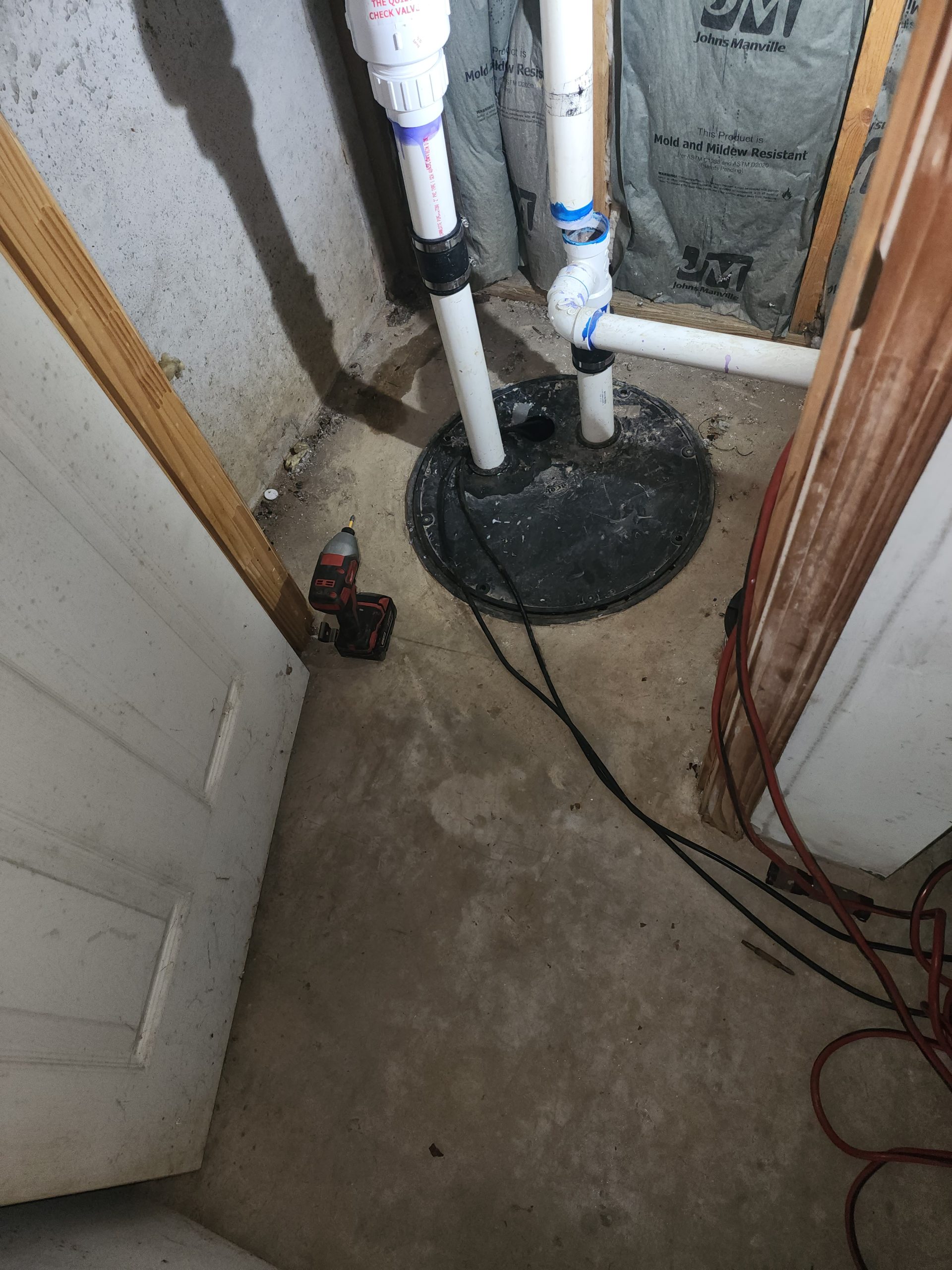
Signs You Need Sump Pump Repair or Replacement
A sump pump does nothing at all until the day everything depends on it. Test yours before storm season and watch for these signs:
- The pump runs constantly or will not shut off — a stuck float, a failed check valve returning water to the pit, or a pump undersized for the volume arriving.
- The pump does not start with water in the pit — a failed float switch, a burned-out motor, or a tripped circuit.
- Grinding, rattling or screeching while running — a worn impeller, failing bearings, or debris drawn into the pump.
- Rust-colored sludge or heavy silt in the pit — iron bacteria and sediment are clogging the intake and wearing the impeller.
- Water on the floor despite a working pump — the discharge line is blocked or frozen, or water is entering above the drain line.
- The pump is seven to ten years old — it is at the end of typical service life and should be replaced before it fails during a storm.
- Discharge dumping right beside the foundation — the same water soaks back down and returns to the pit within the hour.
How a Sump Pump Protects Your Home
A sump system collects groundwater before it can reach your living space. Perimeter drain tile around or under the foundation gathers water and routes it by gravity to a pit, the sump. When the water in the pit rises high enough to lift the float switch, the pump starts and pushes the water up a discharge line and away from the house. A check valve in that line keeps the discharged water from falling back into the pit when the pump stops.
This matters in North Metro Atlanta because of what is under most of our houses. Red clay holds water and releases it slowly, so after a heavy rain the ground around a foundation stays saturated far longer than sandy soil would, and hydrostatic pressure builds against basement walls and crawlspace footings. Homes with basements, daylight basements and crawlspaces on sloped lots all benefit from a pump that is correctly sized, correctly discharged and actually tested before the weather turns.
| Submersible pump | Pedestal pump | |
|---|---|---|
| Location | Sits in the pit, underwater | Motor sits above the pit on a shaft |
| Noise | Quieter, water muffles the motor | Louder |
| Capacity | Generally higher | Generally lower |
| Servicing | Must be lifted out of the pit | Motor is easy to reach |
| Best for | Finished basements, high water volume, sealed pits | Narrow pits, lighter duty, easy access |
Our Sump Pump Service Process
- Inspect the whole system — we look at the pit, pump, float, power supply, check valve and the full discharge route, not just the pump itself.
- Test under real conditions — we fill the pit to trigger the float, confirm the pump starts, moves water and shuts off cleanly, and watch for backflow.
- Recommend repair or replacement — we tell you whether a switch or check valve fixes it, and if replacement is warranted we size the new pump to the water your pit actually handles.
- Install correctly — new pump set on a solid base above pit silt, new check valve, properly supported discharge piping and a sealed lid where the installation calls for one.
- Add backup protection if you want it — a battery backup pump on its own float keeps working through the power outages that accompany the worst storms.
- Verify and hand off — we run multiple cycles, confirm the discharge terminates well away from the foundation, and show you how to test it yourself.
Sump Pump Service Across North Metro Atlanta
JMJ Plumbing has kept water out of North Metro Atlanta basements and crawlspaces since 1996, working in Acworth, Alpharetta, Canton, Cumming, Dunwoody, Hickory Flat, Holly Springs, Johns Creek, Kennesaw, Marietta, Milton, Roswell, Sandy Springs, Smyrna, and Woodstock. A dead pump during a storm is exactly the kind of call our 24/7 emergency plumbing team takes, groundwater problems sometimes turn out to be a slab leak or a broken supply line rather than rain, and for commercial buildings we install and service sump and ejector pumps on the same principles.
Sump Pump FAQs
How long does a sump pump last?
Most residential sump pumps last somewhere between seven and ten years. Lifespan depends heavily on how often the pump cycles, how much silt and grit are in the pit, and whether the pump was sized correctly for the water it has to move. A pump that runs constantly through a wet season ages much faster than one that runs occasionally.
How often should a sump pump run?
That varies with your water table and rainfall. Running for a short cycle every few minutes during heavy rain is normal; running every few minutes on a dry week is not. Continuous cycling in dry weather usually means a stuck float, a failed check valve letting discharged water fall back into the pit, or groundwater intruding somewhere new.
Why is my sump pump running constantly?
The three usual causes are a float switch stuck in the on position, a bad or missing check valve that lets the discharge column drain back into the pit each cycle, and a pump too small for the volume of water arriving. A cracked pit liner or a downspout discharging next to the foundation can also feed it continuously.
Do I need a battery backup sump pump?
Consider one if losing the pump would mean real damage. Severe storms bring both the heaviest groundwater and the most power outages, which is exactly when a primary pump goes offline. A battery backup unit sits in the same pit on its own float and takes over automatically. It is the standard recommendation for finished basements.
Why does my basement still get water even though I have a sump pump?
A sump pump only handles water that reaches the pit. If the perimeter drain is clogged, if the water is entering through a wall crack above the drain line, or if surface water is coming in at a door or window well, the pump never sees it. Check grading, gutters and downspout discharge alongside the pump itself.
Where should a sump pump discharge?
Discharge should be routed well away from the foundation so the water does not simply soak back down to the drain and return to the pit. Whether it may be tied into a storm system, and how far from the structure it must terminate, are set by local rules that differ by county and city. It must never discharge into a sanitary sewer.
Can a sump pump be installed in a crawlspace?
Yes, and it is common in North Metro Atlanta, where many homes sit over crawlspaces on clay soil that drains slowly. A pit is dug at the low point, connected to a perimeter drain where one exists, and fitted with a sealed lid, check valve and discharge line. It is often paired with a vapor barrier and encapsulation work.
Why does my sump pump make a loud bang when it shuts off?
That bang is the check valve slamming closed as the column of water in the discharge line falls back against it. It is common and usually harmless, but a spring-loaded or quiet check valve eliminates it. Persistent hammering can loosen fittings over time, so it is worth correcting rather than living with.
The worst time to find out your sump pump failed is during the storm. Book sump pump service online or call JMJ Plumbing at (770) 966-9654. We have served North Metro Atlanta since 1996 and offer 24/7 emergency service, with financing available through GreenSky.