
JMJ Plumbing provides professional tankless water heater installation and replacement services designed for long-term performance and reliability. Tankless systems can deliver endless hot water and improved energy efficiency, but only when they are properly sized and installed. We handle new installations and system replacements, ensuring correct gas line sizing, venting, condensate management (when required), and safe startup procedures. The result is dependable hot water, optimal system performance, and fewer nuisance shutdowns or operational issues.
Signs You Need a Tankless Water Heater
Most homeowners start thinking about going tankless when their existing tank stops keeping up. These are the situations where the switch usually makes sense:
- You run out of hot water partway through a shower — the tank’s recovery rate cannot keep up with how your household actually uses hot water.
- Your tank heater is past ten to twelve years old — it is at the end of its expected service life and a failure will be sudden.
- Rusty or metallic-smelling hot water — the tank’s interior lining and anode rod are gone and the steel shell is corroding.
- Popping or rumbling from the tank — sediment has built up on the bottom and is trapping steam under it, wasting fuel and stressing the tank.
- You need the floor space — a wall-mounted unit frees up a sizable footprint in a garage, basement or closet.
- You are adding bathrooms or fixtures — a remodel or addition raises peak demand beyond what the existing heater was sized for.
- Water damage risk worries you — there is no stored volume in a tankless unit to dump on the floor when something fails.
How Tankless Water Heaters Work
A tankless heater stores nothing. When you open a hot tap, a flow sensor starts the burner or heating elements and water is heated as it passes through a heat exchanger, then stops when you close the tap. That removes the standby loss of keeping a tank hot around the clock and lets the unit deliver hot water for as long as you need it.
The tradeoff is that output is measured in flow rate at a given temperature rise rather than gallons stored. Incoming ground water temperature and the number of fixtures you run at once both matter, so a unit that handles a two-bath household easily may struggle in a larger one. A gas unit also needs adequate gas supply and dedicated venting, and an electric unit needs substantial electrical capacity. That is why sizing and infrastructure come before product selection.
| Tank water heater | Tankless water heater | |
|---|---|---|
| Hot water supply | Limited to tank volume, then recovery time | Continuous, limited by flow rate |
| Typical service life | Roughly 8–12 years | Roughly 20 years with maintenance |
| Space used | Floor-standing, large footprint | Wall-mounted, compact |
| Standby energy loss | Yes, keeps stored water hot | None |
| Installation demands | Modest, usually a like-for-like swap | Gas line sizing, dedicated venting or heavy electrical service |
| Maintenance | Flush sediment, replace anode rod | Annual descaling and filter cleaning |
| Failure mode | Can leak the full tank onto the floor | No stored water to release |
Our Tankless Water Heater Installation Process
- Assess demand and infrastructure — we count fixtures, ask how your household uses hot water, and check gas line and meter capacity, electrical service, venting routes and water quality.
- Size the unit — we calculate the flow rate you need at the temperature rise our local incoming water requires, so the heater is matched to the house rather than to a brochure number.
- Present options and pricing — we lay out equipment choices and any gas, venting or electrical work involved, and financing through GreenSky is available.
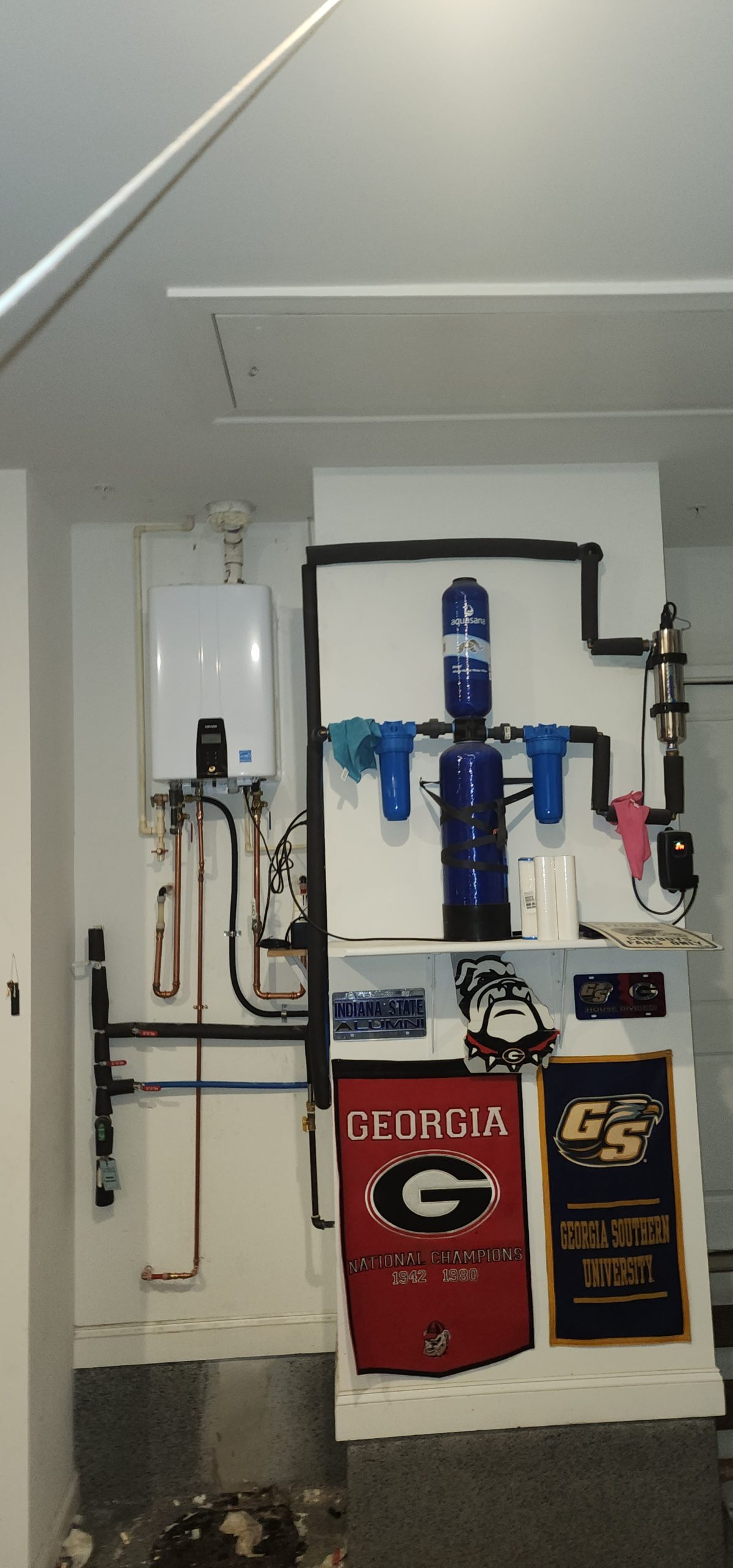
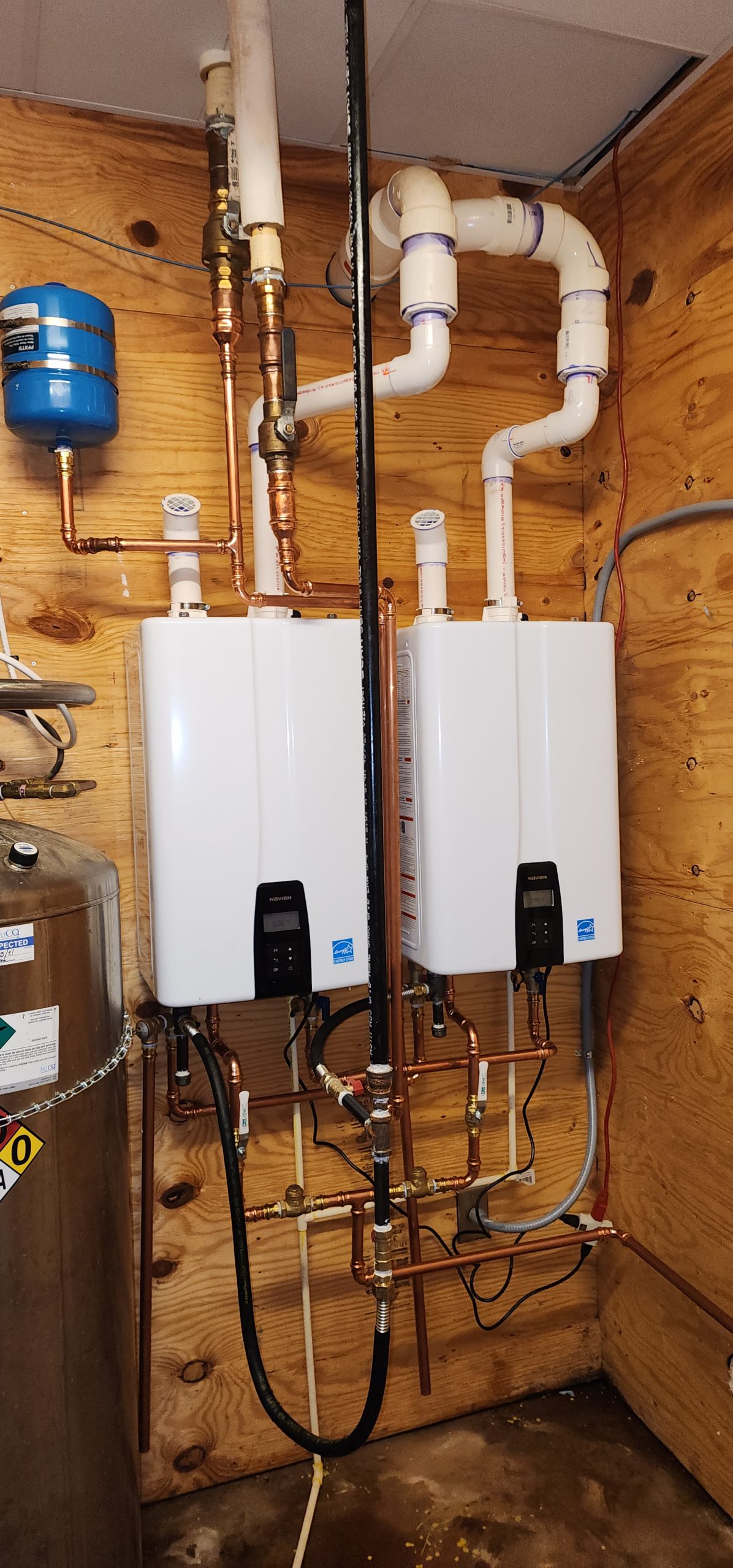
- Install — we mount the unit, upsize the gas line if needed, run new venting to the manufacturer’s specification, pipe the water connections with isolation and service valves, and provide condensate drainage on condensing models.
- Commission and test — we verify gas pressure and combustion, confirm venting is correct, set the output temperature, and run every fixture to check delivery.
- Walk you through it — we show you the controls, the service valves and the maintenance schedule before we leave.
Tankless Water Heaters Across North Metro Atlanta
JMJ Plumbing has installed and serviced water heaters across North Metro Atlanta since 1996, including Acworth, Alpharetta, Canton, Cumming, Dunwoody, Hickory Flat, Holly Springs, Johns Creek, Kennesaw, Marietta, Milton, Roswell, Sandy Springs, Smyrna, and Woodstock. We install tankless units, and we are equally willing to tell you when a conventional tank water heater is the better fit for your home. Because a gas tankless unit usually needs more fuel volume than the appliance it replaces, our gas line work is part of the same job, and we set every installation up for the annual tankless flush that protects the heat exchanger in our area’s hard water.
Tankless Water Heater FAQs
How long do tankless water heaters last?
A well-maintained gas tankless unit commonly lasts around twenty years, roughly double a standard tank heater. The heat exchanger is the expensive component, and it lasts longest when the unit is descaled on schedule. Skipping maintenance in a hard water area shortens that lifespan considerably, which is why annual flushing matters more here than the sales brochure suggests.
Do tankless water heaters really give unlimited hot water?
They give continuous hot water, not unlimited flow. A tankless heater raises the temperature of water as it passes through, so it can run indefinitely, but only up to its rated flow at the required temperature rise. Undersize the unit or run too many fixtures at once and the output temperature drops. Correct sizing is what makes the difference.
Do I need a bigger gas line for a tankless water heater?
Frequently, yes. A gas tankless heater fires at a much higher input rate than the tank it replaces, so the existing gas line and sometimes the meter cannot deliver enough volume. We calculate the demand for the whole house, check the meter capacity, and upsize the line where needed. Venting almost always has to be replaced as well.
Is a tankless water heater worth it?
It is worth it if you value continuous hot water, want the floor space back, and plan to stay in the home long enough to benefit from lower standby losses. It is less compelling if your gas and venting would need extensive upgrades, or if your household hot water use is low and a tank already keeps up fine.
Where can a tankless water heater be installed?
Tankless units mount on a wall and take up roughly the space of a carry-on suitcase, so garages, basements, utility closets and exterior walls all work. The real constraints are venting to the outdoors, access to adequate gas or electrical service, condensate drainage on condensing models, and clearance for future servicing. We confirm all of that before recommending a location.
How long does tankless water heater installation take?
A straight replacement of an existing tankless unit can often be done in a day. Converting from a tank usually takes longer, because the gas line may need upsizing, new venting has to be run to the outside, water piping has to be rerouted to the wall mount, and condensing units need a condensate drain.
Do tankless water heaters need maintenance?
Yes. Tankless heaters need periodic descaling to remove mineral buildup from the heat exchanger, plus cleaning of the inlet water filter screen and a check of venting and combustion. Parts of Cherokee and Cobb County have hard water, and scale forms fastest on the hottest surfaces inside the unit. Most manufacturers specify annual service.
Why does my tankless heater send a burst of cold water?
That is the cold water sandwich. When you stop and restart hot water quickly, the slug of water sitting in the pipe between the heater and the tap arrives before the burner catches up. It is normal behavior, though a recirculation system, a small buffer tank, or a unit with better modulation reduces it noticeably.
Ready to stop running out of hot water? Book a tankless water heater consultation online or call JMJ Plumbing at (770) 966-9654. We have served North Metro Atlanta since 1996 and offer 24/7 emergency service, with financing available through GreenSky.