
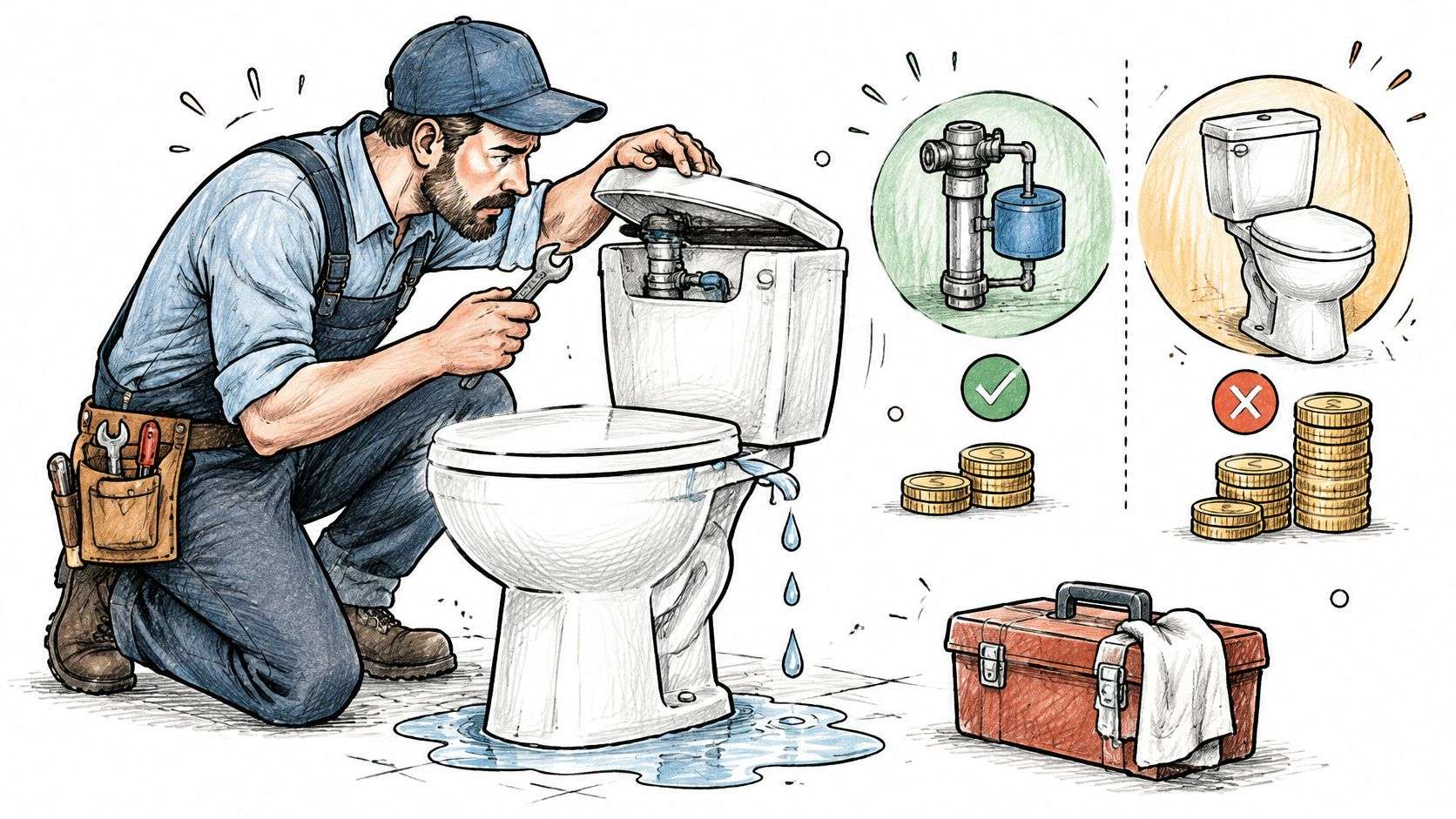
Professional toilet repairs average approximately $150–$391 nationally, while broader leak repairs can run about $100–$600. Your North Metro Atlanta quote will depend on the failed part, labor, access, and whether the toilet needs replacement.
You might be hearing the tank refill after everyone’s gone to bed, finding a damp patch beside the toilet, or wondering why your water use increased. Don’t approve a repair based on the puddle alone. Find out where the water starts, then weigh the immediate plumbing bill against the cost of letting the leak continue.
Why Toilet Leak Costs Depend on Location
A toilet that refills while nobody’s using it presents a different job from one that leaves water on the bathroom floor. Both need attention, but they don’t necessarily need the same parts, labor, or response.
Consider a homeowner who hears occasional running water but sees no moisture outside the fixture. The plumber’s investigation starts inside the tank. Another homeowner notices water near the base after flushing, so the investigation must include the connection beneath the toilet and the surrounding floor.
Those are illustrative situations, not customer case studies. The point is straightforward: the leak’s location matters more than the size of the visible puddle.
Separate the Repair Bill From Water Loss
Keep distinct budgets for the work and for the water wasted while you wait. An internal leak can affect your utility bill without making the bathroom look wet. An external leak adds a different concern because water can reach building materials.
The EPA’s explanation of toilet leak rates and water costs shows why the ongoing expense deserves attention alongside the service invoice. Its estimates are national reference points, not local utility calculations or plumbing quotes.
For someone seeking toilet leak repair in Alpharetta, the useful question isn’t whether a national average sounds affordable. It’s what the plumber must inspect, replace, remove, and test at that particular home.
- Fixture condition: Ask whether the toilet itself is sound or whether damaged components change the recommendation.
- Access requirements: Find out whether the plumber can work inside the tank or must disconnect and lift the fixture.
- Additional damage: Keep flooring or surrounding plumbing work separate from the basic toilet repair scope.
Practical rule: Compare written scopes, not just the total at the bottom of competing estimates.
This applies equally to leak repair in Woodstock, Acworth, Roswell, or Marietta. A meaningful local estimate follows a diagnosis, not a ZIP code alone.
Identify the Type of Toilet Leak
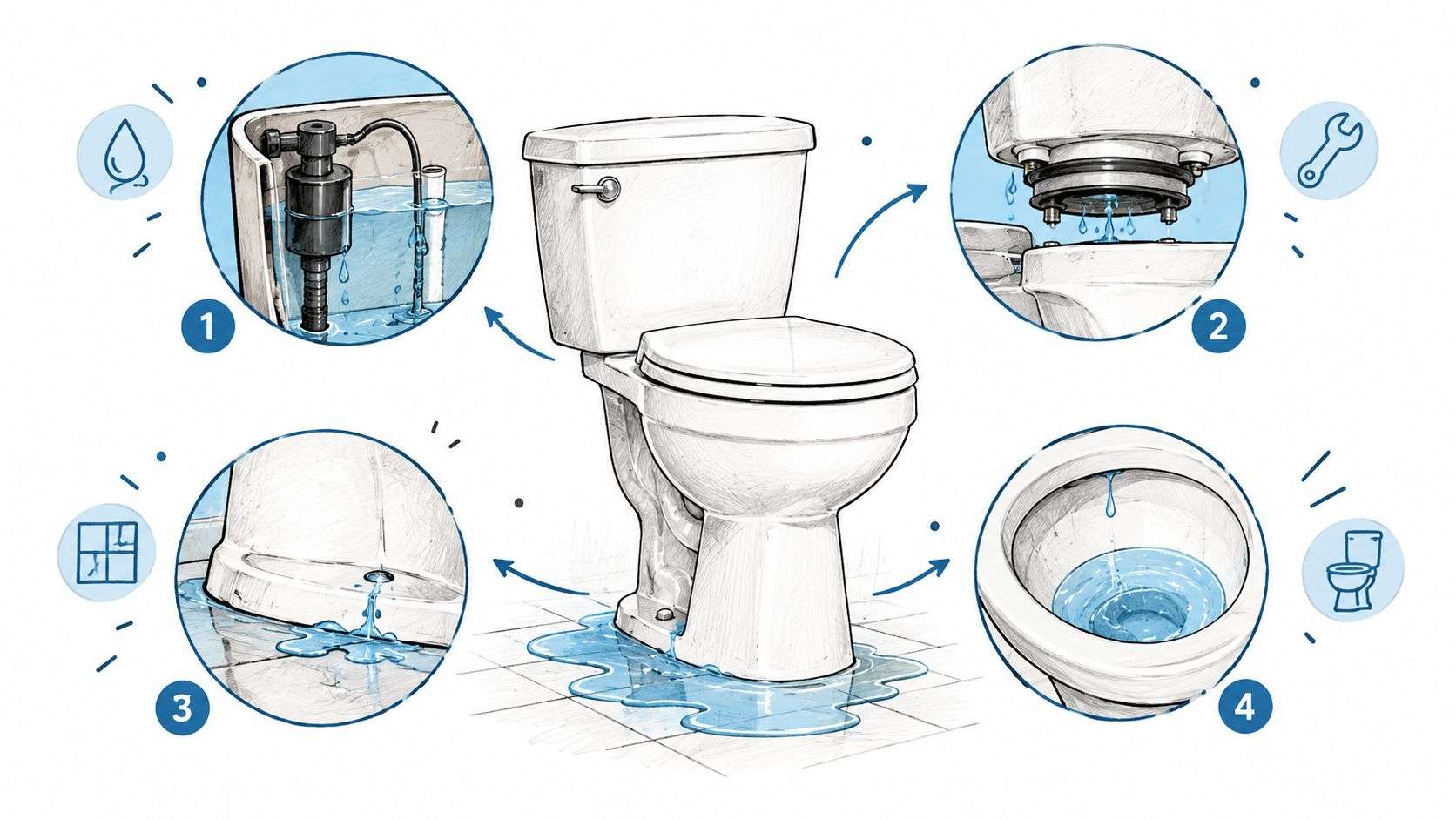
Think of the toilet as connected water pathways. The supply connection brings clean water into the tank, the tank releases it into the bowl, and the outlet beneath the fixture carries it into the drain.
A fault along each pathway calls for a different investigation. Water on the floor doesn’t automatically prove that the base seal failed, because water can travel down from a connection above it.
Check for an Internal Tank Leak
The EPA’s toilet leak-testing protocol recommends adding dye or food coloring to the tank, waiting 5–10 minutes without flushing, and checking the bowl. Color entering the bowl indicates that water is bypassing the flapper or flush-valve seal.
Watch the mechanism without taking it apart. A tangled chain or misaligned handle deserves attention before you assume a replacement part is necessary. If a new flapper doesn’t stop a confirmed internal leak, the valve seat or overflow-tube assembly may need inspection.
- Intermittent refilling: Record whether the toilet starts filling between uses.
- Water entering the overflow: Describe what you see to the plumber rather than adjusting unfamiliar parts.
- Persistent leakage: Mention any recent flapper replacement and whether it changed the symptom.
Trace External Moisture Carefully
Dry accessible surfaces and note where fresh moisture appears first. Check visually around the supply connection, beneath the tank, and along the base without loosening fittings.
Western Bathroom Renovations’ guide to signs of a bathroom leak is a useful companion when moisture extends beyond the toilet and you need to organize your observations.
If water is actively escaping, use the toilet’s supply shutoff if you can operate it safely. Don’t force a stuck valve, keep flushing to reproduce a floor leak, or reach into water near electrical equipment.
For an uncertain source, arrange residential leak detection and repair rather than buying parts by guesswork. Your job is to describe the symptom clearly, not dismantle the fixture before service arrives.
Compare Parts Labor and Repair Costs
A low-priced part doesn’t guarantee a low-priced service visit. The plumber still needs to identify the failure, obtain a compatible component, complete the work, and check the result.
Use the national benchmarks in the opening as broad planning context only. They aren’t component-specific price lists, and they don’t establish what a plumber in Canton, Cumming, or Johns Creek will charge. There’s no reliable way to turn them into a guaranteed local invoice without inspecting the job.
Read the Estimate by Scope
A useful estimate explains what you’re purchasing rather than describing everything as “toilet repair.” Ask for enough detail to distinguish a straightforward component replacement from work that requires opening connections or removing the fixture.
- Diagnosis: Does the estimate include locating the leak, or is further investigation separately authorized?
- Materials: Which flapper, fill valve, seal, supply connector, or other component will be installed?
- Labor: What removal, installation, adjustment, and testing does the quoted work include?
- Fixture handling: If removal is necessary, does the quote include resetting and reconnecting the toilet?
- Related work: Are flange repairs, supply-valve work, flooring issues, or required installation corrections included or excluded?
Don’t insist that every contractor use the same billing format. A fixed-price proposal can still be transparent if it identifies the work and its limits. What matters is knowing whether the total covers a completed repair or only an initial step.
Keep Bathroom Restoration Separate
A plumbing repair and a bathroom restoration aren’t interchangeable expenses. If the leak has affected flooring or you’re considering broader improvements, Jennifer Gilmer Kitchen & Bath’s bathroom renovation budget breakdown provides a separate planning resource.
Don’t let a renovation discussion obscure the immediate plumbing problem. Ask which work stops the leak, which restores affected materials, and which represents an optional upgrade.
A quote should tell you what happens if the plumber discovers additional damage after removing the toilet.
Request an approval checkpoint for concealed conditions. That protects your ability to compare options before the job expands beyond the original diagnosis.
Match Common Causes to Repair Options
Match the proposed repair to an observed symptom and a confirmed failure. Replacing whatever part looks oldest isn’t a diagnosis, and a wet floor doesn’t identify the source by itself.
Use this comparison to discuss possibilities with the plumber. It’s a conversation aid, not permission to assume that a particular symptom proves a specific defect.
Common Toilet Leak Symptoms and Likely Repair Scope
| What You Notice | Likely Area | Typical Scope to Confirm | Why Cost Varies |
|---|---|---|---|
| Dye enters the bowl between flushes | Flapper or flush-valve seal | Check alignment, compatibility, and sealing surfaces | A simple seal issue differs from damage to the assembly |
| Filling continues or water enters the overflow | Fill valve or related tank mechanism | Check operation and determine whether adjustment or replacement is appropriate | Component condition and the supply connection affect the work |
| Internal leakage continues after a flapper change | Valve seat or overflow-tube assembly | Inspect the remaining sealing components | Additional disassembly may be necessary |
| Moisture appears between tank and bowl | Tank-to-bowl connection | Inspect the gasket, hardware, and surrounding fixture | Access and hardware condition affect removal and reassembly |
| Drips appear near the water connection | Supply connector or shutoff | Trace the first wet point and inspect the connection | The problem may involve the connector, valve, or adjoining plumbing |
| Water appears beneath the base | Base seal, flange, or water traveling from above | Identify the source and determine whether removal is needed | Hidden flange or floor conditions can expand the scope |
| A visible crack accompanies leakage | Tank, bowl, or base | Assess fixture integrity and replacement needs | The decision may involve a replacement fixture rather than a service part |
Judge Urgency by Where Water Goes
An internal leak calls for prompt service, but water escaping onto the floor deserves immediate containment. Stop using a toilet that repeatedly releases water at its base until the source has been assessed. Don’t treat drying the floor as a repair.
- Contained inside the fixture: Arrange diagnosis and avoid letting the problem become a standing utility expense.
- Escaping onto finished surfaces: Shut off the supply when safe and request prompt assistance.
- Associated with a crack: Ask for an integrity assessment before discussing cosmetic patches.
The distinction matters during quote review. If the diagnosis is a worn flapper, ask why the proposed work extends beyond it. If the fixture is cracked, ask why the estimate recommends another component repair instead of addressing the damaged porcelain.
A clear explanation should connect what the plumber observed, what failed, and what the proposed work will correct. You don’t need technical vocabulary to ask for that connection.
Prepare for a Plumber Visit and Quote
Give the plumber a short symptom history, not your best guess at a diagnosis. “Water appears behind the tank while nobody’s using it” is more useful than “I need a wax ring.”
Before the visit, photograph the visible moisture and note whether the toilet was flushing, filling, or sitting unused. Record any recent work and whether the problem changed afterward.
Make the Service Handoff Useful
Keep the area accessible without disturbing the suspected connection. Move stored items away from the toilet and tell the dispatcher if you’ve shut off its supply.
- Describe the timing: Explain whether the leak is continuous, intermittent, or associated with flushing.
- Identify the affected area: Mention flooring, nearby cabinetry, or a ceiling below the bathroom.
- Flag access problems: Say if the shutoff is stuck or difficult to reach.
- Request authorization boundaries: Ask the plumber to explain additional work before proceeding.
- Confirm completion checks: Find out how the repaired fixture will be tested before the visit ends.
For work extending into bathroom restoration, Aureli Construction’s bathroom contractor questions can help you prepare a broader contractor conversation. Keep that discussion distinct from authorization to stop the leak.
Document Damage Without Assuming Coverage
Keep photos, mitigation notes, the plumber’s findings, and invoices. Ask the plumber to describe the identified cause in writing, especially if surrounding materials are affected.
Allstate’s guidance on homeowners insurance and water damage distinguishes sudden, accidental events from gradual damage and maintenance-related problems. Coverage for resulting damage doesn’t automatically mean coverage for the faulty plumbing itself.
Ask your insurer about the cause, policy terms, deductible, and documentation requirements. Don’t postpone reasonable mitigation while assuming that insurance will pay, and don’t assume a running toilet and a floor-damaging supply leak create the same claim.
Before authorizing work: Ask what’s included, what remains uncertain, and what would require your further approval.
Choose Repair or Replacement

A 15-year-old toilet with a $25 flapper failure and sound porcelain is a repair. The same toilet with a hairline crack at the base is a replacement, regardless of how inexpensive the parts are. The confirmed failure drives the decision, not the fixture’s age.
Repair a sound toilet with an identifiable service-part failure. Consider replacement when the fixture itself can no longer reliably contain water.
Weigh the Invoice Against the Water Loss
Every option carries two costs: the plumber’s bill and the water the leak keeps wasting while you decide. A modest repair that stops the loss this week often beats a cheaper-looking path that leaves the toilet running for another month.
Ask the plumber to explain what you’ll have after each option. A repair proposal should identify the corrected defect and any remaining concerns. A replacement proposal should identify the fixture and the installation work needed to put it into service, including removal and disposal of the old unit.
- Favor repair: The toilet is structurally sound, the fault is isolated, and compatible parts are available.
- Discuss replacement: The fixture has a leaking crack, recurring failures, or condition problems that make further investment questionable.
- Question either proposal: The recommendation doesn’t address the confirmed leak source or leaves necessary connection work unexplained.
Don’t Replace the Wrong Thing
Recurring trouble deserves a fresh assessment rather than an automatic repeat of the last repair. Ask whether the previous work addressed the cause or only a symptom, and whether the proposed replacement would resolve the remaining problem.
A new toilet won’t, by itself, correct every issue in connected plumbing or surrounding materials. If those conditions require work under either option, separate that shared expense from the choice of fixture.
Choose the option that addresses the confirmed failure with a complete, understandable scope. Don’t pay for replacement merely because it sounds more permanent, and don’t keep authorizing small repairs when the fixture’s condition makes them poor value.
Control Water Loss and Act Quickly
The cost to fix a leaking toilet isn’t just the plumber’s bill. You also need to consider water consumed before the repair and, for external leaks, the separate possibility of damage restoration.
Inside the tank, escaping water lowers the level and causes the fill valve to replace it. The EPA’s technical guide to household leaks estimates that a hard-to-detect worn-flapper leak can waste approximately 30 gallons daily, or about 900 gallons monthly. That’s why a quiet leak still deserves a service appointment.
Use Water Costs as Context, Not a Promise
For a more substantial continuous leak, the EPA’s commercial leak-detection guidance models 0.5 gallons per minute, totaling 21,600 gallons monthly and approximately $2,100 annually, using a combined water-and-wastewater rate of $8.25 per 1,000 gallons.
That’s a commercial example, not a prediction for your home. Your actual loss depends on the leak rate and utility pricing. Use the example to justify prompt diagnosis, not to calculate guaranteed savings.
Choose the Right Local Service Request
Homeowners searching for toilet leak repair near me or a 24 hour plumber should describe the active symptom first. For an uncontrolled leak, shut off water if safe, document what’s visible, and contact an available emergency plumber in North Metro Atlanta.
Across Woodstock, Acworth, Alpharetta, Canton, Roswell, Marietta, Cumming, and Johns Creek, request an on-site assessment rather than treating national benchmarks as local prices. The same advice applies throughout Cobb County, Cherokee County, North Fulton, Forsyth County, and surrounding Metro Atlanta communities.
- Drain concerns: A clogged toilet won’t flush, slow drains, a sewage smell, or a sewer backup calls for assessment before choosing drain cleaning, sewer repair, or sewer replacement.
- Water-line concerns: Report low water pressure or water in the yard when requesting main water line repair, water line replacement, or burst pipe repair.
- Hot-water concerns: If there’s no hot water, request a water-heater diagnosis rather than assuming water heater replacement is necessary.
These are different service conversations. Give the dispatcher the symptoms so the visit starts with the right problem.
JMJ Plumbing offers toilet leak detection and repair, on-site quotes, and 24/7 emergency availability across North Metro Atlanta. Visit JMJ Plumbing to request service, describe where you’re seeing water, and get a repair-versus-replacement recommendation based on your toilet’s condition.