A water meter is the cash register for your home's water use. It measures the total volume of water moving through your pipe, usually in gallons, cubic feet, or cubic meters, and that running total is what your utility uses for billing.
If you're in Acworth, Woodstock, Marietta, or anywhere around North Metro Atlanta and your water bill suddenly jumped, this little device is the first place I'd look. Homeowners often think of the water meter as the city's equipment by the curb, and that's true in one sense. But in practice, it's also your best early-warning tool for hidden leaks.
The simplest way to think about it is this. Your water meter is like the odometer on a truck. The odometer doesn't tell you where you drove, why you drove, or whether you hit traffic. It just tells you how much movement happened. A water meter works the same way. It doesn't explain the problem, but it tells you whether water is moving when it shouldn't be.
That's why the question isn't only what is a water meter. The more useful question is what your meter can tell you about a high bill, a wet yard, low water pressure, or a leak that hasn't shown itself yet.
Your Homes Water Meter Explained
A confusing water bill usually sends homeowners to the same place. Out to the curb, lifting the meter box lid, wondering what this little device does and whether it can explain the extra charge.
A water meter is the device that keeps a running total of how much water enters your home from the main line. It works a lot like a car's odometer. It does not tell you which faucet used the water or where a leak is hiding. It records only that water passed through.
That simple job is what makes the meter so useful. Your utility uses it to calculate your bill, and you can use it as a first check when the numbers stop making sense. If every fixture is off and the meter is still registering flow, water is moving somewhere on your property.
Your meter is often the fastest way to confirm whether a high bill points to real water use or a hidden leak.
Homeowners around Acworth, Woodstock, and Marietta often assume the meter only matters to the city. In real life, it matters to you just as much. It can warn you about a buried service line leak, a running toilet, or a pressure problem that is putting extra strain on your plumbing. If your house has unusually strong water pressure, it also helps to understand how a pressure reducing valve affects your home's plumbing system.
Why this matters for your house
Hidden leaks rarely announce themselves right away. A pipe can leak under the yard, a toilet flapper can fail, or a small line can seep behind a wall while the meter keeps counting every bit of water that passes through.
That is the part many homeowners miss.
You may not see a puddle indoors. You may not hear running water. But the meter still records the loss, and that makes it one of the best tools for catching trouble before it turns into a soaked yard, damaged slab, or another month of inflated bills.
Watch for clues like these:
- A bill that jumps without a clear change in water use
- Wet or unusually green ground near the service line, sidewalk, or driveway
- Lower water pressure at sinks or showers
- The sound of water running when nothing is turned on
- A toilet that refills over and over
If one or more of those signs sounds familiar, your meter can help you narrow down whether the problem is inside the house or somewhere on the main water line feeding it.
How Your Water Meter Measures Usage
Your water meter works like your car's odometer. Instead of tracking miles, it tracks how much water has passed through the service line and into your home. That running total is usually shown in gallons, cubic feet, or cubic meters. Analysts at Research and Markets project that the U.S. water meter market will grow from 25.06 million units in 2025 to 31.35 million units by 2030, according to this U.S. water meter market analysis.
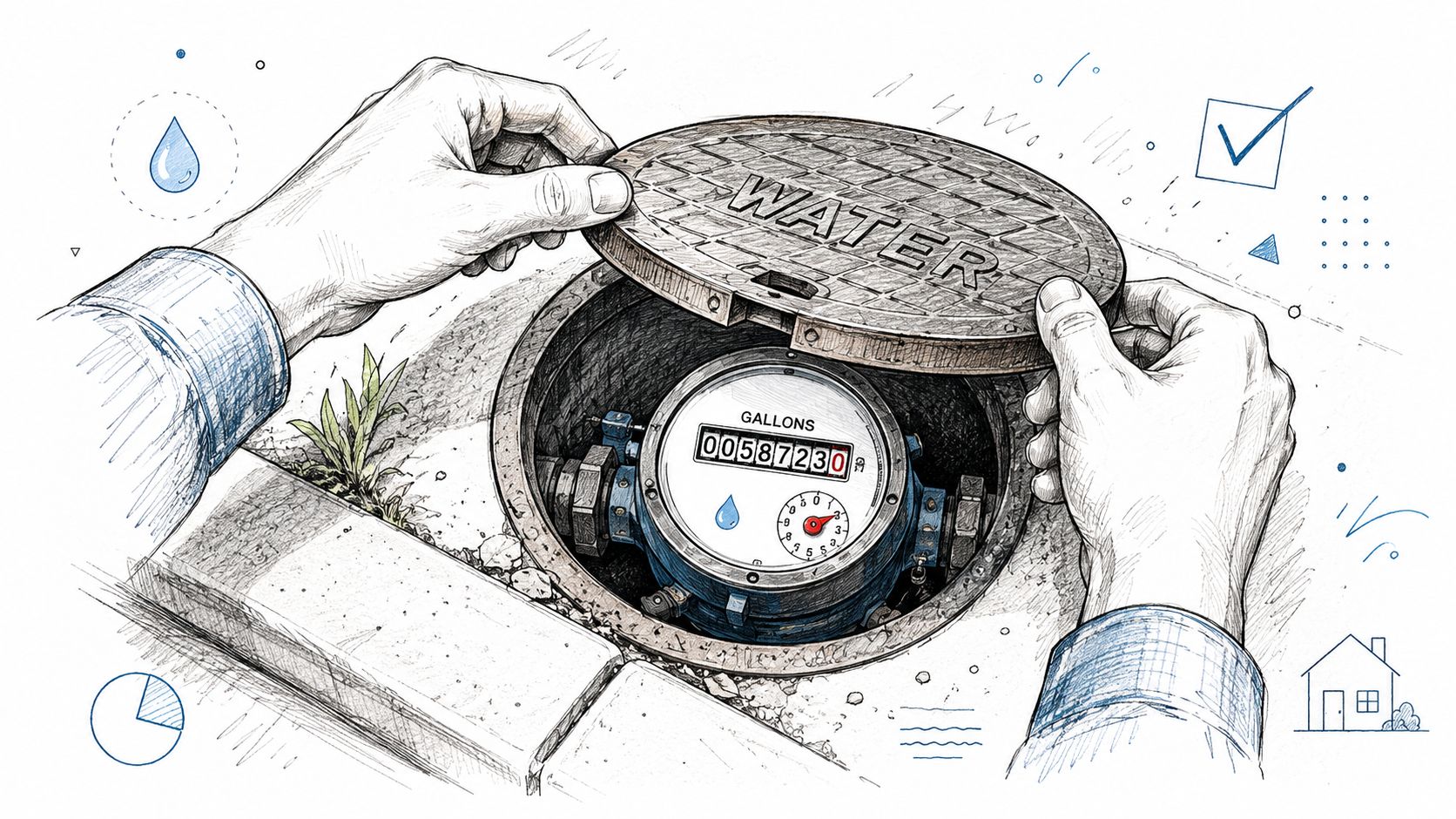
How a mechanical meter works
Most homes still have a mechanical meter. Inside the body of the meter, water flow turns or shifts internal parts. As those parts move, the register adds up the volume that has gone through.
A simple way to picture it is a small counting device being pushed forward by water every time you open a faucet, run a shower, flush a toilet, or fill the washing machine. The display does not start over each day. It keeps climbing over time, which is why it is so useful when you are trying to spot water use that should not be happening.
That matters for one big reason. If water is moving through the meter, the meter records it whether the water is going to your kitchen sink or leaking under your yard.
What you might have at your house
Around Alpharetta, Cumming, and other North Atlanta areas, homeowners usually see one of these meter types:
| Meter type | What it looks like | What it means for you |
|---|---|---|
| Analog mechanical meter | Dial face with numbers and a small moving indicator | You can check the total reading and watch the indicator for movement when everything in the house is off |
| Digital meter | Electronic display | The reading is often easier to see, especially for quick usage checks |
| Smart meter | Usually read remotely by the utility | Usage changes may be easier for the utility and homeowner to spot sooner |
For your house, the main point is not the technology label. It is whether the meter gives you a clear reading and whether it shows movement when no water should be running. That is what helps you catch hidden waste before it turns into a high bill or a water line repair.
If your fixtures seem weak one day and forceful the next, the meter may not be the only part to check. A pressure reducing valve can change how water pressure behaves in your home, and pressure problems can sometimes look like meter problems at first glance.
A Step By Step Guide to Reading Your Meter
If you've never checked your meter before, don't worry. Once you've done it one time, you'll know exactly what you're looking at.
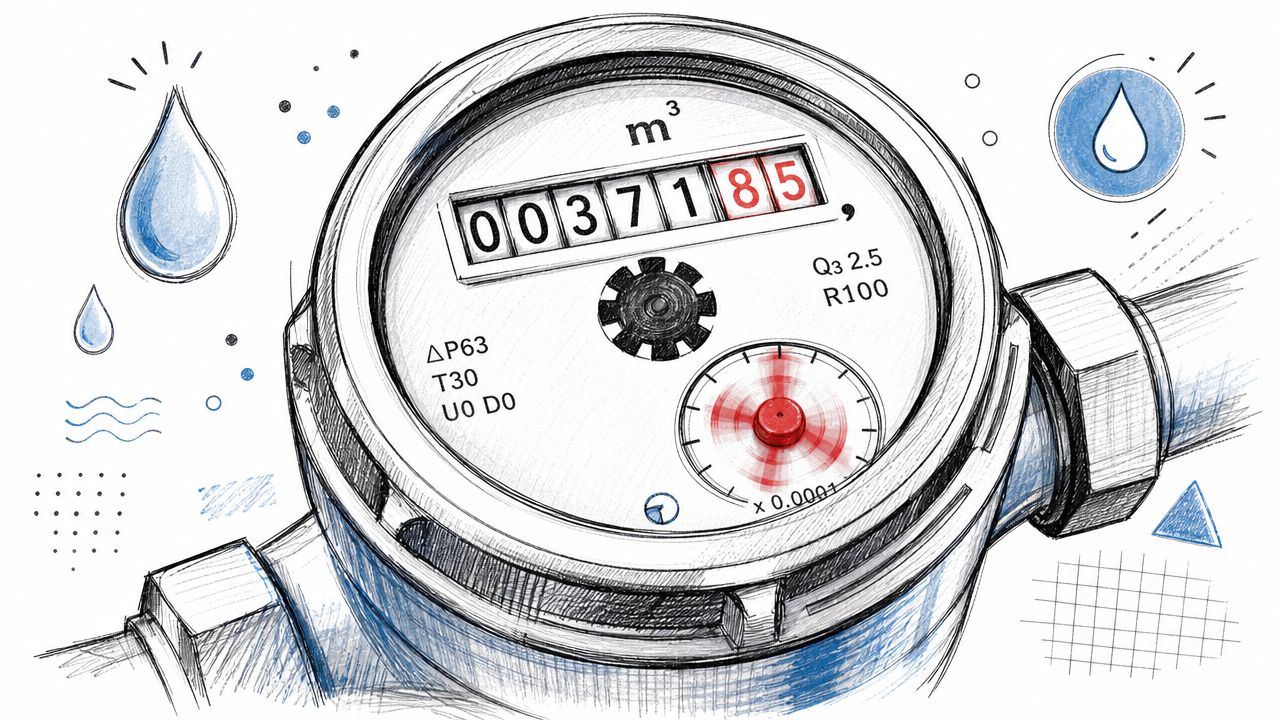
Where to find it
Most residential water meters are near the street or curb, often inside a covered ground box. In some homes, the lid may say "water." Lift the cover carefully and look for the register face.
If the box is dirty, you may need to brush off the display so you can read it. Use care around insects, mud, and standing water.
How to read the display
Use this simple process:
-
Find the main register
This is the total usage number. Think of it as your running count of all water that has entered the home. -
Look for the small moving indicator
On many analog meters, it's a tiny triangle, star, or sweep hand. On digital units, it may be a leak symbol or flow icon. -
Ignore tiny display differences at first
Some meters show gallons. Others show cubic feet or cubic meters. For a basic leak check, the exact unit matters less than whether the meter is moving when all water should be off. -
Write down the reading
A phone photo works well too. That gives you something to compare later.
How to do a simple leak check
The most useful question is often not what a water meter is, but what it can reveal about hidden leaks. Utility guidance shows that if you turn off all fixtures and then watch for movement on the meter's leak indicator, you can uncover small leaks. The catch is that the meter can't tell you the location or cause of the problem, as explained in guidance on reading a water meter for leak checks.
Try this at home:
-
Turn everything off
Shut off faucets, ice makers, irrigation, washing machine use, dishwashers, and anything else that uses water. -
Check the indicator immediately
If it's still moving, water is likely passing through somewhere. -
Wait a short period
Give it a little time, then compare the reading again. -
Repeat if needed
If the number changed and no water was used, you likely have an active leak.
If the leak indicator moves with everything off, the meter is telling you one clear thing. Water is still flowing.
Analog and digital meters differ a little
With an analog meter, your eyes go to the dial and the small leak indicator. With a digital meter, you may need to wake the screen or cycle through the display.
Either way, the key question stays the same. Is the total changing when the house should be using no water?
What Your Meter Can Reveal About Hidden Leaks
A high water bill often starts the same way. Nothing looks wrong inside the house, nobody remembers using extra water, and the yard seems normal at first glance. Your water meter helps answer the first practical question. Is water still moving somewhere on your property when it should not be?
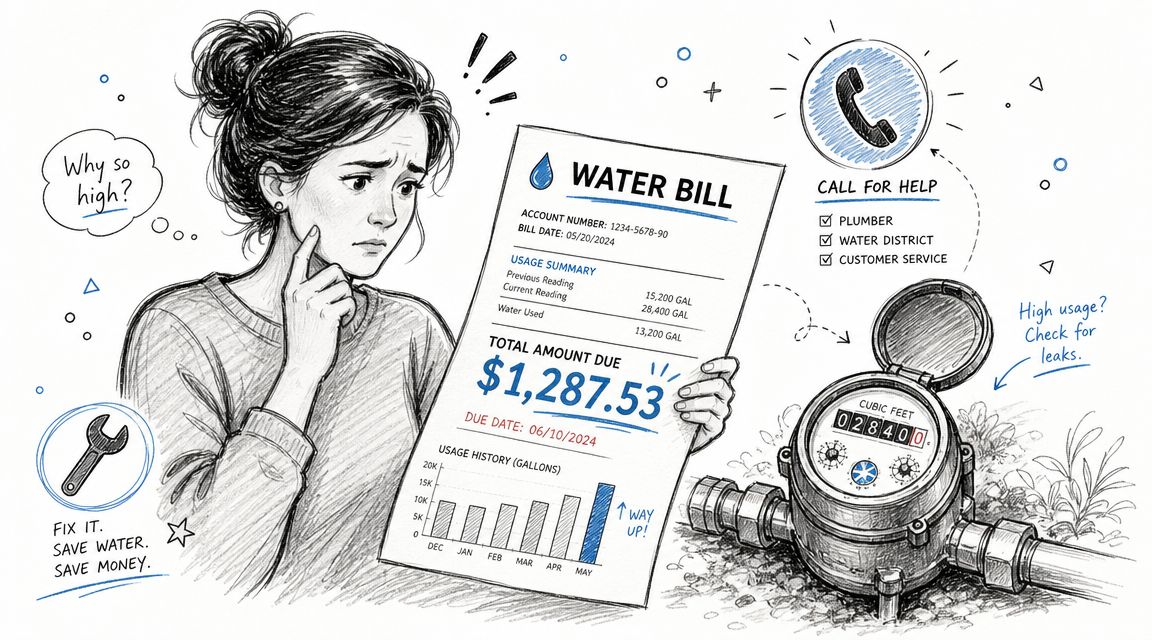
That is why I tell homeowners in Acworth and around Metro Atlanta to treat the meter like the home's water odometer. If the number keeps changing while every fixture is off, the house is still "driving" water somewhere. You may not know the exact spot yet, but you do know the problem is real.
What a moving meter usually means
A moving meter points to unwanted water use. In a real home, that often traces back to one of a few common problems:
- A toilet leak that keeps refilling the tank
- An irrigation leak in a buried sprinkler line
- A service line leak between the meter and the house
- A slab leak under the foundation
- An appliance leak that stays small enough to miss for a while
The meter cannot label the leak for you, but it does help you narrow the search. For example, soggy ground in the yard often pushes suspicion toward the exterior water line. Warm spots on the floor, damp flooring, or the sound of running water with everything off can point more toward a hidden indoor line. If the meter is moving and you cannot find a visible source, slab leak diagnosis and repair may be part of the next step.
Small leaks matter more than homeowners expect.
A toilet flapper that does not seal fully can waste water all day without making a dramatic mess. A line leak under the yard can run for weeks before the soil gets soft enough to notice. A leak under the slab can keep going while the only clue is a bill that keeps climbing month after month.
What the meter can tell you, and what it cannot
The meter gives you proof of flow. It does not give you a map.
| What the meter can tell you | What it cannot tell you |
|---|---|
| Water is moving through the system | Where the leak is located |
| Usage is continuing when it should be stopped | What caused the failure |
| The total reading changed over time | Which exact pipe or fixture needs repair |
That distinction saves time and frustration. Homeowners sometimes see a moving leak indicator and jump straight to "the meter is bad" or "it must be the main line." The meter supports a simpler conclusion first. Water is being used somewhere, and the next job is finding out where.
A few clues that help you interpret the meter
The meter becomes much more useful when you pair it with what you notice around the house.
If the meter moves and you hear a toilet occasionally refill, start there. If the meter moves and one patch of lawn stays greener or wetter than the rest, the buried line becomes more likely. If the meter moves but there is no visible water anywhere, hidden leaks under flooring, behind walls, or under concrete rise higher on the list.
That is the homeowner advantage here. The utility uses the meter to measure usage for billing. You can also use it as an early warning tool to catch a leak before it turns into ruined flooring, foundation moisture, or a much larger repair.
What about the meter itself?
Meters can age, and utilities do replace them from time to time. If your readings seem inconsistent over a long period, it is fair to ask your utility to review the meter. But if the dial or leak indicator is actively showing movement during a no-use check, I would first suspect actual water flow through the system.
For a homeowner, that is the big takeaway. Your water meter usually does not solve the mystery by itself. It tells you whether you have a mystery at all, and that makes it one of the best tools in the house for catching hidden leaks early, before they cost you more money or damage your property.
Meter Costs Replacement and Working with Your Utility
One of the biggest points of confusion is responsibility. Homeowners often assume that because the meter is tied to utility billing, the utility handles every problem connected to it. That's not usually how it works.
Who handles what
In most situations, the utility handles the meter itself, while the homeowner handles the service line from the meter to the house. That distinction matters because a hidden leak on your side of the meter can lead to a high bill and damage on your property, even though the meter box is near the street.
If you suspect the meter hardware is damaged, unreadable, or inaccurate, contact your utility first. If the meter shows continuous use and the leak appears to be on the homeowner side, that's when you call a licensed plumber for leak repair, main water line repair, or water line replacement.
Don't confuse a water meter with a flow meter
A water meter measures total consumption in gallons or cubic feet, while a flow meter measures flow rate and may also capture other variables. For homeowners, that distinction matters because billing and leak detection depend on cumulative volume tracked by the water meter, as explained in this guide to water meters versus flow meters.
That difference clears up a lot of misunderstanding. If you're trying to explain a high bill, you care about total usage over time. That's water meter territory.
A simple homeowner checklist
- Call the utility when the meter box is damaged, the display can't be read, or you suspect the utility-owned meter itself has an issue.
- Call a plumber when the meter shows ongoing usage and you suspect a hidden leak in the house, yard, or service line.
- Take photos and notes so you can explain what changed and when.
- Act sooner rather than later if you have soggy ground, dropping pressure, or signs of a burst pipe repair issue.
If you're comparing repair versus replacement, the answer depends on pipe condition, leak location, accessibility, and whether the line has a history of trouble. That's why an on-site diagnosis matters more than guessing from the bill alone.
Your Next Steps for High Bills or Suspected Leaks
When a meter keeps moving and nobody is using water, that's not something to put off until next month. Hidden leaks can turn into yard damage, slab problems, or a much larger bill.
Use this simple decision path
-
If the bill is high but the meter stays still during a no-use test
Start with the utility and your recent usage habits. -
If the meter moves with all fixtures off
You likely need leak detection or water line repair. -
If you see water in the yard
Ask about main water line repair or water line replacement. -
If pressure has dropped suddenly or a pipe has failed
Treat it like an urgent plumbing problem. -
If the problem starts after hours
Look for an emergency plumbing service instead of waiting for normal business hours.
Why professional follow-up matters
Proper installation affects meter accuracy. EPA guidance recommends at least 10 pipe diameters downstream and 5 upstream of straight pipe for many setups, while some electronic meters can work with little or no straight-run requirement, according to EPA WaterSense metering guidance. That's one reason field diagnosis matters. Reading a meter is one task. Interpreting the full plumbing picture is another.
When contacting an emergency plumber in Acworth, Woodstock, Alpharetta, Canton, Roswell, Marietta, Cumming, or Johns Creek, the meter reading provides a strong starting point. It helps you explain the symptom clearly. "The leak indicator is moving with everything off" is useful information when you're calling about leak repair, burst pipe repair, main water line repair, drain issues, sewer backup, or other urgent plumbing trouble.
A water meter won't fix the problem. But it can tell you when the problem is real, active, and worth acting on today.
If your water bill has climbed, your yard is wet, or your meter keeps moving when no water is on, contact JMJ Plumbing. They serve North Metro Atlanta, including Acworth, Woodstock, Marietta, Roswell, Alpharetta, Canton, Cumming, and Johns Creek, with help for leak detection, water line repair, sewer repair, drain cleaning, water heater replacement, clogged toilets that won't flush, and 24-hour plumbing emergencies.