A lot of homeowners notice the same thing first. The yard stays wet when it hasn't rained. The water bill jumps for no clear reason. Or the shower pressure drops and you start wondering if the house has a bigger plumbing problem hiding underground.
That concern is valid. A main water line leak can stay out of sight for a long time, especially in North Atlanta neighborhoods where lines run under lawns, driveways, planting beds, and sometimes close to slab foundations. You might not see a dramatic burst pipe. You might only see clues.
The good news is that there are a few safe checks you can do yourself before you start digging or guessing. The better news is that modern main water line leak detection is far more accurate than the old trial-and-error approach. A licensed plumber can often narrow the leak location without tearing up the whole yard.
Is Your Main Water Line Leaking Early Warning Signs
A homeowner in Woodstock might spot one soft patch in the front yard that never seems to dry out. Someone in Marietta might open a bill and realize usage looks wrong even though nothing changed inside the house. In Alpharetta or Roswell, the first clue is sometimes a faint sound of water running when every fixture is off.
Those are the kinds of calls that deserve attention quickly. The U.S. Department of Energy notes that the EPA estimates average water loss for utilities across the United States is 16%, and a significant portion comes from leaks in main distribution and service lines, which shows how common and costly hidden leaks can be across water systems (U.S. Department of Energy leak detection overview).

What homeowners usually notice first
Some signs are obvious. Others are easy to dismiss.
- A soggy area in the yard: One patch stays muddy, greener than the rest, or spongy underfoot.
- A higher water bill: If usage rises without extra guests, irrigation changes, or appliance issues, hidden water loss moves up the list.
- Low water pressure: A leak in the line feeding the house can reduce pressure at showers, faucets, and hose bibs.
- Water sounds with everything off: A hiss or faint rushing noise can point to pressurized water escaping underground.
- Discolored water: Disturbed pipe conditions can sometimes show up as cloudy or rusty-looking water.
- Foundation or slab concerns: If water is migrating in the wrong direction, it can create symptoms that overlap with slab leak problems.
Signs that get missed
Homeowners often focus on the yard and forget to pay attention to the house itself. If floors feel warmer or cooler in one area than usual, if exterior walls near the service entry stay damp, or if a driveway edge starts settling oddly, those details matter.
Practical rule: If you have two symptoms at the same time, such as low pressure plus a wet yard, stop assuming it's harmless.
A main line leak doesn't always announce itself with a dramatic washout. Small leaks can run unnoticed for weeks or longer before they create visible damage. That's why early detection matters. The sooner you confirm whether water is escaping between the meter and the home, the more options you usually have for repair instead of full replacement.
Quick DIY Checks You Can Do Today
Before calling for excavation, get some basic facts. The goal isn't to repair anything yourself. The goal is to confirm whether water is moving when it shouldn't be.
The most useful homeowner test is the water meter test. It's simple, safe, and it tells you whether the plumbing system is losing water somewhere out of sight.
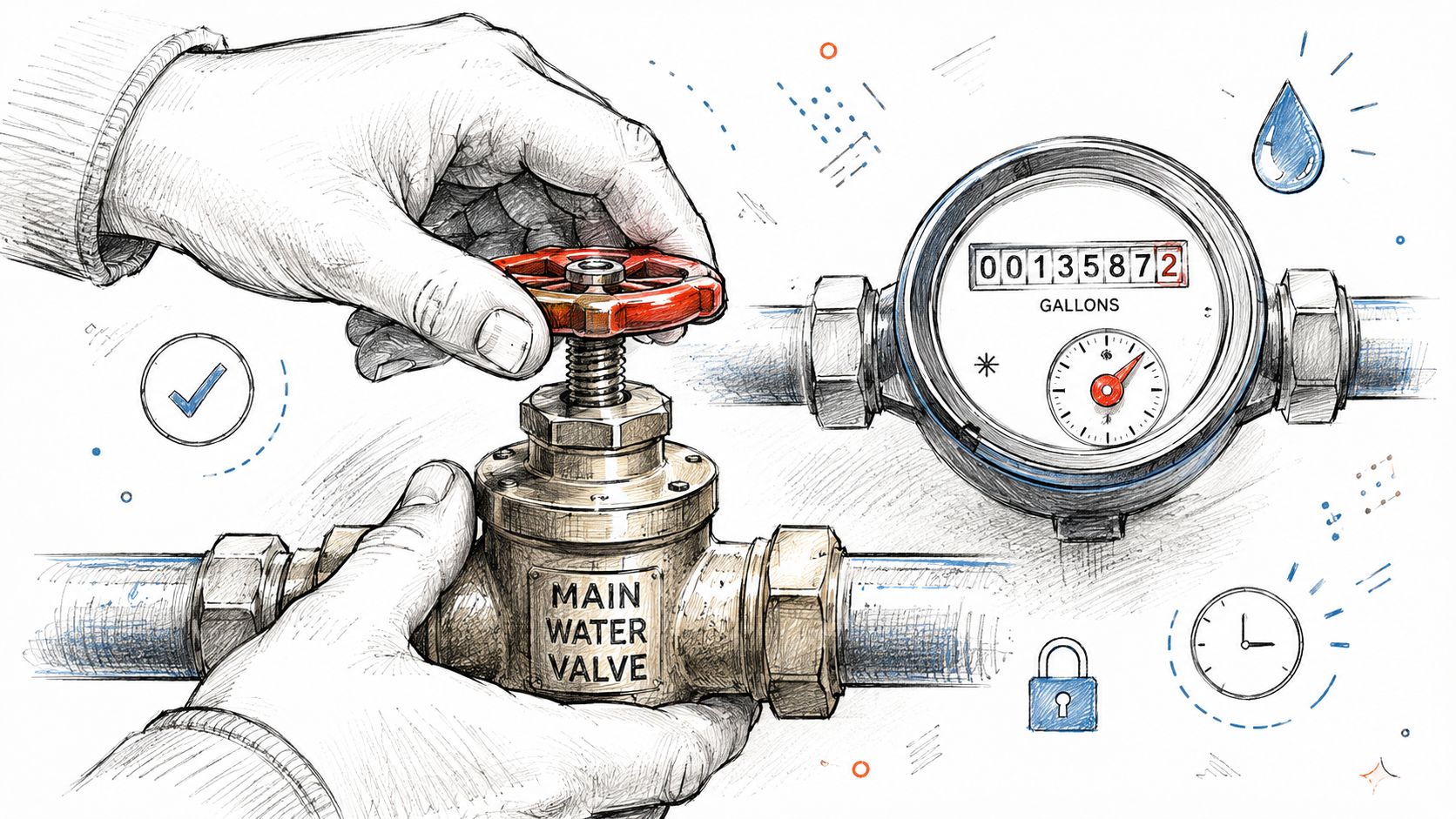
Start with the meter
Your water meter is usually near the street or sidewalk, often under a small utility lid. Open it carefully. Inside, you'll usually see a register and, on many meters, a small leak indicator or flow dial.
Then do this carefully:
Step 1: Turn off every fixture and appliance that uses water. That includes faucets, showers, toilets, the dishwasher, washing machine, ice maker, and any irrigation zone you can control.
Step 2: Look at the meter and note the reading. If there's a small leak indicator, check whether it's moving.
Step 3: Don't use any water for a period of time. If possible, give it enough time that even a slow leak has a chance to show itself.
Step 4: Recheck the meter. If the reading changed, or the leak indicator moved while everything was off, water is going somewhere.
That result doesn't always mean the leak is in the main line. It can still be a toilet flapper, irrigation issue, or another hidden leak inside the property. But it gives you proof that the problem is real.
A second check that helps narrow it down
If you know where your house shutoff valve is, you can gather one more clue.
- Close the house shutoff valve: This shuts off water flow into the home.
- Watch the meter again: If the meter still shows movement after the house is isolated, the leak is more likely between the meter and the house.
- If the meter stops moving: The leak may be inside the home or on a branch line after the shutoff.
If you aren't sure which valve is which, don't force anything. Older shutoff valves can fail when handled roughly.
What not to do
A lot of damage starts with a homeowner trying to “just take a quick look.”
- Don't start digging blind: Water lines don't run alone. Gas, electric, cable, and irrigation can all be in the same area.
- Don't rely on one wet spot alone: Surface water can travel. The puddle isn't always directly above the leak.
- Don't ignore pressure changes: A pressure drop paired with meter movement is meaningful.
- Don't assume it's a sewer issue: Sewer and water line problems can both affect the yard, but the diagnosis process is different.
If the meter test suggests a leak and you can't identify an indoor source, that's the point where a professional should take over. Good diagnosis saves money because it prevents random digging and unnecessary repairs.
Professional Leak Detection Methods Explained
Once a leak is suspected, the critical task is locating it accurately. That's where professional main water line leak detection earns its value. Homeowners can confirm symptoms. Plumbers pinpoint the problem.
Professional plumbers typically follow a multi-step workflow for pressurized systems. They isolate the suspected area, perform acoustic listening, and then use leak correlators between access points like hydrants or valves to estimate the location before digging, which reduces unnecessary excavation (pressurized system leak detection workflow).

Acoustic listening and correlation
A pressurized leak makes noise. Water escaping through a crack, pinhole, failed fitting, or split line creates vibration and sound that can travel through the pipe and surrounding soil.
A plumber uses sensitive listening equipment at accessible points, often valves or hydrants, to hear that leak signature. Then a leak correlator compares the sound arriving at two points and estimates where the leak sits between them. This is much more precise than walking the yard and guessing where to dig.
What works well with acoustic methods:
- Pressurized leaks with accessible fittings nearby
- Metallic or well-transmitting pipe sections
- Situations where the yard shows no obvious break point
What makes it harder:
- Plastic pipe can dampen sound
- Heavy traffic or environmental noise
- Complex branch layouts and poor access
That last point matters more than most homeowners realize. A peer-reviewed study on data-driven leak detection found XGBoost reached 99.79% accuracy when enough pipeline telemetry was available, and the same study emphasized that network layout strongly affects success rate and planning, which is why GIS review and pressure-point analysis matter before relying on any single method (machine-learning leak detection study).
Thermal and visual support tools
Not every leak leaves the same footprint. In some cases, surface temperature differences, moisture patterns, or site conditions add useful clues. For homeowners who want a plain-English overview of how that side of the process works, Survey Merchant's guide to thermal imaging is a useful background read.
Thermal methods can help under the right conditions, but they aren't a magic shortcut. Soil depth, weather, ground cover, and slab construction all affect what shows up.
Acoustic equipment finds many underground leaks because it listens to the pipe system itself, not just the surface symptoms.
When cameras help and when they don't
Homeowners often ask whether a camera can be sent through the water line. Sometimes an inspection camera helps with related diagnostics, especially when the concern overlaps with line routing, entry points, or a possible mix-up between sewer and water symptoms. For those situations, a sewer camera inspection is one tool a plumbing company like JMJ Plumbing may use as part of broader underground diagnostics.
But a camera isn't the primary answer for most buried main water line leaks. Water service lines are pressurized, smaller in diameter, and often not suited to the same camera approach people associate with sewer lines. In day-to-day practice, acoustic testing, isolation, pressure behavior, and careful site reading usually do the heavy lifting.
The main advantage of modern detection is simple. The plumber is trying to mark the smallest reasonable dig area before repair begins. That protects the lawn, shortens disruption, and keeps the repair focused on the actual failure instead of the nearest wet spot.
Understanding Repair Costs and Timelines
Homeowners usually want one number right away. That's understandable, but main water line repair doesn't price out like replacing a faucet. The biggest variables are underground, and you don't know all of them until the leak is located and the access path is clear.
What changes the scope
The location of the leak matters more than anything else.
A leak in open soil is a different project from a leak under a driveway, walkway, retaining wall, or mature landscaping. Access, restoration work, depth, pipe material, and local conditions all affect labor and time. A short exposed repair might be straightforward. A line under hardscape can become a larger excavation and restoration decision.
These are the usual cost drivers:
| Factor | Why it matters |
|---|---|
| Leak location | Grass is easier to open and restore than concrete or stone |
| Pipe material | Repair options differ depending on the line type and condition |
| Depth and access | Deeper or obstructed lines take longer to reach safely |
| Spot repair vs replacement | One damaged section may be repairable, but an aging line may justify a larger fix |
| Permit and code requirements | Some jobs need inspections or specific installation methods |
Repair or replacement
Not every main line leak means full replacement. If the pipe is otherwise sound and the damage is isolated, a spot repair may make sense. If the line is older, poorly routed, repeatedly leaking, or made from material that's failing in more than one place, replacement becomes the more durable answer.
That's why it helps to look at the problem the way property owners are advised to look at maintenance generally. This guide for property owners is focused on maintenance budgeting, but the same logic applies here. The cheapest short-term fix isn't always the lowest long-term cost.
For homeowners comparing options, water line repair and replacement services usually start with one question. Is this line worth repairing, or are you spending money to chase the next failure?
What affects timeline
Some jobs can be diagnosed and repaired quickly once the leak is pinpointed. Others take longer because access is tight, utility locates are pending, or restoration planning matters almost as much as the pipe work.
A realistic timeline depends on:
- Whether the leak is already located
- How quickly utilities can be marked
- Whether permits are required
- If replacement materials are needed
- How much site restoration is involved after the repair
A good estimate explains the scope. It should tell you what the plumber knows, what still needs to be confirmed, and what could change once the ground is opened.
Safety First Code Compliance and Buried Utilities
This is not a weekend trench project. Before any digging starts, public utilities need to be marked. That means calling 811.
If a shovel or small machine hits a buried gas or electric line, the situation can turn dangerous fast. Even hitting communications lines can create expensive avoidable damage. Good leak detection narrows the search area, but it doesn't remove the need for safe locate procedures.
Why early detection matters
A widely cited review in Computers and Electronics in Agriculture reports that roughly 20 to 30% of water is lost every year in water supply systems due to leakage, and it notes that acoustic emission methods are especially valuable because they can identify small leaks early, before they become larger failures and service interruptions (review of acoustic emission leak detection).
That matters at the homeowner level too. Catching a small underground leak before it turns into a washout, burst, or undermined driveway is always preferable to reacting after the damage spreads.
Compliance protects the repair
A licensed plumber doesn't just fix the wet spot. The work has to meet code, use the right materials, and account for safe burial depth, proper connections, and site conditions. That matters in Woodstock, Marietta, Canton, Cumming, and anywhere else in Cobb, Cherokee, North Fulton, or Forsyth where local inspection requirements may apply.
- Call 811 first: Utility marking isn't optional before digging.
- Use a licensed and insured plumber: Underground repairs carry safety and liability issues.
- Think about nearby trees: Roots can complicate excavation and contribute to line stress. Homeowners dealing with repeated root pressure may find this article on how to protect your property from tree roots helpful for planning.
A proper repair fixes the pipe and avoids creating a second problem in the yard.
Unlicensed work often looks cheaper until it damages another utility, fails inspection, or leaks again because the wrong repair method was used.
When and How to Call an Emergency Plumber in North Atlanta
There's a point where investigation needs to stop and response needs to start. If the meter shows active flow when nothing is running, the yard is holding water, pressure has dropped, or you hear water moving underground, it's time to call.
In Woodstock, Acworth, Marietta, Roswell, Alpharetta, Canton, Johns Creek, and nearby North Metro Atlanta communities, fast action matters most when the symptoms are getting worse by the hour. A small leak can stay manageable. A failing main line can suddenly become a major excavation and water service interruption.
Call right away if any of these are happening
- Water is pooling near the meter or service path
- You've shut fixtures off and the meter still moves
- Pressure dropped sharply across the house
- The ground is washing out near a driveway, sidewalk, or foundation
- You suspect a burst pipe or active underground break
What to do before the plumber arrives
If you know where the main shutoff is and it's safe to access, turn it off. Keep people away from soft or washed-out ground. Don't start digging. Don't assume the leak is exactly where the water is showing.
A 24 hour plumber should arrive ready to verify the leak, isolate the line if needed, and explain whether you're looking at a repair, a replacement, or more diagnostic work first. Clear diagnosis comes before a meaningful quote. That's how you avoid paying for guesswork.
If you need help with a suspected main water line leak in Woodstock, Marietta, Acworth, Alpharetta, Canton, Roswell, Cumming, Johns Creek, or the surrounding North Metro Atlanta area, contact JMJ Plumbing. They provide licensed plumbing service, underground leak diagnosis, main water line repair, and emergency response so you can get a clear answer and the right repair plan without unnecessary digging.