You're usually not shopping for a whole home water filter because you woke up excited about plumbing. You're doing it because something feels off. The water smells like a pool. Glassware comes out cloudy. Your shower leaves your skin feeling tight. Maybe you're in Woodstock, Marietta, or Canton and you've already replaced fixtures, scrubbed stains, and wondered whether the problem is your water, not your cleaning routine.
That's the right question.
A whole home water filter isn't a countertop gadget. It's a plumbing decision. If the water entering your house is carrying chlorine, sediment, taste, odor, or other nuisance contaminants, every fixture and every water-using appliance deals with it. So do you. In North Metro Atlanta, that matters because homeowners aren't just thinking about drinking water. They're thinking about showers, laundry, ice makers, dishwashers, water heaters, and the long-term condition of the plumbing system itself.
Is a Whole Home Water Filter Right for Your Atlanta Home
A homeowner in Acworth called after noticing three things at once. The tap water had a chlorine smell, the white sink kept showing spots, and the kids complained that the water tasted “weird.” Nothing had technically failed. No burst pipe repair, no sewer backup, no emergency plumber situation. But the house wasn't comfortable to live in.
That's how this usually starts.
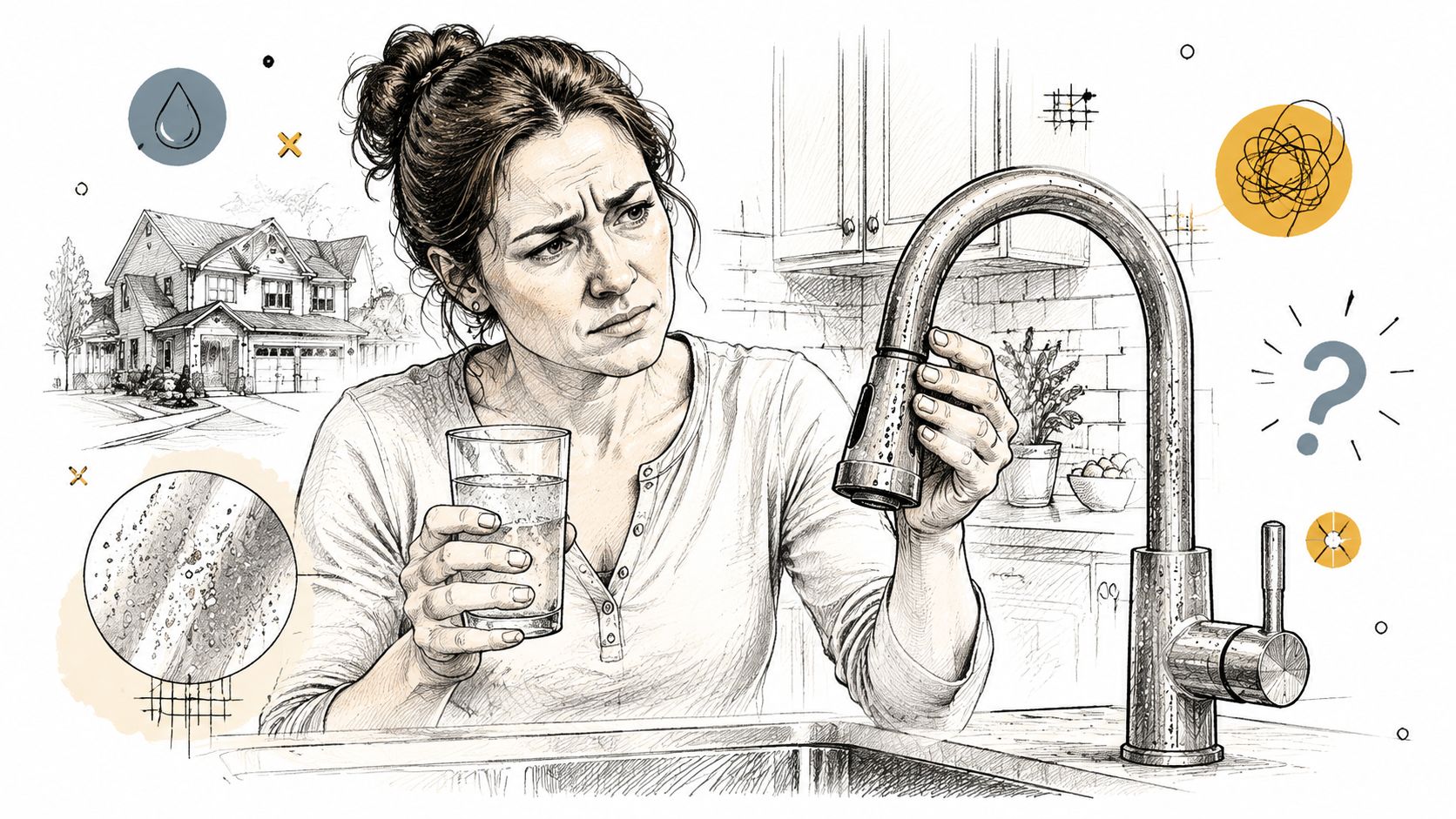
In Roswell or Cumming, it may show up a little differently. You might notice sediment in a tub, a smell when hot water runs, or low pressure that seems worse when multiple fixtures are on. In Marietta, maybe you're tired of replacing refrigerator filters and still not liking the water. In Woodstock, maybe you're planning other plumbing work, like a water heater replacement or main water line repair, and you want to fix water quality while the system is already being evaluated.
When the problem is house-wide
If the issue shows up at more than one fixture, stop thinking one faucet at a time. A whole home filter makes sense when the concern isn't limited to one kitchen tap.
Common examples include:
- Chlorine smell in multiple rooms: You notice it at the kitchen sink, in the shower, and when the washing machine fills.
- Sediment or discoloration: Water looks cloudy or leaves residue in more than one bathroom.
- Taste and odor complaints: Drinking water tastes off, but so does the ice and anything cooked with tap water.
- Appliance wear concerns: You want to protect the equipment that uses water every day.
A whole house fix makes sense when the whole house is affected.
When it may not be the right move
A whole home filter isn't automatic. If your only goal is highly targeted drinking water treatment at one sink, a point-of-use setup may be the smarter choice. If you already have a serious plumbing problem, like a leak repair issue, a clogged toilet that won't flush, or a sewer smell tied to drainage, filtration won't solve that. It handles water quality, not every plumbing defect in the home.
The practical answer is simple. If your water complaints follow you from room to room, a whole home water filter deserves a hard look.
How a Whole Home Water Filter Protects Every Faucet
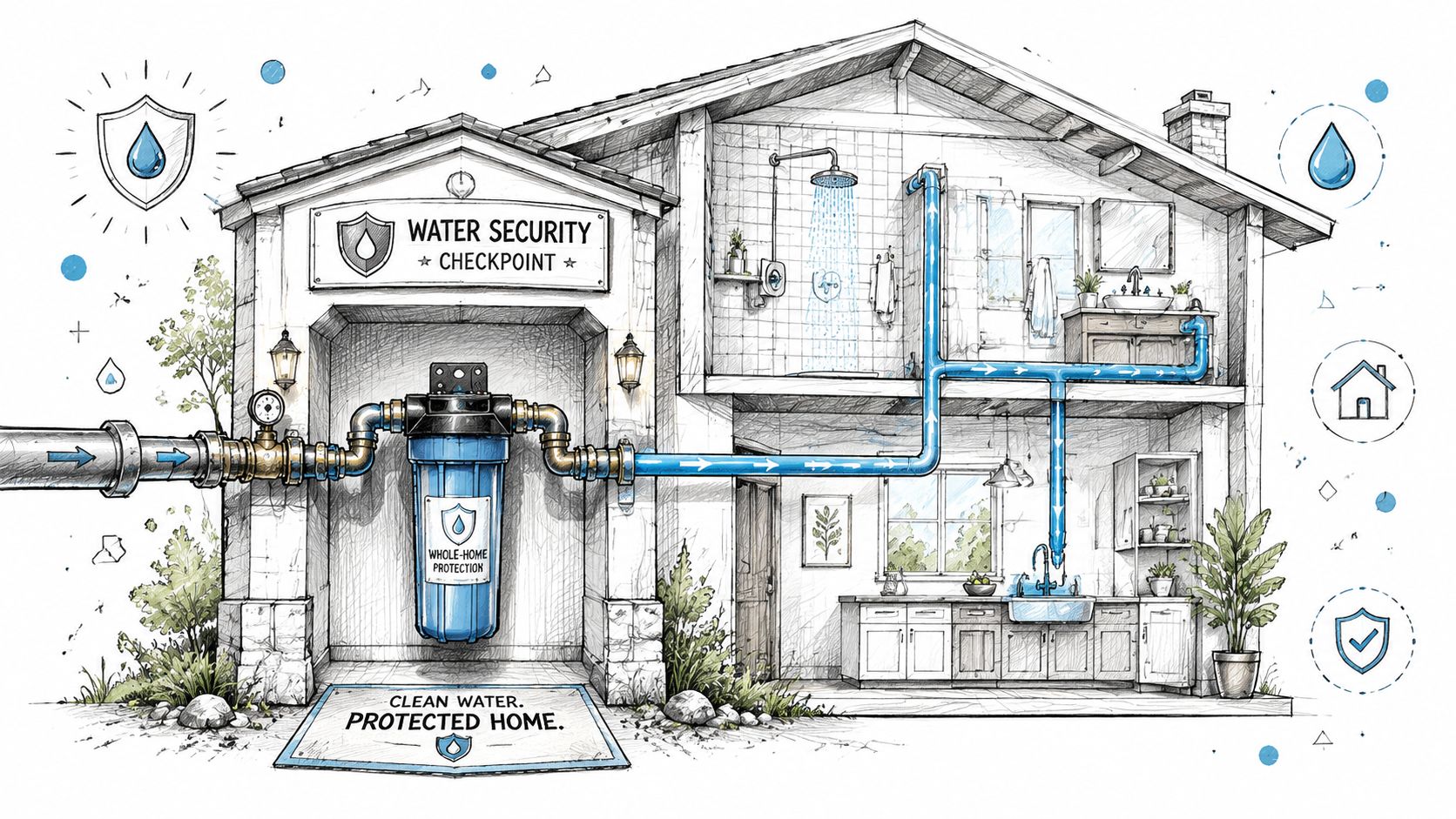
A whole home water filter works at the front door of your plumbing. More accurately, it works at the point of entry, where water enters the house from the main line. That's why it protects more than drinking water. It treats the water before it reaches showers, sinks, toilets, the water heater, the dishwasher, and the washing machine.
It acts as a gatekeeper. Any water entering your home goes through that checkpoint first.
Point-of-entry means full-house coverage
The NSF guidance on home water treatment describes whole-home systems as point-of-entry units, and it notes common sizing ranges of 7–10 GPM for 1–2 bathrooms, 12–15 GPM for 3–4 bathrooms, with a typical household of 4–6 people often needing 10–15 GPM to avoid pressure loss.
That sizing point matters more than most homeowners realize.
A filter can be good on paper and still feel bad in real life if it's undersized. If two people are showering, someone starts the dishwasher, and another faucet turns on, a weak system becomes a bottleneck. That's when homeowners start saying, “Ever since we added the filter, the pressure feels off.” Usually the problem isn't the idea of filtration. It's bad sizing.
Why flow rate matters in real homes
In Alpharetta, Johns Creek, and larger homes across North Fulton, simultaneous water use is normal. You need a system that fits how your house runs, not how a sales brochure imagines it runs.
Here's the simple rule:
- Smaller homes: A lower flow range may work if fixture demand is limited.
- Mid-size family homes: You need room for overlapping water use.
- Larger homes: The system has to keep up without turning every busy morning into a pressure complaint.
Practical rule: Don't choose a whole home water filter by tank size alone. Choose it by how many bathrooms, people, and water-using appliances you're asking it to support.
It's different from under-sink filtration
An under-sink unit helps one outlet. A refrigerator filter helps one appliance. A pitcher helps one person at a time. Those are fine for narrow goals.
A whole home system solves a different problem. It improves the water that moves through the plumbing system itself. That's why homeowners looking at broader concerns, including fixture residue, shower comfort, water heater performance, or house-wide taste and odor issues, usually end up considering a point-of-entry setup instead of another single-faucet filter.
If you want coverage at every tap, you need a system installed where the water first enters the home. There isn't a shortcut around that.
Choosing the Right Filter for North Atlanta's Water
Not every whole home water filter does the same job. Homeowners often misunderstand this distinction. They hear “whole house” and assume “covers everything.” It doesn't.
A filter has to match the problem.
Carbon, sediment, and multi-stage options
A sediment filter is the basic first line of defense. It's there to catch visible particles and debris that can cloud water or collect in fixtures. If you've seen grit, rust-colored material, or recurring buildup, sediment filtration belongs in the conversation.
A carbon-based filter is usually where homeowners notice the lifestyle difference. That's the category commonly associated with improving chlorine, taste, and odor. If your water smells like a pool or tastes harsh, carbon is often the part doing the heavy lifting.
A multi-stage system combines functions. That can make sense when the goal is broader household treatment instead of one narrow fix. One example of that category is HALO water filtration, which is installed as a whole-home solution and selected based on the home's water conditions and plumbing setup.
Know what certification actually means
One of the clearest reality checks comes from an example whole-house filter described by WaterBoss. Its whole-house unit is rated to NSF/ANSI Standard 42 and may remove up to 96.9% of chlorine for aesthetic improvement, but it is not a purification system and does not remove hardness, heavy metals, or microbes, according to the WaterBoss whole-house filter product guidance.
That distinction is huge.
If your goal is better taste and odor, an aesthetic chlorine-reduction filter may be exactly what you need. If your goal is something more specific, you need a system chosen for that job. A lot of disappointment comes from buying the wrong category, not from buying a bad unit.
Don't buy a chlorine filter and expect it to solve hardness. Don't buy a sediment filter and expect it to handle every water quality concern in the house.
The right question to ask
Don't ask, “What's the best whole home water filter?” Ask, “What exactly am I trying to remove, and what am I trying to protect?”
That changes the conversation fast. For one homeowner, the target is chlorine smell in showers. For another, it's sediment affecting fixtures. For another, it's protecting appliances during a broader plumbing upgrade. The right filter depends on the goal, the house, and the incoming water.
If a plumber can't explain what the filter does and what it does not do, keep looking.
More Than Just Better Taste The Benefits of Filtered Water
Most homeowners start with taste because that's the easiest thing to notice. The smarter reason to install a whole home water filter is protection.
Your plumbing system doesn't care whether the water “seems fine.” If sediment, chlorine, and other nuisance contaminants keep moving through the house day after day, your fixtures, valves, appliances, and water-using equipment absorb that wear.
Plumbing protection is the real value
A whole-home system is often marketed to reduce up to 97% of chlorine, and standard cartridges commonly need replacement every 6–12 months, according to Consumer Reports' guidance on whole-house versus under-sink water filters. The maintenance matters, but so does the reason people accept it. They want cleaner water moving through expensive plumbing equipment.
That includes:
- Water heaters: Cleaner incoming water can support better long-term system care, which matters if you're already thinking about water heater service or replacement.
- Fixtures and valves: Less nuisance material in the supply can mean less residue and less aggravation at faucets and showerheads.
- Appliances: Dishwashers, washing machines, and ice makers all benefit when the water feeding them is cleaner.
Daily quality-of-life improvements
You don't have to be a plumbing nerd to appreciate the household payoff. Filtered whole-house water often makes the home feel easier to manage.
Homeowners usually care about things like:
- Showers that feel better: Less chlorine smell and a cleaner feel at the tap can make bathing more comfortable.
- Cleaner-looking surfaces: Fixtures, tubs, and sinks are often easier to keep looking good when the water is less irritating.
- Laundry and dishes: Clothes, glassware, and cookware often show the difference before anything else.
- Less dependence on single-point filters: You stop trying to patch a whole-house problem with one little cartridge.
The win isn't only what you drink. It's what your plumbing system stops dealing with.
It's preventative, not cosmetic
Homeowners in Metro Atlanta are quick to act when a drain cleaning turns urgent, when a leak repair can't wait, or when a sewer replacement becomes unavoidable. Water quality deserves the same mindset. A whole home filter won't replace every future plumbing repair, but it can be part of keeping the house from working harder than it should.
That's why I don't put this in the “luxury add-on” category. If the incoming water is rough on the home, filtration is a practical upgrade.
Telltale Signs Your Home's Water Needs Help
Bad water quality doesn't always announce itself clearly. Sometimes it shows up as a collection of nagging house problems that never seem to stay solved. The sink gets dingy again. The shower glass clouds over again. The water smells odd for a minute, then seems normal. Homeowners often shrug that stuff off for too long.
Look at the pattern, not one symptom by itself.
Common Water Problems in North Metro Atlanta & Their Solutions
| Symptom | Potential Cause | How a Whole Home Filter Helps |
|---|---|---|
| Chlorine smell from taps or showers | Treated municipal water with noticeable disinfectant odor | Carbon-based whole-home filtration can reduce chlorine-related taste and odor issues |
| Cloudy or gritty water | Sediment or particulates moving through the supply | A sediment stage can catch debris before it reaches fixtures and appliances |
| Spots on fixtures and glass | Water quality issues showing up after repeated use | A whole-home approach improves water entering every room, not just one faucet |
| Dry-feeling skin after showers | Water quality factors affecting bathing comfort | Filtering house-wide water can improve the shower experience |
| Recurring residue in tubs or sinks | Particles or nuisance contaminants in incoming water | Point-of-entry treatment addresses the source before water spreads through the home |
What homeowners usually notice first
Sometimes the first clue is visual. Brown or rusty-looking water in a tub can point to sediment or corrosion somewhere in the system, and it deserves a proper diagnosis before anyone assumes it's “just old pipes.” If you've seen that, how Onsite Pro addresses brown water gives a useful breakdown of what can cause discoloration and why it shouldn't be ignored.
Other times the signs are more subtle:
- Your shower smells different than your kitchen sink: That often points to a broader water issue, especially when hot water makes the odor more obvious.
- Your house keeps collecting residue: If you're constantly wiping fixtures and still seeing buildup, the water may be part of the problem.
- You don't like the water anywhere: Not just one tap. All of it.
If the complaint follows the water through the house, the source is probably upstream of every fixture.
Don't confuse water quality with plumbing failure
A whole home filter can help with incoming water quality. It won't fix a hidden leak, a sewer smell from a drain issue, or a main line problem causing water in the yard. Those need plumbing diagnostics.
But if your complaints are mostly about smell, taste, residue, sediment, or shower comfort, the water itself may need attention.
What to Expect with Installation and Maintenance
This is plumbing work, not a weekend experiment. A whole home water filter installs at the main line, and that means mistakes affect the entire house. A bad install can create leaks, flow problems, service headaches, and code issues.
Use a licensed plumber.
What the installation actually requires
A whole-home system isn't always the right tool for every job, and installation has real conditions attached. Guidance from NuAqua notes that these systems require sufficient space, compatible plumbing, and water pressure typically in the 20–80 PSI range. It also points out that homeowners should budget for ongoing replacement costs and that a whole-home unit isn't always better than a point-of-use option for highly specific goals, as explained in NuAqua's whole-house installation guidance.
That lines up with what plumbers see in the field.
Before installation, a pro should be looking at:
- Location on the main water line: The system needs a practical serviceable spot, not just any open wall.
- Available room: Filters need clearance for servicing and cartridge changes.
- Pressure conditions: If the house already has pressure concerns, solve those first or account for them during design.
- Plumbing condition: A new filter won't repair worn shutoff valves, aging pipe, or pre-existing leaks.
Pressure matters more than most homeowners think
If your house already deals with pressure swings, check that before adding equipment. A pressure issue can come from several places, and a filter should never be used as a guess-and-see fix. It's smarter to evaluate the home's existing pressure setup first, especially if you may need a pressure reducing valve and water pressure review.
A good install protects flow. A sloppy install creates a callback.
What maintenance looks like
Whole-home filtration is not maintenance-free. That's not a reason to avoid it. It's just reality. If you don't want to replace filters, check service intervals, or plan for periodic upkeep, don't buy a system that depends on those tasks.
Here's the practical mindset:
- Expect routine service: Filters wear out. Performance depends on replacing what the system uses up.
- Plan for access: If the filter is crammed into a terrible location, every future service call becomes harder than it should be.
- Know the limit of the equipment: A whole home filter treats water quality. It does not fix clogged drains, sewer repair problems, burst pipes, or damaged water lines.
That last point builds trust because it matters. The right filter helps a lot. It does not magically cure every plumbing complaint in the building.
Why Choose JMJ Plumbing for Your Water Filter Installation
Local experience matters with water filtration because the system has to fit the house, the plumbing, and the homeowner's actual complaint. A company that spends its time doing real service work in Woodstock, Acworth, Alpharetta, Canton, Roswell, Marietta, Cumming, and Johns Creek sees how water quality concerns overlap with pressure issues, fixture wear, water heater problems, and aging plumbing.
That matters more than a glossy brochure.
JMJ Plumbing serves North Metro Atlanta as a licensed full-service plumbing company with over 25 years of experience, 24/7 availability, and Master Plumber certification MP210218, according to the company background provided for this article. That combination is useful because homeowners rarely deal with water filtration in isolation. Sometimes the same visit uncovers a shutoff issue, a pressure concern, or a water heater problem that also needs attention.
Why local plumbing judgment matters
A filter installer should be able to answer practical questions without dancing around them.
Questions like:
- Will this affect pressure in my house?
- Do I have enough room near the main line?
- Is this solving chlorine and sediment, or am I expecting too much from the wrong equipment?
- Do I need filtration, a pressure fix, pipe repair, or some combination of the three?
That's the difference between a plumbing recommendation and a product pitch.
The right contractor doesn't just sell a unit. They diagnose the house.
For homeowners who want a straight answer
If you're searching for a plumber near me in Cobb County, Cherokee County, North Fulton, Forsyth County, or anywhere in Metro Atlanta, keep it simple. You want a licensed plumber who can inspect the incoming water setup, explain whether a whole home water filter makes sense, and install it cleanly if it does.
That's especially important if you're already dealing with other plumbing concerns, whether that's low water pressure, no hot water, leak detection, emergency plumber calls, sewer repair questions, or main water line replacement planning.
If your water smells off, leaves residue everywhere, or just doesn't feel right in the shower, talk to JMJ Plumbing. They can evaluate the plumbing setup, explain whether a whole-home system fits your goals, and give you a clear quote without turning it into a sales circus.