
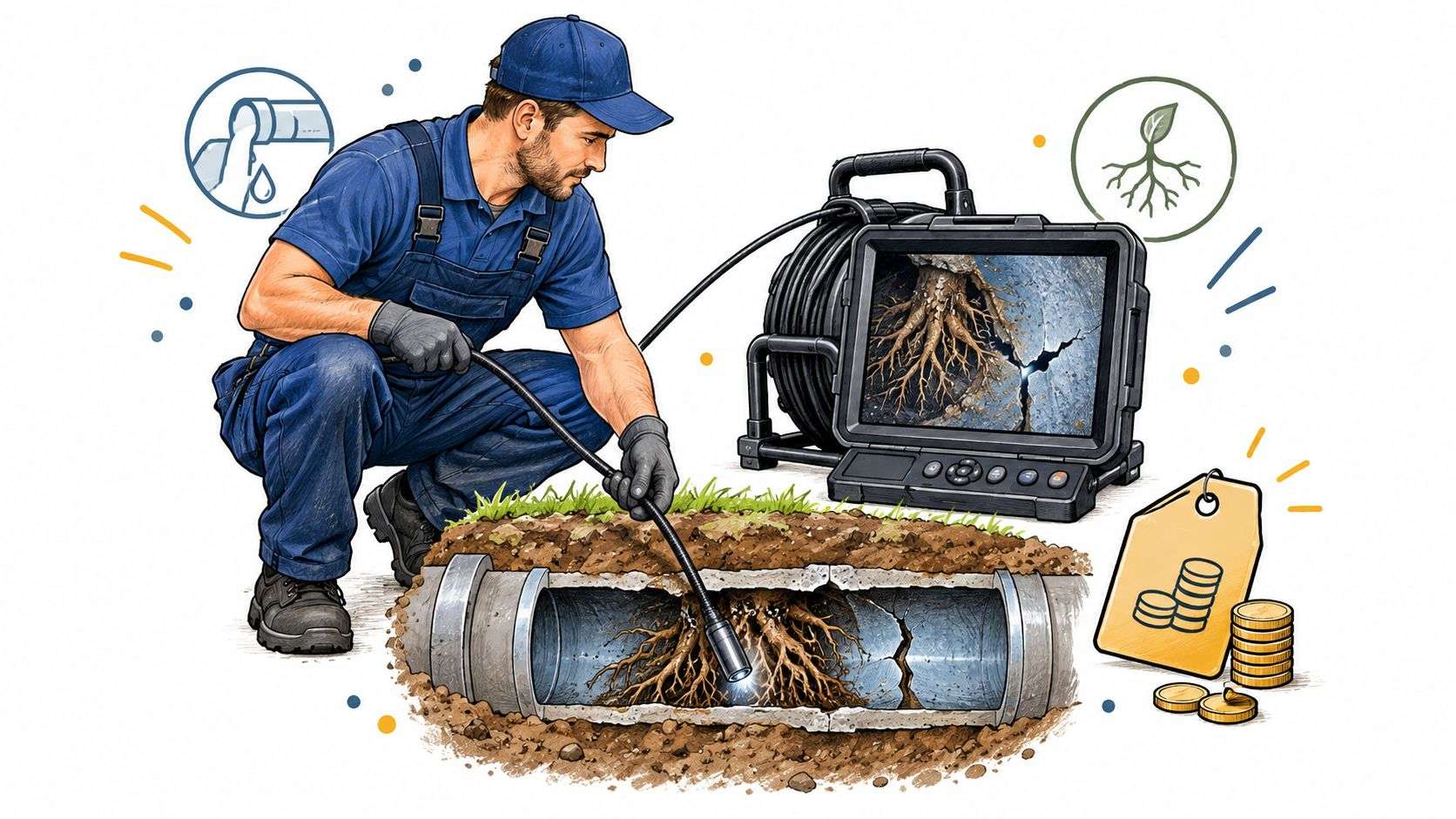
A basic residential drain camera inspection commonly falls in the $125–$500 range, with a national average near $280, and your final invoice depends on what that quote includes. You’re probably looking at a slow drain, a sewer backup, or a clogged toilet won’t flush situation, and now you’re holding a number that doesn’t explain itself. Think of that quote like a line on a kitchen table estimate. The useful question isn’t just what it costs. It’s what you’re buying, what it leaves out, and what happens if the camera can’t reach the problem.
How Much a Drain Camera Inspection Costs
You’re standing over a tub that drains slower every week. A company gives you a price over the phone, and you have no way to tell if it’s fair, low, or missing half the job. Start with a benchmark, then check the scope behind it.
National consumer cost guides place a typical residential drain or sewer camera inspection in the low hundreds of dollars, with HomeGuide data showing $125–$500 and a national average of approximately $280, according to industry cost summaries of sewer and drain inspection pricing. That’s your starting point for a standard drain camera inspection cost, not a promise for any single home.
How to Use That Benchmark in North Metro Atlanta
Treat that average as a national yardstick, not a fixed price for Woodstock, Acworth, Marietta, Roswell, or Canton. A home in Cherokee County with an easy cleanout near the house is a different job from an older home in Cobb County where the tech has to hunt for access. The benchmark tells you if a quote is in a normal neighborhood. It doesn’t tell you if two quotes cover the same work.
Context changes the price, too. That same cost summary notes a sewer scope added to a broader home inspection generally runs about $100–$250, because it’s bundled with an existing property assessment rather than booked as a standalone plumbing visit. If you’re buying a home in Alpharetta, Cumming, or Johns Creek, that bundled scope can be a smart first look. If you’re chasing an active backup, you may need more than a bundled look.
A quote in the normal range can still be a poor value if it only pays for a quick look and no usable record of what the tech saw.
One more thing confuses homeowners. A camera visit and a cleaning visit aren’t the same job, even though they often happen together. If a tech mentions clearing the line first, it helps to compare drain cleaning cable types so you understand what tool might go in before the camera does. Ask whether cleaning is included, separate, or only charged if it’s needed.
So keep the benchmark in your pocket. It’s useful. Just don’t judge the quote by the number alone.
What a Drain Camera Inspection Actually Includes
Think of it this way. A basic camera pass is like a photo of a room. A complete inspection is like a floor plan with measurements and notes written on it. Both show you something, but only one helps you make a decision later without guessing.
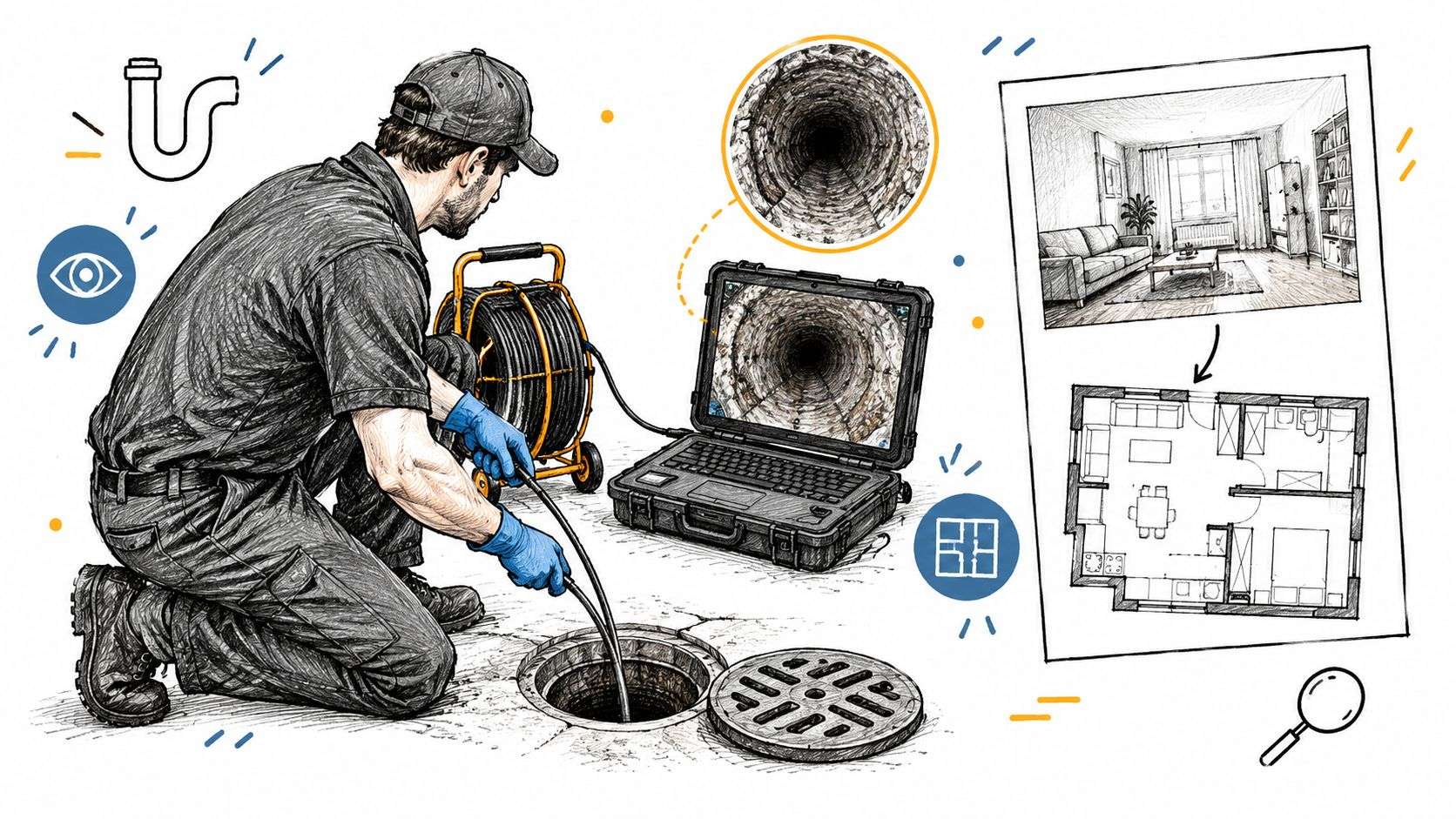
A complete inspection separates into distinct pieces, and published estimates span roughly $125–$500, with many residential scopes at $150–$400, which is why a breakdown of what a sewer scope should document stresses asking what you’re receiving for that price. Each piece has a clear purpose.
The Parts of a Complete Inspection
- Camera access and live diagnosis: The tech gets into the line, usually through a cleanout, and watches the feed as the camera moves. You’re paying for eyes inside the pipe.
- Recorded video: You get a copy you can keep, share with a buyer, or compare after a repair. Without it, you’re relying on memory.
- Written defect documentation: Plain notes that say what was found, such as roots, a belly, an offset joint, or a break.
- Pipe-distance measurement: The report notes how far from the entry point each problem sits. Distance turns a picture into a location.
- Electronic location of defects: A locator marks the spot on the ground above the problem. That’s what lets a repair crew dig in the right place.
- A report others will accept: For a home sale, that may mean documentation a buyer, municipality, insurer, or lender can use.
Two quotes can look similar and deliver very different results. One includes the video, the distances, and the surface marks. The other includes a live look and a verbal summary at your door. The second one isn’t dishonest. It’s just thinner, and thin findings are hard to price, negotiate with, or verify later.
Before you book, confirm four things. Does the inspection cover the full lateral to the street or septic tank? Do you get the video? Are findings written down with distances? Is locating included or billed separately? If a company can’t answer those clearly, you’re not comparing prices yet. You’re comparing guesses.
Price Factors That Change Your Final Invoice
A camera quote works a bit like a taxi meter. The starting fare gets the car moving, but distance, traffic, and extra stops decide the final total. With a camera inspection, the camera itself is rarely the expensive part.
Pricing is shaped less by the camera than by labor, pipe length, entry-point difficulty, reporting requirements, and timing, and after-hours work can add roughly $100–$300 to standard rates, according to a national compilation of drain camera pricing factors. That same source reports a much higher average of $995, with most homeowners paying $271–$1,726, likely because those figures fold in broader work like access, locating, and diagnosis. Don’t panic at that gap. It usually means the service definitions differ, not that one number is fake.
Price Factors and the Questions to Ask
| Price Factor | How It Changes the Quote | Question to Ask |
|---|---|---|
| Cleanout access | Easy access keeps labor low. No usable cleanout can mean pulling a toilet or finding another entry point. | Do I have a cleanout, and what if you can’t use it? |
| Pipe length | A longer run to the street or septic tank takes more time to inspect and document. | Does the price cover the full lateral? |
| Obstructions | Roots, grease, or debris can block the camera and require clearing first. | Is snaking or jetting included if the camera stops? |
| Locating and reporting | Surface locating, distance notes, and a formal written report add skilled time. | Do I get the video, distances, and a written report? |
| Timing | Nights, weekends, and emergency plumber calls carry a premium. | What is the after-hours charge, exactly? |
| Property type | Commercial lines and transaction-grade reports usually need more documentation. | Is this priced as a diagnostic scan or a full assessment? |
Access deserves special attention because homeowners rarely see it coming. A usable cleanout is like having a front door key. Without one, the tech may need to remove a toilet, reset it afterward, and spend time you didn’t budget for. That labor is real work, but it should be named in the quote, not discovered on the invoice.
Practical rule: Never compare two quotes until each one lists access, locating, video, and reporting the same way.
Ask for an itemized quote that separates inspection, access, locating, and emergency charges. Once those lines are visible, a higher quote sometimes turns out to be the more complete one, and a lower quote sometimes turns out to be only the first chapter.
What Happens When the Camera Cannot Reach the Problem
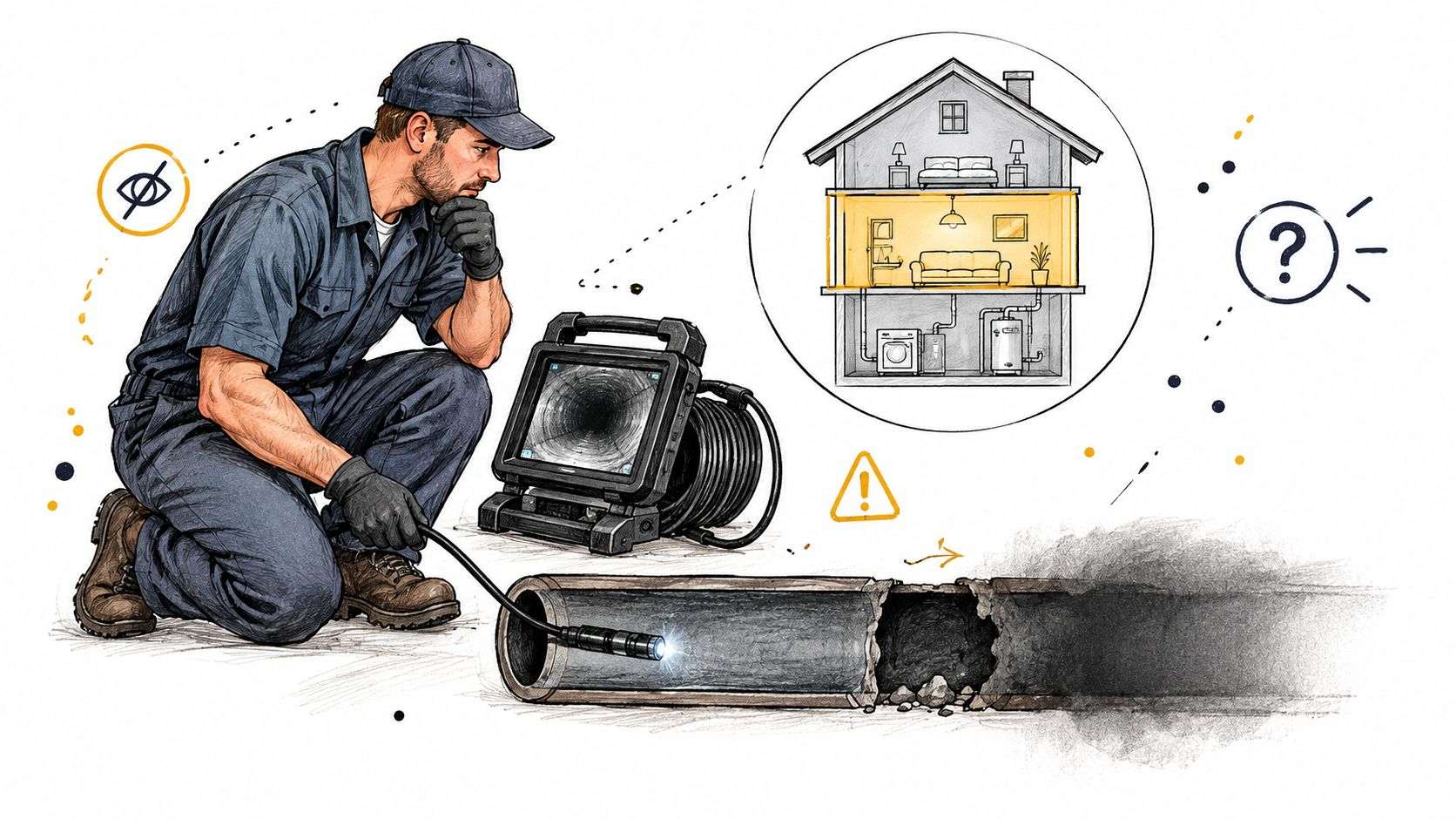
Here’s the trap nobody warns you about. The camera goes in, travels partway, and stops at roots, grease, a collapsed section, or a sharp turn it can’t pass. The tech shows you clean pipe up to that point. That does not mean your line is fine.
That’s like inspecting the first floor of a house and declaring the wiring safe. You’ve only seen part of the system. A clean-looking first section doesn’t establish that the entire sewer lateral is sound, and the unseen stretch may hold the break that’s causing your slow drains, sewage smell, or recurring backup.
All-in Pricing Versus Base Plus Contingencies
An all-in quote defines the outcome upfront. It covers the inspection and states what happens if access is hard or the line is blocked. A base-plus-contingencies quote starts lower, then adds charges as obstacles appear. Neither is automatically wrong, but you should know which one you’re holding.
Contingencies to ask about include:
- Access labor: Pulling and resetting a toilet, or using a second entry point.
- Partial clearing: Snaking or hydro-jetting so the camera can pass. If clearing is likely, review what drain cleaning for clogs and toilet clogs involves before you approve it.
- Electronic locating: Marking where the camera stopped or where a defect sits.
- Repeat visits: Returning after clearing to finish the inspection.
- After-hours premiums: Extra cost if this is a 24 hour plumber emergency in Marietta, Woodstock, or Roswell.
Technology helps, but it doesn’t remove this problem. Trade reporting has cited automated defect classification accuracy of 97%, according to industry coverage of camera inspection costs and technology, yet software can’t classify pipe it never reached. Findings still need manual verification and a full pass of the line.
There’s also a bigger picture when damage sits under a slab or foundation. In rare, serious cases, repair access can involve work beneath the home, and resources like Advanced Foundation Repair’s tunneling services show why precise locating matters before anyone talks about digging. Accuracy now prevents expensive guesswork later.
Ask one direct question before anyone starts. If the camera stops early, do I pay again, and what’s the next step? A clear answer protects your wallet.
Turning Camera Footage Into a Repair Decision
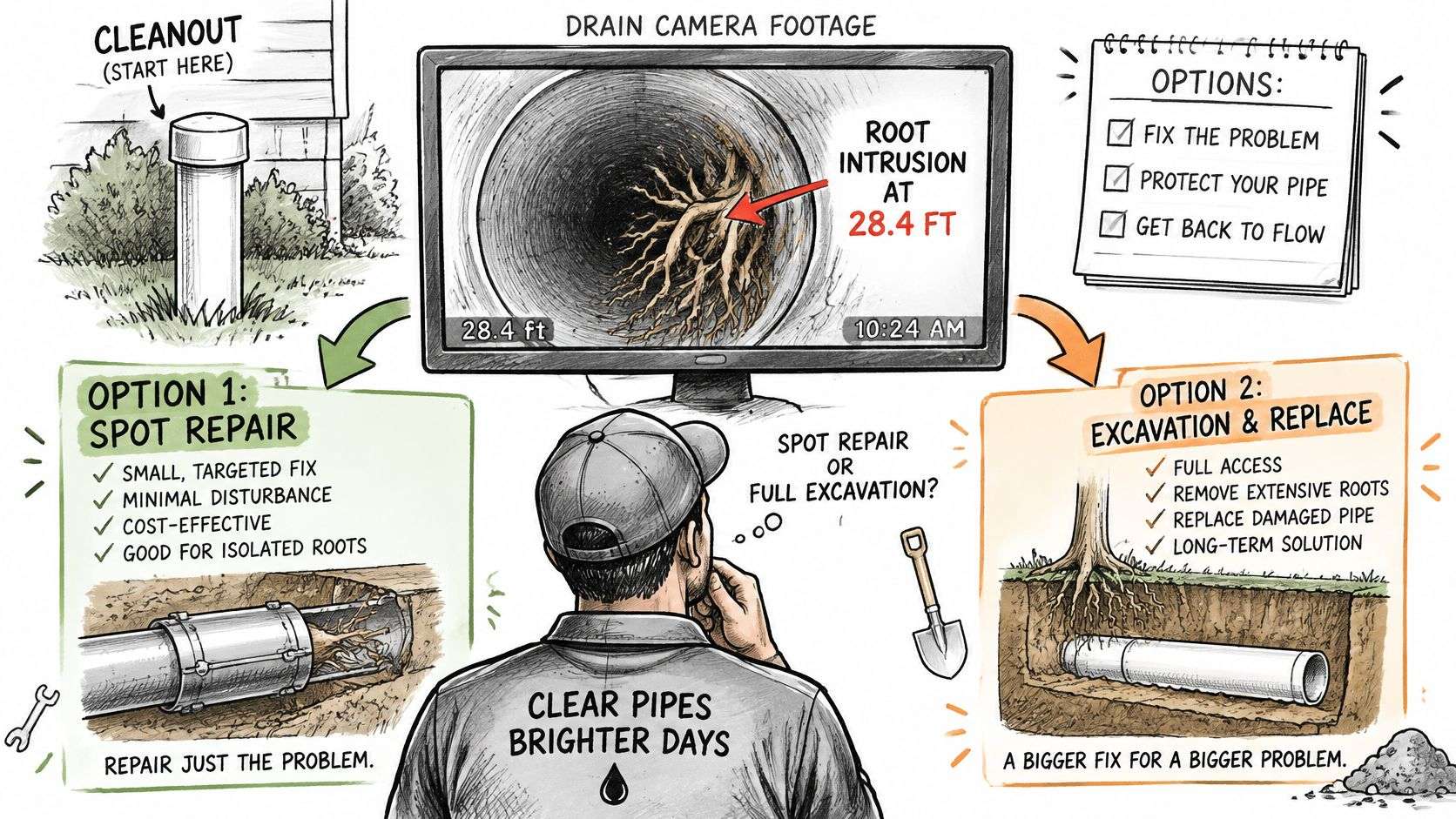
Footage only helps if it leads somewhere. The value of an inspection shows up when you sit down with the findings and decide between a small fix, sewer repair, or full sewer replacement. That decision rests on three things the report should give you: what the defect is, where it is, and how bad it is.
One Example, Two Different Answers
Say the report shows root intrusion at one joint, at a measured distance from your cleanout, with the spot marked in your yard. The rest of the line looks sound. That’s a contained problem. A plumber can talk about clearing the roots and repairing that joint, and you can get a price tied to a known location.
Now change one detail. The camera finds a broken, sagging section much farther along the line, plus standing water that suggests a belly. That’s not a contained problem anymore. The conversation shifts toward replacing a stretch of pipe, and the options under sewer line repair and replacement become relevant. Same camera, same visit, completely different decision, because location and severity changed.
Footage without a documented location is hard to price, hard to negotiate with, and hard to prove fixed.
That last point matters more than people expect. If a report just says roots were found, a repair company has to guess where to dig or run its own camera. If you’re selling a home in North Fulton or Forsyth County, a buyer can’t verify what they’re being asked to accept. And after a repair, you can’t confirm the work solved the problem unless you know where the problem was.
Use the report to compare repair quotes fairly. Give each company the same findings, the same distances, and the same video. Then ask each one what they’d fix, what they’d leave alone, and why. If two plumbers see identical evidence and propose very different scopes, ask the one proposing more work to point to the frame that justifies it.
Also ask what the camera can’t tell you. It shows the inside of the pipe. It won’t fully describe soil conditions, depth complications, or related issues like low water pressure, a main water line repair, or water in yard from a separate leak repair need. A good report separates confirmed findings from things that still need checking. That’s not weakness. That’s honesty you can build a decision on.
Why a Licensed Plumber Inspection Adds Value
Anyone can push a camera into a pipe and describe what scrolls by. The difference shows up in what happens next. A licensed plumber ties findings to a repair plan, stands behind the interpretation, and can legally perform the follow-up work to code.
Comparing a Licensed Inspection With a Low-cost Quote
- Accountability: A licensed company puts its name and license behind the findings. If the diagnosis is wrong, you have someone answerable.
- Findings tied to location: You’re more likely to get distances, surface marks, and written notes a repair crew can act on, rather than a verbal summary.
- Code-compliant follow-up: If the inspection leads to sewer replacement, water line replacement, or burst pipe repair, the same licensed team can often do that work without handing you off.
- One continuous record: The company that found the problem can show before and after footage of the same spot, so you can verify the fix.
A low-cost quote isn’t automatically a bad quote. It may suit a simple, single drain cleaning question, like confirming a kitchen line is clear. The risk appears when stakes rise, such as a home purchase, a recurring sewer backup, or a repair that involves digging. At that point, thin documentation weakens your position.
In North Metro Atlanta, JMJ Plumbing is one option in this category. It’s a licensed, full-service company serving the area for over 25 years, led by certified Master Plumber MP210218, with a local office in Acworth, 24/7 availability, and transparent on-site quotes. Because it also handles sewer repair, replacement, drain cleaning, water heater replacement, and leak work, an inspection there can lead directly into the next step without starting over with a new company.
Don’t take any of that on trust, from JMJ or anyone else. Ask the company to confirm exactly what its inspection covers before you book. Does it include the full lateral, the video, written findings with distances, and surface locating? What happens if the camera can’t get through?
Before you book: If a company won’t describe its scope in plain language, its price doesn’t mean much yet.
Licensing doesn’t make an inspection perfect. It does mean the person interpreting your footage can be held to a standard, explain repair versus replacement, and carry the job through. For most homeowners in Cobb County, Cherokee County, and Metro Atlanta, that continuity is where the value sits.
Booking Your Inspection and Next Steps
You don’t need to become a plumbing expert before you call. You need a short list of facts, a few direct questions, and a quote you can read without a translator. Here’s a simple way to do it.
Gather This Before You Call
- Your symptoms: Slow drains in one fixture or several, gurgling, sewage smell, water in yard, or a toilet that won’t flush. Note when it started and whether it’s getting worse.
- Your urgency: An active backup with sewage in a tub is an emergency. A slow drain you noticed last month usually isn’t, and scheduling during normal hours can avoid after-hours premiums.
- Your access: If you know where your cleanout is, say so. If you don’t, say that too. It helps the company quote access accurately.
- Your purpose: Are you diagnosing a problem, buying or selling a home, or getting a second opinion on a repair quote? Purpose decides how much documentation you need.
Other symptoms help the plumber sort the problem, too. No hot water points toward the water heater, not the sewer. Low water pressure across the house may point to the main water line. Mention everything, even if you’re unsure it’s connected. Sorting it out is the plumber’s job.
Ask for the Quote in Writing
Request an itemized quote that separates the inspection itself, access work, locating, the report, and any after-hours charge. Confirm the video and written findings are included, and ask whether the price covers the full lateral to the street or septic tank. Then ask the incomplete-inspection question: if the camera stops early, what’s the next step and what does it cost?
For a drain camera inspection near me or an emergency plumber near me in Acworth, Alpharetta, Canton, Cumming, Johns Creek, or Woodstock, JMJ Plumbing offers online booking and a service map, a local Acworth office, and round-the-clock availability for emergencies. You can book an inspection online or call and ask for the itemized scope before committing.
Don’t wait on warning signs to settle the question for you. Recurring backups, multiple slow drains at once, and sewage odors rarely fix themselves, and a planned inspection on your schedule beats an emergency dig on the worst possible weekend. Even if the camera finds nothing serious, you’ll have a recorded baseline of your line’s condition, which is useful the next time something changes.
Your next step is small and concrete. Write down your symptoms, pick up the phone or open the booking page, and ask for an itemized, full-scope quote. You’ll know what you’re paying for before anyone opens a cleanout, and that’s the whole point.
If you’re weighing a drain camera inspection cost in North Metro Atlanta, JMJ Plumbing can give you an itemized, on-site quote that separates the camera work, access, locating, and reporting before any work begins. Their licensed team serves Acworth, Woodstock, Marietta, Roswell, Alpharetta, Canton, Cumming, and Johns Creek around the clock, and can follow an inspection directly into sewer repair, drain cleaning, or other needed work. Visit JMJ Plumbing to book your inspection and see exactly what’s included before you commit.