
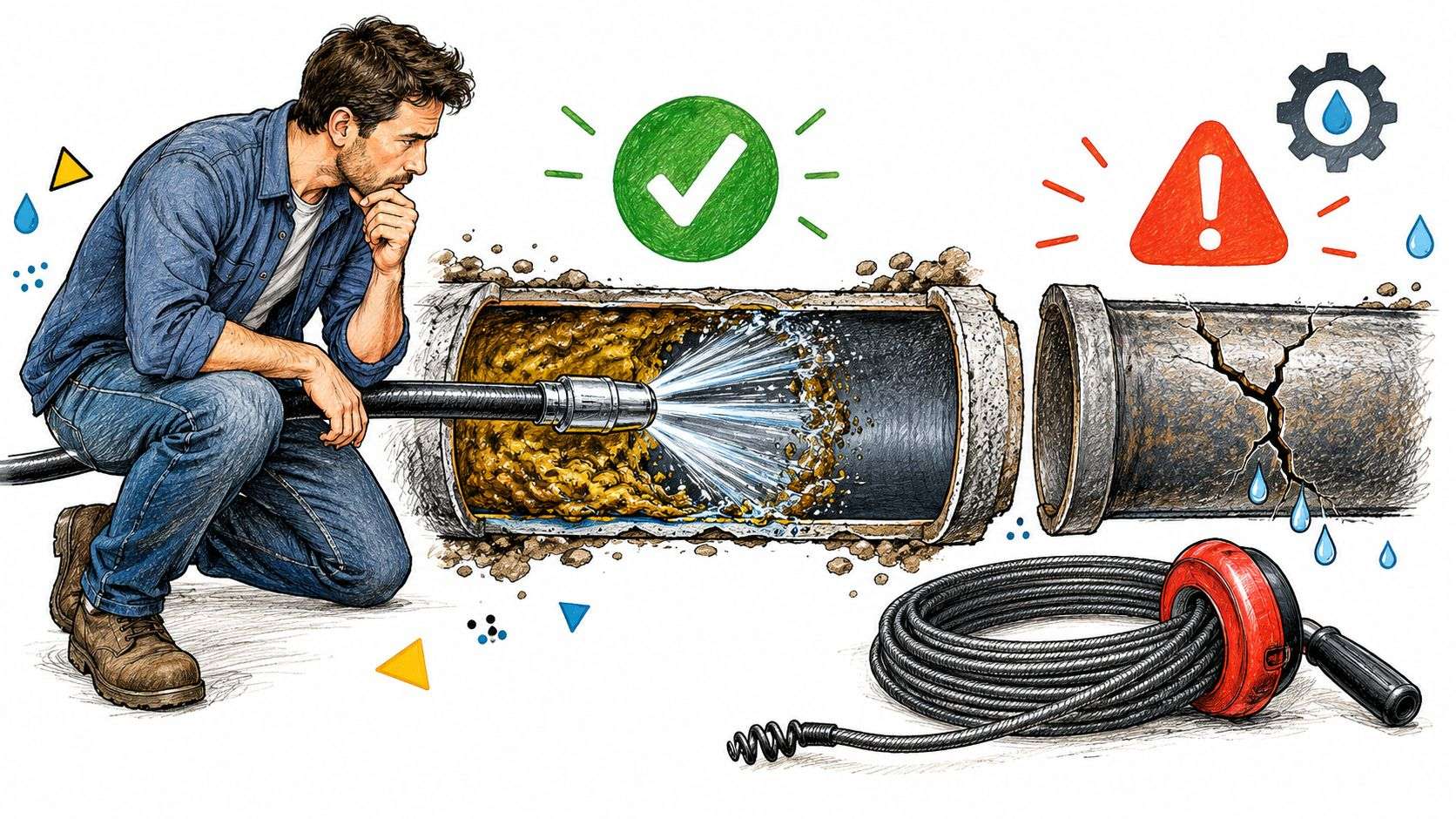
Hydro jetting is worth it for cleaning grease, sludge, or scale from an otherwise sound pipe, with soft debris sometimes requiring only about 60 bar of pressure, but it isn’t worth it as a stand-alone fix for collapsed lines, severe root intrusion, or Orangeburg or severely corroded pipe.
Your kitchen sink is slow again. The toilet gurgles when you drain the tub, and the last drain cleaning only bought you a temporary reprieve. Before you approve a more expensive service, ask the plumber to show you what’s blocking the line and whether the pipe underneath it is still serviceable.
What This Guide Will Help You Decide
You’ve already paid to get the drain flowing, and now you’re being told it needs hydro jetting. That recommendation might be right. But a recurring sewer backup deserves a diagnosis, not an automatic equipment upgrade.
Judge the recommendation by the camera findings, not by how impressive the machine sounds. A useful inspection should distinguish accumulated material from a physical defect. Those are different problems, and paying to clean a broken pipe doesn’t turn it into a sound one.
Start with the evidence
Your decision rests on these inputs:
- Blockage material: Ask whether the technician sees grease, sludge, sediment, roots, or an isolated obstruction.
- Pipe condition: Ask whether the visible pipe walls and joints are serviceable or whether cracks, corrosion, deformation, or displacement change the recommendation.
- Documented diagnosis: Ask to see the findings and receive an explanation of what the proposed service can reasonably accomplish.
Don’t let symptoms substitute for evidence. A slow drain, gurgling toilet, or sewage smell tells you to investigate. It doesn’t tell you which cleaning method to buy.
For a homeowner comparing drain cleaning in Woodstock or Acworth, the useful question isn’t just whether hydro jetting costs more than snaking. It’s whether the additional work addresses something the earlier service left behind.
Decide what you’re buying
Separate restoring flow, cleaning the pipe, and correcting a defect. A quote should say which outcome the contractor expects, what remains unresolved afterward, and how you’ll verify the result.
Practical rule: Don’t approve a cleaning upgrade until the plumber can explain what it will remove and what it won’t fix.
That distinction also helps when you’re under pressure to make a decision. Ask for the immediate stabilization plan separately from the long-term recommendation. You shouldn’t have to confuse emergency relief with a complete repair.
My recommendation is straightforward: pay for jetting when documented buildup justifies it. Don’t pay for it as a substitute for dealing with a known structural problem.
How Hydro Jetting Actually Works
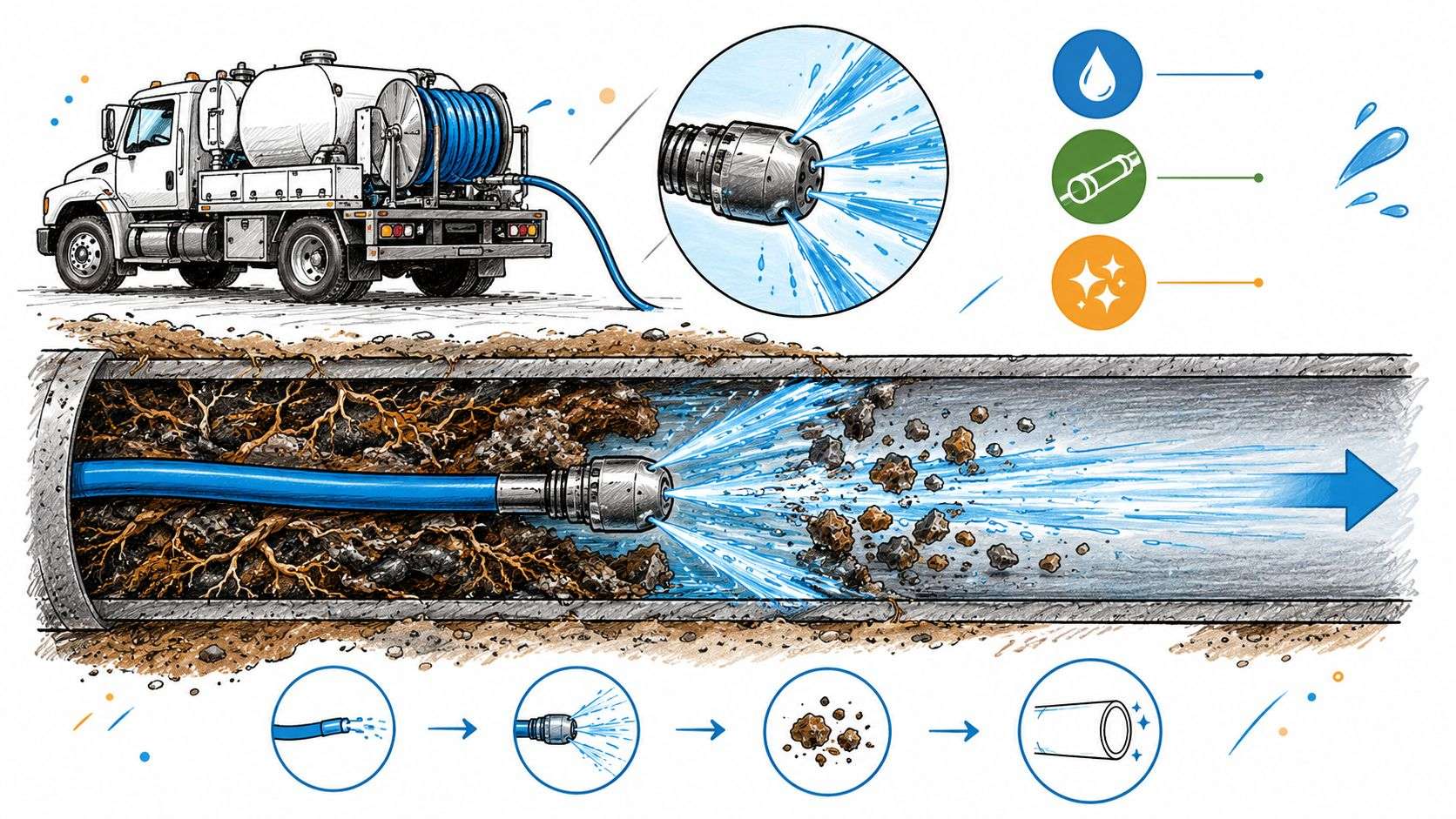
A hydro jetter combines a pump, high-pressure hose, and specialized nozzle. The technician selects the equipment configuration to break up deposits, clean the pipe wall, and move loosened material through the line. Pressure loosens material; adequate water flow helps carry it away.
Pressure isn’t the whole job
Common sewer-cleaning parameters are approximately 1,500–4,000 psi and 8–80 gallons per minute, with settings selected for pipe material, diameter, blockage, nozzle design, and hose length, according to sewer-cleaning guidance published by the WaterJet Technology Association. Those are operating ranges, not a prescription for your house.
A machine can develop substantial pressure without providing enough flow to transport everything it dislodges. That distinction matters: piercing an opening through debris isn’t the same outcome as flushing the loosened material out.
When a technician talks about pulling the line, ask how they control the nozzle during withdrawal. Cleaning requires deliberate coverage, not just pushing a hose to the obstruction and hauling it back as quickly as possible.
- Pressure selection: The setting should suit the deposit and the pipe’s condition.
- Flow selection: The equipment must move loosened debris, not merely disturb it.
- Nozzle selection: The jet arrangement should match the cleaning task rather than default to the most aggressive attachment.
- Controlled movement: The technician needs to manage where and how long the jets work.
What a finished job should demonstrate
The useful result isn’t a dramatic stream of dirty water. It’s a visible improvement inside the line, with the targeted deposits removed and any remaining limitations identified.
Ask the technician to explain the camera footage in plain language. Which section had buildup? Is that section now visibly cleaner? Did cleaning reveal a joint or wall defect that wasn’t clear beforehand?
Don’t demand maximum pressure. Demand a reason for the chosen settings and evidence that they accomplished the intended work. A responsible technician should be able to connect the equipment choice to the actual condition of your drain.
Hydro Jetting Compared to Other Drain Cleaning Methods
The right tool is the one that matches the problem. An isolated clog doesn’t automatically justify full-line cleaning, and a damaged sewer doesn’t become a cleaning problem just because cleaning is easier to schedule.
Drain Cleaning Options at a Glance
| Method | Best For | Durability | Approx. Cost | Key Risk |
|---|---|---|---|---|
| Hydro jetting | Documented deposits in a serviceable line | Depends on deposit recurrence and pipe condition | Site-specific cleaning quote | Unsuitable equipment settings or overlooked defects |
| Drain snaking or augering | A localized obstruction requiring mechanical clearing | Depends on whether other restrictions remain | Ask for a targeted-clearing quote | Restoring flow without resolving broader buildup |
| Chemical drain cleaners | Not my recommendation for an undiagnosed recurring backup | No dependable outcome without diagnosis | Product cost doesn’t establish total solution cost | Treating an unknown problem without inspecting it |
| Sectional repair or replacement | A confirmed physical defect | Addresses the repaired defect rather than just the obstruction | Requires a separate repair scope | Choosing a repair extent without adequate investigation |
There’s no honest universal price range to put against your property without knowing access, line condition, and scope. Ask for written prices tied to a defined outcome instead of comparing unlabeled totals.
Choose the least extensive work that solves the problem
For an isolated obstruction, a cable or appropriate auger may be the sensible starting point. For recurring wall deposits, broader cleaning deserves consideration. The supplied European sewer-maintenance guidance supports matching the cleaning method and operating conditions to the material being removed, rather than treating every blockage alike.
Chemical treatment is the option I’d leave off the shopping list for a recurring, undiagnosed backup. It won’t provide camera evidence, identify a separated joint, or give you a repair plan. Don’t substitute another bottle for finding out why the drain keeps stopping.
A repair proposal deserves the same scrutiny as a jetting proposal. Ask the contractor to identify the defect, explain the proposed repair limits, and distinguish necessary work from optional improvements.
The cheapest clearing isn’t automatically good value. Neither is the most expensive cleaning.
If you’re arranging drain cleaning or help with a clogged toilet that won’t flush, describe exactly what happens and which fixtures are affected. Let the technician diagnose the location before you commit to a main-line service.
Ask these questions when comparing quotes:
- Scope: Is the price for opening the blockage, cleaning a defined length, or correcting damage?
- Verification: How will the contractor show that the promised work is complete?
- Exclusions: What happens if access is inadequate or inspection reveals a defect?
- Recurrence: Does the recommendation address the reason earlier clearing didn’t last?
What Type of Blockage Are You Actually Dealing With
Don’t accept “the sewer is clogged” as the final diagnosis. You need to know what occupies the pipe and whether the pipe itself contributes to the restriction.
A UK contractor survey attributed blockages to grease at 22%, sewage-related material at 20%, silt at 15%, tree roots at 14%, solids at 12%, and miscellaneous causes at 17%, in the European maintenance guidance linked above. That guidance also supports the soft-debris pressure benchmark in the opening. These findings describe surveyed systems, not the odds for your particular Atlanta-area home.

Grease and sediment are cleaning problems
If the camera shows layered deposits narrowing an otherwise serviceable pipe, jetting has a clear purpose: remove the accumulated material rather than repeatedly open a path through it.
Ask the technician to identify where the deposits begin and end. After cleaning, ask to see those same locations again. That gives you a meaningful comparison instead of relying on the fact that a sink now empties.
For silt or heavier deposits, the technician should explain both removal and flushing. Material that has been loosened but not transported out hasn’t necessarily been dealt with.
Roots and structural failure need different expectations
Waterloo recorded 91 sewer blockages in 2025, including 32 attributed to roots, 10 to structural failure, 7 to grease, and 26 to unknown causes, according to its wastewater collection system annual report. The important distinction is that roots and structural failure aren’t interchangeable with grease buildup.
Root removal may restore flow without correcting the entry point. If the camera shows roots entering through a damaged joint, ask what will prevent recurrence. Don’t buy repeated clearing under the impression that it seals the opening.
For suspected structural problems, request specific findings:
- Belly: Ask whether the footage shows retained water and whether further assessment is needed to establish the problem.
- Broken section: Ask the technician to locate and document the visible damage.
- Joint separation or offset: Ask whether the discontinuity changes the cleaning plan or calls for repair.
- Root entry: Ask whether the contractor can identify where roots enter and explain the corrective options.
Arrange a sewer camera inspection before choosing between cleaning and repair. For an older North Metro Atlanta property, don’t assume the pipe material or condition from the neighborhood’s age alone.
A clear diagnosis might support jetting, targeted mechanical work, or repair planning. “Unknown cause” should prompt further investigation, not a confident promise that more cleaning will solve it.
Risk Factors Homeowners Often Overlook
More pressure doesn’t automatically mean a better result. The relevant question is whether the pipe can tolerate the proposed cleaning method in its current condition.
Guidance on hydro jetting risks in older pipes identifies thinned or corroded cast iron, cracked clay, Orangeburg, separated joints, and offsets as conditions requiring particular caution. Intact PVC and ABS generally tolerate appropriate jetting better, but material alone isn’t a safety guarantee.
Inspect condition, not just material
A contractor shouldn’t say “it’s cast iron” and stop there. Ask what the footage shows: significant corrosion, cracks, distorted sections, displaced joints, or another visible concern.
Likewise, “it’s plastic” isn’t permission to ignore defects. The technician still needs to assess the accessible line and explain any limitations in the inspection.
- Cast iron: Ask whether visible corrosion or thinning changes the proposed method.
- Clay: Ask about cracks and joint condition, not just whether water passes through.
- Orangeburg: Don’t approve aggressive cleaning as a routine substitute for evaluating degraded pipe.
- PVC or ABS: Ask whether joints and visible pipe sections appear intact.
A blocked line can also limit what the camera reveals. If the technician can’t inspect beyond the obstruction, ask how they’ll proceed cautiously and when they’ll reassess. An incomplete view shouldn’t become a claim that the entire line is sound.
Put responsibility in writing
Before authorizing work, ask how the company distinguishes a pre-existing defect from damage associated with the service. Request written terms explaining authorization, exclusions, warranty coverage, and what happens if cleaning exposes a repair need.
Don’t assume the homeowner always bears the risk, and don’t assume the contractor automatically covers every failure. The contract and circumstances matter. If the explanation is unclear, get it clarified before work begins.
A line that drains today isn’t necessarily a line that’s structurally serviceable.
Keep the footage, location notes, and written findings. Those records can help you explain the condition to a future contractor or buyer, but don’t treat them as a guarantee of insurance coverage or future performance.
My advice is to buy documented work, not reassurance. A bargain clearing that leaves you without findings may force you to pay for another diagnosis later. A careful provider should explain both the expected benefit and the unresolved risk before putting equipment into a vulnerable line.
What a Responsible Hydro Jetting Quote Should Include
A useful quote names the problem, the proposed treatment, and the stopping point if the findings change. “Hydro jet sewer” on an invoice isn’t enough detail for a recurring backup.

Ask for a defined scope
Before scheduling, request confirmation of:
- Inspection sequence: Whether camera work occurs before cleaning and how an obstructed view will be handled.
- Pipe details: The identified material, diameter, accessible route, and visible condition.
- Equipment plan: The approximate pressure, flow considerations, and nozzle configuration.
- Access and limits: The entry point, intended cleaning extent, and conditions requiring additional authorization.
- Deliverables: Video or written findings and a post-service assessment of the treated section.
- Follow-up: A recommendation based on the findings, with no unsupported promise that the line will stay clear indefinitely.
Equipment selection isn’t a technicality. Experimental testing in Italy evaluated seven commercial jetting heads in a 24-meter-long, 300-millimeter-diameter PVC pipe and found cleaning times of 4–20 minutes; efficiency declined when jet angles exceeded 20 degrees for deposits occupying 15% or 30% of the pipe’s cross-section. That controlled test isn’t a timetable for your service call, but it demonstrates why nozzle geometry and blockage depth matter.
Ask what will happen if cleaning reveals something different from the initial diagnosis. A responsible answer should include pausing, documenting the finding, and obtaining approval for a changed scope.
Verify local service and emergency terms
For drain cleaning in Canton, Roswell, Alpharetta, or Marietta, ask about arrival availability and diagnostic charges separately. A search for an emergency plumber near me or a 24 hour plumber shouldn’t end with assumptions about immediate arrival or included services.
The same questions apply in Cumming, Johns Creek, Kennesaw, and across Cobb County, Cherokee County, North Fulton, and Forsyth County. Ask for property-specific findings instead of accepting a neighborhood-wide assumption about pipe material.
Verify licensing, ask who supervises the work, and request an explanation of applicable code requirements if repair becomes necessary. Have the provider distinguish the cleaning warranty from any separate repair warranty.
Finally, compare complete scopes. A lower quote that excludes inspection, documentation, or necessary access isn’t directly comparable with one that includes them.
When Hydro Jetting Is and Is Not Worth It for You
So, is hydro jetting worth it? Yes, when the inspection supports cleaning and the contractor can document the result. No, when the proposal amounts to repeatedly washing out a line that needs structural correction.
- Residential buildup: Approve cleaning when the evidence supports it, not just because excavation would be inconvenient.
- Commercial or shared lines: Consider planned maintenance for documented grease problems, with intervals based on findings and use.
- Previously repaired root intrusion: Discuss maintenance only after confirming what was corrected and what remains.
- Known structural failure: Move toward sewer repair or sewer replacement planning instead of treating another clearing as the final solution.
For another homeowner-focused explanation before comparing proposals, consult Good Boy Plumbing’s hydro jetting guide, then judge any recommendation against your own inspection.
Keep unrelated symptoms on separate diagnostic tracks. Low water pressure or water in the yard calls for leak detection and assessment for leak repair, exterior leak repair, main water line repair, or water line replacement. An active break calls for urgent burst pipe repair evaluation, not sewer cleaning.
Likewise, no hot water calls for water-heater diagnosis and a repair-versus-water heater replacement decision. Tell the dispatcher exactly what’s happening so the responding plumber arrives prepared for the right problem.
JMJ Plumbing offers hydro jetting, sewer inspection, and repair services, with 24/7 availability across North Metro Atlanta. Visit JMJ Plumbing to request an assessment, describe your backup or slow-drain symptoms, and ask for documented findings before deciding between cleaning and repair.