Water Heater Not Enough Hot Water? A Homeowner’s Guide for North Metro Atlanta
That cold shock in the middle of a hot shower is more than just a rude awakening; it’s your plumbing system telling you something is wrong. When you’ve got a water heater not providing enough hot water, you’re dealing with one of the most common high-intent searches we get from homeowners all over North Metro Atlanta—from Woodstock, Acworth, and Alpharetta to Canton, Roswell, Marietta, Cumming, and Johns Creek. Beyond sudden cold showers, we also handle slow drains, low water pressure, sewer backup, and clogged toilets that won’t flush with fast drain cleaning, sewer repair or replacement, water line replacement, leak repair, and more.
Sometimes the fix is simple, like a quick thermostat adjustment. Other times, it points to a bigger issue like sediment buildup or a burned-out heating element.
Understanding Why the Hot Water Suddenly Vanishes
Running out of hot water always feels like a crisis, but the reason behind it is often pretty straightforward. For many folks we help in North Metro Atlanta, from Canton to Johns Creek, the problem is usually a system that just can’t keep up anymore.
A lot of this comes down to older tank-style water heaters that are constantly losing heat—a problem known as “standby loss.” This forces the unit to fire up and reheat water over and over, even when you aren’t using any. Plus, if you notice your main water line seems compromised or you have a burst pipe, don’t hesitate to reach out for our main water line repair or burst pipe repair services in Cobb County, Cherokee County, and beyond.
The U.S. Department of Energy points out that this is a major energy drain. In fact, for homes using about 41 gallons of hot water a day, switching to a tankless heater can cut energy consumption by a whopping 24% to 34%. If you’re curious, you can learn more about water heater efficiency on energy.gov.
Common Culprits Behind a Lack of Hot Water
Let’s dig into the usual suspects. Knowing what you might be up against can help you figure out if it’s something you can handle or if it’s time to call an emergency plumber near me in Acworth.
- Your Water Heater is Just Too Small: Did your family grow? Or maybe you installed that big soaking tub you’ve always wanted? A 40-gallon tank that was perfect for two people is going to struggle to keep up with a family of four and their laundry.
- Sediment is Choking Your Tank: Here in Cherokee and Cobb County, we have some seriously hard water. Over the years, those minerals settle at the bottom of the tank, creating a thick layer of sediment. This sludge acts like insulation, making it much harder for the burner or element to heat the water.
- A Heating Element Gave Up: Electric water heaters typically have two heating elements. If the upper one fails, you get no hot water at all. If the lower one burns out, you’ll get a little bit of hot water that runs out incredibly fast. It’s like losing half your engine power.
- The Thermostat is Off: Don’t overlook the simple stuff. Someone may have accidentally turned the thermostat down. For safety and efficiency, it should be set to 120°F. Of course, the thermostat itself could also be broken and not reading the temperature correctly.
Pro Tip: If you hear popping, hissing, or rumbling noises coming from your water heater, that’s a dead giveaway for major sediment buildup. It’s the sound of water getting trapped under the mineral layer and boiling. It’s also a red flag that you may need professional flushing, inspection, or even leak repair before it turns into a burst pipe repair situation.
Figuring Out What’s Wrong With Your Hot Water
When your shower goes from steamy to chilly in a matter of minutes, it’s time to put on your detective hat. The good news is that running out of hot water doesn’t always mean your entire system is shot. More often than not, it’s a single component that’s either struggling or has finally called it quits.
Let’s walk through the most common culprits we see every day.
Is Your Water Heater Just Too Small?
One of the first questions I ask homeowners is, “Has anything changed recently?” If your family has grown, you’ve got long-term guests, or maybe you just installed a gorgeous new soaking tub, your trusty old 40-gallon tank might not be able to keep up anymore.
It’s a classic case of demand outpacing supply. We see this constantly in growing communities like Canton and Cumming. A typical 50-gallon tank really only gives you about 30-40 gallons of actually hot water before it starts to cool down. When you consider that a family of four can easily use 86 gallons daily, you can see how quickly you’d run into a problem.
Globally, a staggering 40% of plumbing service requests are tied to undersized or inefficient water heaters. If you’re always running out of hot water during the morning rush but it’s fine later in the day, that’s a dead giveaway. Your tank is probably too small for your needs, and it’s time to think about a water heater replacement.
For more on how market trends affect homeowners, you can explore this global water heater market data. If your tank size just can’t meet your household demand, schedule a professional water heater replacement in Woodstock, Canton, or near me in Cumming.
Sediment Buildup: Georgia’s Hard Water Strikes Again
Our water here in North Metro Atlanta is notoriously hard, and that takes a toll on your plumbing. Over the years, minerals like calcium and magnesium build up at the bottom of your tank, creating a thick, rocky layer of sediment.
This layer acts like a shield, blocking the heat from reaching the water. For a gas heater, the burner has to fight to heat through that sludge. For an electric one, the lower heating element gets buried. The system works overtime, its efficiency plummets, and you get less hot water.
A tell-tale sign of major sediment buildup is a rumbling or popping noise from the tank. That’s water boiling and bubbling up through the sediment—a serious distress call. If you hear that, it’s time to act fast before it causes permanent damage.
Burnt-Out Heating Elements (Electric) or Burner Problems (Gas)
The parts that actually do the heating are common failure points. The symptoms are a bit different depending on your setup.
For Electric Water Heaters
Most electric models have two heating elements: one at the top, one at the bottom.
- If the top element fails: You’ll have no hot water at all. This one kicks on first, so if it’s dead, the whole process stops before it starts.
- If the bottom element fails: You’ll get a quick burst of hot water that immediately turns lukewarm. The top element heats a small amount of water, but there’s nothing to heat the rest of the tank.
This is one of the most common reasons for emergency calls to our 24 hour plumber in Marietta and Woodstock. A quick test with a multimeter can confirm a bad element, which is a fairly simple swap for a pro.
For Gas Water Heaters
Gas heaters rely on a burner assembly.
- A dirty or clogged burner will have a weak, yellow flame instead of a strong, blue one. This means it’s not producing enough heat, giving you lukewarm water that takes forever to recover.
- A failing thermocouple is a safety issue. This little sensor tells the gas valve that the pilot light is on. If it’s going bad, it might shut off the gas for no reason, keeping the burner from ever lighting.
The Sneaky Problem: A Broken Dip Tube
This is one of the trickier issues to diagnose on your own. Inside your tank, a long plastic pipe called a dip tube pushes incoming cold water down to the bottom to be heated.
When this tube cracks or breaks, cold water gushes in and immediately mixes with the hot water at the top, right where it flows out to your faucets. The result? Your hot water turns lukewarm almost instantly. If you’ve recently noticed tiny bits of plastic in your faucet aerators, that’s a huge clue.
A broken dip tube can make you think your whole heater is failing, but it’s often a simple fix. A water heater repair specialist can inspect the tank and replace the part, getting your hot water back to normal in no time.
Safe DIY Fixes You Can Try Today
Before you call a plumber, there are a few straightforward checks you can do yourself. Sometimes, the fix for not having enough hot water is surprisingly simple, and you can solve it without needing a professional visit. But let’s be clear: safety is everything.
No matter what you’re checking, the very first step is always to kill the power or gas. For an electric heater, head to your breaker box and flip the one labeled for the water heater. If you have a gas unit, twist the control knob to the “OFF” position and close the shutoff valve on the gas line feeding it.
Check and Adjust the Thermostat
One of the most common culprits for lukewarm water is a thermostat that’s just set too low. It happens. Maybe it got bumped by accident, or the last homeowner set it down to save a few bucks on energy.
We recommend a setting of 120°F. This temperature gives you plenty of hot water, it’s hot enough to kill off any nasty bacteria, but it’s still cool enough to prevent most scalding accidents.
- Electric Heaters: After the power is off, grab a screwdriver and pop off the access panels on the side of the tank. You’ll see some insulation; gently move it aside to find the thermostat. You’ll see a dial or a screw you can adjust with a flathead screwdriver. Set it to 120°F.
- Gas Heaters: This is usually easier. Just look for the temperature dial right on the gas control valve near the bottom of the tank and turn it to the 120°F mark or a setting like “Hot.” I’d steer clear of settings like “Very Hot” unless you know exactly what temperature they correspond to, as the scalding risk goes way up.
Once you’ve made the adjustment, turn the power or gas back on. You’ll need to give it a few hours to heat the tank, so be patient before you test the water again.
Testing Electric Heating Elements
If you have an electric model and tweaking the thermostat didn’t do the trick, you might have a bad heating element. This is a very common point of failure. You can actually test this yourself with a multimeter, a handy tool you can pick up at any hardware store for cheap.
Make sure the power is still off. Take off the access panels again and pull the insulation back. You’ll need to disconnect the wires from the screws on the heating element you’re testing. Set your multimeter to the ohms setting (look for the Ω symbol) at Rx1K. Now, touch one probe to each screw terminal on the element.
A healthy heating element should give you a reading somewhere between 10 and 30 ohms. If the needle on the multimeter doesn’t budge (which means infinite resistance) or drops straight to zero, the element is shot. It needs to be replaced, and that’s a clear sign to call a professional for a safe water heater replacement or repair.
This flowchart can help you visualize how to diagnose the most common mechanical issues.
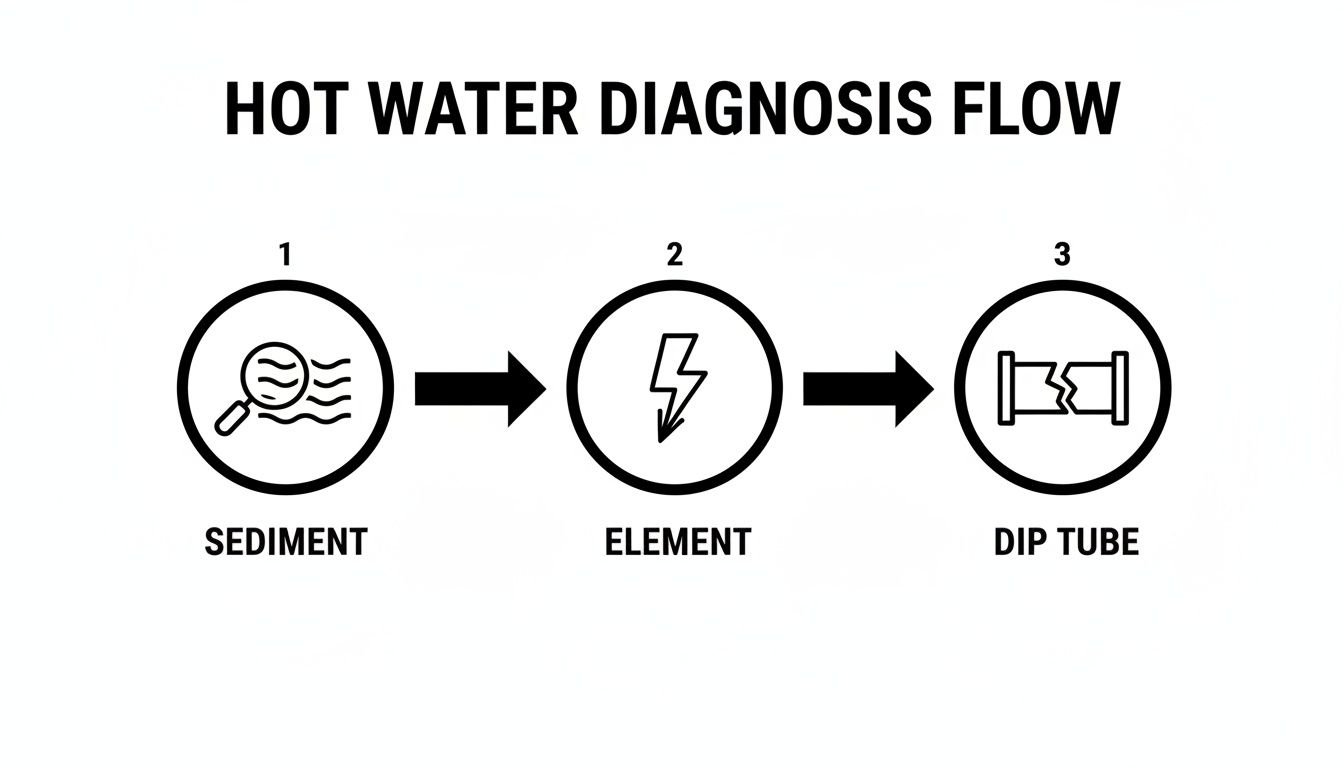
As you can see, sediment, heating elements, and a broken dip tube are the big three culprits that often require a more hands-on approach.
How to Flush Your Water Heater Tank
Living in areas with hard water, like Cherokee and Forsyth County, means sediment buildup is a real enemy to your water heater. This layer of mineral sludge at the bottom of the tank makes it work way harder than it should and can cause it to fail years early. Flushing your tank once a year can work wonders for its performance and lifespan.
This is a more involved job, but it’s definitely doable if you follow the steps carefully.
- First, shut off the power or gas to the water heater.
- Next, close the cold water supply valve—it’s the handle or knob on the pipe going into the top of the tank.
- Connect a garden hose to the drain valve at the very bottom. Run the other end of that hose somewhere safe, like outside or into a floor drain.
- Go open a hot water faucet somewhere in the house (the kitchen sink is a good choice). This lets air into the system so the tank can drain properly.
- Carefully open the drain valve on the tank. Be warned, that water is going to be extremely hot. Let it drain completely. If the water runs clear, you’re in good shape. If it’s clogged, you might need to briefly open the cold water supply valve in short bursts to stir up the gunk at the bottom.
- Once it’s drained, close the drain valve, take off the hose, and turn the cold water supply back on to refill the tank. Don’t turn the power or gas back on until you’re positive the tank is completely full.
If you’re in Woodstock, Acworth, or Alpharetta and flushing your tank feels like too much, or if none of these fixes bring your hot water back, it’s time to call in the pros. JMJ Plumbing has emergency plumbers on call 24/7 to handle anything from a simple element swap to a major main water line repair.
Red Flags That Mean You Need a Professional Plumber
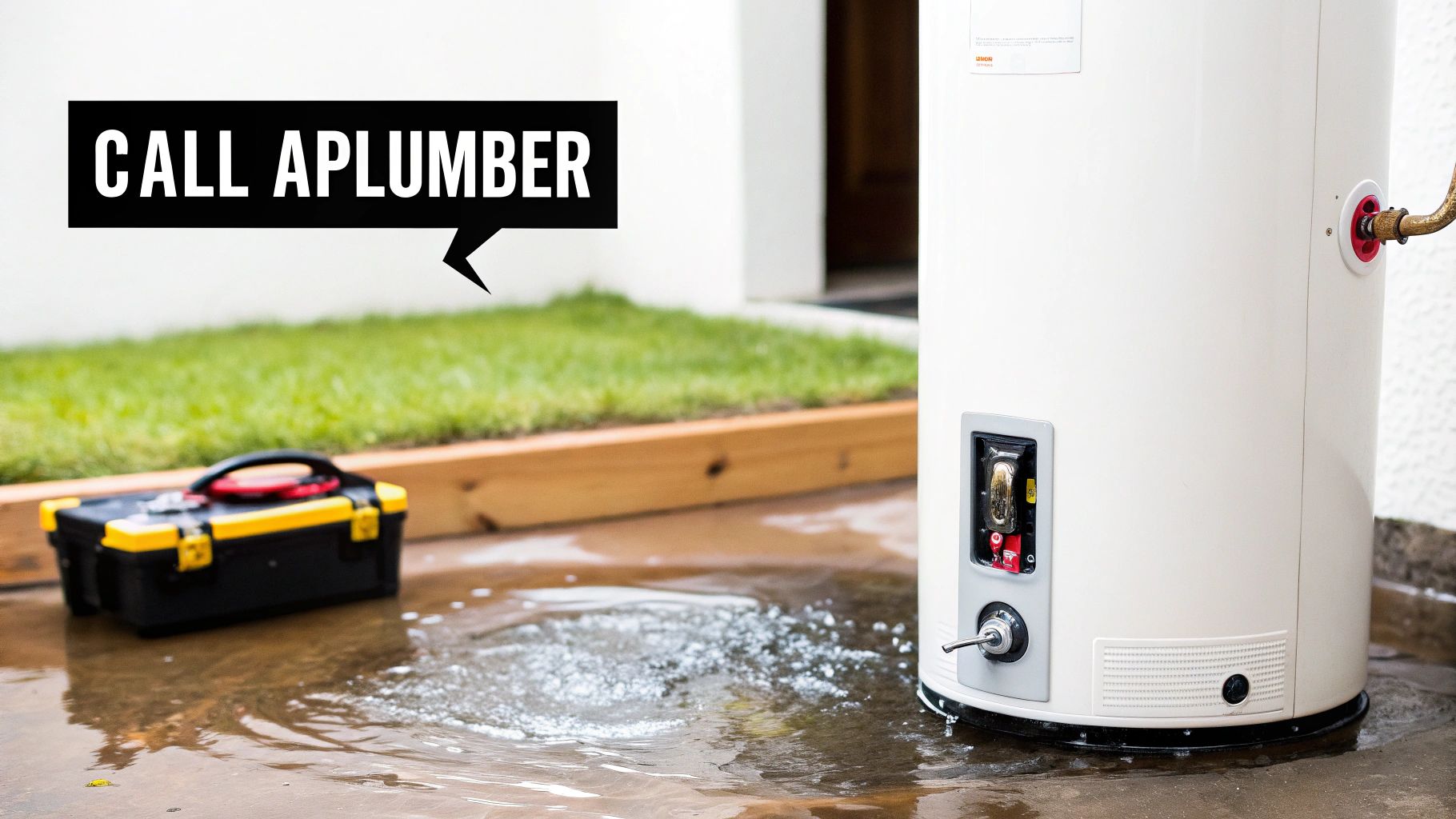
Look, I’m all for homeowners rolling up their sleeves and tackling a DIY project. But when it comes to water heaters, some problems are your unit’s way of screaming for professional help. Ignoring these red flags isn’t just risky for your plumbing—it can be downright dangerous.
Trying to fix certain issues yourself can lead to gas leaks, major water damage, or a safety valve failing when you need it most. Knowing when to put the tools down and call a licensed plumber is the smartest move you can make. These are the signs that you’re dealing with more than a simple glitch.
Alarming Sounds and Smells
Your water heater should be a quiet workhorse. If it starts making noises you can hear from the next room, it’s telling you something is seriously wrong inside.
- Loud Banging or Popping: This is the classic sound of heavy sediment buildup. Water is getting trapped under a thick layer of mineral scale and boiling, creating mini-explosions inside. All that pressure can weaken the tank’s lining, leading to a surprise burst pipe repair situation in your basement or garage.
- High-Pitched Whining or Screaming: This is a terrifying sound, and for good reason. It often points to a restricted water flow or a failing T&P (temperature and pressure) relief valve. That little valve is a critical safety feature, and if it’s faulty, it’s a ticking time bomb.
- Rotten Egg Smell (Gas Heaters Only): If you smell that sulfur or rotten egg odor near your gas water heater, act immediately. This is not a DIY moment. Turn off the gas supply, get everyone out, open some windows, and call for an emergency plumber in Roswell from a safe distance.
- Sewage Smell Nearby: If you detect a sewage odor in your yard or basement, you could be facing a sewer backup or damaged sewer line. Call in a sewer repair or sewer replacement specialist immediately.
Visible Signs of a Failing System
Sometimes the most urgent warnings are the ones you can see with your own eyes. A quick visual check can tell you a lot about your water heater’s health.
Any puddle of water around the base of the tank is a major problem. It might seem small, but it almost always means the tank itself is cracked or corroding from the inside out. Once a tank is compromised, a full-blown flood is usually not far behind. This is when you need to call for leak repair before it turns into a massive water damage claim. It can also indicate a bigger problem like the need for water line replacement or main water line repair.
If you see pooling water in your yard, that’s often a sign of a broken water line. Our team offers fast water line replacement and main water line repair to get your home back to normal.
Also, keep an eye out for rusty, discolored water coming from your hot taps. This is a dead giveaway that the inside of your tank is corroding and its structural integrity is shot. It’s only a matter of time before it springs a leak.
For homeowners in Alpharetta or Marietta, catching a small leak early can be the difference between a manageable water heater replacement and a catastrophe that floods your property. Don’t wait for the puddle to become a pond.
Complex Repairs Are Not for Amateurs
Some jobs just aren’t meant for a weekend warrior. Anything involving gas lines or major safety components legally requires a licensed professional in many areas, including North Fulton and Cherokee County.
Attempting these repairs without the right training is asking for disaster:
- Replacing a Thermocouple or Gas Control Valve: Working on a gas line is no joke. One wrong move and you could have a slow, undetectable gas leak, which is a massive fire or explosion hazard.
- Changing the T&P Relief Valve: This is the single most important safety part on your water heater. If it’s installed incorrectly, it might fail to open when pressure builds, potentially causing the tank to rupture violently.
- Electrical Wiring: On electric models, miswiring a new heating element or thermostat can easily cause a fire or short out your home’s electrical system.
For your family’s safety and to ensure the work is done to code, these jobs should always be left to a Master Plumber.
Repair or Replace? Making the Call on Your Water Heater
You’re standing there, shivering, wondering why the hot water gave out again. This is the moment every homeowner faces: do you patch up your old water heater one more time, or is it time to bite the bullet and get a new one? It’s a common dilemma we see in homes across Woodstock and Marietta, and the answer isn’t always cut and dry.
Making the right choice really boils down to a few practical questions about your unit’s age, how often it’s been acting up, and what it’s costing you on your monthly energy bill. It’s less about a single breakdown and more about the bigger picture.
When a Quick Repair Makes Sense
If your water heater is still on the younger side, a repair is almost always the smart move. A standard tank heater is built to last about 8 to 12 years. So, if your unit is only a few years old and this is its first major hiccup, a simple fix is usually all you need.
A repair is probably your best bet if:
- Your heater is less than 8 years old. A unit this young still has plenty of life left in it, and its other parts are likely in good working order.
- The fix is affordable. Swapping out a faulty heating element or a thermocouple is a relatively minor expense compared to a full replacement. We often use the 50% rule: if the repair costs less than half of what a new unit would, go for the repair.
- This is a one-off issue. Has your heater been chugging along reliably for years? A single problem doesn’t necessarily mean the whole thing is shot.
The Telltale Signs That It’s Time to Replace
On the flip side, constantly sinking money into an aging, inefficient water heater just doesn’t make financial sense. There comes a point where you’re just throwing good money after bad, and a new unit is the more logical, long-term solution.
A water heater replacement in Canton or Cumming is the clear winner when you start noticing these red flags. If your unit is pushing past the 10-year mark, it’s living on borrowed time. You’ll also see your energy bills slowly but surely creeping up as the heater loses efficiency and has to work harder. And if you feel like you know your plumber by name because you call so often, it’s definitely time for an upgrade.
We see it all the time—those frustrating cold showers are often caused by major sediment buildup or failing heating elements. These issues can quietly add an extra 10-20% to your annual energy costs. In fact, about 55% of our service calls in the Acworth area are for temperature problems tied directly to old, inefficient, or undersized heaters. If you want to get into the nitty-gritty of industry trends, you can find more insights on water heater technology here.
Repair vs Replace Your Water Heater: A Decision Guide
Sometimes, you just need to see the options side-by-side. Use this table to quickly compare factors like age, repair costs, and performance to decide if a repair or replacement is the right move for you.
| Consideration | Repair If… | Replace If… |
|---|---|---|
| Age of Unit | It’s under 8-10 years old. | It’s over 10-12 years old (or out of warranty). |
| Repair Cost | The cost is less than 50% of a new unit. | The repair is expensive—more than 50% of a new unit’s cost. |
| Frequency of Issues | This is the first or second minor problem you’ve had. | You’re calling for repairs frequently (once a year or more). |
| Performance | It generally works well, aside from the current issue. | You’re constantly running out of hot water or seeing rust. |
| Energy Bills | Your bills have been stable and predictable. | Your energy costs are steadily increasing for no other reason. |
Ultimately, this guide helps you weigh the short-term cost of a fix against the long-term value and peace of mind that comes with a new, reliable water heater.
Thinking Long-Term: The Payoff of an Upgrade
Putting a new, high-efficiency water heater in your home is about more than just ending the cold showers. It’s an investment in lower energy bills, better performance, and modern convenience.
Today’s models, especially tankless heaters, are in a different league. A tankless unit gives you an endless supply of hot water on demand, which is a game-changer for busy families. Plus, they are incredibly efficient. Since they aren’t constantly burning energy to keep a giant tank of water hot, they eliminate the “standby heat loss” that makes old tank heaters so wasteful. That efficiency translates directly into savings on your utility bills, helping the new heater pay for itself over time.
Answering Your Hot Water Questions
We get a lot of calls from homeowners all over North Metro Atlanta, from Woodstock to Roswell, asking the same kinds of questions. When you’re stuck with a lukewarm shower, it’s natural to have a few concerns. Here are some straightforward answers to the questions we hear most often.
Why Do I Run Out of Hot Water Faster in the Winter?
This is probably one of the most common complaints we hear once the temperature drops in Georgia. Think about it: the groundwater that refills your tank is dramatically colder in the winter. Your water heater, which is trying to get that water up to a comfortable 120°F, has to work much, much harder to bridge that temperature gap.
What this means is that your heater’s “recovery rate”—how fast it can heat a new tank of water—slows way down. Your 50-gallon tank is still 50 gallons, but it can’t keep up with demand like it does in the summer. That’s why those back-to-back morning showers suddenly drain the tank before everyone’s done. A quick inspection can confirm if your unit is sized right for your Canton home and running as it should.
A pro can tell you if your current tank is cutting it or if an upgrade, maybe to a tankless system, would be a better fit for your family’s needs, especially during those cold winter months.
Could a Hidden Leak Cause Me to Lose Hot Water?
You bet it can. A hidden leak in a hot water line, maybe under the slab or tucked away in a wall, is a huge hot water thief. It creates a constant drain, forcing your water heater to run endlessly to heat water that’s just seeping away into the ground or your home’s foundation.
It’s a double whammy: you get a sky-high energy bill and a shortage of hot water when you actually want to use it. If you’ve noticed a warm spot on the floor, hear a faint sound of running water when nothing is on, or just see a sudden spike in your utility bill, it’s time to call for emergency leak detection. Our team has the right equipment to find the source of the leak and handle a main water line repair without tearing your house apart.
What Does a Water Heater Replacement Cost in the Woodstock Area?
This is a tough one to answer with a flat number because the cost of a water heater replacement really depends on the specifics of your home. There’s no “one-size-fits-all” price tag.
Several things will influence the final cost:
- Heater Type: A standard tank model is going to cost less upfront than a high-efficiency tankless unit.
- Size/Capacity: A bigger tank or a tankless model with a higher flow rate will naturally cost more.
- Fuel Source: Gas and electric heaters have totally different venting, plumbing, and safety requirements.
- Installation Quirks: Sometimes we need to relocate a unit, add new venting for a gas heater, or run a new electrical line. These things affect the labor and materials needed.
The only way to know for sure is to get a firm, on-site quote. We give homeowners in Cobb County, Cherokee County, and North Fulton transparent, upfront pricing. Our Master Plumber will come out, assess your home’s setup, check for any required code upgrades, and give you a detailed estimate before any work begins. No surprises.
Does Hard Water Buildup Affect My Water Heater?
Absolutely. You know that crusty white stuff you see on your faucets? That’s limescale from hard water minerals, and it’s a huge problem for us here in North Metro Atlanta. That same gunk is building up inside your water heater, creating a thick, rock-like layer of sediment at the bottom of the tank.
This sediment acts like an insulator, forcing the burner or heating element to work overtime just to heat the water. This not only wastes energy but can also cause the tank to overheat, leading to serious damage and a much shorter lifespan. It’s one of the top reasons we end up doing water heater repair in Alpharetta.
A whole-home water filtration system is a fantastic long-term solution. By softening the water before it even gets to your appliances, you protect not just your water heater but all of your plumbing from the costly damage hard water causes. It’s a smart investment that prevents a lot of future headaches.
When the DIY attempts have failed and you need a pro you can trust, JMJ Plumbing is here to help 24/7. Whether you’re dealing with a sudden cold shower, a leak you can’t find, slow drains, sewer backup, or you know it’s time for a new water heater, our Master Plumbers have the experience to get it done right. We also specialize in sewer repair, sewer replacement, water line replacement, drain cleaning, leak repair, sewer backup response, clogged toilet won’t flush services, main water line repair, and burst pipe repair—available as emergency services near you in Cobb County, Cherokee County, North Fulton, Forsyth County, and throughout Metro Atlanta. Schedule your service today by visiting us at https://www.jmjplumbing.com.