Let’s be honest—few things cause a homeowner more stress than a major plumbing problem. The cost to replace a sewer line is a huge concern, and for good reason. Here in North Metro Atlanta, the price can be anywhere from $3,500 for a smaller repair to over $15,000 for a complete replacement that involves a lot of digging and restoration. If you're facing a potential sewer replacement in Woodstock or anywhere in the area, this guide is for you.
Understanding Sewer Replacement Costs in North Atlanta
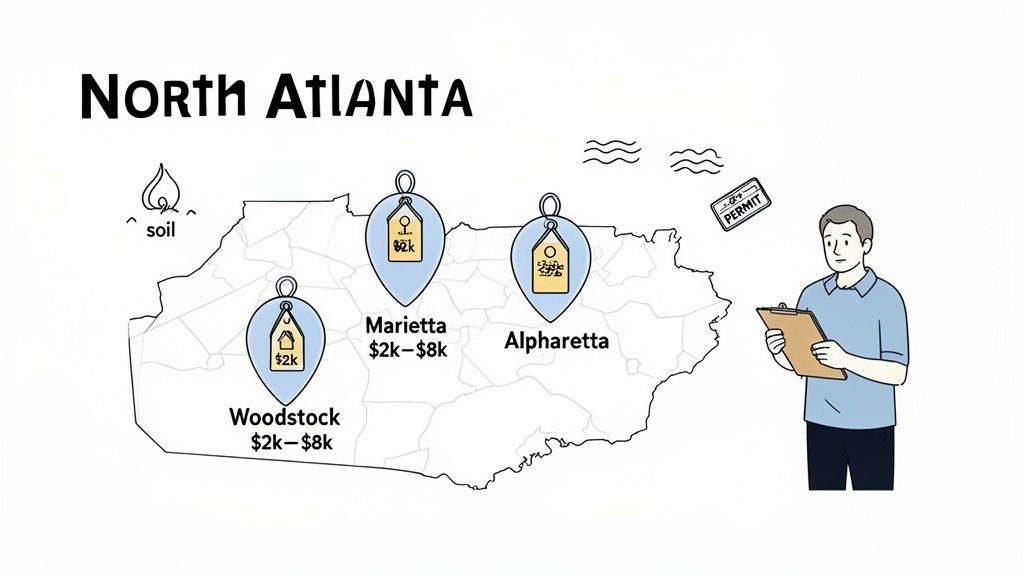
When you’re dealing with a sewer backup in Woodstock, the last thing you need is a surprise on the final bill. The truth is, there’s no single price for this kind of work. What a homeowner pays for a sewer repair in Roswell could be completely different from a job just down the road in Canton. It all comes down to your specific property and the nature of the problem, whether it's a simple drain cleaning or a full water line replacement.
This guide is here to give you a clear financial picture. We’ll walk through the realistic costs for homeowners across Cherokee County, Cobb County, North Fulton County, and Forsyth County, so you can feel prepared and confident when you start getting quotes from an emergency plumber near me.
Why Do Sewer Line Costs Vary So Much?
So, why the big price swing? Several key factors come into play. While national averages can give you a ballpark idea, they don't capture the full local picture. For instance, 2026 data compiled by Angi shows the U.S. average is around $3,319, but can easily top $10,000 for complex jobs.
Here in Metro Atlanta, the price is really driven by a few local realities:
- Property Layout: A long, winding driveway in Alpharetta or mature, expensive landscaping in Marietta makes it harder to get to the pipe. That extra difficulty adds to the cost of a sewer repair.
- Permit Fees: Every city has its own rules and fees. Getting a permit for a sewer replacement in Johns Creek is a different process and cost than it is in Acworth or Cumming.
- Soil Conditions: Much of North Fulton and Cobb County sits on dense red clay. Digging through that is a lot more work than digging through softer soil, which means more labor, whether it's for a burst pipe repair or a new sewer line.
The real question isn't just "How much will this cost?" but "What specific factors are driving the cost on my property?" Figuring that out is the first step toward getting a fair price and a solution that lasts, especially when you need a 24 hour plumber in Marietta.
To give you a clearer idea, here’s a quick breakdown of what you can generally expect to budget for different types of sewer line work in the area.
Estimated Sewer Line Replacement Costs in North Atlanta (2026)
| Service Type | Average Cost Range | Best For |
|---|---|---|
| Traditional Excavation | $4,500 – $15,000+ | Heavily damaged, bellied, or collapsed pipes that require a full sewer replacement. |
| Trenchless Pipe Bursting | $6,000 – $14,000 | Replacing the entire line with minimal digging; a common sewer replacement in Roswell. |
| Trenchless Pipe Lining | $3,500 – $8,500 | Repairing sections with cracks or root intrusion; a great option for sewer repair in Alpharetta. |
| Spot Repair | $2,000 – $4,000 | Fixing a single, isolated problem area like a small leak repair. |
Keep in mind, these are just estimates to help you plan. The only way to get a precise number for your home is to have a professional come out for an on-site inspection. We'll dig into what drives these costs and what you can expect during the process throughout the rest of this guide.
What Really Drives Your Final Sewer Replacement Bill?
It’s a classic head-scratcher for homeowners: why did your neighbor in Woodstock get a sewer replacement quote for thousands less than yours? It can feel random, but I promise you, it's not. The final price tag is a direct result of several key factors unique to your property and the specific problem you're facing, from a simple drain cleaning to a full burst pipe repair.
Getting a handle on these variables is the best way to understand your quotes and avoid any nasty surprises. It’s about more than just the pipe; it’s about the ground it’s buried in, the obstacles in the way, and even the city hall paperwork for a sewer repair in Cobb County.
The Scope of the Project
The single biggest factor is, quite simply, the size of the job. Are we talking about a small, targeted leak repair, or are we replacing the entire line from your foundation all the way to the city main? The answer completely changes the hours, materials, and bottom line.
-
Length of the Pipe: This one’s straightforward. A longer run of pipe means more materials and more labor. A 100-foot water line replacement in Cumming will always cost more than a quick 40-foot job on a smaller lot in Acworth.
-
Depth of the Pipe: Sewer lines need to be buried at a specific depth to use gravity effectively. A pipe that's only 3-4 feet deep is relatively easy to get to. But one that's 8-10 feet down? That requires much more serious, careful, and expensive excavation for a main water line repair.
-
Accessibility: Is your sewer line located under a wide-open patch of grass, or is it buried beneath a prized Japanese maple, a new deck, or your concrete driveway? Any obstacle that a crew has to work around adds time, complexity, and, ultimately, cost to the project.
Materials and Labor Rates
What the new pipe is made of and who’s putting it in the ground are the next major components of your cost. These can vary quite a bit depending on what your plumber recommends and what local codes require.
We often see replacements needed because old pipes have just reached the end of their life. In fact, industry data shows that 40% of sewer line failures are due to corroding cast iron pipes, which typically last 50-75 years. This is why so many homeowners are switching to modern PVC or ABS pipes. If you’re interested in the data, you can find additional sewer service insights here.
For most homes in North Metro Atlanta, modern PVC is the go-to choice—it's durable, reliable, and cost-effective. Cast iron is still an option; it's tougher and quieter, but it costs more upfront and will eventually rust decades down the road.
Labor rates also aren't the same everywhere. An emergency plumber in Alpharetta might have different hourly rates than a crew based in Canton, just due to different overhead and market demand. This is exactly why getting several quotes from local, licensed pros is a must, whether you need a sewer replacement or a new water heater replacement.
"Hidden" Costs and Additional Services
The work doesn't stop once the new pipe is in. Several other services are absolutely necessary for a complete, professional job, and they all contribute to the final invoice.
-
Sewer Camera Inspection: No reputable plumber will start digging without first running a camera through the line. This inspection pinpoints the exact location and nature of the problem—from root intrusion causing a sewer backup to a collapsed line—and while it costs a few hundred dollars, it prevents costly guesswork.
-
Permit Fees: Cities like Marietta and Roswell, along with counties like Cobb County and Forsyth County, require permits for this kind of work. The fees ensure a city inspector signs off on the job, confirming it’s done to code. It’s a crucial step that protects your investment in a sewer replacement near me.
-
Excavation and Restoration: If your job requires a traditional trench, digging is only half the battle. Once the new line is installed and inspected, that trench has to be filled back in and your yard put back together. The cost of restoring your lawn, driveway, or other features is a real part of the budget. Thinking about these related landscaping costs ahead of time will give you a much clearer picture of the total expense.
Trench vs. Trenchless Sewer Replacement Methods
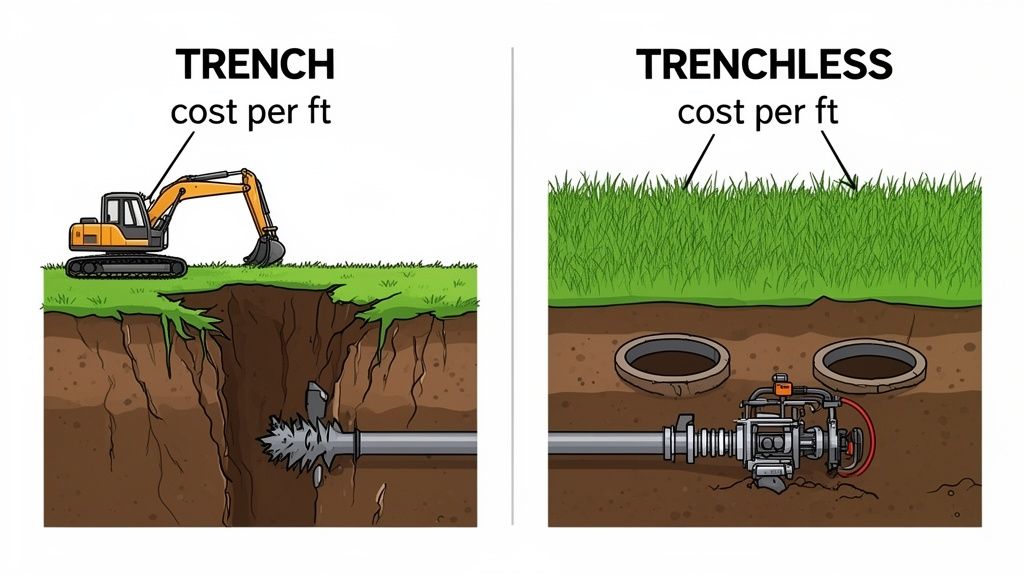
When you learn your sewer line has failed, the first image that comes to mind is often a backhoe digging a massive trench through your beautiful Woodstock lawn or tearing up your driveway in Canton. That's a legitimate fear, but thankfully, that kind of destructive, one-size-fits-all approach isn't your only choice anymore. A trenchless sewer repair in Canton can save your yard.
You can think of the two main options like this: traditional trenching is the "open-heart surgery" for your yard. It's incredibly effective but just as invasive. On the other hand, trenchless methods are more like "laparoscopic surgery," using a couple of small entry points to fix the problem from the inside out with minimal damage.
Getting a handle on how these two approaches differ is the first step in controlling the final cost to replace your sewer line and making the smartest choice for your North Metro Atlanta property.
Traditional Sewer Line Replacement (Excavation)
This is the classic method plumbers have used for decades. A crew digs a long, open trench, usually from your home's foundation to the city sewer tap at the street. This fully exposes the old, broken pipe so it can be removed and a brand-new pipe can be laid in its place before the trench is filled back in.
This approach is direct, effective, and sometimes, it's the only option. If a pipe is severely collapsed, has a major "belly" (a sag where waste collects), or is just too damaged for other methods, digging is the most reliable fix. It's often the go-to for a total main water line repair or a complete sewer system overhaul.
-
The upside? From a pure pipe-and-labor perspective, it can be the most cost-effective option on a per-foot basis. It also gives the crew a direct line of sight to inspect the new pipe and ensure every connection is perfect.
-
The major downside? The collateral damage. You're not just paying for the plumbing work; you're also on the hook for the significant cost of repairing your lawn, landscaping, patio, or driveway. Those restoration costs can easily double the project's price tag.
Trenchless Sewer Replacement Methods
For homeowners in established areas like Roswell and Marietta, where mature trees and pristine landscaping are a point of pride, trenchless technology has been a lifesaver. These modern techniques let us perform a sewer replacement without destroying your yard. The two most common methods we use are pipe bursting and pipe lining.
When your broken sewer line runs under a new stone patio, a prized rose garden, or the entire length of your concrete driveway, the "cheaper" traditional dig can quickly become the far more expensive option. A trenchless solution often pays for itself by completely avoiding thousands in restoration bills.
1. Pipe Bursting
This is a true pipe replacement method. We start by digging two small access pits at either end of the damaged line. Then, we pull a brand-new, seamless HDPE (high-density polyethylene) pipe through the old one. A powerful "bursting head" at the front of the new pipe fractures the old clay or cast iron pipe, pushing the fragments safely into the surrounding soil as the new, stronger pipe takes its place. This is the ideal sewer replacement solution when the old line is shattered or collapsed.
2. Pipe Lining (Cured-in-Place Pipe or CIPP)
Think of this as creating a brand-new pipe right inside the old one. It’s technically a sewer repair but results in a pipe that's often stronger than the original. We insert a flexible, resin-saturated liner into the damaged pipe and inflate it, pressing it tightly against the old pipe's walls. We then use a special curing system (often with hot water or UV light) to harden the resin. The result is a seamless, joint-free, and incredibly durable new pipe that seals cracks, stops root intrusion, and can last for 50 years. This is a top choice for sewer repair in Marietta.
Trench vs. Trenchless Sewer Replacement Comparison
When you're dealing with a nasty sewer backup, you need a solution that fits your property and your budget. While traditional digging might have a lower initial price tag for just the plumbing, looking at the total project cost—including putting your yard back together—is what really matters. This table breaks down the key differences to help you see the bigger picture.
| Factor | Traditional (Trench) Replacement | Trenchless Replacement (Pipe Bursting/Lining) |
|---|---|---|
| Upfront Cost | $80 – $175 per foot | $100 – $250+ per foot |
| Disruption | High; requires digging a long, wide trench across your yard. | Minimal; only requires one or two small access pits. |
| Timeline | Typically takes 2 to 5 days from start to finish. | Often completed in just 1 to 2 days. |
| Restoration Costs | High; you must budget for repairing the lawn, landscaping, driveway, or patio. | Low to none; your existing yard and hardscaping are preserved. |
| Best For | Completely collapsed or bellied pipes; new construction projects. | Properties with valuable landscaping, long driveways, or other obstacles. |
Ultimately, choosing between digging and trenchless comes down to weighing the upfront installation cost against the long-term, all-in cost of getting your property back to normal. For many homeowners in our area, preserving their property makes the trenchless route for a sewer replacement in Cumming the clear winner.
Warning Signs That Your Sewer Line Is Failing
We’ve all had that sinking feeling. A drain moves a little slower than usual, or the toilet needs a second flush. Is it just a simple clog, or the first hint of a much bigger, messier problem? For homeowners across North Metro Atlanta, knowing how to spot a failing sewer line can be the difference between a manageable sewer repair and a full-blown sewer backup disaster.
Think of these signs as your home's check engine light. Ignoring symptoms like slow drains or low water pressure won't make the problem disappear; it just guarantees a more expensive and stressful fix down the road. A tiny crack from a tree root can quickly turn into a catastrophic failure, flooding your home with raw sewage. Spotting the issue early gives you time to call an emergency plumber in Woodstock for a camera inspection before it's too late.
Persistent Clogs and Slow Drains
A single clog is one thing. But when every drain in your house suddenly slows to a crawl, you've likely got a bigger issue on your hands. If the toilet won't flush properly, the shower drain is pooling, and the kitchen sink is gurgling in protest, that’s not a coincidence. It's a classic sign of a blockage in your main sewer line that needs more than just a simple drain cleaning.
A clogged toilet that won’t flush on its own might just be a local problem. But when you see widespread drainage issues, it’s a strong signal that something is obstructing the main pipe—like invasive tree roots or even a partial collapse.
A backed-up sewer line is more than just a plumbing headache; it's a serious health risk. Raw sewage is full of bacteria and pathogens you don't want anywhere near your family. If you flush a toilet and see water bubbling up in the bathtub, you need to call a 24 hour plumber near me right away.
Unpleasant Odors and Strange Noises
Your plumbing is a closed system for a reason: to keep nasty sewer gas out of your house. So, if you catch a whiff of sewage in your basement, yard, or anywhere inside your home, that’s a major red flag. That sewage smell means there's a crack or break in the line somewhere.
- Gurgling Sounds: Ever notice your toilet gurgle when the washing machine drains? That sound is trapped air being forced through the water in your toilet bowl because of a blockage downstream.
- Sewage Smell: That unmistakable sewage smell wafting through your yard is a dead giveaway. It means wastewater is leaking from the pipe and soaking into the soil, creating a gross and unsanitary mess.
These sounds and smells are your pipes screaming for help. A quick call for sewer repair in Alpharetta or Marietta can get a camera in the line to find the source before that smell turns into a flood.
Changes in Your Yard
The signs aren't just inside your house. Your own lawn can tell you a lot about the health of your sewer line. Take a walk along the path where the pipe runs from your house to the street and look for anything out of the ordinary.
One of the sneakiest signs is a single patch of grass that's suddenly incredibly green and lush compared to the rest of the lawn. It might look great, but it’s often because sewage is leaking out and acting as a powerful—and unwanted—fertilizer. You might also find unexplained soggy spots or water in your yard. That pooling moisture points to a significant leak from the sewer line or a main water line repair issue that needs immediate attention.
The Sewer Line Replacement Process From Start to Finish
Facing a major plumbing project like a sewer line replacement can feel pretty overwhelming. But knowing what to expect, step-by-step, makes it a whole lot less stressful. We want to pull back the curtain on the entire process, from that first frantic call about a sewer backup in your Woodstock home to the final handshake when the job is done right.
The path from a nasty symptom to a fully functioning new sewer line is actually quite logical. This chart breaks it down into the main stages: spotting the trouble, getting a professional camera inspection, and then moving forward with the replacement.
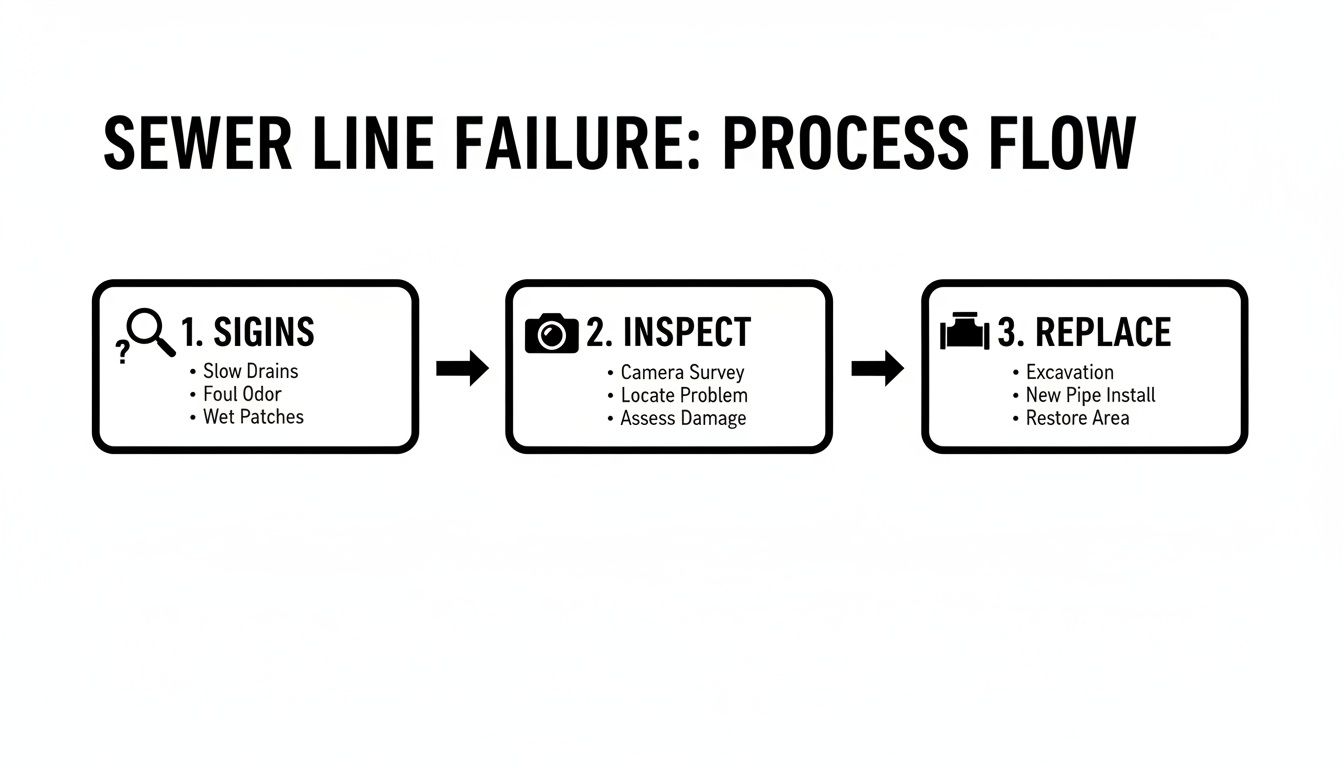
This methodical approach is all about diagnosing before we prescribe a solution. Guesswork has no place here, especially when you need to control the final cost to replace a sewer line. A clear diagnosis leads to a precise, efficient, and cost-effective fix.
Step 1: Initial Call and Diagnosis
It almost always starts with a phone call. Maybe you're dealing with a clogged toilet that won’t flush in Marietta or you’ve noticed a foul sewage smell in your Roswell yard. Whatever it is, the first step is to call a 24 hour plumber.
When our team shows up, we don’t just start digging. The most important tool we have is our sewer camera. A technician will feed a high-resolution camera down into your sewer line, giving us a live video feed of exactly what’s happening inside. This lets us pinpoint the problem, whether it’s aggressive tree roots, a sag or "belly" in the pipe, or a total collapse.
Step 2: Detailed On-Site Quote
Once we see what’s going on inside your pipes, we can give you a detailed and accurate quote right there on the spot. This isn't some ballpark guess. It's a complete proposal that explains the best solution—whether that's a traditional trench replacement or a modern trenchless method—and breaks down all the costs for labor, materials, and permits for your sewer replacement in Acworth.
We believe in total transparency. You'll see exactly what you're paying for with no hidden fees or last-minute surprises. This way, you can make a confident decision that’s right for your home and your budget.
Step 3: Permitting and Preparation
After you approve the quote, we take care of all the red tape. Just about every city in North Metro Atlanta, from Alpharetta to Acworth, requires a permit for sewer line replacement. We handle the entire permitting process with the right city or county office—like Cobb County or Forsyth County—to make sure all the work is 100% compliant with local codes.
During this phase, we also coordinate with utility companies to get all underground lines marked. It’s a crucial safety step before any digging begins for a sewer replacement or main water line repair. You can get a sense of the careful work involved in this kind of utility and service excavation by reading up on the general process.
A permit isn't just paperwork; it's your protection. It guarantees that a city inspector will verify the finished work, confirming it meets safety standards and protecting your home's value.
Step 4: The Replacement and Inspection
On the day of the job, our crew gets to work. If we’re doing a traditional dig for a sewer replacement, this means carefully excavating a trench to access and replace the old, busted pipe. For trenchless jobs, we only need to create a couple of small access points to do the work with minimal damage to your yard.
After the new line is in place, a city inspector comes out to approve everything. This isn't optional; it’s a required step where they check that the new pipe is bedded correctly, has the proper slope for drainage, and is connected securely.
Step 5: Final Restoration
Once we have the city inspector’s thumbs-up, we move on to the last step. For a trenched job, this means we carefully backfill the area, compacting the soil in layers to make sure it doesn't sink later on.
We then finish by cleaning up the entire work site, leaving your property as neat as we found it. All that's left for you to do is enjoy your new, worry-free plumbing system.
Common Questions About Sewer Line Replacement
Facing a major repair like a sewer line replacement brings up a lot of questions. It's a big job, and for homeowners in North Metro Atlanta, the uncertainty about how long it will take, what it will cost, and how it all works can be pretty stressful.
To give you some peace of mind, we've put together answers to the questions we hear most often from our customers in places like Woodstock, Alpharetta, and Marietta. Getting clear answers is the first step to making a smart decision for your home and your wallet.
How Long Does a Sewer Line Replacement Take?
This is usually the first thing people want to know, and the honest answer is: it depends entirely on the method we use. A sewer replacement in Marietta or Roswell can be wrapped up in a single day or stretch out for close to a week.
A traditional, open-trench replacement is what takes the most time. It's a multi-step process:
- First, we have to excavate the trench. Depending on your soil, and what's in the way (like tree roots or concrete), this alone can take a full day.
- Then we remove the old, broken pipe and carefully lay the new one.
- After that, we have to wait for a mandatory inspection from the city.
- Finally, we backfill the trench and start the cleanup process.
All in, a traditional job often takes 2 to 5 days, and your yard will definitely show it. The good news is that modern trenchless methods are much, much faster. A trenchless sewer repair in Canton, like pipe bursting, can typically be done in just 1 to 2 days since we skip all that heavy digging. The only way to know for sure is to have a licensed plumber see the property firsthand.
Will My Homeowners Insurance Cover Sewer Line Replacement?
Unfortunately, the answer here is almost always "no." Your standard homeowners insurance policy is written to cover sudden, accidental damage—not problems that crop up over time from normal aging or lack of maintenance. A burst pipe repair inside your walls is often covered, but a sewer line outside is a different story.
Most policies will not cover a failure caused by:
- Simple wear and tear from an old pipe.
- Corrosion or rust that has slowly eaten away at cast iron pipes.
- Tree roots that have been working their way in for years.
- A pipe that has gradually sagged or developed a "belly."
To an insurer, a 50-year-old pipe that finally gives out is seen as a maintenance issue, not a surprise accident. However, it's worth checking your policy for an add-on called "service line coverage" or "utility line coverage." For a small monthly fee, this can provide thousands of dollars in protection.
Your best bet is to call your insurance agent and go over your policy. If you can prove the damage was caused by a specific, one-time event (what they call a "covered peril"), you might have a case. Just don't count on it.
Is a Permit Required for Sewer Line Work?
Yes, absolutely. Whether you’re in Cherokee County, Cobb County, North Fulton, or Forsyth County, any work on the main sewer line requires a plumbing permit from your local building department. This isn't just red tape; it's a crucial step that protects you.
A permit ensures a few very important things:
- Code Compliance: It’s a guarantee that the job is done right and meets all current safety and plumbing codes.
- Official Inspection: A city inspector has to physically come out and approve the new line's materials, slope, and connections before the trench can be filled in. This is your third-party verification of a job well done.
- Future-Proofing Your Property: Trust me, you don't want the headache of unpermitted work when you go to sell your house. It can completely derail a sale.
Any reputable, licensed emergency plumber in Johns Creek or Cumming will handle the entire permitting process for you. They’ll know the rules for your specific area and make sure the project is 100% legal, safe, and up to code.
Are There Ways to Save Money on a Replacement?
Of course. While the cost to replace a sewer line isn't trivial, you can take practical steps to manage the expense without sacrificing quality.
First, don't wait for a total catastrophe. If you notice warning signs like slow drains or a recurring sewage smell, call for help. Tackling a problem early with a targeted leak repair is always cheaper than dealing with a flooded basement from a full sewer backup. A proactive camera inspection costs a fraction of an emergency replacement.
Second, get multiple quotes. We always suggest getting at least three detailed estimates from licensed, insured plumbers. This lets you compare not just the final number, but the work they're proposing, the materials they plan to use, and the warranty they offer for your sewer replacement.
Finally, talk through the options with your plumber. Ask if different pipe materials could work for your situation—PVC, for example, is often more budget-friendly than cast iron. If the upfront cost is a barrier, don't be afraid to ask about financing. Many plumbing companies offer payment plans that can turn a huge, unexpected bill into a manageable monthly payment.
If you're dealing with a sewer line crisis or just want a professional opinion, don't wait. At JMJ Plumbing, our licensed and insured team is on call 24/7 to provide fast diagnostics and clear, on-site quotes across North Metro Atlanta. From emergency sewer repairs to full replacements and water heater replacement, we’re here to deliver solutions that last. Contact us today to schedule your service.