How to Reset an Electric Water Heater for Fast Hot Water
It’s a feeling we all know and dread: you turn the shower knob, ready for a warm start to your day, and get hit with an icy blast instead. Before you jump online to search for an emergency plumber in Woodstock, take a deep breath. The fix for having no hot water might be as simple as pushing a single button.
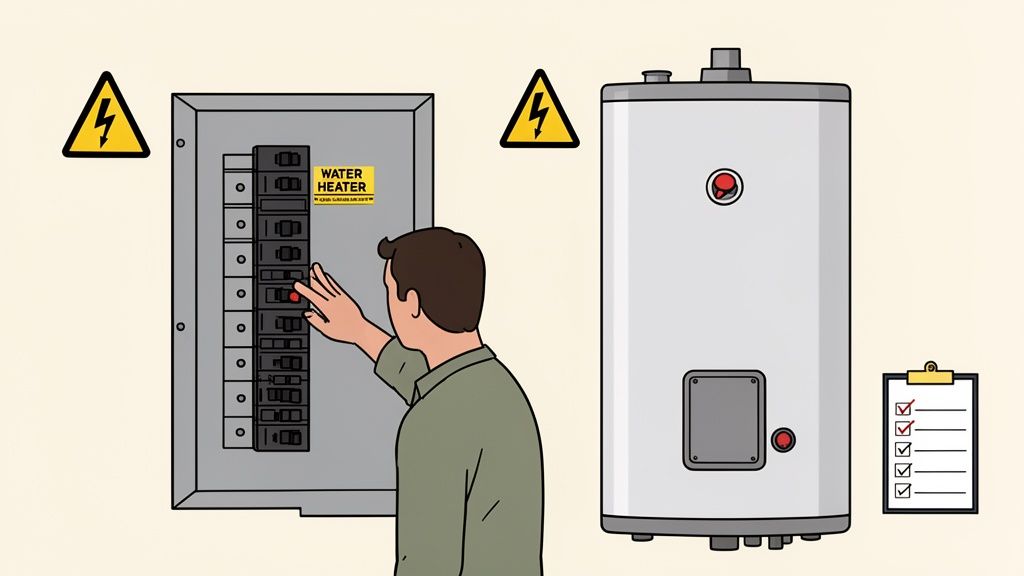
Your electric water heater has a red reset button that acts as a safety switch. It's hidden behind a small access panel, and learning how to safely access it can often get your hot water flowing again, saving you from a cold shower in Canton or Cumming.
What to Do When Your Hot Water Disappears
When the hot water suddenly vanishes, most homeowners assume the worst, thinking they’re in for a costly water heater replacement in Acworth. But more often than not, it’s just the high-limit switch doing its job. This little device cuts power to the heating elements if the water inside the tank gets too hot, preventing a dangerous situation.
Resetting that switch is usually all it takes to solve the problem. In fact, electric models are the most common type out there—they hold a 51.3% share of the market according to some recent market reports—so this is a skill every homeowner in Cobb County or Cherokee County should have. Here at JMJ Plumbing, we’ve seen it all, and we know that doing this reset correctly is key to avoiding electrical shock or further damage.
Is a Reset the Right First Step?
Okay, so a reset is easy, but it isn't a cure-all. You have to know when it’s the right move and when it’s a symptom of a bigger problem. A one-time trip might just be a fluke, but if you’re dealing with other issues, the reset button won't help.
For example, if you're noticing slow drains, soggy spots in your yard pointing to a main water line issue, or have a clogged toilet that won't flush, these are all separate problems that need a professional plumber’s attention, not a water heater reset.
To help you figure out what’s going on, we put together a quick diagnostic table. It’s designed to help homeowners in Canton, Marietta, and the surrounding Metro Atlanta area know whether to try a reset or call us for emergency service right away.
Reset vs Repair: What Your Water Heater Is Telling You
| Symptom | Potential Cause | Your First Step |
|---|---|---|
| No hot water (first time this has happened) | The high-limit switch tripped once. | Attempt a single reset. |
| Hot water runs out very quickly | A bad lower heating element or thermostat. | Call a professional; a reset won't fix this. |
| No hot water, and the reset button trips again | Failing thermostat or a shorted heating element. | Do not keep resetting. Call an emergency plumber near me immediately. |
| Water is lukewarm, not hot | A faulty thermostat or a bad heating element. | This requires a professional diagnosis. |
| Popping or sizzling sounds from the tank | Sediment buildup on the heating elements. | Call for a tank flush and inspection. |
| Water leaking from the tank | A crack in the tank or a pressure relief valve issue. | Turn off the water and call a 24 hour plumber. |
This table should give you a better idea of your next move. Remember, a single successful reset is a win, but repeated issues signal a problem that needs an expert eye from a local professional in Forsyth County or North Fulton.
A constantly tripping reset button is a clear warning sign. It often points to a failing thermostat or a heating element shorting out—issues that need professional attention to prevent further damage or a complete system failure.
When you're not 100% sure what to do, the safest bet is always to call a 24 hour plumber in Roswell. It's far better to be cautious than to attempt a fix that could lead to a bigger, more expensive disaster like needing burst pipe repair.
Your Non-Negotiable Safety Checklist
Alright, let's talk safety. Before you touch a single wire or panel on your water heater, we have to cut the power. I can't stress this enough—mixing water and electricity is a recipe for disaster, and your safety is the only thing that matters right now.
Head over to your home’s main electrical panel. You’ll usually find it tucked away in a basement, garage, or utility closet in your Johns Creek home. Now, you’re on the hunt for the breaker that powers your water heater.
Finding the Correct Breaker
Most electric water heaters are on a double-pole breaker. It looks like two regular breakers that are joined together and move as one. It should be labeled something like "Water Heater" or "WH."
But in the real world, especially in older North Metro Atlanta homes, labels can be wrong or missing. I’ve seen them mislabeled as "AC" or "Stove" more times than I can count. If you have any doubt at all, it's far better to be safe and call a professional for help, whether it's for this issue or a suspected leak repair in Alpharetta, than to take a guess.
Once you’re confident you've found the right one, flip that switch firmly into the "OFF" position.
Pro Tip: Here’s a trick I use on every job. I slap a piece of bright painter’s tape over the breaker I just turned off and write "DO NOT TOUCH" on it. It’s a simple step that ensures someone else in your Forsyth County home doesn't accidentally flip the power back on while you’re working.
Finally, you have to be 100% certain the power is off. A pro would use a voltage tester, but a quick way to check is to have someone turn on a hot water tap. If you don't hear the familiar hum or click of the heater kicking on, you're good to go. Only then should you move on to the next step.
Finding and Using the Reset Button
Alright, now that you've safely killed the power to the unit, it’s time to find that little red reset button. On most electric water heaters, you'll see two small metal access panels on the side of the tank. Each one is usually held in place by a couple of screws.
You’ll just need a basic Phillips or flat-head screwdriver for this part. Carefully unscrew and remove both panels, then tuck them somewhere you won't lose them. Behind each panel, you'll find a fluffy patch of insulation—just gently push it aside to get a clear view of the thermostat assembly.
Pressing the High-Limit Switch
The reset button is a distinct, usually red, button that's part of the high-limit switch on the upper thermostat. Go ahead and press it firmly.
What you're listening for is a solid "click." That sound is your confirmation that the switch had indeed tripped and you’ve now successfully reset it.
If you press the button and feel nothing—no click, no feedback at all—it means the switch wasn't the problem. This is a tell-tale sign that your lack of hot water is caused by something else, like a burnt-out heating element or a bad thermostat. It's at this point that many homeowners in Alpharetta or Johns Creek realize it's time for professional diagnostics, which can sometimes uncover unrelated issues needing sewer repair or other expert attention.
A quick but important note on safety: mishandling home wiring is a serious fire hazard, contributing to about 10% of home electrical fires annually. Also, never set your water heater thermostat above 120°F. Keeping it at 120°F can reduce the risk of scalding by as much as 80%, a safety benchmark recognized worldwide. You can dig deeper into the data in this storage water heater market report.
Before you even think about touching a wire, this is the simple safety process we follow on every single job.
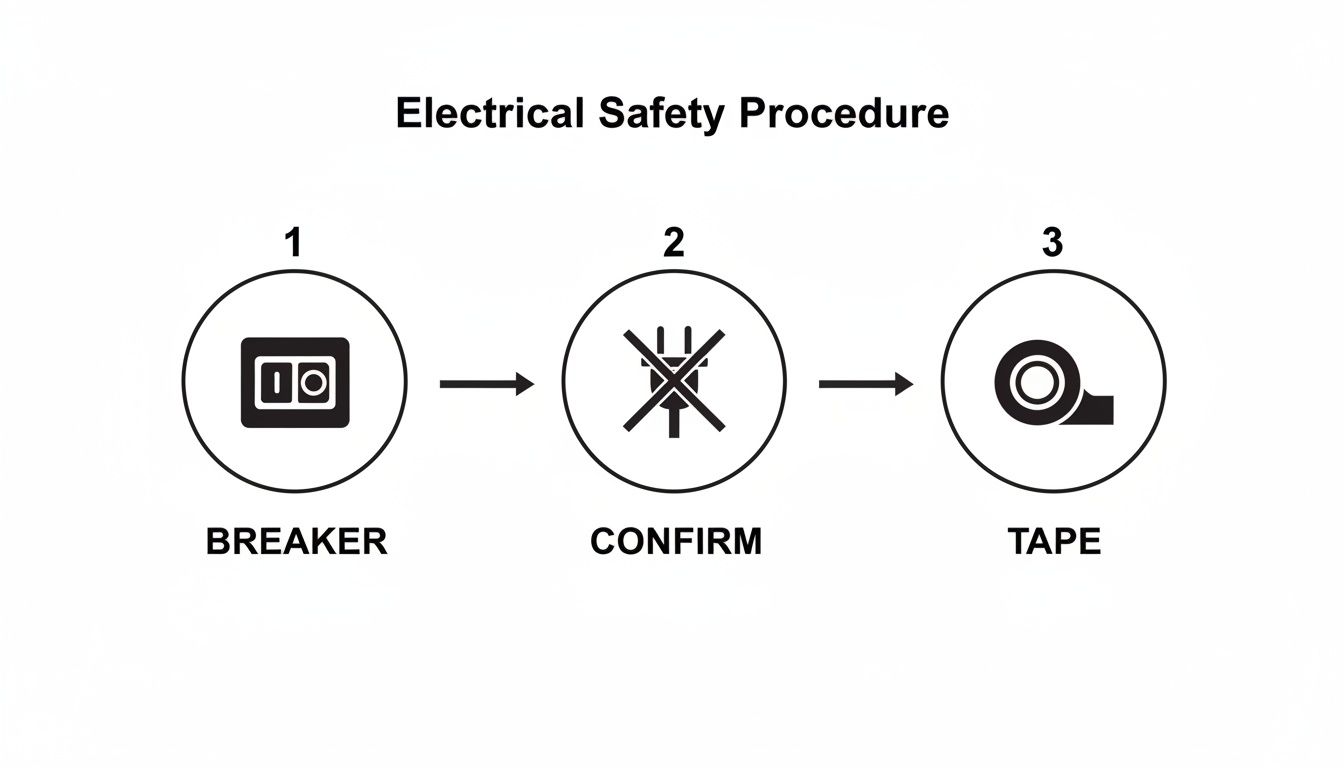
This three-step drill—breaker off, power confirmed off, breaker taped—is non-negotiable. It’s a core safety habit our plumbers use, whether we’re doing a full water heater replacement in Marietta or just a quick thermostat check over in Cumming.
What If the Reset Button Keeps Tripping?
It’s a frustrating scenario. You find the reset button, give it a firm push, and feel relieved when you have hot water again. But just an hour or two later, you're right back where you started—with a cold shower.
A high-limit switch that trips over and over is your water heater's way of sending up a flare. It’s a safety feature doing its job, and simply pushing it repeatedly won't solve the underlying issue. In fact, forcing it to reset again and again can stress the components and lead to bigger, more expensive problems, increasing the cost of your eventual repair.
Something is causing your tank to overheat, and we need to figure out what it is.
Common Culprits Behind a Tripping Reset Button
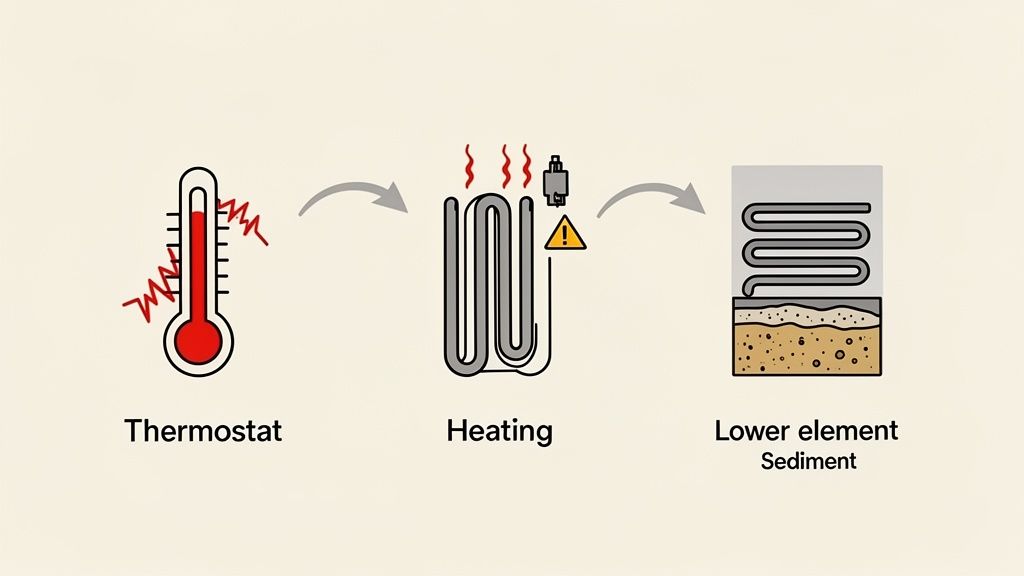
When a reset button won't stay put, it usually points to one of a few common culprits. From what we've seen in homes all over North Metro Atlanta, the problem is almost always one of these three things:
- A Faulty Thermostat: Think of the thermostat as the water heater's brain. It's supposed to tell the heating elements when to turn on and off. If it's broken, it might not sense that the water is already hot enough, causing it to overheat and trip the safety switch. This is a common repair for an emergency plumber in Acworth.
- A Shorted Heating Element: Heating elements do the heavy lifting, and they eventually wear out. They can develop a short, which causes them to draw way too much electricity. The reset button pops to prevent a dangerous electrical fault.
- Sediment Buildup: Here in Georgia, especially in areas like Cumming and Johns Creek, we deal with hard water. Over the years, mineral deposits can build up a thick layer of sediment at the bottom of your tank. This sludge buries the lower heating element, causing it to work too hard and overheat, which in turn trips the reset. This often requires professional drain cleaning services for the tank itself.
A constantly tripping reset button is a sign that you've moved beyond a simple DIY fix. At this point, you're dealing with failing electrical components, and it's much safer and more cost-effective to get a professional plumber near me involved.
If you believe the issue is purely electrical, a licensed residential troubleshooting electrician can safely diagnose the wiring. However, for most water heater problems, a plumber is your best bet. A professional plumber can test the thermostats and elements, and if needed, handle a full water heater replacement in Roswell.
Of course. Here is the rewritten section, designed to sound like it was written by an experienced human expert.
When to Call a Professional Plumber in North Metro Atlanta
Look, being able to reset your water heater is a great skill for any homeowner in Woodstock or Marietta. But the smartest thing you can do is recognize when you're out of your depth. A simple DIY attempt can spiral into a costly, dangerous mess if you don't know the warning signs.
If your water heater is acting up in any of the ways I'm about to describe, it's time to put the tools down and call a pro. These aren't reset button fixes; they're serious red flags that demand professional attention.
Alarming Sounds and Smells
Your water heater should be a quiet workhorse. If it suddenly starts making popping, hissing, or sizzling sounds, it's screaming for help. That noise often means there’s a thick layer of sediment buildup causing the heating elements to fry themselves, or even worse, water is dripping onto live electrical parts. A strange sewage smell or signs of a sewer backup are other critical alerts that your plumbing system needs an expert.
A burning plastic or metallic smell is another signal you absolutely cannot ignore. That’s a classic sign of an electrical short in the wiring or thermostats. Pushing your luck here is a serious fire risk. Don't hesitate—these are the moments you need an emergency plumber in Woodstock or your corner of the metro area, fast.
If you spot any water at all—a small drip, a puddle, or moisture stains—around the tank, treat it as a critical emergency. A leaking tank can't be patched up. It’s a guaranteed water heater replacement, and acting quickly is the only way to prevent a flood, major property damage, and the need for a costly main water line repair.
The Value of Professional Diagnosis
Trying to troubleshoot complex electrical or tank problems on your own is a huge gamble. The traditional tank water heaters in about 70% of U.S. homes are built to last 8–12 years. But I've seen that lifespan cut short in about 25% of failure cases because of improper resets or botched DIY fixes. On top of that, roughly 40% of DIY repairs can actually void your manufacturer's warranty, leaving you holding a much bigger bill. You can dig into some of the data by exploring research on the water heater market.
When you're faced with bigger issues, like persistently low water pressure or a water in yard situation, it’s time to bring in a Master Plumber. A licensed professional in Acworth or Canton has the experience and diagnostic tools to find the real source of the problem safely. They'll know if it's a thermostat issue or something more serious that requires a water line replacement or even a full sewer replacement, and they'll get the job done to code, keeping your home and family safe.
Got Questions? We’ve Got Answers.
Even when a reset works, you're probably left with a few questions. That's smart. Knowing a bit more about how your electric water heater operates can help you tell the difference between a quick fix and a serious problem down the road.
We get calls from homeowners all the time, so we've heard just about every question there is. Here are the most common ones we answer.
Common Water Heater Questions
From Alpharetta to Canton, we often hear the same concerns about timing, recurring issues, and DIY repairs. Knowing what’s normal and what’s a warning sign is key.
-
How long until I have hot water again? Once you’ve successfully reset the button, you should have hot water in about 30 to 60 minutes. If an hour passes and the water is still cold, the reset didn't solve the real problem. This usually points to a failed heating element or a faulty thermostat, and it's time to call a plumber for fast service.
-
Why does only the bottom reset button keep tripping? Electric water heaters use two heating elements. The top one heats the water at the top of the tank first, and then the bottom one kicks on to heat the rest. When that bottom button keeps tripping, it’s a classic sign of a bad lower element. Here in North Georgia, it’s even more common for heavy sediment buildup to be the culprit, causing the element to overheat. This is a clear sign to call a plumber for a professional repair vs replacement evaluation.
-
Can I just replace a heating element myself? We really advise against this. While it might look straightforward on a YouTube video, it's a risky job. You have to completely drain the tank and handle high-voltage wiring right next to water connections. A small mistake can cause a major flood or a dangerous electrical short, leading to a much higher repair cost.
A quick tip from the field: Sometimes a water heater problem isn't about the heater at all. We’ve seen cases where what looked like a failing heater was actually low water pressure caused by a hidden leak somewhere else in the house. A professional diagnosis for leak repair in Alpharetta is always the safest bet.
If you've tried the basics and you're still out of hot water, it’s time to call in an expert for professional water heater service. A licensed plumber can quickly figure out if you just need a new part or if it's time to start thinking about a full replacement.
Don’t let a plumbing problem throw a wrench in your day. Whether you need a 24-hour emergency repair or a quote on a new water heater, JMJ Plumbing is here to help. Visit us online or call today to schedule fast, reliable service in North Metro Atlanta.