Let's be honest—you've probably filled a glass from your kitchen tap and wondered what's really in your water. It’s a common thought. A home water quality test is the only way to get real answers, turning that uncertainty into clear, actionable knowledge about your water's health.
What a Home Water Quality Test Reveals About Your Water
Even though municipal water in places like Woodstock and Roswell is treated at the source, a lot can happen on its journey to your home. Old city pipes and the specific service lines running to your house can introduce contaminants you can't see, smell, or taste. Think of a water test as a final inspection that reveals the hidden story of what’s coming out of your faucet, which can help you avoid costly issues like a main water line repair down the road.
This isn't just a local concern. Homeowner awareness is growing everywhere. The global water testing market is expected to reach an incredible USD 6.98 billion by 2033, and it’s no surprise that North America is leading the charge, thanks to EPA guidelines and people simply wanting to know more. For families in Canton, Acworth, and Marietta, this trend shows why a simple test is becoming a non-negotiable first step. You can explore more about this growing market to see why homeowners are taking control of their water quality.
Signs You Need a Home Water Quality Test
Sometimes, your home sends out clear signals that your water quality is off. Ignoring them can lead to bigger headaches, from plumbing emergencies to potential health issues. A musty or sewage smell in the basement, for example, is more than just an annoyance—it could be a sign of a dangerous sewer backup that requires an emergency plumber in Cobb County.
Here's a quick guide to what your home might be telling you.
| Symptom You Notice | What It Could Mean for Your Water | Potential Impact on Your Home |
|---|---|---|
| Unpleasant Tastes or Odors | A metallic taste might mean excess iron, while a "rotten egg" or sewage smell points to sulfur or a potential sewer backup. | Can make water unappealing and may signal the need for a sewer repair in Woodstock. |
| Blue-Green or Brown Stains | Blue-green stains on fixtures are a classic sign of copper pipe corrosion. Reddish-brown streaks signal high iron content. | Indicates your plumbing system is actively deteriorating, potentially leading to a burst pipe repair. |
| Dry Skin and Brittle Hair | Water that feels "hard" and leaves soap scum behind is loaded with minerals like calcium and magnesium. | These minerals strip natural oils, leading to skin irritation and dull, lifeless hair. |
| Frequent Plumbing Headaches | If you're constantly fighting slow drains or a clogged toilet that won’t flush, it’s often due to mineral scale buildup. | This scale can choke your pipes, leading to low water pressure and the need for professional drain cleaning in Marietta. |
These clues aren't just cosmetic issues; they are direct indicators of underlying problems that a water quality test can confirm.
A home water quality test isn't just for your health—it's a diagnostic tool for your entire plumbing system. The results often explain exactly why you have no hot water, or why you can't seem to get rid of low water pressure.
For homeowners across Cherokee County and North Fulton, this data is power. Finding high levels of calcium and magnesium can help you act before you’re stuck searching for an emergency water heater replacement in Alpharetta. Likewise, catching corrosive elements early can be the key to preventing a catastrophic burst pipe repair in your Cumming home. Testing gives you the power to protect your family and your biggest investment.
DIY Kits vs. Professional Lab Testing: Which Is Right for You?
When it comes to testing your water, you’ve got two main options. It can be tough to know which way to go, but the choice really boils down to what you’re trying to find out. Are you just curious, or do you have a specific, serious concern like a sewage smell in your basement?
Think of DIY test kits as your first line of defense. They're cheap, they're fast, and they give you a quick, general idea of what's going on.
When a DIY Kit Is Your Best Bet
If you just moved into a new house in Roswell and want a basic wellness check on your water, a DIY kit is a great place to start. I often recommend them for getting a quick read on the most common issues.
These kits are perfect for:
- Quick Chlorine Checks: Does your tap water smell like a swimming pool? A simple test strip can confirm if chlorine levels are too high within minutes.
- Hardness Assessment: If you’re tired of soap scum, dry skin, or that chalky buildup inside your appliances, a hardness test can tell you if minerals are the culprit.
- General pH Balance: A DIY kit gives you a fast look at whether your water is acidic or alkaline.
The big catch, however, is accuracy. While these kits are handy for spotting the basics, you have to be realistic about their limitations. The accuracy of at-home tests can vary, and they simply aren't designed to find the really nasty stuff that might require a sewer replacement or water line replacement.
When You Absolutely Need a Professional Lab Analysis
A professional lab test is the only way to go when you need definitive answers. This is your deep-dive investigation, and it’s non-negotiable if you suspect serious contamination or if a DIY kit has already thrown up a red flag. I always recommend this path for older homes in Metro Atlanta or for households with anyone who has health sensitivities.
A professional lab test is the only way to detect invisible but dangerous contaminants like lead, arsenic, bacteria, and volatile organic compounds (VOCs). A basic test strip will miss these every single time.
For example, if you live in an older neighborhood in Cobb County or Cherokee County and are worried about lead leaching from old plumbing, only a lab analysis can give you the precise measurements to know for sure. This information can help you decide between a simple leak repair and a full main water line replacement.
It’s no surprise that more homeowners are turning to these advanced tests. Concerns over bacteria, heavy metals, and chemicals are driving huge growth in the potable water testing market, which is expected to jump from USD 1.3 billion in 2026 to USD 2.2 billion by 2036. Reports consistently point to PFAS 'forever chemicals,' lead, and arsenic as top threats that only a professional lab can reliably identify. You can read the full research on this expanding market and see why this is becoming such a major concern.
At the end of the day, if a DIY test gives you a weird result or your gut just tells you something is off with your water in Alpharetta or Cumming, don't guess. Investing in a professional lab analysis is the only way to get real answers and true peace of mind.
How to Collect a Water Sample the Right Way
You've decided to test your water—that's the first step. But the results you get are only as good as the sample you provide. A simple mistake during collection can throw everything off, either giving you a false positive or, even worse, a false sense of security about the water you drink every day.
Getting it right is pretty straightforward, but the details really matter.
First things first, always use a cold water tap. Your hot water heater can add minerals, rust, and other gunk that will definitely skew the results, especially if you're already experiencing symptoms like no hot water. We usually recommend the kitchen sink since it’s a primary source for drinking water. Just make sure to unscrew any aerator or filter from the end of the faucet before you start.
This handy chart gives you a quick overview of your testing options, whether you're doing a quick spot-check or a full-blown lab analysis.
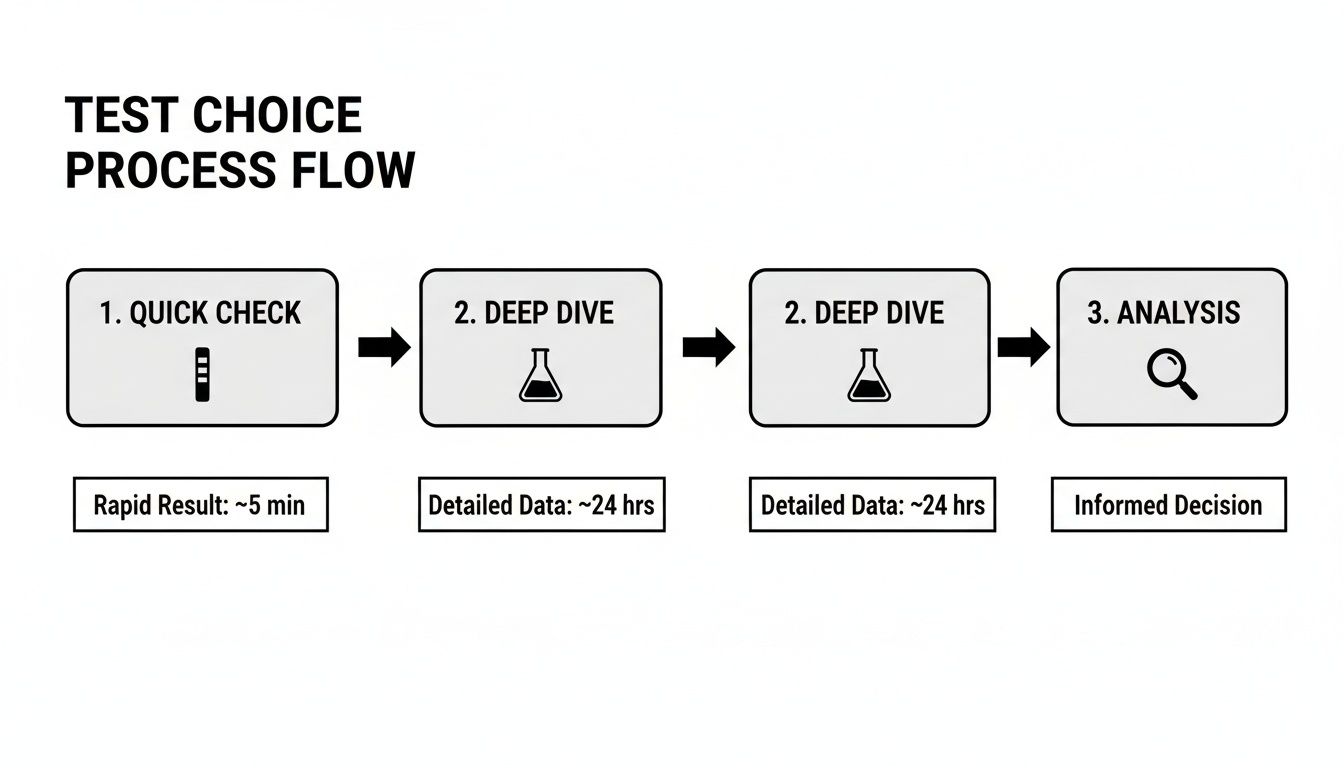
As you can see, you can start with a simple "Quick Check" or go straight for the "Deep Dive" with a professional lab. Your collection method will depend on what you're testing for.
For a General Water Quality Check
Most of the time, you want to test the water that’s coming from your main supply, not the water that’s been sitting in your pipes overnight.
To do this, turn on the cold water and let it run for a full 2 to 3 minutes. This flushes out the immediate plumbing and gives you a sample that truly represents the water flowing into your home in Marietta or Johns Creek.
When it's time to actually fill the bottle:
- Only use the sterile container that came with your DIY kit or from the lab. Don't just grab a water bottle from the recycling bin.
- Be careful not to touch the inside of the bottle or the cap. Contamination from your hands is a classic rookie mistake.
- Fill it up to the line indicated on the container, then screw the cap on tight.
If you’re sending your sample to a lab, write down the date and time of collection. Get it in the mail or drop it off as soon as you can. The fresher, the better, as some contaminants can break down over time.
For Testing Specifically for Lead
But what if you're worried about something specific, like lead? That's a whole different ballgame, and the collection process is the complete opposite.
Lead tends to leach into the water from old pipes or solder when the water has been sitting still for a while. To see if this is happening, you need to capture a "first-draw" sample.
A "first-draw" sample is the very first water that comes out of the tap in the morning. You need to collect it before anyone uses any water in the house—no flushing toilets, no showering—for at least six hours. This method is designed to capture the worst-case scenario for lead concentration.
This is especially critical if you live in an older home in areas like Woodstock or Canton, where aging plumbing is more common. A high lead level from a first-draw test is a major red flag. It often points to a serious issue with your plumbing, and you may need to look into a main water line replacement in Canton to keep your family safe.
If that test comes back high, don't wait. It’s time to call an emergency plumber for an immediate pipe inspection.
Making Sense of Your Water Test Results
So, you’ve got your water test report. It’s usually a dense sheet of paper filled with acronyms, chemical names, and numbers that look more like a science experiment than a simple answer to "is my water okay?" Don’t worry. We’ll help you translate that technical jargon into plain English. Knowing what’s in your water is the first step to protecting your home in Woodstock or Acworth.
More and more homeowners are taking this step. In fact, the water quality monitoring market is expected to become a USD 6.69 billion industry by 2026. People are using these tests and discovering that things like high chlorine or very hard water can increase sewer repair needs by as much as 40%. If you're curious about the industry trends, you can get more insights on the water monitoring market from Fortune Business Insights.
Decoding the Most Common Measurements
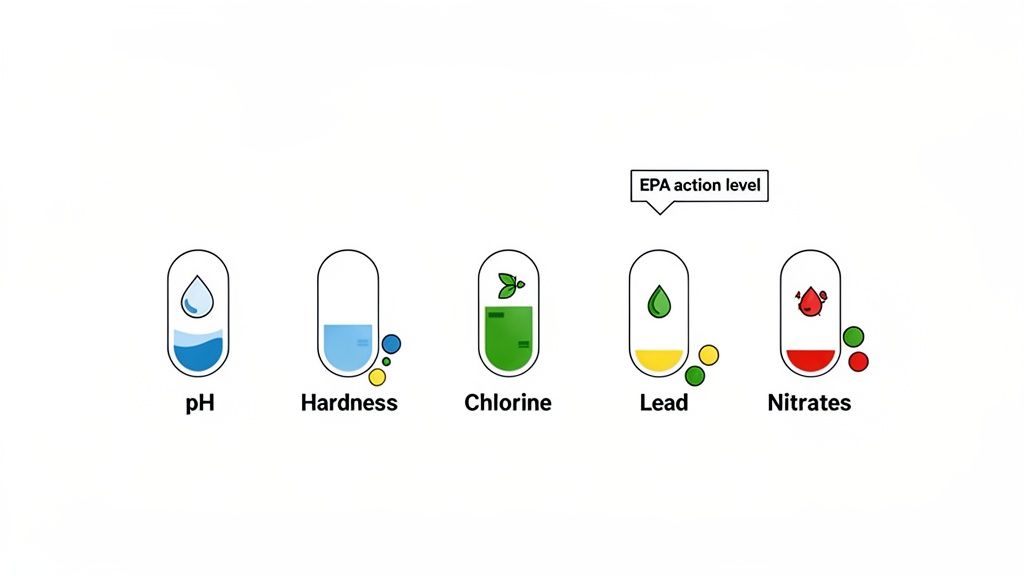
Your report will list several key results. Let's break down what the most common ones mean for your home’s plumbing and your family’s health.
-
pH Level: This tells you how acidic or alkaline your water is on a scale from 0 to 14. For drinking water, the EPA recommends a balanced range between 6.5 and 8.5. If your water is too acidic (below 6.5), it can eat away at your copper pipes, eventually leading to a costly water line replacement in Roswell.
-
Total Hardness: This is just a measure of dissolved minerals like calcium and magnesium. Hard water isn't a health concern, but it's public enemy number one for your plumbing system. A reading over 180 mg/L is considered very hard, and from our experience, it's a primary reason for premature water heater replacement and constant drain cleaning calls in areas like Alpharetta and Canton.
-
Chlorine: Municipalities use chlorine to kill germs, but that doesn't mean you want to drink it. The EPA's maximum is 4.0 ppm (parts per million), but you can often taste and smell it at much lower levels. If your water has that distinct "swimming pool" vibe, a high chlorine reading is the culprit.
Of course, a full lab test will screen for dozens of other things, from pesticides to bacteria. Each number tells part of a larger story about your water.
The Big Two: Lead and Nitrates
While hardness and pH are tough on your home, a few contaminants are a direct threat to your health. Pay close attention to the results for lead and nitrates.
Lead is a highly toxic metal. It often leaches into drinking water from old service lines or corroded plumbing fixtures, especially in homes with more acidic water. The truth is, there is no safe level of lead in drinking water.
The EPA has an established action level of 15 parts per billion (ppb) for lead. If your test comes back at or above this number, it’s a serious red flag. For a homeowner in Johns Creek or Forsyth County, a result this high means you need a professional plumbing inspection right away to find the source.
Nitrates are another concern. These chemicals can come from fertilizer runoff or failing septic systems and contaminate groundwater. High levels are especially dangerous for infants. The EPA has set the maximum contaminant level for nitrates at 10 ppm.
If your report shows high levels of either lead or nitrates, don't wait. It's time to call in a professional plumber for immediate diagnostics and to discuss options like sewer repair or sewer replacement.
When Your Test Results Mean It's Time to Call a Plumber
So, you've got the test results in hand. That piece of paper turns your gut feeling about your water into hard data, and now you can make some real decisions. Some results are just "good to know," but others are a clear sign that you need to get a professional plumber on the phone to protect your home and family.
If your test flags any detectable level of lead, that’s not something you can ignore. It’s a serious red flag and a true health hazard that demands immediate action. This almost always points to older, corroding pipes or solder joints somewhere in your system. We’d need to run a camera inspection to pinpoint the source and likely talk about a main water line replacement. Don't wait on this one—it’s an urgent call for an emergency plumber near me.
High Mineral Content and What It's Doing to Your Plumbing
One of the most frequent complaints we hear from homeowners around North Metro Atlanta is about hard water. If your report shows high levels of calcium and magnesium, you're not alone. While it's not a direct threat to your health, it is incredibly destructive to your home's entire plumbing system. The mineral buildup, or "scale," is the number one enemy of your pipes and appliances.
Honestly, we get called out for water heater replacement jobs in Alpharetta and Cumming all the time where the root cause is a tank completely choked with scale. That's just the start, though. Hardness also leads to:
- Stubborn Clogs: Minerals build up inside your pipes, leading to a clogged toilet that won’t flush and slow drains. This is a job for professional drain cleaning in Cumming.
- Frustratingly Low Water Pressure: As scale coats the inside of your pipes, it narrows the opening, restricting water flow and causing that weak shower you hate.
- Shorter Appliance Lifespans: Your dishwasher, washing machine, and even your coffee maker are all fighting a losing battle against hard water buildup.
The signs aren't always hidden inside your pipes, either. High mineral content is the culprit behind those persistent hard water stains on your windows and fixtures. If the test confirms what you already suspected, the best long-term fix is a HALO whole-home water filtration system. It's the only way to protect every pipe and faucet in your house.
When to Call for Emergency Service
Sometimes, a water test reveals a problem that needs a 24-hour plumber, right now. If your results suddenly show bacteria, coliform, or high turbidity (cloudiness) that wasn't there before, it often means contaminants from outside are getting into your water supply.
A sudden spike in contaminants, especially when paired with physical signs like an abrupt drop in water pressure, discolored water, or water in your yard that won't go away, is a classic sign of a burst pipe or a major leak in your main water line.
This is not a "wait and see" situation. That combination of symptoms points to a serious breach in your plumbing. You need an emergency plumber in Woodstock who can provide immediate leak detection and burst pipe repair whether you're in Marietta or anywhere else in Cobb and Cherokee County. Our team is always ready to find the problem fast and stop the damage before it gets worse.
Your Home Water Testing Questions, Answered
Over the years, we've heard just about every question you can imagine when it comes to the water quality in homes across North Metro Atlanta. To help you out, we’ve put together some straight answers for the things homeowners ask us most.
How Often Should I Test My Water?
This is a great question, and the answer really depends on where your water comes from.
If you’re on city water, like in most of Acworth or Alpharetta, a yearly home water quality test is a good rule of thumb. For those of you with a private well, you'll want to be a bit more diligent. Plan on testing it annually for bacteria and nitrates, and then every few years for a wider range of potential contaminants.
Beyond the schedule, always trust your senses. If you suddenly notice a change in your water’s taste, smell, or appearance, it’s time to test. We also strongly recommend testing after any major plumbing work, like a water line repair, just to make sure nothing unwanted got into your system during the process.
My Water Tastes Like a Swimming Pool. Is a DIY Test Enough?
Yes, absolutely. That "swimming pool" taste is almost always chlorine, and a basic DIY kit is a perfect, quick way to confirm your suspicion. Municipalities use chlorine to keep water safe, but sometimes the concentration can be high enough to affect the taste and smell.
If your test does show high chlorine, the best fix is a HALO 5 whole-home filtration system. We install these all the time because they’re fantastic at removing chlorine and other chemicals, which dramatically improves the water from every single tap in your house.
A sudden change in your water's taste or smell isn't just an annoyance; it's a symptom. A simple test can tell you if it's a minor issue like chlorine or a warning sign of a more serious problem like a break in your plumbing that requires a leak repair.
Can a Water Test Tell Me if I Have a Leak?
A water test won't flash a big red sign that says "LEAK," but it can definitely point you in the right direction. It's all about looking for clues that don't belong.
For example, if a test suddenly picks up sediment, odd colors, or bacteria that wasn't there before, it’s a strong hint that groundwater and soil are getting into your pipes through a crack or break. This often means main water line repair is needed.
If you get these kinds of results—and especially if you also notice other red flags like water in your yard, a drop in water pressure, or gurgling sounds from a sewer backup—treat it as an emergency. You need to call a 24-hour plumber right away for immediate leak repair.
Will a Test Show if My Pipes Need Replacing?
Yes, a water test can be a crucial piece of evidence when it comes to the health of your pipes. The results can tell a story.
If your test comes back with elevated levels of lead or copper, that’s a major red flag. It’s a clear sign that your pipes are corroding and leaching these toxic metals directly into your drinking water. This is a serious health risk, especially for children.
For homeowners in older neighborhoods in places like Canton or Marietta, these results often mean a water line replacement is necessary. If you see high metal content in your report, don't hesitate. Contact a certified plumber immediately for a professional inspection and to discuss the water line replacement cost.
If your test results have revealed a problem, don't wait for it to get worse. JMJ Plumbing provides expert diagnostics and solutions for everything from hard water to emergency pipe repairs. Contact us today to restore your peace of mind and protect your home's plumbing. Book your service online now.