DIY Guide: How to Fix Sink Dripping Faucet Easily
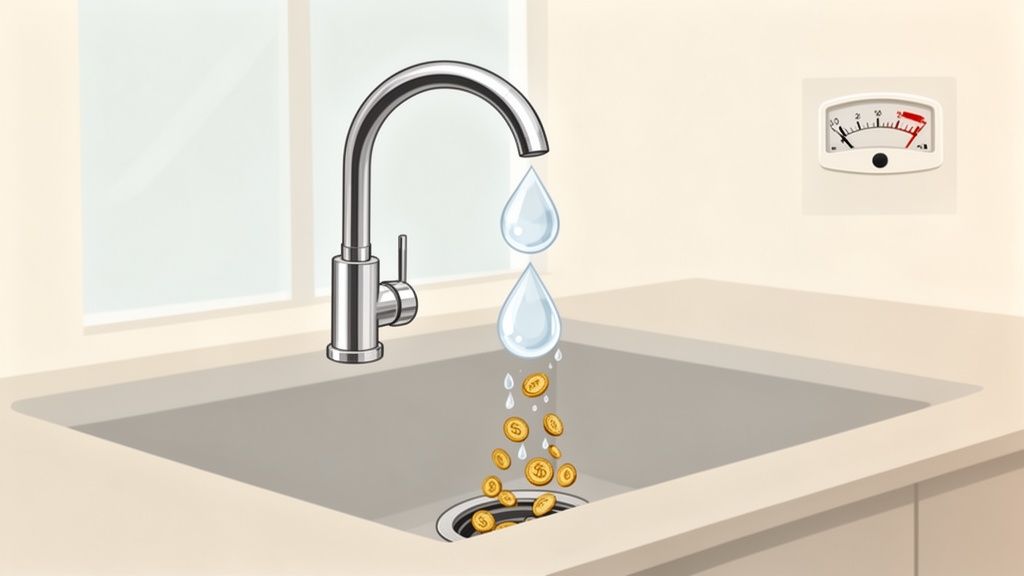
That endless drip, drip, drip isn't just annoying—it's the sound of your money washing away. Most people don't realize that fixing a leaky sink is often a simple DIY job. You just need to shut off the water, figure out what kind of faucet you have, and swap out a tiny, worn-out part like a washer or an O-ring.
But ignoring it? That’s where the real trouble begins, leading to surprisingly high bills and much bigger plumbing headaches down the road, potentially even requiring an emergency plumber in Woodstock.
Why You Should Fix That Annoying Drip Today
Let’s be honest, that constant dripping from your kitchen or bathroom sink is easy to put off. But as plumbers serving Woodstock, Roswell, and the North Metro Atlanta area for over 25 years, we’ve seen how this "small" problem can snowball. Tackling it now can make a huge difference for your wallet and your home, and prevent the need for more serious leak repair in Alpharetta.
The Hidden Costs of a Dripping Faucet
It’s shocking how much water a single leaky faucet can waste. According to EPA estimates, a single faucet can drip away up to 3,000 gallons of water per year. Think about that—it’s enough water to take more than 180 showers!
Across the U.S., household leaks can waste nearly 1 trillion gallons nationwide annually. For the average family, that can easily add up to an extra $300 on your water bills each year. Here at JMJ Plumbing, we've helped countless homeowners in Acworth, Canton, and Marietta stop these money leaks. It’s one of the most common calls we get, and you can see from faucet installation and repair trends just how widespread the issue is.
The table below puts this into perspective, showing how the tiny cost of a DIY fix stacks up against the cost of doing nothing.
DIY Faucet Repair Cost vs Potential Water Waste Cost
| Drip Rate | Water Wasted Per Year (Gallons) | Estimated Annual Cost | Average DIY Repair Parts Cost |
|---|---|---|---|
| 1 Drip / Second | 3,153 | $35 – $60 | $2 – $15 |
| 1 Drip / 5 Seconds | 630 | $7 – $12 | $2 – $15 |
| 1 Drip / 10 Seconds | 315 | $3 – $6 | $2 – $15 |
As you can see, spending a few dollars on a new washer or O-ring offers a massive return on investment. But a drip isn't just about the money.
A small drip is often the first symptom of a larger problem. It could be a simple washer, or it could be an early indicator of high water pressure that’s stressing your entire system, increasing the risk of a burst pipe repair in Johns Creek down the line.
More Than Just Wasted Water
Beyond the financial drain, a constant drip can cause real, physical damage to your home. That persistent moisture creates a perfect breeding ground for mold and mildew inside your cabinets, which can lead to musty smells and even health issues. What starts as water in your yard can lead to a need for sewer repair in Canton.
Over time, we've seen this moisture completely destroy vanities, warp flooring, and rot away the subfloor. What starts as a simple leak can spiral into a costly renovation.
Here are a few common issues we see from an ignored drip:
- Cabinet and Countertop Damage: Water quietly seeping from the faucet's base can delaminate your countertops and turn the particleboard in your vanity to mush. This is a common call for our leak repair in Cumming team.
- Ugly Stains and Buildup: The hard water we have in many parts of Cherokee and Forsyth County leaves behind crusty, ugly mineral deposits that are a nightmare to clean and can lead to slow drains.
- Catastrophic Plumbing Failures: A dripping faucet means its internal parts are wearing out. If they fail completely, you could be dealing with a sudden gusher, forcing you to call for an emergency plumber in Canton or your local area.
Fixing a drip is a small investment of your time that protects your home and saves you money. This guide will walk you through it, but we’ll also show you the warning signs for when it’s time to call a pro—whether it's for a faucet or a bigger issue like needing main water line repair near me. Sometimes, you just need a 24 hour plumber in Alpharetta to handle it, and knowing when to make that call is half the battle.
Your Pre-Repair Checklist and Figuring Out Your Faucet
Before you even think about grabbing a wrench, let’s talk prep. Trust me, jumping into a faucet repair without a plan is the fastest way to get frustrated, make multiple trips to the hardware store, and maybe even turn a tiny drip into a much bigger headache. A few minutes of prep work will make the whole process go smoothly.
First things first, and this is non-negotiable: shut off the water supply. You'll find two small valves under your sink—one for hot, one for cold. Turn them clockwise until they’re tight. Then, open the faucet to let any trapped water drain out and release the pressure in the lines. If you have no hot water, it could be a sign you need water heater replacement in Marietta.
Protect Your Workspace
With the water off, take a second to protect your sink. It’s way too easy to drop a wrench and chip that nice porcelain or put a nasty scratch in your stainless steel sink.
Just lay a thick towel or a rag down in the basin. This does two things: it pads the surface and, just as importantly, it plugs the drain so you don’t lose a tiny, irreplaceable screw down the pipes. We've all been there. A clogged drain is another headache you don't need, though our drain cleaning in Roswell service is always here to help.
Pro Tip from a Woodstock Plumber: Snap a few pictures of your faucet with your phone before you take anything apart. If you get interrupted or just plain forget how it all goes back together, having a photo reference is an absolute lifesaver.
Gather Your Essential Tools
Nothing kills your momentum like having to stop midway through a fix to hunt for the right tool. The exact tools you'll need depend on your faucet, but a basic kit will see you through most common repairs.
- Adjustable Wrench: This is your go-to for loosening and tightening the various nuts on the faucet.
- Screwdrivers: You’ll want both a Phillips head and a flathead for handle screws.
- Allen Wrench Set: Many modern, single-handle faucets have a small Allen screw holding the handle in place.
- Slip-Joint Pliers: Great for gripping all sorts of small parts that your fingers can't.
- Rags and a Small Bucket: For catching those last few drips and keeping the cabinet underneath dry.
Having your tools ready to go is half the battle. If you're looking to build out your home tool collection, this guide on Essential Tools for Homeowners is a great resource.
Identify Your Faucet Type
This is the most critical step. Faucets aren't all built the same, and the part causing the leak is completely different from one type to the next. Knowing what you have is the only way to buy the right repair kit.
Most faucets you’ll find in homes around Cobb County and North Fulton are one of these four types:
-
Compression Faucet: The classic old-school faucet with two separate handles for hot and cold. You have to crank them down to turn the water off. If it's dripping, you almost certainly need to replace a small rubber washer.
-
Cartridge Faucet: These usually have a single handle that moves up and down for flow and side to side for temperature. The handle movement feels smooth. The fix here involves swapping out the entire internal cartridge.
-
Ball Faucet: Very common in kitchens, these have one handle that moves around on a ball-shaped cap right at the base of the faucet. The leak is typically caused by worn-out little rubber seats and springs inside.
-
Ceramic Disc Faucet: This is a modern, very durable design, also with a single lever. You can spot them by their smooth handle action and often wider, stouter body. They rarely leak, but when they do, it's because one of the two internal ceramic discs has cracked.
Once you know which type of faucet you're working with and have your tools laid out, you're ready to tackle the repair. The job is a whole lot simpler now that you’re prepared. Of course, if you're ever in doubt, our 24 hour plumbers in Marietta and Roswell can figure it out in no time.
Tackling Drips in Compression and Cartridge Faucets
Alright, let's roll up our sleeves and get to work. Most homes in the North Metro Atlanta area have one of two main faucet types: the older compression style or the more modern cartridge-based models. They each have their own quirks and common points of failure, but you can usually fix either one with a little know-how.
Before you even think about grabbing a wrench, a quick pre-repair check will save you a world of headache.
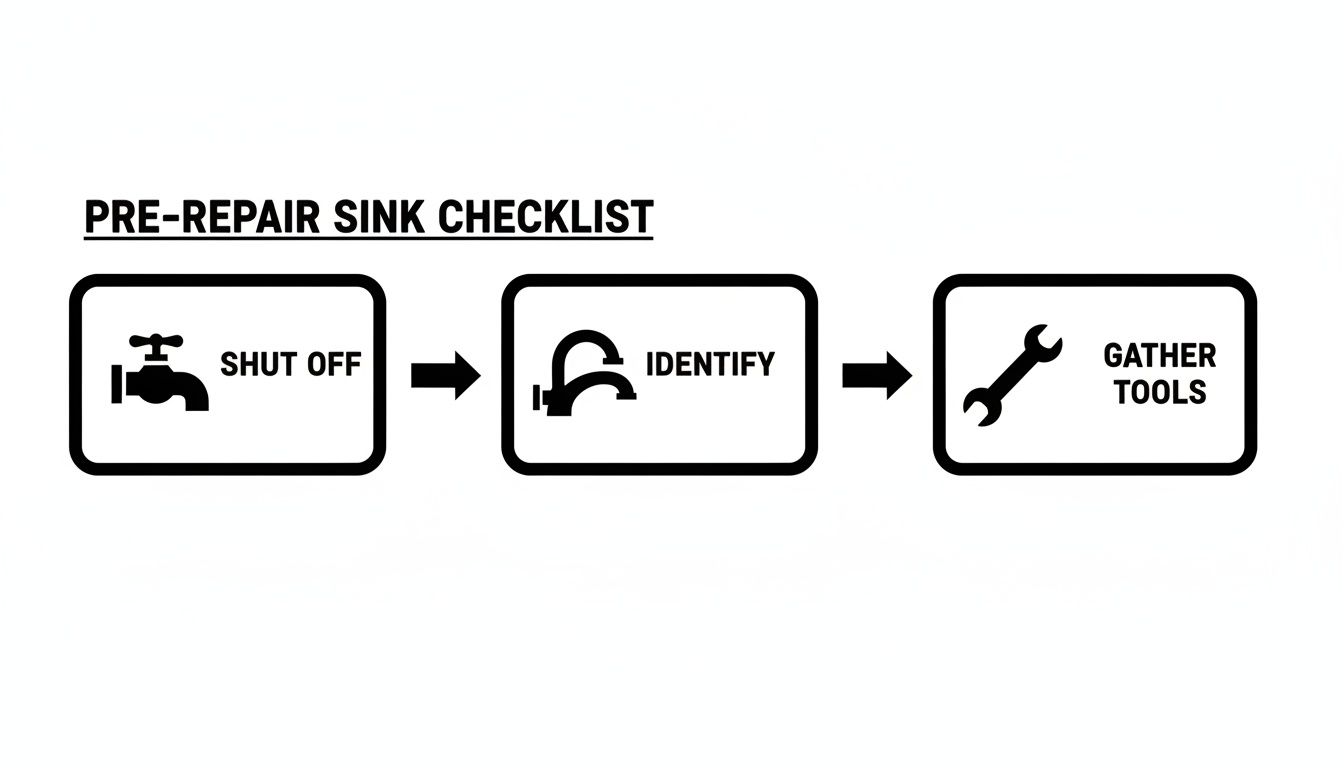
Seriously, don't skip these basics. Taking a moment to shut off the water, figure out exactly what’s wrong, and get your tools ready makes the actual repair go much more smoothly.
How to Stop a Compression Faucet Drip
If you have a faucet with two separate handles for hot and cold that you need to tighten down to shut off, you're looking at a compression faucet. I've seen it a thousand times—in over 90% of cases, a drip from one of these is just a worn-out rubber seat washer or O-ring giving up the ghost.
Here’s the game plan:
- First, get the handle off. Pop off the decorative cap on the handle (hot or cold, whichever is dripping) with a flathead screwdriver. Go easy here to avoid scratching the finish. Underneath, you’ll see a screw. Remove it, and the handle should pull straight off. If it's stubborn, a little wiggling usually does the trick.
- Next, expose the stem. Using an adjustable wrench, loosen the packing nut (that's the hex nut you now see). Once it's unscrewed, you can lift the entire valve stem out.
- Time to replace the parts. Look at the very bottom of the stem. See that small rubber washer held on by a brass screw? That’s the seat washer, and it's almost always the source of your drip. Unscrew it, swap it with a new one that’s an exact match, and put the screw back. While you're at it, inspect the O-rings along the stem's body and replace any that look cracked or worn.
Once the new parts are in, just put everything back together in the reverse order you took it apart. Turn the water supply back on slowly and watch for any leaks.
How to Swap Out a Faulty Faucet Cartridge
Single-handle faucets are everywhere these days, and most of them use a cartridge system. The beauty of these is that the entire mechanism for controlling water flow is housed in one self-contained, replaceable cartridge. When it starts dripping, you simply swap out the old one for a new one.
This is a huge part of the plumbing world. The global market for plumbing fixtures is expected to climb to $123.37 billion in 2026, up from $114.31 billion in 2025, driven by home renovations and aging infrastructure. Here in North Metro Atlanta, from Cumming to Marietta, leak-related issues account for over 60% of our service calls at JMJ Plumbing.
Cartridge faucets, which make up about 33.5% of new installations, are a common source of these calls. The hard water we have in areas like Johns Creek is tough on them; we see a 50% failure rate after 5 years because the minerals cause the plastic to become brittle and crack. In fact, mineral buildup clogging the cartridge is the culprit in about 70% of cases we diagnose, which can also cause low water pressure.
A Real-World Scenario: We got a call from a customer in Acworth whose single-handle kitchen faucet wouldn't stop dripping. It was a classic cartridge failure. The local hard water had caused so much mineral buildup that the cartridge was seized in the faucet body. Instead of forcing it, we used pliers to gently wiggle it back and forth, which broke it free without damaging the faucet. A new cartridge, and the drip was gone. This saved them from a full water line replacement.
Here’s how you can do it yourself:
- Remove the handle. Much like the compression faucet, you'll probably need to pry off a small decorative cap to get to the screw that holds the handle in place.
- Pull the retaining clip. With the handle gone, you'll see the top of the cartridge. There’s usually a small metal clip holding it down. Use a pair of needle-nose pliers to pull it straight out.
- Yank the old cartridge. This can be the trickiest step. Some new cartridges come with a little plastic tool designed to help you twist and pull the old one out. If you don't have one, just grab the top of the cartridge with your pliers and pull it straight up and out.
- Seat the new cartridge. Align the new cartridge with the notches inside the faucet body and press it down firmly. Pop the retaining clip back in, put the handle back on, and you should be good to go.
Knowing the different types of faucets, including modern water-saving valves and faucets, can help you narrow down the problem. But if a simple parts swap doesn't fix the drip, or if you notice the faucet body itself is corroded, you might be looking at a bigger problem. That’s usually when it’s time to call in a pro. For homeowners around Alpharetta or Roswell, our team can quickly handle a full faucet replacement or even diagnose a more complex issue, like needing a main water line repair, if the drip turns out to be a symptom of high water pressure.
Tackling Leaks in Ball and Ceramic Disc Faucets
Alright, let's move on to the more modern workhorses you’ll find in kitchens and bathrooms: ball and ceramic disc faucets. We often recommend these to our clients in Roswell and Alpharetta for high-traffic sinks because they’re simply built to last.
While their insides look a bit different from the older compression and cartridge models, fixing a drip is definitely something you can handle on your own. Don't be intimidated; the principles are the same, even if the parts are unique.
Repairing a Leaky Ball Faucet
You can spot a ball faucet by its single handle that moves around on a dome-shaped base. They're all over Canton and Marietta kitchens. When one of these starts to drip, the culprits are almost always a couple of small rubber seats and the tiny springs underneath them.
Getting to them just requires taking things apart in the right order.
- Pop the Handle Off: First, you'll need to find the little set screw, usually tucked away at the base of the handle. An Allen wrench is your tool here. Loosen it, and the handle should lift right off.
- Get to the Guts: Now you'll see a cap and collar. Use your adjustable wrench to unscrew them. Once they’re off, you can lift out the plastic cam, the washer, and the metal ball itself.
- Swap the Seats and Springs: Peer down into the faucet body. You'll spot two little rubber seats. A small screwdriver or a pick is perfect for prying out the old ones and the springs they sit on. This can be the fiddliest part of the job, so be patient.
- Put in the New Parts: Drop the new springs in first, then place the new seats right on top. When you put the ball back in, pay close attention. There’s a small notch on the ball that must line up with a tab inside the faucet. This is the most important step.
A Plumber's Tip: Getting that ball faucet notch aligned is non-negotiable. If you miss it, the handle won’t work right, and you could end up with a bigger leak than you started with. Always give it a little wiggle to make sure it's locked in place before you put everything back together. It's a key step to avoid calling for an emergency plumber near me.
Fixing a Ceramic Disc Faucet
Ceramic disc faucets are the undisputed champions of durability. They operate with two super-hard, polished ceramic discs that glide over each other. It’s a nearly flawless design, which is why they so rarely leak.
When a drip does happen, it's usually because one of the neoprene seals at the base has worn out, or in rare cases, a disc has cracked. Unlike other faucets where you're swapping tiny parts, the fix here is to replace the entire cylinder cartridge as one piece.
It's actually a pretty quick job:
- Start by taking off the handle, which is usually held on by a set screw.
- With the handle off, unscrew the decorative cap covering the cylinder.
- You’ll see the retaining screws holding the cylinder in place. Unscrew them and lift the old cylinder straight out.
- Before you drop the new one in, take a second to wipe out the inside of the faucet body. You want to clear out any grit or mineral buildup. This is a basic form of drain cleaning in Johns Creek.
- Seat the new cylinder, making sure its seals line up perfectly, and then just put everything back together the way you took it apart.
To give you a better idea of what you might be working with, here’s a quick comparison of the faucet types we’ve covered. This can help you quickly identify what’s under your sink and what to expect.
Comparing Faucet Types at a Glance
| Faucet Type | Common Cause of Drips | DIY Repair Difficulty | Average Lifespan |
|---|---|---|---|
| Compression | Worn rubber washer | Easy | 5-10 years |
| Cartridge | Worn O-rings or cartridge | Easy to Moderate | 15-20 years |
| Ball | Worn seats and springs | Moderate | 10-15 years |
| Ceramic Disc | Worn inlet seals | Easy (replace cylinder) | 20-30+ years |
As you can see, each faucet has its own personality and common failure points. Knowing which one you have makes the trip to the hardware store—and the repair itself—much smoother.
In North America, ceramic disc faucets hold a 34% market share for a good reason: they’re incredibly reliable. Ball faucets are also common, found in an estimated 30% of Atlanta homes built after 1990, but their seals are more susceptible to wear over time. You can find a ball faucet repair kit for about $15. Keep in mind, Georgia's hard water can speed up wear on these seals by up to 40%, making it crucial to clean out mineral buildup when you do a repair. You can read more about these faucet market trends and statistics if you're curious.
Whether it’s a tiny spring in a ball faucet or a whole cylinder in a ceramic disc model, patience and the right replacement kit are your best friends. If you follow the steps and the faucet still leaks, you might have a bigger problem on your hands, like a cracked faucet body. At that point, give a professional a call. An emergency plumber in Woodstock or your neighborhood can diagnose the issue and get it fixed right.
When to Skip The DIY And Call An Emergency Plumber
There’s a real sense of pride in fixing something yourself, especially a nagging drip. But as a plumber, I've seen countless times when a "simple" fix turns into a homeowner's worst nightmare. Knowing when to put the tools down is the most valuable skill you can have.
That little drip might seem harmless, but sometimes it’s the tip of the iceberg—a warning sign that something much bigger is going wrong inside your walls. Pushing ahead with a DIY repair when you shouldn't can turn a $5 washer replacement into an expensive emergency call for a burst pipe repair in Roswell.
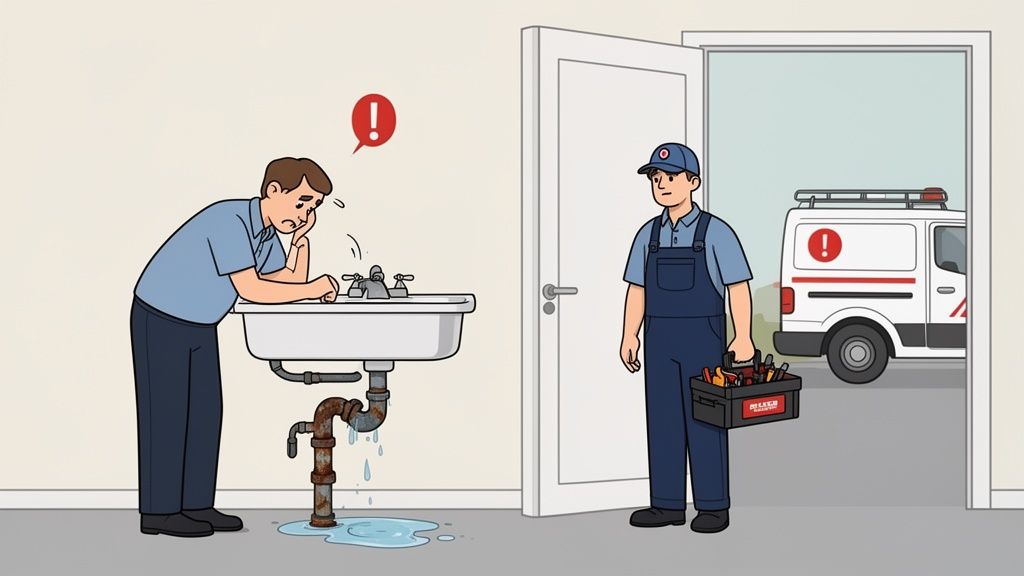
If you spot any of the following red flags, it’s time to trade the wrench for the phone.
Obvious Signs You Need a Professional Plumber
Sometimes the problem is clearly more than just a worn-out part. If your dripping faucet comes with any of these friends, it's a good idea to get an expert diagnosis right away.
Here’s what to look out for:
- The Drip Won't Quit: You did everything right. You followed the steps, put in a new cartridge, and tightened everything up. But the drip is back. This usually points to a deeper issue, like a cracked faucet body or a corroded valve seat that you can't fix with off-the-shelf parts. This could require a full water line replacement in Acworth.
- Corrosion on the Pipes: Peek under the sink. See any heavy rust, flaking metal, or those ugly greenish-blue stains on your supply lines or the shut-off valves? That's your plumbing crying for help. Trying to wrench on old, compromised pipes is a gamble that often ends with a snap and an uncontrolled gush of water, forcing an emergency water line replacement.
- Water Pressure Takes a Nosedive: Is the faucet dripping while the flow everywhere else in the house seems weak? A sudden, noticeable drop in water pressure is a huge red flag. It could mean you have a significant hidden leak repair in Marietta needed elsewhere, or even a serious issue with your main water line repair from the street.
These problems go way beyond a simple DIY. Our team offers fast leak detection in Cobb County and Cherokee County, using professional tools to find the real source of the problem before it gets worse.
When a Small Drip Signals a System-Wide Problem
Not all warning signs are as dramatic as a burst pipe. Some are subtle, but they hint at a systemic issue that could threaten your whole house. If you ignore them, you could be looking at major water damage or even a sewer backup in Alpharetta.
Think of your plumbing as one big, interconnected network. A problem in one spot can signal trouble everywhere else. For example, high water pressure is a common problem in neighborhoods across Alpharetta and Cumming. Sure, it makes for a strong shower, but it also puts constant, excessive strain on every single pipe, fixture, and appliance you own.
A dripping faucet is often the first casualty of high water pressure. The constant force wears out seals and washers way too fast. If you just fix the drip but don't address the pressure, you're just starting a countdown to the next failure—which could be a much more expensive washing machine hose or require water heater replacement in Woodstock.
If you have even a small suspicion that your drip is part of a bigger picture, it’s time to call in the pros. Our 24 hour plumbers in Woodstock and the surrounding areas are ready to diagnose these complex issues. We don’t just slap a bandage on the symptom; we find and fix the root cause.
Whether it’s a full faucet replacement, a tricky sewer repair in Canton, or installing a pressure-reducing valve to protect your entire system, we make sure the job is done right. Don’t risk it—a call to JMJ Plumbing gives you peace of mind and saves your home from thousands in potential damage.
Answering Your Lingering Questions About Dripping Faucets
So, you’ve tried the DIY fix, but you're still running into issues or have a few questions. That's completely normal. Let’s tackle some of the most common things we hear from homeowners around North Metro Atlanta.
What Should a Plumber Cost to Fix a Dripping Faucet in Marietta or Acworth?
It’s true that a DIY repair kit can be incredibly cheap, sometimes only $5-$20. But when that doesn't work, calling in a pro is your best bet to avoid accidentally causing a much bigger, more expensive problem.
The final price tag for a professional repair really boils down to the type of faucet you have and what’s actually causing the leak. A simple fix, like swapping out a bad washer or a standard cartridge, is a quick and affordable job for an experienced plumber.
However, if the whole faucet is shot and needs replacing, or if the drip is just a symptom of a larger issue like needing sewer replacement in Roswell, the cost will naturally be higher. At JMJ Plumbing, we’re all about transparency. We’ll come out, take a look, and give you a clear, upfront quote before we touch a single tool. No surprises. Think of it as an investment that not only stops the annoying drip but also saves you from potentially thousands in water damage down the road.
I Replaced the Washer, So Why Is My Faucet Still Dripping?
This is probably the most common point of frustration we see with DIY repairs. If you put in a new washer and are still getting that drip-drip-drip, the real culprit is almost always the valve seat.
The valve seat is the little metal ring that the washer presses against to stop the water. Over the years, friction and minerals in the water can wear tiny grooves into its surface. You might not even be able to see them, but it’s enough for water to sneak right past that brand-new washer.
Fixing this requires a special tool to re-grind the seat smooth, or the seat needs to be replaced entirely. On other types of faucets, a persistent drip might mean you have a tiny, hidden crack in the internal cartridge or that a part was just slightly misaligned when you put it back together. Rather than cranking down on everything and risking damage, this is the perfect time to call our 24 hour plumber in Cobb County or Cherokee County for a quick diagnosis.
Is a Drip Really a Big Deal Beyond a High Water Bill?
Yes, absolutely. The water bill is just the most obvious problem, but a constant drip can be a warning sign of much more serious issues.
The biggest risk isn't the drip itself, but what it might be telling you about your home’s plumbing. Often, a stubborn drip is the first clue you have dangerously high water pressure, which puts a ton of stress on every single pipe, joint, and appliance in your house.
High pressure dramatically raises the risk of a disaster, like needing a burst pipe repair in Forsyth County or having a water heater tank fail. On top of that, the moisture from even a small, slow drip can:
- Encourage mold and mildew to grow in the dark, enclosed space under your sink. This can cause a persistent sewage smell.
- Lead to wood rot in your vanity, cabinets, and even the subfloor beneath.
- Be an early warning of a problem with your main supply, like needing a main water line repair, if the pressure issue is system-wide.
And if you’re already dealing with a clogged toilet that won't flush or you notice a sewage smell in your home, you're past the warning stage. These are serious red flags that need a professional’s immediate attention. Don’t let a little drip turn into a catastrophe.
When a simple fix doesn’t cut it or you suspect a bigger problem, it’s time to call in the experts. For fast diagnostics, reliable repairs, and clear pricing in North Metro Atlanta, get in touch with JMJ Plumbing today. Visit us online at https://www.jmjplumbing.com to schedule your service.