How to Test Water Hardness at Home A Homeowner’s Guide in 2026
Ever wonder if your home has a secret enemy? For many of us in North Metro Atlanta, that enemy is hard water, and it could be silently waging war on your home's entire plumbing system. The only way to know for sure and stop the damage is to test your water.
Why Testing Is a Non-Negotiable for Atlanta Homeowners
If you're battling stubborn soap scum on your shower doors, dingy laundry, or frustratingly low water pressure, you're likely seeing the calling cards of hard water.
This is a common headache across our area, from Woodstock to Alpharetta and Marietta. Our water supply is naturally high in dissolved minerals—mostly calcium and magnesium. While they won't harm you to drink, they are incredibly destructive to your home.
In fact, the problem is bigger than most people realize; the water in over 85% of American homes is considered "hard". This isn't just an annoyance—it's a direct threat to your pipes, fixtures, and expensive appliances.
The Hidden Damage Hard Water Leaves Behind
Those minerals don't just rinse away. They stick around and form limescale, a rock-hard deposit that slowly chokes the life out of your plumbing. This silent buildup is the real source of so many expensive and frustrating problems we see every day.
- Appliance Killer: Limescale is particularly brutal on water heaters. It creates a layer of mineral "sludge" on the heating element, forcing it to work much harder and leading to a shockingly short lifespan. If you have no hot water, you could find yourself needing a water heater replacement in Roswell years ahead of schedule.
- Choked Pipes & Drains: As scale builds up, it narrows the inside of your pipes. This is what causes that slow drop in water pressure over time, leads to slow drains, and can even cause a clogged toilet that won’t flush. Left unchecked, it can contribute to a messy sewer backup that emits a sewage smell in your house.
- Skyrocketing Utility Bills: When your water heater is coated in scale, it has to burn more energy just to heat your water. You'll see the evidence of this inefficiency on your rising monthly bills.
The Water Quality Association has shown that hard water can reduce a water heater's lifespan by up to 30% simply from scale buildup. That's a huge financial risk to ignore. For a deeper dive, check out this comprehensive guide to water hardness testing.
How a Small Annoyance Becomes an Emergency
What begins as a few spots on your glassware can quickly spiral into a full-blown plumbing disaster.
That gradual scale buildup doesn't just clog your pipes; it makes them brittle and weak. This puts them at a much higher risk of developing leaks or, in a worst-case scenario, rupturing completely. One minute you're dealing with slow drains, the next you're frantically searching for an emergency plumber in Canton to fix a burst pipe repair.
Testing your water hardness is the only way to get ahead of the problem. It gives you the information you need to take action—like installing a water softener—and prevent a catastrophic failure like a main water line repair in Cumming. Don't wait for a crisis; a simple test protects your home and your wallet.
The Quick and Easy Soap Suds Test
Before you spend a dime on fancy kits, you can get a surprisingly good feel for your water hardness with a simple experiment you can do in two minutes. All you need are a couple of things you almost certainly have lying around the house.
This classic soap suds test has been around forever for a reason: it’s fast, free, and gives you a clear visual clue about what’s going on with your water. It’s more than just a home science project; it's a practical first step for any homeowner in Woodstock or Marietta who’s tired of soap scum and suspects their water is the problem.
How to Do the Soap Test Right
Getting a useful result here is all about the details. You can't just grab any dish soap from under the sink. Modern detergents are packed with chemicals designed to create suds even in the hardest water, which would defeat the whole purpose of the test.
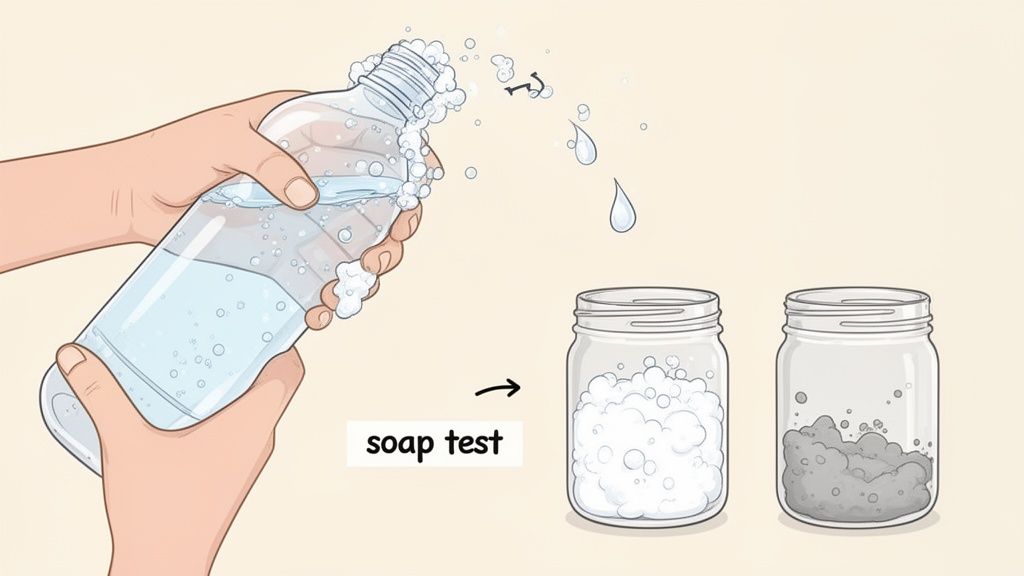
First, find a clean, clear bottle with a cap that seals tight—an old water bottle is perfect. Fill it about a third of the way with cold water straight from your tap.
Now for the most important part: the soap. You need to use a pure liquid soap, something like Castile soap. Add about 10 drops into the bottle.
Finally, screw the cap on tight and give it a really good shake for 15 to 20 seconds. Don't be shy—you want to really agitate the mixture. Set the bottle down and see what happens.
The science here is simple. The minerals in hard water, like calcium and magnesium, literally grab onto soap molecules. When they bond, they form a gross, cloudy film—what we call soap curd—and stop the soap from making bubbles.
Reading the Results
What you see in that bottle is your answer. It's a pretty straightforward "yes" or "no" on whether you have hard water.
-
Lots of Suds + Clear Water = Soft Water: If you get a thick, rich layer of fluffy bubbles on top and the water underneath stays clear, congratulations. You probably have soft water. The suds should look stable and stick around for a bit.
-
Few Suds + Cloudy Water = Hard Water: This is the telltale sign. If you get barely any bubbles and the water turns milky, cloudy, or has a scummy film, you’ve got hard water. The minerals are interfering, just as we suspected.
For homeowners in Alpharetta or Johns Creek, that cloudy bottle might be the "aha!" moment that explains the constantly clogged showerheads and frustratingly low water pressure.
While this test won't give you a precise hardness number, a "fail" is a strong sign that it's time to investigate further. If you see that scummy mess, your next move should be to get a more accurate measurement to find out just how hard your water really is.
Using Test Strips for a Real Water Hardness Number
If that soap test felt more like a science fair project than a real diagnosis, you're not wrong. It’s a good starting point, but for a number you can actually act on, water hardness test strips are the way to go. They’re inexpensive, you can find them anywhere, and they’ll give you a clear, specific measurement of what’s happening inside your plumbing.
This isn't just about satisfying your curiosity. Knowing your water's hardness level is the first step in preventing serious issues, like a premature water heater replacement in Acworth or a weekend-ruining call for 24 hour plumber services in Marietta. Getting an accurate number is crucial for making the right call.
How to Avoid Common Mistakes for a Spot-On Reading
I've seen it a hundred times. People buy the strips, do the test wrong, and think their water is fine—right up until a pipe clogs or an appliance fails. Using these strips looks easy, but a few simple mistakes can completely skew the results.
Here’s what to watch out for to make sure you get it right the first time:
- Don't Swirl the Strip. Read the instructions on your specific kit. Most just need a quick, one-second dip. If you stir or swish it around, you'll wash off the very chemicals that are supposed to react with the minerals, giving you a falsely low reading.
- Timing Is Everything. This is the biggest mistake people make. The colors on the strip change over time. If the instructions say to read it at 15 seconds, set a timer on your phone and read it exactly at 15 seconds. Waiting even 30 seconds longer can make the color darken, suggesting your water is much harder than it actually is.
- Test a Fresh, Cold Sample. Let the cold water run from your tap for a few seconds before filling a clean glass. Don't use water that's been sitting out or water from the hot tap, as its mineral content can be different.
Getting a reliable reading is no joke, especially around here. Atlanta's water comes from limestone-rich aquifers, and because of that, over 60% of local water samples clock in above 120 mg/L—the official threshold for hard water. That level of hardness can speed up pipe corrosion by 2-3 times and make you use up to 50% more soap and detergent, which can cost a family an extra $200 a year. You can read the full research about these local water findings for a deeper dive.
Reading the Results and What They Mean for Your Home
After you’ve dipped the strip and your timer goes off, you'll match the color on the strip to the color chart on the bottle or box. The chart will give you a reading in Parts Per Million (PPM) or, hopefully, Grains Per Gallon (GPG).
Pro Tip: Grains Per Gallon (GPG) is what plumbers and water treatment specialists use. It's the industry standard. If your kit only gives you a PPM number, don't worry. Just divide the PPM by 17.1 to get the GPG. A reading of 180 PPM in Alpharetta, for example, is about 10.5 GPG.
A number like 10.5 GPG tells a story. It explains the stubborn white spots on your dishes, the weak flow from your scale-clogged showerhead, and the constant strain on your plumbing system.
From my experience, anything over 7 GPG is hard enough to cause noticeable and costly damage over time. It significantly increases your risk of needing an emergency plumber for a burst pipe repair in Roswell or, even worse, dealing with a major sewer backup caused by mineral buildup narrowing your drain lines.
Getting Serious: Advanced Tests for a Definitive Hardness Number
Okay, so the soap test or basic strips gave you a hint that something’s up with your water. But if you're about to invest in a solution like a water softener or are trying to diagnose a serious plumbing issue, a "hint" just doesn't cut it. You need a hard number.
That’s when it’s time to bring out the more advanced tools. These methods give you the kind of precise data you can take to a plumber and use to make confident decisions about protecting your home.
You might see people using a digital Total Dissolved Solids (TDS) meter. They’re quick and easy, but it's crucial to understand their limitations. A TDS meter reads everything dissolved in your water—not just the calcium and magnesium that cause hardness. It also picks up salts, minerals, and other organic matter.
So, while a high TDS reading can point to a problem, it doesn't give you the specific Grains Per Gallon (GPG) number needed to properly size a water softener. Think of it this way: a TDS meter tells you the road is bumpy, but it doesn't tell you if the bumps are potholes or just gravel. If you're dealing with low water pressure in your Johns Creek home, a high TDS reading confirms something is in the pipes, but we need to be more specific.
For Unquestionable Accuracy, Use a Titration Kit
When you need a number you can bank on, the gold standard for at-home testing is a titration test kit, sometimes called a drop test kit. This is, hands down, the most precise method you can do yourself. It gives you a result that justifies big decisions, like a new water heater replacement or a whole-home softening system.
This guide shows the general idea of how color-changing tests work, using the simpler test strips as an example.
With a strip, you dip it and match it to a color chart, which involves a bit of guesswork.
A titration kit eliminates that guesswork with a simple chemical process. You’ll add a precise amount of your tap water to a small vial. Then, you'll add a buffer solution that turns the water a certain color, usually pink or red.
The real test comes next. You add a second chemical, the "titrant," one drop at a time, swirling and counting each drop. You keep going until the water suddenly changes color—often to a clear blue. That color change is your finish line.
The magic of this test is its simplicity: Each drop needed for the color to change equals one Grain Per Gallon (GPG) of hardness. It's a direct, one-to-one measurement.
Let's say it took 12 drops to turn your water sample blue. That means your water hardness is 12 GPG. Seeing a number that high in Forsyth County isn't just a statistic; it's a direct cause for the scale buildup on your faucets and inside your pipes.
That 12 GPG figure explains why you might be looking at a potential sewer backup from mineral-choked lines or why you're about to call an emergency plumber in Woodstock for an issue that's been years in the making. Having that definitive number is what empowers you to choose the right water softener and stop the damage before it escalates into a catastrophic burst pipe repair.
So You Have Hard Water. Now What?
You’ve tested your water and you have a number. Great. But that number is just the beginning of the story. The real question is what it means for your home and, more importantly, what you need to do about it. Getting this next part right can be the difference between a simple fix and a frantic, expensive call for a 24 hour plumber in Marietta.
Think of your hard water test result as a sneak peek into the future of your plumbing. The higher the number, the more urgent the situation. For some, it might just mean a bit more cleaning. For others, it’s a clear signal that a plumbing crisis, like a premature water heater replacement in Alpharetta, is just around the corner if you don't act.
Knowing When to Clean vs. When to Call for Help
That GPG (Grains Per Gallon) number is your key. It tells you whether you’re dealing with a small nuisance or a serious threat to your home's pipes and appliances.
-
Slightly Hard (3.5-7 GPG): You're in the early warning zone. You'll notice the classic signs—soap scum on your shower doors and spots on your dishes. At this stage, you can stay on top of it with more frequent cleaning. Using household tricks, like these four not so commonly known cleaning uses of vinegar, can work wonders on mineral deposits. But don't get too comfortable; even at this level, scale is already beginning to build up inside your appliances.
-
Moderately Hard (7-10.5 GPG): This is a serious red flag. Damage is no longer a future possibility—it's happening right now. Your water heater is working harder and losing efficiency, your showerheads clog up constantly, and you're probably seeing more frequent clogs that have you considering a call for drain cleaning in Johns Creek. At this point, scrubbing the fixtures is just treating the symptoms. It’s time to think about a real solution.
-
Very Hard (10.5+ GPG): You have a plumbing emergency in the making. Water this hard is incredibly destructive. Scale buildup becomes aggressive, choking off water flow and putting extreme stress on your pipes. The likelihood of an emergency plumber for a burst pipe repair in Woodstock or a costly main water line repair skyrockets. This is also when you see symptoms like a sewage smell from slow-draining pipes or a clogged toilet that won't flush no matter what you do.
I can't stress this enough for homeowners in areas like Canton or Acworth where very hard water is common: ignoring this is not an option. The slow, silent damage is what leads to catastrophic failures—a sewer backup on a holiday weekend or a water heater that quits without warning.
The Only Real Fix for Hard Water Damage
While regular cleaning helps with the visible effects, it does absolutely nothing to stop the damage happening inside your pipes and appliances. The only way to truly solve the problem is to treat your water before it ever has a chance to cause harm.
This is where a professional solution, like a whole-home water softener or a filtration system like the HALO systems we install, comes in. These aren't just fancy gadgets; they're your home's best defense.
A water softener works by removing the problem-causing minerals, primarily calcium and magnesium, from the water. This stops scale buildup completely, protecting everything from the pipes in your walls to the heating element in your coffee maker.
Figuring out the best system for your home isn't a guessing game. A licensed plumber can verify your water hardness, inspect your plumbing for any existing scale damage, and recommend a solution that fits your specific needs. Don't wait until you're dealing with a clogged toilet that won’t flush or a surprise puddle in your yard from a leaking pipe, a classic sign you need leak repair. Taking action now is the smartest way to protect your investment and save yourself from the headaches of future plumbing disasters.
Here are some of the most common questions we get from homeowners all over North Metro Atlanta. Let's get you some straight answers so you can figure out what to do about your home's water.
Can't I Just Trust My City's Water Report?
You can, but it only tells you part of the story. Think of that report for Cobb County or Cherokee County as a bird's-eye view. It gives you a general average for a huge area, but it can't possibly tell you what’s happening in the specific pipes running to your house in Woodstock or Roswell.
Water picks up things as it travels. More importantly, the city's report has no idea what's going on inside your home's plumbing. The only way to know for sure what's coming out of your kitchen tap is to test it right there. That's how you get the precise data to connect the dots on frustrating issues like low water pressure, a lingering sewage smell from slow drains, or a toilet that just won’t flush right.
Will a Pitcher or Faucet Filter Soften My Water?
This is a big misconception, and it's an easy one to make. The short answer is no.
Those standard filters are fantastic for making your water taste better. They use activated carbon to pull out chlorine and other things that affect taste and smell. But they aren't designed to remove the hardness minerals—calcium and magnesium—that are responsible for destructive scale buildup.
To truly protect your pipes, water heater, and appliances from the kind of damage that has you calling a 24 hour plumber near me for an emergency, you need a system built specifically for the job. We're talking about a whole-home water softener or a dedicated filtration system.
My Water Is Hard. How Quickly Do I Need to Act?
Think of hard water damage like rust—it’s slow, steady, and relentless. The longer you put it off, the more of that rock-hard scale builds up inside your pipes, gradually choking your water flow and putting a strain on your entire plumbing system.
How urgent is it? That really depends on your test results and the symptoms you're already seeing around the house.
If your test came back with very hard water (over 10.5 GPG) and you're already dealing with slow drains or appliances dying before their time, you need to act now. Waiting can easily turn a fixable problem into an emergency call for a main water line repair near me or even a catastrophic burst pipe repair in Alpharetta. It could also be the difference between a simple sewer repair and a full sewer replacement.
Getting a professional to look at it can tell you just how aggressive the scale buildup is. It helps you get ahead of a much bigger, more expensive repair down the road, and it can prevent you from needing a water heater replacement years too soon. It’s always better to tackle a small problem before it becomes a major headache.
If you’ve tested your water and the results are a wake-up call, it's time to take back control of your plumbing's future. The team at JMJ Plumbing specializes in professional water analysis and installing HALO whole-home filtration systems to stop hard water damage in its tracks. Schedule your service online today and protect your home from the stress of costly repairs.