Whole Home Water Filter Installation A Complete Guide for North Metro Atlanta
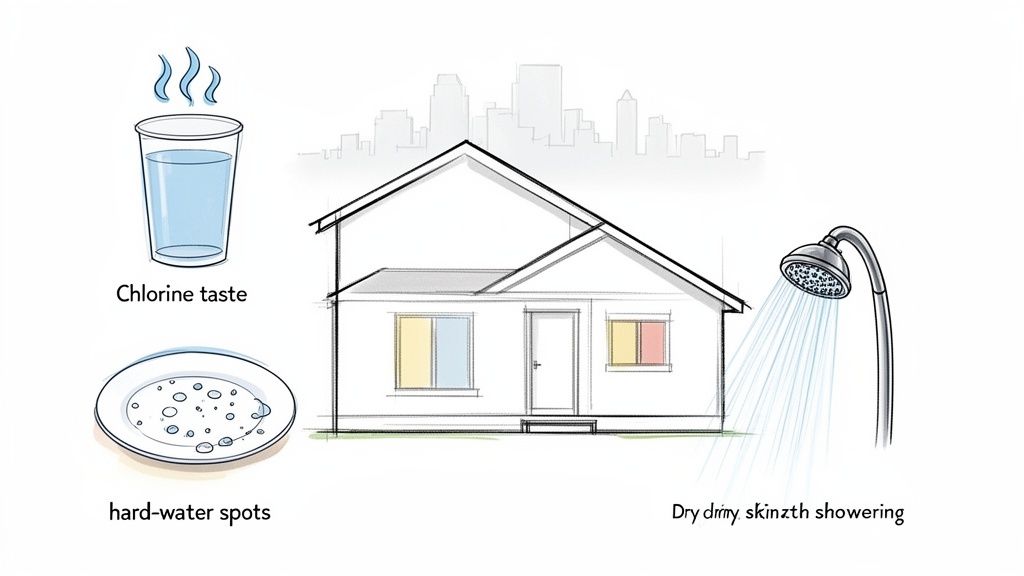
Have you ever run your dishwasher in your Woodstock home only to find your "clean" glasses are covered in chalky white spots? Or maybe you step out of the shower in Alpharetta feeling like your skin is tight and your hair is impossibly brittle, no matter what conditioner you use. These issues, along with problems like slow drains or low water pressure, often point to a bigger issue—your water.
A whole-home water filter tackles these problems at the source, purifying every drop of water that enters your house before it ever reaches a faucet, showerhead, or appliance. It’s a serious upgrade for your home and a game-changer for your family's daily life, protecting everything from your skin to your plumbing system.
Is a Whole-Home Water Filter Right for Your Atlanta Home?
As plumbers providing service across North Metro Atlanta, from Woodstock and Acworth to Roswell and Marietta, we hear this question all the time. Your city’s water is treated to meet federal safety standards, but that’s just the minimum. "Safe" doesn't necessarily mean "good." The chlorine used for disinfection, sediment from aging pipes, and hard minerals are all still present, and they can cause plenty of headaches for homeowners in Cobb County, Cherokee County, and North Fulton.
It's clear that families are looking for better solutions. As of 2026, a whopping 91% of Americans use some kind of water filter, which is a 25% jump since just 2023. This is largely driven by a growing mistrust of what’s coming from the tap. With reports that 27% of public water systems violated drinking water standards in 2025 and only 45% of suburban residents saying they trust their tap water, it’s easy to see why.
You can discover more insights about this growing demand for certified filtered water and learn why an overwhelming 79% of parents now insist on it for their children.
Signs You Need a Water Filtration System
The issues with your water often sneak up on you. You might not connect the dots at first, but these are the classic signs we see in homes from Canton to Cumming that could really benefit from a filtration system. If any of these sound familiar, it’s probably time to take a closer look at your water quality.
- Hard Water Buildup: That white, crusty scale on your showerheads and faucets is a dead giveaway. It’s limescale, caused by calcium and magnesium, and it’s a common problem for homeowners seeking a plumber in Roswell or Marietta.
- Appliance Breakdowns: Scale is the silent killer of expensive appliances. It forces your water heater to work harder—a leading cause of premature water heater replacement—clogs your dishwasher's spray arms, and wears down your washing machine.
- Dry Skin and Dull Hair: The same minerals that coat your fixtures can also strip your skin and hair of their natural oils. After a shower, you’re left feeling dry, itchy, and irritated.
- Foul Tastes and Odors: Does your tap water have a faint swimming pool smell? That’s chlorine. A whole-home carbon filter, a key component in HALO systems, is specifically designed to remove these unpleasant tastes and smells for good. A sewage smell in the yard, however, points to a much more serious issue requiring immediate sewer repair in Woodstock.
Investing in a whole-home water filter installation is about more than just better-tasting water. It's a proactive step to protect your home's entire plumbing ecosystem, from preventing costly main water line repair down to the smallest faucet.
Point-of-Use vs. Whole-Home Filtration
It's easy to get overwhelmed by the options out there. While faucet attachments and pitchers are a start, they're a band-aid solution. A whole-home system is a true fix.
This table breaks down the key differences:
| Feature | Point-of-Use Filter (e.g., Pitcher, Faucet) | Whole-Home Filter (e.g., HALO System) |
|---|---|---|
| Coverage | Treats water from a single tap | Treats all water entering the home |
| Protection | Only protects drinking water | Protects plumbing, appliances, skin, and hair |
| Convenience | Requires frequent refills and cartridge changes | "Set it and forget it" with minimal annual maintenance |
| Long-Term Cost | Lower upfront cost, but ongoing cartridge costs add up | Higher upfront investment, but lower long-term cost per gallon |
A whole-home system, professionally installed at your main water line, ensures that every single tap—from the kitchen sink to the laundry room—delivers purified water. This is where a HALO system truly excels. It offers comprehensive filtration that removes contaminants and conditions the water to prevent damaging scale buildup without salt.
For homeowners in Cumming and Johns Creek, this means protecting your home's value while giving your family clean, safe water for drinking, cooking, and bathing. It also reduces the strain on your plumbing that can lead to needing leak repair in Alpharetta.
Choosing The Right HALO System For Your Home

Alright, you’re convinced that a whole-home system is the way to go. Smart move. But now comes the big question: which one? It’s tempting to just look at the price tag, but picking the right HALO system is about matching the technology to your home's unique needs in the Metro Atlanta area.
Think about it—a family of five in a big Alpharetta house is going to use water very differently than a couple in a Roswell townhouse. We want to find that sweet spot where you get total protection without paying for a massive system you don't need. This is where professional advice really shines, helping you sidestep the common pitfall of an undersized system that tanks your water pressure—a frustrating problem that can mimic the symptoms of a main water line leak.
Matching The Filter To Your Water Problems
Here in North Metro Atlanta, our water has a few common quirks. The first part of any successful whole home water filter installation is figuring out what you're up against. HALO Water Systems has a solution for each one.
- Chlorine Taste and Smell: If your tap water reminds you of a public pool, you need a solid granular activated carbon (GAC) filter. The HALO 5 is the system we trust for this, as it's a beast at removing not just chlorine but also trickier chloramines that cities often use.
- Hard Water Scale and Buildup: For those of you in Woodstock or Marietta fighting that chalky residue on everything, the HALO ION Inline Water Conditioner is a game-changer. It’s a salt-free conditioner that changes the minerals so they can't stick to your pipes and appliances, saving them from long-term damage that could lead to needing a water heater replacement in Canton.
- A Bit of Everything: Let's be honest, most of us have both issues. The water is hard and it smells like chlorine. That’s why the HALO 5 is so popular—it’s a complete, five-stage filtration and conditioning unit packed into one tank.
Sizing Your System For Optimal Performance
Getting the size right is absolutely critical for keeping your water pressure strong. A system’s capacity is measured in gallons per minute (GPM), and it needs to be able to handle your home’s busiest moments.
Picture a hectic morning in Johns Creek: the shower's running, the dishwasher is on, and the coffee pot is brewing. An undersized filter just can't keep up, and you'll feel that frustrating drop in pressure. A professional plumber takes the time to calculate your home's actual flow rate to make sure your new HALO system can handle that peak demand without even flinching. Low water pressure isn't just an annoyance; it can also be a symptom of a hidden leak needing water line replacement.
A properly sized system means you can run multiple faucets and never even notice a change in water pressure. It’s one of the biggest differences between a professional job and a DIY headache.
Real-World Scenarios For HALO Systems
Let’s put this into perspective with two common examples we see in Forsyth and Cherokee County:
- The Large Family Home: For a five-bedroom house in Cumming with three bathrooms and a few teenagers, water usage is high. We’d look at a HALO 5 system sized for a 15-20 GPM flow rate. This ensures no pressure drop, even when the washing machine and a couple of showers are going at once.
- The Downsizer's Condo: Now consider a two-bedroom condo in Acworth with two people. Their water demand is much lower. A more compact system rated for 8-10 GPM is perfect. It delivers all the benefits of pure, conditioned water with a lower upfront cost.
Understanding these details is key to getting the right fit. It's interesting—even looking at how to pick the best RV water filter system shows the same core principle. Whether you're in a house or on the road, you have to match the filter to the water source and your daily use.
Alright, you've picked your HALO system and set the date for your installation. So, what happens now?
Getting your home ready for our arrival is simple, but it makes a huge difference. A little bit of prep work on your end helps our plumbers get straight to work, which means the job gets done faster and with less disruption to your day. This is true whether you're getting a filter installed or calling us for emergency drain cleaning near me.
Think of it as a team effort. You handle a few quick things before we show up, and we'll take care of all the technical plumbing to get you that crystal-clear water you're looking for. Here’s a quick rundown of how you can help us make your installation day a breeze.
Know Where Your Main Water Shut-Off Is
This is the big one. Before we can even think about touching a pipe, we have to turn off the water to your entire house. Knowing where your main shut-off valve is located ahead of time saves us from having to play detective when we arrive.
In most homes around Cherokee County and North Fulton, that valve is hiding in one of a few usual spots:
- In the garage, usually on a wall where the water line comes in from the street.
- Down in the basement, typically near the foundation wall and close to the water meter.
- Tucked away in a utility closet, often right next to your water heater.
Can't find it? Look for a small access panel in a wall or check for a box in your yard near the curb. Finding this valve now not only helps with the filter installation, but it’s also critical information to have in case of an emergency, like a sudden burst pipe repair.
Clear the Deck for Our Plumbers
Our team needs a safe, open area to work. We’ll be installing your HALO system right where the main water line enters your home, which is usually in the garage or basement. These units are pretty tall and need some elbow room for all the plumbing connections.
Please try to clear out a space roughly five feet wide by five feet deep around where the installation will happen. That just means moving things like storage bins, bikes, or lawn equipment out of the way. A clear workspace prevents accidents and gives our plumbers the room they need to maneuver, cut pipe, and securely install your new system.
It's a lot like clearing a path for a new fridge or washing machine. The more space we have to work, the more efficiently we can get the job done right, whether it's a filter install or an emergency sewer replacement in Marietta.
Double-Check the Connections
Different HALO systems have different needs, so it’s a good idea to confirm what your specific model requires before we arrive.
Drain Access: Most of our advanced systems need to backwash, which is a cycle that flushes out all the gunk the filter has trapped. To do this, the system needs access to a drain. This could be a floor drain, a utility sink, or a standpipe (the same kind your washing machine uses). This is different from issues like a sewer backup which requires immediate professional drain cleaning. If there isn't one nearby, we can often run a small drain line—it's a common part of the job for us.
Electrical Outlet: Some models also need electricity to power their digital controls and automatic cycles. Take a look and see if you have a standard 120V electrical outlet within about 10 feet of where the filter will go. If not, just give us a heads-up.
Taking care of these small details makes a massive difference on installation day. It lets our licensed plumbers focus on what they do best: giving you a professional, leak-free whole home water filter installation that will protect your family and your home's plumbing for years to come.
What Happens During A Professional Installation
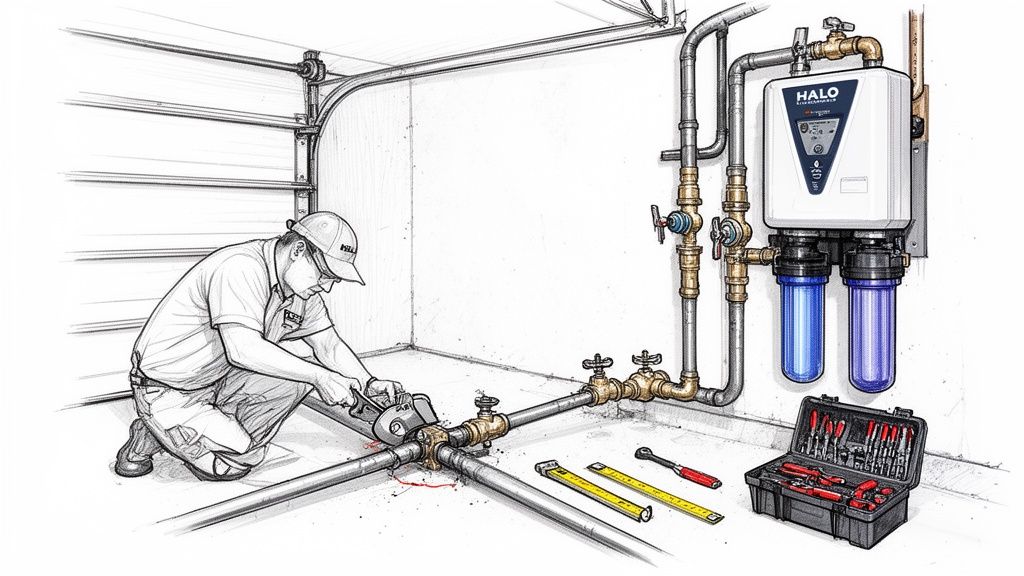
So, what actually happens when our plumber shows up at your door? A professional whole home water filter installation isn't just about hooking up a tank; it's a precise plumbing operation that requires a skilled hand. From the moment we arrive at your home in Canton, Cumming, or Johns Creek, our entire focus is on a perfect, leak-free installation. The whole thing usually takes just two to four hours.
First things first, our plumber will do a final walkthrough with you. We'll confirm the spot we picked out, make sure the area is clear, and double-check that we have access to the drain and electrical connections we need. Then comes the most important safety step: we’ll shut off your home’s main water supply. This allows us to work on your main water line safely, with zero risk of water damage.
Once the water is off, the real plumbing work begins. This is where you see the difference between a DIY project and a seasoned professional.
The Core Installation Steps
The heart of the job is carefully integrating the HALO system into your home’s existing plumbing. Our Master Plumbers follow a strict, code-compliant process to create a durable setup that’s easy for you to manage for years to come.
This is precisely why a pro install matters so much. One bad cut or a poorly sealed fitting can lead to a slow, hidden leak—or worse, a major flood. A DIY attempt can quickly spiral into an emergency call for a burst pipe repair near me, which is a stressful and expensive headache we help you avoid entirely.
The real value of a professional plumber isn't just in the work they do, but in the problems they prevent. A perfect installation means no leaks, no pressure loss, and no worries.
Our process breaks down into a few key actions:
- Precision Cutting: We measure everything twice to make one perfect cut. The plumber makes two clean cuts into your main water line to create the exact space needed for the new filter system.
- Fitting the Connections: Next, we solder or crimp new fittings onto the existing pipes. These connections have to be flawless to handle your home's water pressure for decades without a single drop.
- Installing the Bypass Valve: This is one of the most critical components we install. A bypass valve is a simple three-valve loop that lets you direct water around the filter whenever you need to. It’s essential for maintenance or if you ever need a 24 hour plumber for something else, like when your clogged toilet won't flush.
Why The Bypass Valve Is a Non-Negotiable
Think of the bypass valve as your system's "off-ramp." If your filter ever needs service, or if you're leaving town for a while, you just turn a few handles to bypass the unit. Water will flow straight to your taps just like it did before, so you're never left high and dry.
Without a bypass, any future filter maintenance would mean shutting off the water to the whole house all over again. It’s a small detail that provides a massive amount of convenience and is a true sign of a professional job. It’s the kind of practical foresight that prevents future headaches.
Once the bypass and pipes are in, we carefully position and secure the HALO unit itself. We connect the inlet and outlet ports, ensuring every seal is absolutely watertight. For systems with backwashing features, we'll also run a drain line to a nearby utility sink or floor drain.
Finally, we turn the water back on slowly, check for any pressure changes, and meticulously inspect every single connection for leaks. We don't consider the job done until we are 100% confident the installation is perfect.
What Does a Whole Home Water Filter Really Cost in North Georgia?
Let's get right to it—the question on every homeowner's mind, from Acworth to Alpharetta, is "What's this going to cost me?" It's a fair question. You're not just buying a piece of equipment; you're making a significant upgrade to your home's infrastructure and your family's daily life.
The final price tag for a whole home water filter installation is a combination of two things: the HALO system you choose and the professional installation by a certified plumber. Think of it less as a simple expense and more as an investment that starts protecting your home the moment it's turned on.
Why Your Quote is Unique to Your Home
I can't give a single flat price because every home is different. When we put together a quote, we’re looking at your specific situation to make sure there are no surprises down the road. We believe in being upfront and honest about the real cost, whether it's for a filter or for sewer repair cost estimates.
Here’s what we look at:
- Your Chosen HALO System: Are you looking for the all-in-one HALO 5 that filters and conditions, or a more targeted solution? The equipment itself is the first major factor.
- The State of Your Plumbing: The age, material (like copper or PEX), and especially the location of your main water line all play a role. A straightforward installation in a Woodstock garage is a different job than navigating a tight crawlspace in a historic Roswell home.
- Site Prep and Modifications: Sometimes, we need to add a nearby drain for the system to regenerate or run a new electrical outlet. If your setup requires these kinds of modifications, we'll build that into the project plan from the start.
This kind of home improvement is becoming incredibly common. The market for home water filtration was valued at USD 20.26 billion in 2024 and is expected to climb to USD 50.89 billion by 2033. For a complete whole-house system, homeowners typically invest between $1,500 and $10,000. Our most popular HALO systems, which both filter and condition your water, usually land in the $2,000 to $6,000 range, fully installed. That one-time cost can prevent scale buildup that has been shown to reduce the lifespan of water-using appliances by up to 30%. It's clear why so many families are choosing to upgrade when you learn more about the growing market for home water filtration.
Looking Beyond the Upfront Price Tag
It’s natural to focus on the initial quote, but the real value becomes clear when you look at the long-term picture. A whole-home system is a defensive strategy for your biggest asset.
Think about it this way: what’s the cost of a water heater replacement in Marietta five years too early because of scale damage? Or calling for an emergency sewer repair in Woodstock because of decades of mineral buildup? Suddenly, the cost of prevention looks a lot more attractive.
By neutralizing hard water minerals before they ever enter your plumbing, a HALO system is your home's personal bodyguard. Your dishwasher, washing machine, and especially your water heater will run better and last longer. You’ll also find yourself saving hundreds of dollars a year by ditching bottled water and flimsy pitcher filters. From that perspective, the system starts paying you back immediately.
Caring For Your New Water Filtration System

Alright, your new whole home water filter installation is done and you're ready for amazing water. Now, let’s talk about keeping it that way. A little bit of simple care will make sure your system performs beautifully for a decade or more, and it starts right now.
Before we leave, we'll do a full system flush. This just involves running water through your faucets for a few minutes. It’s a normal step to clear out any harmless carbon "fines"—think of it like dust from the new filter media—and to make sure the water is running clear. All you need to do is keep an eye on your water pressure over the next 24 hours to make sure everything feels normal. If you notice symptoms like low water pressure or see water in your yard, it could signal a bigger problem unrelated to the filter, requiring an emergency plumber.
Your Simple Maintenance Schedule
One of the best things about a HALO system is that it mostly takes care of itself. It’s not another appliance you have to fuss over. That said, a couple of small things will go a long way in keeping it in peak condition.
The main task you'll handle is swapping out the sediment pre-filter cartridge. This filter is your system's first line of defense, catching all the bigger gunk like sand, rust, and dirt before it ever gets to the main tank.
- Pre-Filter Change: You’ll want to change this cartridge every 6 to 12 months. The timing really just depends on the quality of your incoming water. The classic sign it's time for a change is a gradual drop in water pressure throughout your house. It’s a super simple DIY job, and we’ll show you exactly how to do it before we pack up our tools.
- Professional Check-Up: We suggest having a professional swing by every 3 to 5 years for a quick tune-up. We’ll check the system’s internal valve, test your water, and just give everything a once-over. Think of it like a routine oil change for your car—it’s all about preventing bigger problems down the road, like the need for a costly water line replacement in Cumming.
When To Call For Service
HALO systems are workhorses, but it's always good to know what to watch for. If you notice a significant, sudden drop in water pressure and changing the pre-filter doesn't fix it, give us a call. That usually points to something that needs a professional eye.
Also, if you spot a leak—no matter how small—or hear any strange noises coming from the unit, don't wait. Catching these things early can be the difference between a quick fix and a major repair, whether it’s the filter itself or another part of your plumbing that might need a main water line repair near me.
You made a smart choice by investing in a whole-home system. It’s a move that more and more homeowners are making, with an estimated 91% of households now filtering their water due to concerns over municipal supplies. Having your system professionally installed in Acworth or Woodstock doesn't just guarantee it works; it ensures it meets all local codes and protects your home's entire plumbing network. You can read more about the home water filtration market and its growth to see just how popular this upgrade has become.
Our team is always here for you. Whether you have a quick question about changing a filter or need to get a check-up on the books in Roswell or Marietta, we're ready to help. As your local 24 hour plumber, we're available for everything from filter maintenance to emergency leak repair.
Common Questions About Water Filter Installation in Metro Atlanta
Thinking about a whole-home filter is a big step, and it's smart to have questions. We get asked a lot of the same things by homeowners all over North Metro Atlanta, from Woodstock to Roswell, so let's clear up the most common ones right now.
Will A Whole-Home Water Filter Kill My Water Pressure?
This is hands-down the number one question we get. The short answer is no—not when the system is installed by a pro.
When we scope out a job, we’re not just looking at where to put the tank. We calculate your home’s flow rate and peak demand to make sure we select a HALO system that can keep up. You should be able to run the dishwasher and take a shower at the same time without missing a beat. A sudden loss of pressure could indicate a different problem, like a burst pipe, which requires an immediate call to an emergency plumber in Alpharetta.
If you do see a big pressure drop, it’s almost always one of two things: an undersized unit from a DIY job, or a sediment pre-filter that’s clogged with gunk and needs swapping out. Proper installation prevents this from being an issue.
A sudden pressure drop of more than 10–15 psi across the system is the classic sign of a clogged sediment pre-filter. It's the most common cause of low pressure and, thankfully, an easy fix.
What’s The Difference Between A Water Filter And A Water Softener?
It's easy to get these two confused because they both improve your water, but they solve completely different problems. Think of it this way:
- A Water Filter is like a high-tech screen. It grabs and removes things you don't want to drink or bathe in, like chlorine, sediment, pesticides, and other chemicals. This is all about making your water taste, smell, and feel cleaner and safer.
- A Water Softener has one specific job: it removes hard minerals like calcium and magnesium. It tackles the "hard water" that causes chalky limescale buildup, which ruins appliances and leaves spots on your glasses. The scale can also cause issues like a lack of hot water, which may lead you to search for water heater replacement near me.
A lot of homes in Cobb and Forsyth County have both issues—city water that needs filtering and is moderately hard. That's a big reason the HALO 5 is so popular. It’s a filtration system and a salt-free water conditioner rolled into one, giving you the best of both worlds.
How Long Does The Filter Media Last And What Are The Ongoing Costs?
The main filter media inside the HALO tank is the workhorse of the system. It's designed to last for a very long time—often up to 10 years or for over a million gallons of water use. The exact lifespan depends on your family's water usage and the starting quality of your local water supply.
This brings us to ongoing costs, which are surprisingly minimal.
Your only real recurring expense is changing out the small sediment pre-filter cartridge. This should be done every 6 to 12 months and is a simple, five-minute task most homeowners can easily do themselves. When you think about what you spend on bottled water or pitcher filters, the long-term value is incredible.
Can I Just Install A Whole-Home Filter Myself?
We get it. The DIY route can look tempting to save a few bucks. But unless you are a licensed plumber with experience in this specific work, we strongly advise against it.
Installing a whole-home system means cutting into your home's main water supply line. One little mistake—a poorly soldered joint, a cross-threaded fitting—can lead to a slow leak or a catastrophic flood. A project meant to improve your home can quickly become a frantic search for "burst pipe repair near me."
Going with a professional plumber from JMJ Plumbing means you know it's done right.
- The system is installed correctly and meets all local plumbing codes in Cherokee County, Cobb County, and across Metro Atlanta.
- Every connection is secure and guaranteed to be leak-free.
- Your manufacturer's warranty is protected.
- A bypass valve is installed, making future service simple.
The peace of mind that comes from a guaranteed, professional job is worth every penny. It protects your home and ensures your new system works perfectly from the moment we turn it on.
Ready to enjoy pure, clean water from every tap in your house? The team at JMJ Plumbing specializes in professional HALO whole-home water filter installations across North Metro Atlanta. From routine plumbing to emergency services like sewer line replacement in Alpharetta, we are the trusted plumber for Woodstock, Canton, Roswell, Marietta, Cumming, and Johns Creek. Contact us today for a personalized consultation and a free on-site quote!