Backflow prevention device testing is a routine, but critical, safety check for your water supply. Think of it as an inspection for the security gate on your water line. This test verifies that a special valve is working properly, ensuring contaminated water can't flow backward and mix with the clean water your family drinks and uses every day.
What Is Backflow and Why Is It a Risk to Your Water?
Your home's plumbing is designed to be a one-way street. Clean, treated water flows in from the municipal supply, and used water flows out. Backflow is what happens when water suddenly reverses direction on that street, creating a dangerous U-turn.
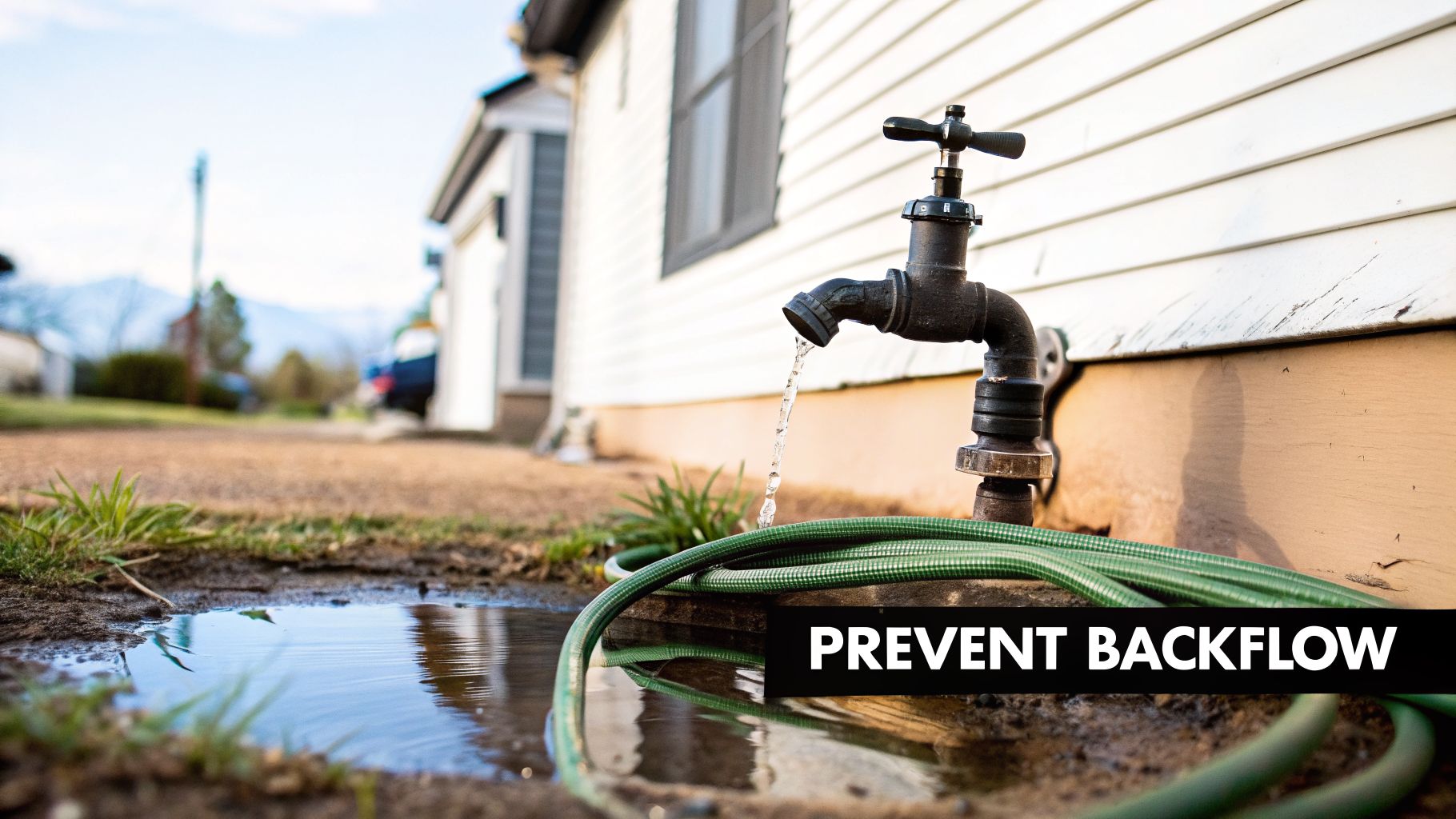
This reversal can pull unsafe water—from sources like irrigation systems, pools, or even a garden hose left in a puddle—back into your home's pipes. Worse yet, it can contaminate the public water supply. It's a serious public health hazard, which is why water authorities across North Metro Atlanta, from Cherokee County to North Fulton, have strict requirements for preventing it.
Understanding the Two Main Causes of Backflow
A quick look at the two common scenarios that can compromise your clean water supply. While the names sound a bit technical, the ideas are pretty straightforward and can happen anywhere, from a quiet Roswell neighborhood to a busy commercial area in Marietta.
| Cause of Backflow | Simple Explanation | Common Real-World Scenario |
|---|---|---|
| Backsiphonage | Negative pressure in the city water main creates a vacuum, sucking water backward from your property. | A burst pipe repair or a major main water line repair down the street in Acworth causes a sudden, massive drop in city water pressure, which can also cause low water pressure in your home. |
| Backpressure | Your property's plumbing system pressure exceeds the city's supply pressure, forcing water to flow backward. | An improperly installed irrigation system in Alpharetta builds up pressure that is higher than the incoming city water pressure, sometimes indicated by water in the yard near the valve box. |
Both situations create the perfect storm for contamination. Understanding them makes it clear why having a reliable backflow preventer is non-negotiable.
Real-World Contamination Risks
The real danger is what the reversed water can bring with it. It’s often the simple, everyday things that pose the biggest threat.
For example, a garden hose left submerged in a bucket of soapy water, a sprinkler head sitting in a puddle of lawn fertilizer, or a cross-connection to a boiler system can all introduce harmful substances into your pipes during a backflow event.
Even issues inside your home, like a clogged toilet that won’t flush or a messy sewer backup creating a sewage smell, create a risk. If a pressure change occurs, waste materials could be siphoned from the drain lines into the freshwater lines. This is why addressing problems with prompt sewer repair in Woodstock is so important.
This is exactly why cities from Woodstock to Canton require regular backflow prevention device testing. It’s the only way to be certain that the mechanical safeguard protecting your water is ready to slam shut and prevent a contamination disaster before it even has a chance to happen.
The Role of a Backflow Prevention Device
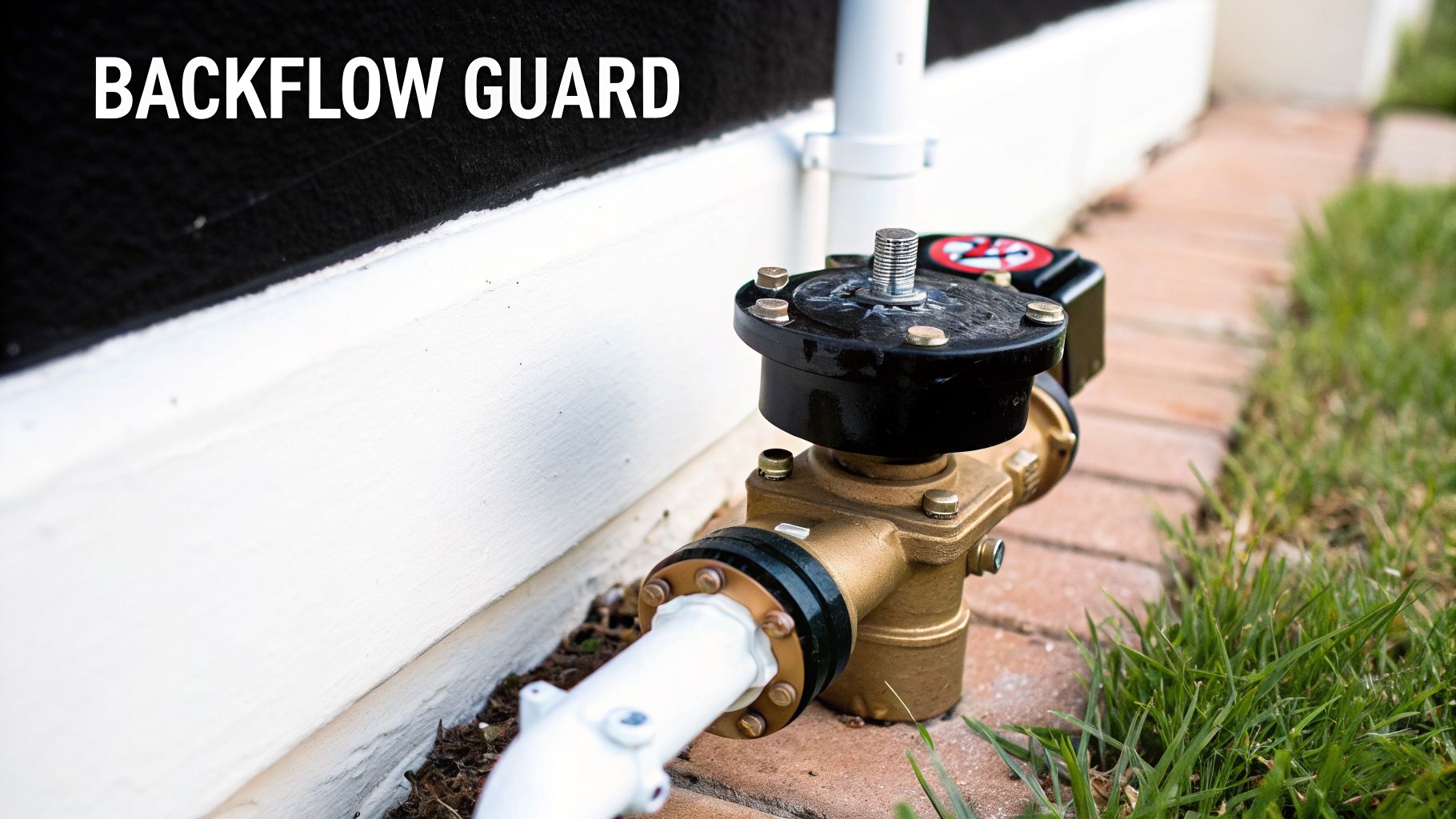
So, if backflow is like traffic going the wrong way down a one-way street, a backflow prevention device is the non-negotiable barrier that stops a head-on collision. These mechanical assemblies are installed on your main water line with one critical mission: to ensure water only flows in a single direction—from the city’s supply into your property, never the other way around.
These devices are the quiet guardians of your plumbing system. They stand watch 24/7, protecting not only your own home but the entire public water supply for communities from Woodstock to Alpharetta. They are a vital line of defense against the kind of contamination that can affect thousands of people.
How a Backflow Device Works
The easiest way to picture how a backflow preventer works is to think of a one-way turnstile. It lets you go through in one direction, but if you try to go backward, it locks up. A backflow device does the exact same thing, but for water.
Inside the device, there's a carefully engineered system of check valves, springs, and chambers that respond to water pressure. When everything is normal, the pressure from the city's supply keeps the valves open, letting water flow into your home in Marietta or Canton. But the moment that pressure drops or reverses—from a backpressure or backsiphonage event—the internal valves instantly slam shut, creating a physical barrier that stops any water from flowing backward.
A backflow preventer is a purely mechanical safeguard. It doesn't rely on electricity or complex electronics; it reacts physically to water pressure. This is what makes its mechanical health so incredibly important.
Why Mechanical Parts Need Regular Testing
Just like any mechanical part on your car, the components inside a backflow preventer can wear out over time. Seals get old, springs lose their tension, and debris can cause major problems.
Here are a few common points of failure we see all the time:
- Seals and Gaskets: The rubber O-rings and gaskets that create the watertight seals can dry out, crack, or get brittle, which means they can no longer close properly. A failed seal can be a source of a leak repair.
- Springs: The internal springs are calibrated to react to specific pressure changes. If they weaken or break, they won't have the force to snap the valves shut when needed.
- Debris: It’s surprisingly common for sediment, rust flakes, or tiny pebbles from a recent main water line repair in Johns Creek to get lodged in a valve, keeping it from closing all the way. This can also lead to slow drains or low water pressure.
- Freeze Damage: Winter freezes are a huge threat. If the device isn't winterized correctly, the water inside can freeze, expand, and crack the main body. This often requires a full water line replacement for the damaged section.
Any one of these issues could cause the device to fail without any obvious signs. You’d never know there was a problem until a backflow event actually happened. This is precisely why backflow prevention device testing isn't just a recommendation—it's a legal requirement across Cobb County, Cherokee County, and North Fulton.
The Importance of Certified Annual Testing
The requirement for annual testing isn't just a local ordinance; it’s a reflection of global best practices for water safety. Backflow prevention device testing is a cornerstone of public health programs around the world, with strict regulations in place to protect potable water. In fact, North America accounts for about 58% of the global backflow preventer market, driven by our mature infrastructure and rigorous plumbing codes. You can read more about these global market trends in a recent report from Straits Research.
Think about it: when an emergency plumber responds to a burst pipe repair in Roswell, that sudden, dramatic drop in pressure can easily trigger a backflow event. The only thing standing between clean water and widespread contamination is a network of properly functioning backflow preventers. A certified test is the only way to confirm your device is ready to do its job when it matters most.
Making Sense of Local Backflow Testing Rules in North Georgia
Alright, so you understand why backflow prevention is a big deal. The next hurdle is figuring out the specific rules for your property. This is where things get really local, as different water authorities across North Metro Atlanta have their own specific requirements.
For homeowners and business owners, these aren't just friendly suggestions—they're legal mandates. Water authorities like the Cobb County-Marietta Water Authority, Forsyth County Water & Sewer, and the city water systems in Alpharetta and Johns Creek all require annual testing. Their goal is simple: to keep the public water grid safe. And they don't mess around when it comes to enforcement.
Who Needs to Get Their Device Tested?
While the exact rules can vary a little from one county to the next, they generally follow the same logic. Testing is mandatory for:
- All Commercial Properties: If you own or manage a business in places like Roswell, Marietta, or Canton, you’re on the list. This applies to everyone, from restaurants and doctor's offices to large industrial facilities. Annual testing is a standard part of doing business.
- Homes with High-Risk Features: It's not just businesses. Many homes in communities like Woodstock and Cumming are also required to comply. The common triggers? In-ground sprinkler systems, swimming pools, fire suppression systems, or even a private well that's also connected to the public water line.
If your property has any of these features, you’ll eventually get an official notice in the mail from your water provider.
Think of this notice less like a reminder and more like a legal summons. It will give you a firm deadline to have your device tested by a state-certified technician and ensure the results are sent back to the water authority.
What Happens if You Ignore the Notice?
Putting that letter aside and forgetting about it is a bad idea. The penalties get serious, and fast. Water authorities view a faulty backflow preventer as a major threat, since one failure could potentially contaminate the water for an entire neighborhood.
If you don't comply, you can expect:
- Steep Fines: This is usually the first step. The longer you wait, the more the fines can add up.
- Your Water Gets Shut Off: This is the final resort, but they have the right to do it. For a business, it means shutting down operations. For a homeowner, it makes your house unlivable until you resolve the issue and handle any related plumbing repairs.
These strict local rules are part of a much bigger picture. All over the world, especially in North America, regulations are getting tighter to protect our water infrastructure. States like Texas have already set a precedent with residential testing requirements, and we're seeing that same commitment here in Metro Atlanta. It's why our certified experts at JMJ Plumbing are busy managing tests for everything from sewer replacement projects in Acworth to new homes being built in Woodstock.
Bottom line? The best way to deal with a testing notice is to handle it right away. Working with a certified plumber who already knows the specific forms and processes for Cherokee County or North Fulton makes it painless. They can get the test done, file the paperwork correctly, and make sure you stay in good standing with the water authority.
What to Expect During Your Backflow Test
A lot of folks in North Metro Atlanta hear they need a "backflow test" and immediately picture a huge, messy plumbing project that takes all day. The good news? It's nothing like that. A professional backflow prevention device testing service is a quick, precise, and clean procedure. We’re in and out with minimal disruption to your day.
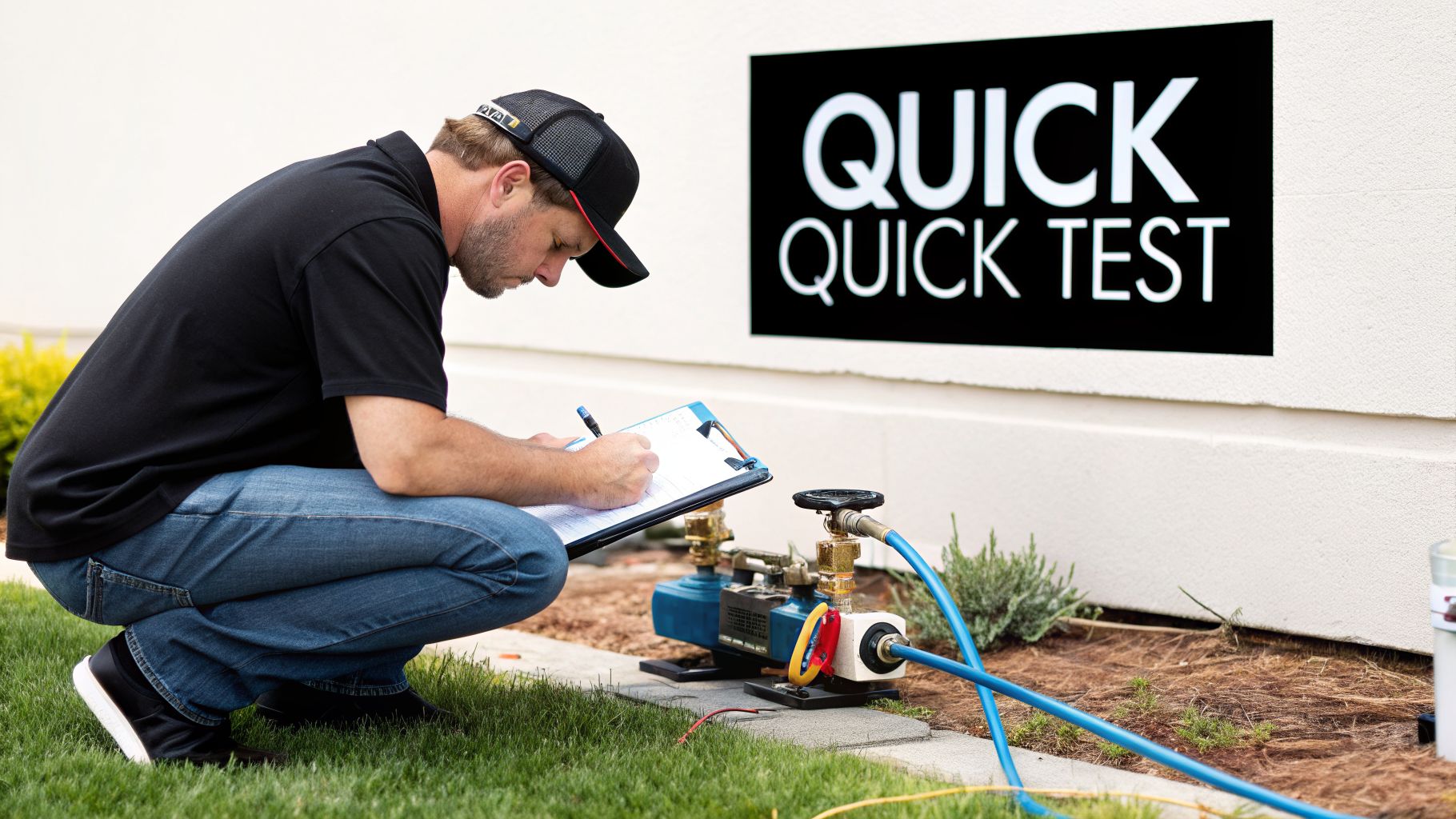
The whole point is to give you confidence that your water is safe and that you're in compliance with local regulations, whether you're in Acworth, Marietta, or Roswell. Let's walk through what actually happens when one of our certified technicians shows up. You'll be surprised to learn the entire process usually takes just 15 to 30 minutes.
Step 1: Arrival and Device Location
First things first, our technician will find the backflow preventer on your property. These devices are almost always installed on your main water line, right after the water meter. For most homes in places like Canton or Woodstock, it’s often inside a green irrigation box in the front yard or near the foundation where the water line enters your house.
On commercial properties, we might find it in a mechanical room or a locked cage outside. Don't worry about it—our techs have seen every setup imaginable and will locate it in no time.
Step 2: The Brief Water Shutoff
Once we've found the device, we need to briefly turn off the water leading to it. This is the only part of the test that affects your water supply, and it’s very quick. We close two shutoff valves, one on each side of the backflow preventer, which isolates the device from the rest of your system.
This step is crucial because it allows us to get accurate pressure readings without the city's water pressure interfering. Your water will be back on before you can even make a cup of coffee. This is a far cry from the long shutoffs required for a main water line replacement or a sewer replacement.
Step 3: Attaching the Specialized Test Kit
Next, our technician connects a special piece of equipment—a differential pressure test kit—to small ports on your backflow device called "test cocks." This isn't some generic gauge; it’s a highly sensitive instrument that must be calibrated every year to guarantee its readings are perfect for official reporting.
This isn't a tool you can just pick up at the hardware store. It's a professional-grade device designed to measure microscopic pressure changes inside the backflow preventer's chambers, confirming its internal parts are working exactly as they should.
Step 4: The Valve and Pressure Check
This is the heart of the backflow prevention device testing process. The technician follows a specific sequence of opening and closing the test cocks to simulate the exact conditions of a backflow event, both backpressure and backsiphonage. Here’s what they are looking for:
- Check Valve #1: Is it holding pressure tightly, making sure no water can leak backward?
- Check Valve #2: Is it acting as a reliable secondary barrier?
- Relief Valve (for RPZ units): Does it open at the right pressure to dump potentially contaminated water, proving it will do its job in a real emergency?
Every reading is carefully watched and written down. If a valve fails to hold the required pressure—even by the smallest margin—the device fails the test. This careful process ensures there are no hidden flaws that could put your water at risk during a sewer backup or a sudden pressure drop from a burst pipe repair down the street in your Johns Creek neighborhood.
Step 5: Recording Results and Filing Paperwork
With the test complete, the technician records the pass or fail results on the official test form required by your local water authority, whether that's in Forsyth County or Cobb County. At JMJ Plumbing, we take care of the final step for you by submitting the completed paperwork directly to the right city or county department. You'll get a copy for your records, and just like that, you're compliant for another year.
What Happens When a Backflow Device Fails?
Hearing your backflow device "failed" its test can sound pretty serious, but it’s a situation our certified technicians handle every day across North Metro Atlanta. A failure isn't a disaster—in fact, it usually means we've caught a small, fixable issue before it could cause real trouble. Think of it as a mechanical safeguard doing its job by showing signs of wear.
A failed test simply means one or more of the internal parts didn't hold pressure correctly during our calibrated test. It's a lot like a routine car inspection where the mechanic finds your brake pads are worn. It’s not a catastrophe; it’s a necessary maintenance flag that protects you from a much bigger problem down the road, similar to how addressing slow drains with drain cleaning prevents a major clog.
Common Reasons for a Failed Test
Most of the time, a test failure boils down to one of three culprits. These issues can pop up on any device, whether it's protecting a home's irrigation system in Cumming or a commercial fire sprinkler system in Marietta.
- Debris and Contamination: The most common reason we see is tiny bits of debris. If the city recently did a main water line repair down the street, sediment or even small pebbles can travel through the pipes and get stuck in a valve, preventing a perfect seal.
- Normal Wear and Tear: The rubber gaskets, O-rings, and springs inside are under constant pressure, and they don’t last forever. After years of service, they can get brittle or lose their tension, causing tiny leaks that are just enough to fail the test.
- Freeze Damage: A harsh Georgia winter can be brutal on an unprotected backflow device. If water freezes inside, it expands with incredible force, which can crack the brass body or mangle internal parts. This often leads to an immediate need for burst pipe repair or a full device replacement.
From Failure to Fix: The Repair Process
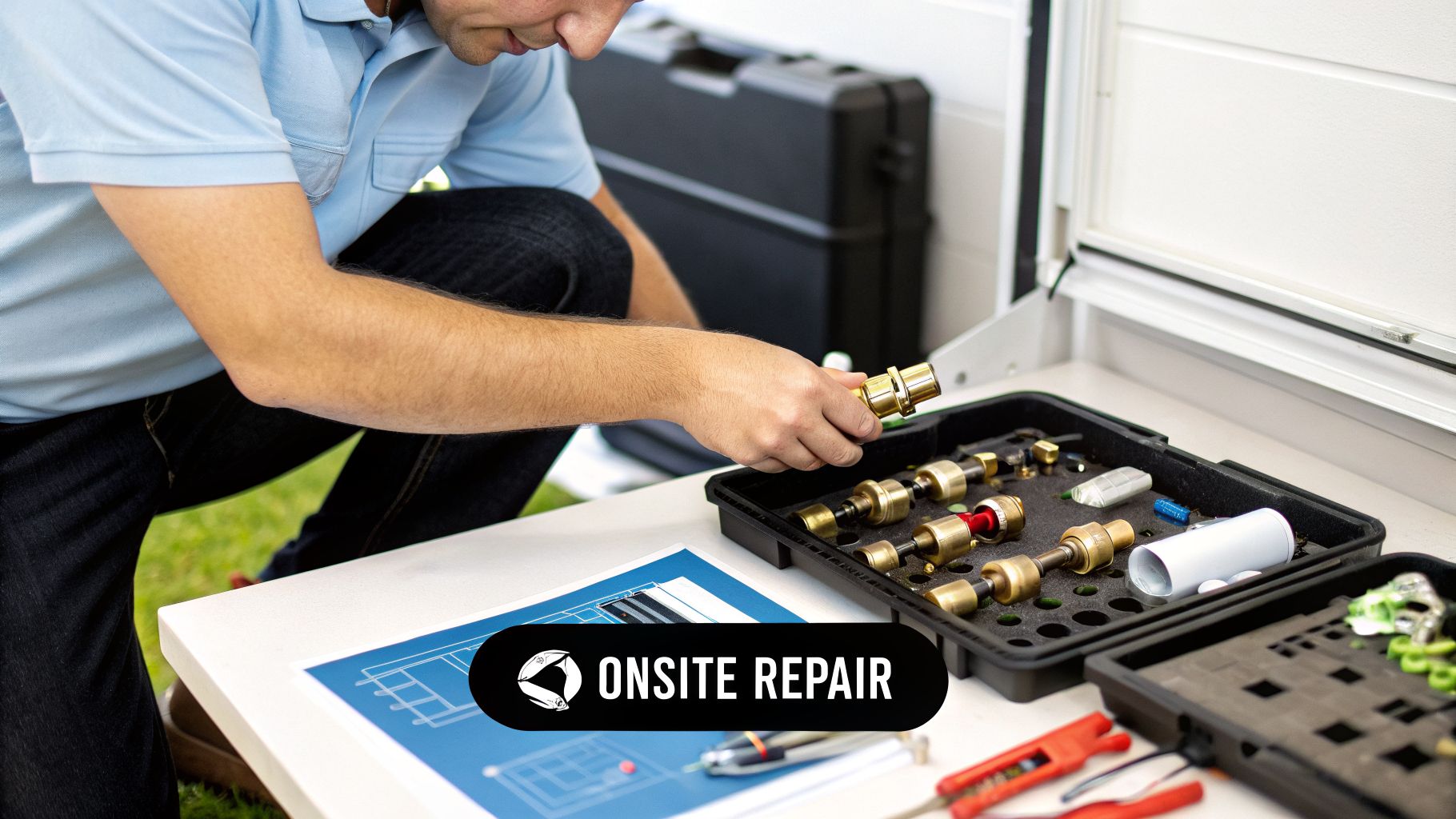
Here’s the good news: most failures are fixed quickly, often right after the initial test. As your emergency plumber in Acworth, we stock our trucks with the parts needed to solve these common problems on the spot. This means no scheduling delays and a fast track to getting you back in compliance.
A failed backflow test isn't a dead end—it's the first step toward a quick and efficient repair. Our goal is to turn a potential crisis into a simple, same-day resolution for homeowners and businesses from Johns Creek to Acworth.
The right fix depends entirely on what caused the failure:
- Clean and Re-Test: If debris is the problem, the solution is often as simple as taking the device apart, cleaning the internal components, and putting it back together. We then run the test again to confirm it passes.
- Install a Rebuild Kit: For worn-out parts, we use a manufacturer-approved rebuild kit. This kit contains all new rubber gaskets, seals, and springs to basically give the device a factory-fresh set of internal workings.
- Full Device Replacement: In cases of severe damage, like a cracked body from freezing, a full water line replacement of the backflow device itself is the only safe option. While it's more involved, this guarantees your system is secure and meets all local codes.
The world of backflow prevention device testing is always improving, with better parts and materials that extend the life of these devices. By 2025, it's expected that around 56% of manufacturers will be focused on innovations like corrosion-resistant alloys. For our customers in North Metro Atlanta, this means the rebuild kits and replacement devices we install offer superior durability. You can read more about backflow preventer technology to see how these advancements are shaping the industry. Our focus on quality parts ensures you stay compliant and protected for years to come.
Choosing Your Certified Backflow Tester in North Metro Atlanta
Getting that notice from your water provider can be a little stressful. You need to get your backflow prevention device testing done, but where do you start? Just grabbing the first plumber you find online isn't the best move. Your water safety and compliance with local rules hinge on picking the right expert for the job.
The most important thing to know is that not just any plumber can handle this. In places like Cobb County, Cherokee County, North Fulton, and Forsyth County, the water authorities are very specific: they will only accept test results from a technician who holds a valid Georgia Backflow Assembly Tester Certification. This isn't just red tape; it's a guarantee that the person testing your device has the right training and properly calibrated tools to do the job correctly and legally.
Why Certification and Experience Matter
Having that certification is the absolute baseline—it's non-negotiable. But what truly makes the difference between a headache and a hassle-free experience is a tester's local experience. An experienced pro knows the ins and outs of the paperwork for each city, whether it's Acworth, Alpharetta, or Roswell. They've seen it all when it comes to device failures and can pinpoint the problem in minutes, not hours.
Here’s a quick checklist of what to look for:
- Verifiable Certification: The company should be upfront about their technicians being Georgia-certified. Don't be afraid to ask for proof.
- Local Experience: A plumber who has worked in North Metro Atlanta for years will understand the specific issues common to our area, like hard water causing no hot water due to sediment in a water heater in Marietta, or debris getting into lines after city maintenance in Woodstock.
- On-the-Spot Repair Capability: A failed test shouldn't derail your whole week. The best companies, especially a 24 hour plumber, come prepared with the parts and tools to fix most common issues, like installing a simple rebuild kit, right on the spot.
Making the Right Choice for Your Property
When you search for "backflow testing near me" in Johns Creek or "emergency plumber Canton," you're really looking for a partner, not just a service. You need someone who can take the entire compliance process off your plate, from scheduling the test to filing the final report with the city.
Many skilled backflow testers use smart marketing to make sure homeowners and businesses can find them easily. For professionals in the trade, a resource like a plumber's local SEO guide can be a game-changer, helping them connect with customers who need their specialized skills.
At JMJ Plumbing, we take the complexity out of compliance. Our technicians are fully Georgia-certified and bring over 25 years of hands-on experience to homes and businesses across North Metro Atlanta. We don’t just run a test and leave. We manage the entire process for you, including submitting all the required paperwork directly to your water purveyor.
When you call us, you’re not just hiring a tester—you’re gaining a compliance partner. We ensure you're protected from fines or water service interruptions by handling every detail correctly and on time.
If your device happens to fail, we’re ready to solve it. We can quickly diagnose the issue, whether it’s some stray debris from a recent main water line repair or just normal wear on the internal parts. We’ll give you a clear, straightforward cost estimate right then and there for any work needed, from a quick cleaning to a full device water line replacement. Our goal is simple: fix the problem and get you back in compliance immediately.
Frequently Asked Questions About Backflow Testing
When it comes to backflow prevention device testing, we find that most homeowners and business managers in North Metro Atlanta have the same set of questions. Here are some quick, straightforward answers to help you understand what’s involved and what your responsibilities are.
How Often Is Backflow Testing Required in Georgia?
If your property has a backflow preventer—common for irrigation systems, pools, fire lines, or commercial buildings—then you’re required to have it tested once every year.
You don’t have to track this yourself. Your local water authority, whether in Cobb County, Cherokee County, or elsewhere, will mail you a formal notice when your deadline is coming up. Missing that deadline can result in fines or, in some cases, your water service being shut off. We can easily get you on an annual schedule so you never have to worry about a missed notice again.
Can Any Plumber Perform My Backflow Test?
No, and this is an important distinction. The technician must not only be a licensed plumber but also hold a specific Backflow Assembly Tester Certification from the state of Georgia. Water authorities in cities like Alpharetta and Marietta will only accept test reports from these certified professionals.
Every one of our technicians at JMJ Plumbing holds this state certification. This is your guarantee that the test is done correctly and the paperwork will be accepted without a hitch, keeping you compliant.
Choosing a non-certified plumber means your test won't be valid, wasting your time and money. Always verify certification before booking a backflow prevention device testing service near me.
What Does Backflow Testing Cost in the Acworth Area?
The cost of backflow testing can change a bit depending on a few things: the type of device, its size, and where it’s located on your property. Testing a simple residential device is usually less expensive than a large, complex commercial one.
We always provide clear, on-site quotes for the test itself. That price includes handling and submitting all the required paperwork to your water authority, whether it's in Forsyth County or North Fulton. If the device fails—maybe from debris after a recent main water line repair or normal wear—we'll show you the problem and give you a separate, upfront quote for the repair. You'll always know the full cost before we do any extra work. For related issues like sewer repair cost or water heater replacement cost, we maintain the same transparent pricing policy.
Will My Water Be Shut Off During the Test?
Yes, but only for a very short time. To test the device properly, we have to isolate it by briefly turning off the water supply leading to it.
The good news is that the entire process, including the water shutoff, typically takes only 15 to 30 minutes. Our technicians are trained to work quickly to minimize any disruption to your home or business. It's a fast and non-invasive checkup. When looking for a certified tester, choosing a company with a solid local reputation is always a good move; for example, you could check with local service providers in Acworth.
Whether you've received a notice or just want to make sure you're compliant, the certified team at JMJ Plumbing is here to help. Contact us for fast, reliable backflow testing and repairs throughout North Metro Atlanta. Visit our website at https://www.jmjplumbing.com to schedule your appointment.