Imagine this: you wake up to the dreaded sound of gurgling drains. Or worse, you find a soggy, foul-smelling patch in your yard. In the old days, fixing this meant one thing: a backhoe digging a massive, destructive trench right through your beautiful lawn, flowerbeds, and maybe even your driveway. This is a common fear for homeowners needing sewer repair in Woodstock, GA, and surrounding areas.
Thankfully, we now have trenchless sewer repair. Think of it like keyhole surgery for your home’s plumbing. Instead of digging everything up, we use a couple of small, strategic access points to fix the sewer line from the inside out. Your property stays intact, and you avoid the headache of a yard torn apart.
A Modern Fix for Buried Pipe Problems
For anyone in North Metro Atlanta, from Woodstock to Marietta, the idea of a main water line replacement or sewer replacement can be a nightmare. You've spent years cultivating your landscaping or just paved a new driveway, and the thought of it all being torn apart is heartbreaking. Traditional sewer repair meant exactly that—weeks of noise, mess, and thousands of dollars in restoration costs after the plumbing work was done.
Trenchless technology changes the entire game. It’s a “no-dig” approach that gets straight to the source of the problem—whether it's a sewer backup or a burst pipe repair—without turning your yard into a chaotic construction site.
This is more important than ever for our local communities in Cobb County and Cherokee County, where older homes mean aging pipes. It’s a huge issue nationwide, with the global market for trenchless solutions growing fast because over 70% of sewer lines installed before 1970 are now at the end of their life. For homeowners in cities like Acworth or Alpharetta, this modern method can mean the repair costs 30-50% less overall and is finished in a day or two, not weeks. You can learn more about these market trends and their impact on homeowners.
How Does It Avoid the Mess?
So how do we fix a pipe that’s buried deep underground without digging a huge trench? It’s a lot simpler than you might think. Unlike the old-school method, which requires digging up the entire length of the damaged pipe, trenchless repair is much more precise:
-
Minimal Digging: Our technicians usually just need one or two small holes, which we call access points. These are typically placed at the start and end of the broken pipe section.
-
Internal Repair: All the magic happens underground, right inside the old, damaged pipe.
-
Advanced Technology: We use specialized equipment to either create a brand-new, seamless pipe inside the old one (a method called pipe lining) or pull a new, heavy-duty pipe through the path of the old one, breaking the old pipe apart as we go (this is called pipe bursting).
This means that major headaches—like a clogged toilet that won’t flush because of a main line blockage, or needing burst pipe repair underground—can be solved without ruining your property. It’s simply a faster, cleaner, and more efficient way to handle a plumbing emergency.
For folks in Canton, Roswell, or anywhere in North Fulton and Forsyth County, just knowing what trenchless sewer repair is gives you the power to ask for a better solution. This isn't just about fixing a broken pipe; it's about protecting your home's value and getting your life back to normal as quickly as possible.
The Two Main Types of Trenchless Sewer Repair
So, how does this "no-dig" magic actually work to solve major plumbing headaches like a stubborn sewer backup or a leak repair in your main water line? It might sound high-tech, but the ideas behind it are pretty straightforward. When we talk about trenchless sewer repair, we’re really talking about two main approaches, each designed for a different kind of problem.
Knowing the difference between these methods helps homeowners in places like Marietta and Alpharetta understand what’s happening when an emergency plumber suggests one over the other. It really just boils down to a simple question: can we save the pipe you have, or do we need to replace it from the inside out?
This chart gives you a quick visual of the old way versus the new way.
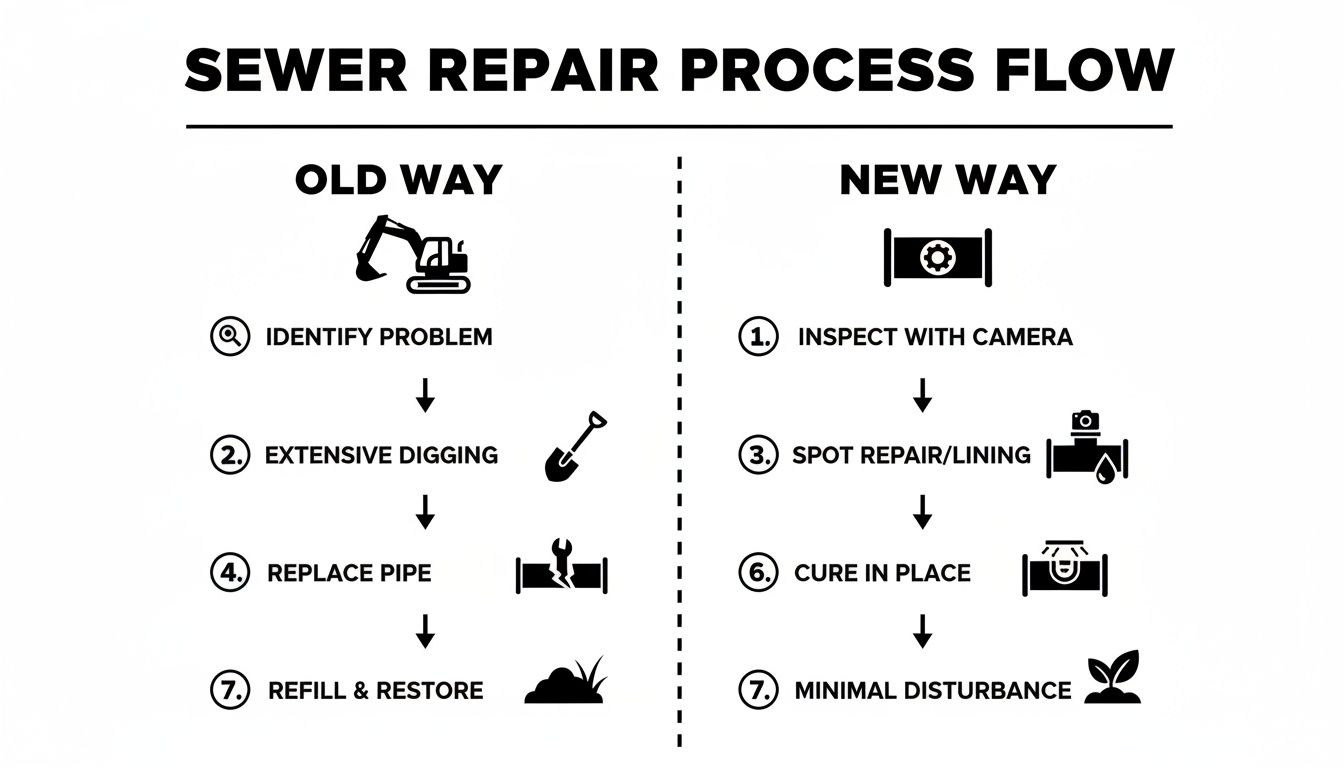
The biggest difference you’ll notice is how we get the job done. Instead of a huge trench across your yard, we work from just one or two small access points. It’s a game-changer for homeowners needing sewer repair near me.
Cured-In-Place-Pipe (CIPP) Lining
The most common method we use is called Cured-In-Place-Pipe (CIPP) lining. The best way to think about it is like doing surgery inside an artery without having to make a big cut. We’re essentially building a brand-new, super-strong pipe right inside your old one.
Here’s how it works, step by step:
- Cleaning and Inspection: First things first, we have to clean out the old pipe. This often involves drain cleaning with high-pressure water jets to scour away any roots, gunk, or scale buildup. Then, we run a special sewer camera through to get a good look and make sure the pipe is ready.
- Liner Insertion: We take a flexible, felt liner and saturate it with a special two-part epoxy resin. This soupy liner is then carefully fed into your damaged pipe, usually through a small access point we can find in your yard or basement.
- Inflation and Curing: Once the liner is in position, we inflate a bladder inside it. This presses the liner tight against the walls of the old pipe. Then, we let the epoxy "cure," or harden, which usually takes a few hours.
- Final Result: We pull the bladder out, and what’s left behind is a rock-solid, seamless new pipe. It’s perfectly smooth and seals up all the old cracks, holes, and bad joints for good.
CIPP lining is the perfect fix for pipes that have cracks, some corrosion, or root problems but haven't completely collapsed. It's a favorite for sewer repair in Roswell and Johns Creek, where nobody wants to tear up beautiful old trees and pristine landscaping.
Many homeowners ask, is pipe relining worth it for their home? The answer usually comes down to the condition of the pipe, but for most situations with viable host pipes, it’s an incredible long-term investment.
Pipe Bursting
But what if the pipe is totally collapsed, severely broken, or you need a bigger pipe to handle more water flow? That's when we turn to our second method: pipe bursting. This one is less like surgery and more like hitting the reset button on your entire sewer line.
As the name suggests, this technique is a bit more aggressive. We literally destroy the old pipe while simultaneously pulling a brand-new one into the exact same spot.
Here’s the rundown on pipe bursting:
- Access Pits: We start by digging two small pits, one at each end of the section of pipe we're replacing.
- The Bursting Head: We attach a cone-shaped steel head, the "bursting head," to a new, seamless pipe made of high-density polyethylene (HDPE). This new pipe is tough, flexible, and made to last over 50 years.
- Pulling It Through: A heavy-duty cable gets threaded through the old, busted pipe and connected to the bursting head. Then, a powerful hydraulic machine starts pulling.
- Breaking and Replacing: As the machine pulls, the bursting head smashes the old pipe (whether it's clay, cast iron, or PVC) into the surrounding soil. The new, stronger HDPE pipe follows right behind it, sliding perfectly into place.
Pipe bursting is our go-to for sewer replacement when the original line is just too far gone to be relined. We also use it for main water line replacement, which lets a 24 hour plumber upgrade a home’s water service in Canton or Cumming without turning the whole yard into a construction site.
Why Choose Trenchless Repair for Your Atlanta Home
When you discover a problem with your main sewer line, the first image that probably pops into your head is a backhoe tearing a massive trench across your beautiful lawn. For homeowners across North Metro Atlanta, from Woodstock to Johns Creek, that mental picture is a nightmare. But what if you could fix the pipe without destroying your yard? That's exactly why trenchless sewer repair is quickly becoming the go-to solution for smart homeowners.
Opting for a "no-dig" repair over old-school excavation tackles all the big worries head-on: property damage, time, cost, and getting a long-lasting fix. It's more than just a repair—it's an investment in protecting the home you've worked so hard to create.
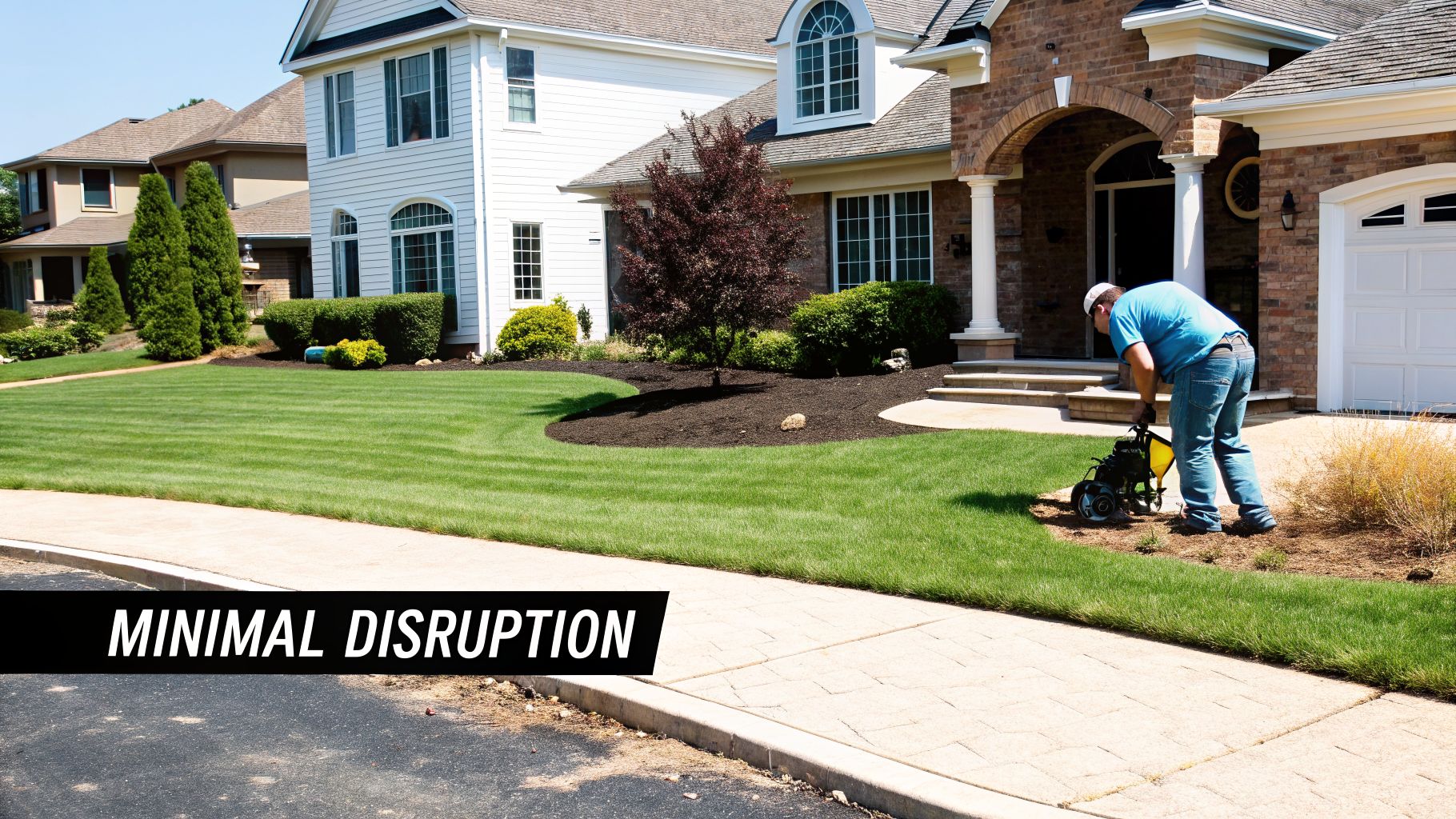
Minimal Property Disruption
This is the benefit you'll see—or rather, won't see—right away. Traditional sewer replacement means digging a long, deep trench from your house all the way to the street, destroying everything in its path. Your carefully tended lawn, that old oak tree, the custom patio, your brand-new driveway—they're all in the line of fire. The whole process can leave your property looking like a disaster zone for weeks.
Trenchless methods, on the other hand, are like keyhole surgery for your pipes. Instead of a huge trench, we can do the entire repair through one or two small, manageable access points. We're talking about holes just a few feet wide.
This approach means:
- Your landscaping is safe: Mature trees, flower beds, and retaining walls are left completely undisturbed.
- Your hardscaping remains intact: We won't have to demolish and rebuild your driveway, walkways, or patio.
- Your yard stays clean: You won't have a mountain of dirt sitting on your lawn for days on end.
For homeowners in established neighborhoods like Roswell or Marietta with landscapes they’ve spent years perfecting, this benefit alone makes trenchless repair the clear winner.
Faster Repair and Restoration
A traditional sewer line dig-up can turn your life upside down for a week, sometimes longer. You have to deal with the noise and mess of digging, the pipe replacement itself, inspections, and then finally filling the trench back in. And even after the plumbers leave, you’re stuck with the slow, expensive job of restoring your yard.
Trenchless sewer repair shrinks that chaotic timeline dramatically. Since there’s almost no digging, most projects can be finished in just one to two days. Our team can show up, fix the pipe, and be out of your hair before you know it, getting your home—and your life—back to normal with incredible speed.
This speed is a game-changer in an emergency. If you have a clogged toilet that won’t flush because of a main line backup or you smell a sewage smell, a 24 hour plumber using trenchless tech can solve the crisis without turning it into a week-long construction project.
Surprisingly Cost-Effective
At first, the price-per-foot for trenchless repair might seem similar to digging. But here's the catch: the initial quote for a traditional excavation almost never includes the biggest expense: restoration costs.
Just think about all the hidden costs that come with digging up your yard:
- Re-sodding your lawn can easily run into thousands of dollars.
- Repaving a concrete or asphalt driveway is a major, costly project.
- Rebuilding a custom brick patio or walkway can be incredibly expensive.
- Replacing mature trees or professional landscaping is sometimes impossible.
Once you add up all these "soft costs," trenchless repair almost always comes out as the more affordable choice. It completely eliminates the need for expensive landscaping and hardscaping repairs, saving homeowners in Cumming and Alpharetta a ton of money and a major headache.
A Long-Lasting, Durable Solution
Don't think of trenchless repair as a temporary patch. It’s a permanent fix that leaves you with a pipe that is often stronger and more reliable than the original. Both CIPP lining and pipe bursting create a brand-new, seamless pipe right inside the old one.
This new pipe has no joints, which gets rid of the weak points where tree roots love to sneak in and cause clogs. The modern materials we use, like epoxy resin for liners and tough HDPE for new pipes, are built to resist corrosion, cracks, and root intrusion. In fact, a professionally installed trenchless pipe has a life expectancy of 50 years or more, giving you true peace of mind for decades to come.
When Is Trenchless Sewer Repair the Right Solution?
So, how do you know if you have slow drains or a sign of something much more serious happening underground? It’s a common question we get from homeowners all over North Metro Atlanta. Telling the difference between a minor plumbing hiccup like needing drain cleaning and a failing main sewer line can be tough.
This guide will walk you through the telltale signs that your home might be a perfect candidate for a "no-dig" trenchless solution. Catching it early can mean the difference between a fast, modern repair and having your entire yard dug up. Certain symptoms are dead giveaways that you're dealing with more than just a backed-up drain.
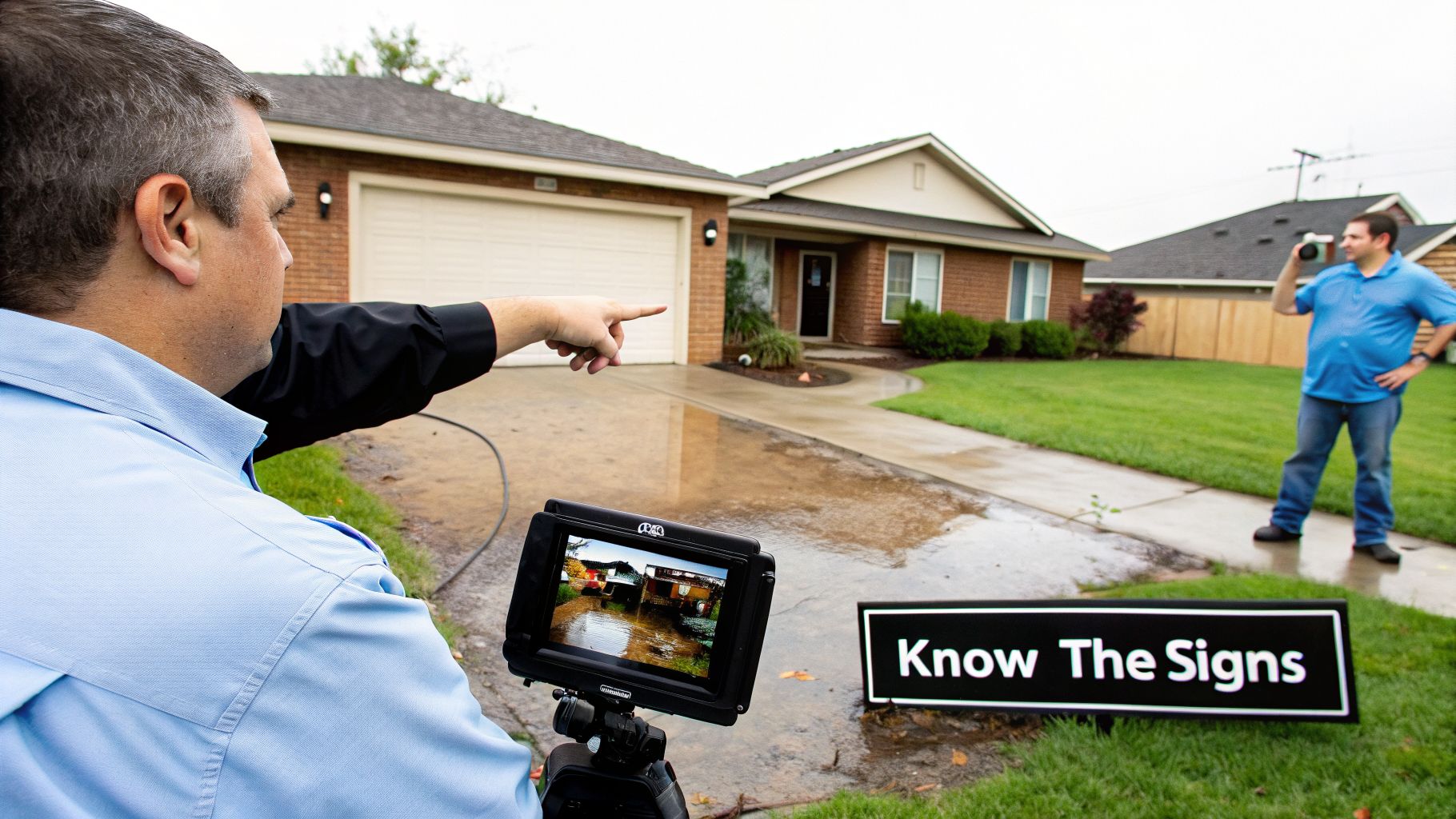
Telltale Signs of a Main Sewer Line Problem
If you spot one of these issues, it might be a localized problem. But if you're dealing with a few of them at once, that’s a strong signal your main sewer line is in trouble and needs a professional look.
- Persistent Backups in Multiple Drains: A single slow drain is annoying. But when the toilet, shower, and kitchen sink all back up together? That's a major red flag. It usually means the problem isn't with an individual pipe but with the main sewer line that everything in your house drains into.
- Gurgling Noises from Toilets and Drains: Ever hear your toilet gurgle when the washing machine drains? Or maybe you've noticed bubbling sounds from the shower drain after flushing? That's air getting trapped by a blockage in the main line and being forced back up through your fixtures.
- Foul Sewage Odors: That unmistakable sewage smell inside your house or wafting through your yard is a clear sign of a break or crack in the line. Don't ignore this one—sewer gas can be hazardous to your health.
- Unexplained Soggy Patches in Your Yard: If there’s a wet, mushy spot on your lawn (water in yard) that never seems to dry out (especially when it hasn't been raining), you likely have a leak repair issue. Wastewater is seeping out of the broken pipe and saturating the ground from below.
- An Unusually Lush, Green Patch of Grass: Sometimes, a leaking sewer acts as a potent fertilizer. If one patch of grass is suddenly way greener and healthier than the rest of your yard, it might be getting a nutrient boost from a cracked pipe.
These are the kinds of symptoms that often lead to calls for an emergency plumber in Woodstock or a 24 hour plumber in Marietta. They point directly to a problem that a simple drain snake just can't handle.
Common Causes of Sewer Line Failure
What causes these kinds of headaches in the first place? Here in areas like Cobb County and Cherokee County, with a mix of both older and newer homes, we see a few usual suspects time and time again.
The most important takeaway is that these symptoms are your home’s early warning system. Ignoring them often leads to a complete sewer backup or a collapsed pipe, turning a manageable repair into a much more expensive and disruptive emergency.
For example, invasive tree roots are a huge problem. They instinctively seek out the water and nutrients inside your sewer line, pushing their way through tiny cracks at the pipe joints. Over time, those roots grow into a thick, tangled mass that catches everything going down the drain, causing serious blockages and eventually breaking the pipe apart.
Deteriorating old pipes are another common issue. Many older homes in Canton and Roswell were built using cast iron or clay pipes. After 50+ years, cast iron can rust and become brittle, while clay pipes can easily crack under the pressure of shifting soil. This leads to leaks, collapses, and the need for a full sewer replacement.
The Only Way to Know for Sure
While these signs are strong clues, there’s only one way to know exactly what’s going on and if trenchless repair is the right move: a professional sewer camera inspection.
A trained technician will guide a high-resolution camera down into your sewer line. This lets us see the pipe's condition in real-time, pinpointing the exact cause, location, and severity of the damage. This inspection is what confirms whether your pipe has cracks that can be relined or if it has collapsed and needs pipe bursting. It’s the essential first step to getting a fast, accurate, and cost-effective sewer repair in Acworth or anywhere else in North Fulton.
Understanding Trenchless Sewer Repair Costs in Atlanta
When you're staring down the barrel of a main sewer line replacement, cost is almost always the first question. Homeowners naturally want to know: is trenchless repair more expensive than the old-school digging method? The answer isn't a simple yes or no—it really depends on how you look at the total project cost.
The initial quote for a trenchless repair might look pretty similar to an excavation quote, especially when you break it down per foot. The real financial story, however, is in what you don't have to pay for once the plumbing work is done.
What Factors Influence the Price
There's no single price tag for a no-dig repair. The final cost for a project in a North Atlanta city like Acworth or Roswell hinges on a few key things that a professional plumber will figure out during a camera inspection.
- Repair Method: CIPP lining and pipe bursting use different materials and have different labor requirements. Pipe bursting, since it involves replacing the whole pipe, is usually a bit more intensive.
- Pipe Length and Diameter: This one's straightforward—longer and wider pipes need more materials, which directly affects the price.
- Accessibility: How easy is it to get to your sewer line? A pipe buried deep under a concrete slab or located in a tight spot might need a little more setup time.
- Severity of Damage: A pipe with a few simple cracks is much easier to line than one that has partially collapsed. A collapsed pipe requires a lot more cleaning and prep work before the real repair can even start.
As you weigh the financial side of things, it helps to understand the factors driving the cost of trenchless pipe lining. Ultimately, getting a transparent, on-site quote is the best way to make a decision you feel good about.
The Real Savings of Going Trenchless
The plumber's bill is only one piece of the puzzle. With traditional excavation, the biggest expenses often pop up after the new pipe is in the ground. This is where trenchless methods really shine and can save you a small fortune.
Think about it: a backhoe tearing a 6-foot-deep trench from your house to the street will destroy everything in its path. Those are all costs you'll have to cover out-of-pocket, and they add up fast.
With trenchless, you completely avoid paying to:
- Re-sod your entire lawn, which can cost thousands.
- Repave a concrete or asphalt driveway.
- Rebuild a custom patio, walkway, or retaining wall.
- Replace mature trees and expensive landscaping.
The market for trenchless solutions is booming, and for good reason. Experts project it will hit USD 70 billion by 2033 because these methods can slash project timelines by 50-70% and cut overall costs by up to 40% compared to digging.
For a homeowner in Cumming or Marietta, this translates to massive savings by sidestepping the huge expense of restoring your property. This trend is why trenchless has become the go-to standard for smart property owners.
If you live in Cobb County, Forsyth County, or North Fulton, this makes trenchless repair a much smarter long-term investment. By avoiding thousands in restoration costs, you protect both your property’s value and your bank account.
Why Choose a Local Expert for Your Trenchless Repair
When your sewer line backs up or you suspect a major break, the situation can feel overwhelming. It’s easy to panic and call the first number you find, but picking the right professional is the most critical decision you'll make. For a job as important as a trenchless sewer repair, a local North Metro Atlanta expert isn’t just a good idea—it’s the key to a lasting, stress-free solution.
A big, faceless national chain just can't offer the same level of specific know-how that a local plumber brings to the table. We know the unique challenges of this area inside and out, from the dense clay soil common in Cobb County and Cherokee County to the particular building codes in cities like Marietta, Woodstock, and Alpharetta. This firsthand experience ensures your repair is done correctly the first time, saving you from headaches down the road.
The Advantage of True Local Knowledge
Fixing a buried pipe isn't a one-size-fits-all task. A local plumber who has spent years working in Forsyth County and North Fulton knows exactly what to look for when they send a camera down your sewer line.
This deep familiarity means we can:
- Quickly identify problems common to the area, like aggressive tree roots in older neighborhoods or pipes that have shifted due to our region’s soil composition.
- Smoothly handle local permitting in cities from Canton to Roswell, avoiding frustrating delays.
- Advise you on the best repair method (CIPP lining vs. pipe bursting) based on the age and type of pipes typically found in homes just like yours.
When you hire a company that lives and works here, you’re getting a team that has already solved your exact problem for your neighbors dozens of times.
Trust, Availability, and Modern Equipment
During a sewer backup or a potential burst pipe repair, you need a team you can trust to be there when you call. That's why our 24 hour plumber service is so vital for local homeowners. We're not a distant call center that dispatches a random subcontractor. We’re your neighbors, ready to respond quickly when you’re searching for an emergency plumber near me.
A Master Plumber certification isn't just a piece of paper; it's a promise of accountability and a dedication to the highest standards in the industry. It means your home is in the hands of a true professional committed to protecting your property and family.
Being part of the community also means investing in the right tools for the job. We use advanced diagnostic cameras for pinpoint-accurate inspections and the best trenchless equipment available to ensure your new sewer line is perfect. It's this commitment to quality that has earned us the trust of homeowners for everything from sewer replacement in Cumming to main water line repair in Johns Creek.
Don’t let a broken sewer line destroy your yard. Contact a proven local expert today for a fast diagnosis and a no-dig repair estimate.
Common Questions About Trenchless Sewer Repair
Even after hearing about the benefits, most homeowners still have a few questions before committing to a no-dig repair. We get it. This approach is worlds apart from the old way of doing things, and you want to be sure you're making the right call. We've pulled together the most common questions we hear from folks in Woodstock, Acworth, and all over North Metro Atlanta to help you feel confident about your decision.
How Long Does Trenchless Sewer Repair Last?
This is usually the first thing people ask, and for good reason. The answer is incredibly encouraging. A trenchless repair isn't just a temporary fix—it's a brand-new, super-strong pipe created inside your old one. The materials, like the epoxy resin in CIPP lining or the tough HDPE pipe used in bursting, are built to fight off corrosion, cracks, and those pesky tree roots.
Bottom line: a professionally installed trenchless repair is expected to last for over 50 years. It's a permanent fix that buys you decades of peace of mind. That durability makes it one of the smartest long-term investments you can make in your home.
Can Trenchless Methods Fix Any Pipe?
Trenchless technology is a game-changer, but it can't solve every single problem. The good news is that it works perfectly for the vast majority of sewer line headaches we see in homes around Roswell and Alpharetta.
It’s an ideal solution for:
- Cracks and fractures: CIPP lining creates a seamless seal over these weak spots.
- Persistent root intrusion: The new joint-free pipe gives roots nowhere to sneak in.
- Gaps and misaligned sections: Both lining and bursting form a single, continuous pipe that won't shift.
- Corroded cast iron pipes: This is the best way to bring an old, deteriorating line back to life.
But there are limits. If a pipe is completely crushed or has a severe "belly" (a dip where waste and water pool), we may need a different strategy. While pipe bursting can handle a collapsed line, a totally flattened section might require a small, targeted dig to fix that spot correctly. A professional camera inspection is the only way to know for sure what kind of sewer replacement or repair will work best for you.
The key takeaway is that trenchless methods are a fantastic match for most sewer line issues. For older homes in Marietta or Canton with original cast iron pipes, it’s a brilliant way to restore the system without destroying the yard.
Is the Process Noisy or Messy?
Compared to digging a giant trench, trenchless repair is incredibly quiet and tidy. You can forget about the nightmare scenario of a loud backhoe tearing up your yard for days. All the action happens at one or two small entry and exit points that are easy to manage.
There's no huge trench scarring your property, no mountain of dirt piled on your grass, and no need to rip out your beautiful patio or driveway. The equipment is powerful, but it runs with far less noise and chaos. Your daily routine—and your good relationship with your neighbors—can carry on almost completely undisturbed.
Will It Work on My Older Home’s Cast Iron Pipes?
Absolutely. In fact, trenchless repair is one of the very best solutions for aging cast iron sewer lines. After decades, cast iron starts to rust, crack, and become brittle. Instead of digging up your entire yard to replace it, CIPP lining lets us build a brand-new, stronger pipe right inside the old one.
This process stops corrosion in its tracks and seals up any leaks or weak points for good. It's the perfect way to modernize the plumbing in an older home in Cumming or Johns Creek without the destructive mess of a traditional main water line repair or sewer excavation.
When you're dealing with a sewer backup or a clogged toilet that won’t flush, you need an expert you can trust—and you need them fast. For over 25 years, JMJ Plumbing has delivered reliable 24/7 emergency service and expert trenchless repairs across North Metro Atlanta. As certified Master Plumbers, we promise a quick, accurate diagnosis and a durable, no-dig solution that protects your home and yard. Schedule your expert sewer camera inspection today by visiting us at https://www.jmjplumbing.com.