That lukewarm morning shower is often the first clue your water heater is on its last legs. But deciding when to replace it is about more than just convenience—it’s about preventing a sudden, messy, and expensive failure. Waiting too long can turn a simple water heater replacement into a full-blown plumbing emergency requiring a 24 hour plumber.
Is It Time for a New Water Heater?
Learning to spot a failing water heater before it bursts is a skill every homeowner in North Metro Atlanta should have. An old unit isn't just inefficient; it's a ticking time bomb for water damage. Ignoring the signs is like gambling with a main water line repair, only the disaster is happening inside your basement, attic, or closet.
Sure, having no hot water is a dead giveaway. But the real trouble usually starts much quieter. You might notice your hot showers are getting shorter or that the water temperature is all over the place. These are classic signs of a failing heating element or, very commonly in our area from Woodstock to Marietta, a tank clogged with sediment, leading to a search for "water heater replacement near me."
Pro Tip: A water heater that's 10-12 years old is living on borrowed time. Once your unit hits that mark, you should be actively planning for a replacement, not waiting for it to fail on a cold winter morning and forcing an emergency plumber call.
Inconsistent Hot Water or Sudden Cold Showers
Does the hot water seem to run out way faster than it used to? That’s a tell-tale sign of trouble. Over the years, sediment builds up at the bottom of the tank, creating a thick barrier between the burner and the water. This forces your heater to work overtime just to do its job, which means less hot water for you and higher energy bills. This slow drain on your hot water supply is as frustrating as a slow drain in your sink.
And what about those shocking blasts of cold water mid-shower? That's often a broken dip tube. This simple plastic tube is supposed to push incoming cold water down to the bottom of the tank to be heated. When it cracks or breaks off, that cold water mixes in right at the top, giving you that unwelcome lukewarm surprise.
Spotting Leaks and Corrosion Early
Any water pooling around the base of your heater needs immediate attention. While you might get lucky with a simple loose fitting, it more often signals a crack in the internal tank. That’s not a repairable problem—it means you need an immediate water heater replacement in Acworth or wherever you are in Cobb County. This type of leak repair is actually a full replacement.
Take a close look at the tank's exterior, especially around the pipe fittings and seams. See any rust or corrosion? That’s a bad sign, indicating the metal is starting to fail. Don't wait on this. A burst pipe repair is one thing, but cleaning up after a 40- or 50-gallon tank lets go is a nightmare you want to avoid.
Why Your Hot Water Is Discolored or Smelly
If your hot water suddenly looks rusty or brown, it's a major red flag that the inside of your tank is corroding away. It means the anode rod, a part designed specifically to prevent rust, has probably been completely used up.
A distinct "rotten egg" smell is another issue. This usually points to bacteria that have started growing inside your tank, often as a result of a chemical reaction with the anode rod. This is different from the sewage smell you might notice from a sewer backup issue.
- Rusty Water: This means the tank itself is rusting from the inside out. It's only a matter of time before it leaks.
- Rotten Egg Smell: Caused by bacteria creating hydrogen sulfide gas. While fixable, it's often a sign of an older, neglected tank.
These aren't just minor annoyances; they're the final warnings before total system failure. If you're seeing any of these signs, it's time to get serious about a replacement. For a more detailed breakdown, this homeowner’s guide to hot water system replacement is a great resource.
Matching Your Water Heater to Your Household Needs
Getting the right size water heater is, without a doubt, the most important part of this whole process. Get one that’s too small, and you’re signing up for cold showers and morning chaos. Go too big, and you're just throwing money away on your energy bill every single month. It’s all about finding that sweet spot.
For homeowners here in Alpharetta, Roswell, and Johns Creek, it comes down to one thing: your actual hot water demand. I'm not just talking about how many people live in your house. What really matters is how many people need hot water at the same time during your busiest hour of the day.
This flowchart is a great starting point. It helps you quickly see if you're in "maintain and monitor" mode or if it's time to start planning a replacement.
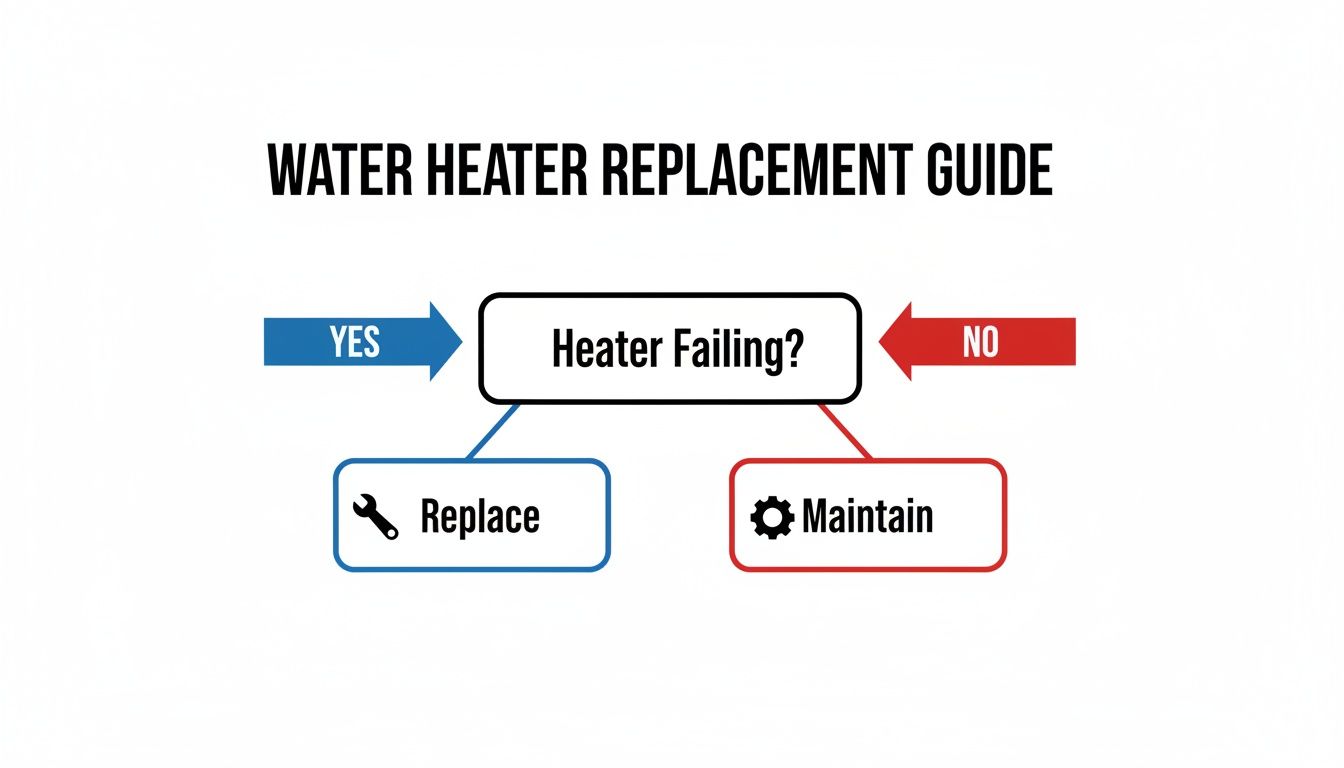
The bottom line is simple: if your heater is on its last legs, replacing it is the only safe move. If it's still chugging along, good maintenance is your best bet to keep it that way.
Sizing Up Your Peak Demand
To get sizing right, you need to know a term we use in the industry: First Hour Rating (FHR). You’ll find this number on the yellow EnergyGuide sticker on the side of any new tank-style water heater. It tells you exactly how many gallons of hot water the heater can deliver in one hour of heavy use, starting from a full, hot tank.
Your goal is to find a heater with an FHR that matches your family's "peak hour."
Think about the most frantic hour in your home. Is someone showering while the dishwasher is running and you've just thrown in a load of laundry? That’s your peak hour, and that’s what we need to calculate for.
Estimate Your Peak Hour Hot Water Needs
You can get a pretty solid estimate of your needs by adding up your hot water usage during that morning rush. This table will walk you through it. Just fill in the last column based on what your family actually does.
| Activity/Appliance | Average Gallons Used | Your Household's Morning Rush (Example) | Your Gallons |
|---|---|---|---|
| Showering | 10-12 gallons | Two showers back-to-back (2 x 12 gal) = 24 gal | |
| Bathing | 20 gallons | ||
| Dishwasher | 6-10 gallons | One cycle = 6 gal | |
| Washing Machine (hot) | 7-10 gallons | ||
| Hand Washing (dishes/sinks) | 4-5 gallons | ||
| Total Peak Hour Need | 30 Gallons | (Your Total) |
Once you’ve added everything up, you have your target FHR. In our example, the family needs a water heater with an FHR of at least 30. This ensures they won't run out of hot water when they need it most.
I see this all the time: people buy a 50-gallon tank heater and assume they get 50 gallons of hot water right away. That’s not how it works. The FHR is the real number that counts, not just the tank size. A high-efficiency 40-gallon unit can easily outperform a cheap 50-gallon one.
Does Tank Size Still Matter?
Absolutely. While the FHR is your performance metric, the tank size itself acts as your reservoir. For a couple in a small Acworth condo, a 40-gallon tank is often plenty. But for a family with a few kids in a Canton house with three bathrooms, a 50-gallon tank is usually the bare minimum we’d recommend. If you've got a big soaking tub or a house full of teenagers, you might even need an 80-gallon tank to keep everyone happy.
Believe it or not, residential use drives 60-70% of the water heater market, so getting this right is a big deal for everyone. For our customers from Johns Creek to Smyrna, it almost always comes back to that peak hour. A typical family of four often needs a unit with an FHR in the 60-80 gallon range to handle things like two showers and a dishwasher running at once. This is also where tankless water heaters shine, as they can deliver 5-8 GPM of endless hot water—a perfect fit for high-demand homes that can also save you a lot on energy. You can dig into more data on water heater market trends to see how sizing impacts efficiency.
Planning Ahead for a Growing Family
Thinking about the future is smart, especially in growing communities across North Fulton and Forsyth County. The water heater you buy today should ideally last you 10-15 years, so you need it to meet your needs down the road.
Here are a couple of real-world scenarios we see often:
- A Young Family in Cumming: A 40-gallon tank might seem fine now, but what happens when you have two teenagers taking long showers every morning? Spending a little more upfront for a 50-gallon model gives you that buffer for the future.
- An Alpharetta Home with a Basement: If you're planning to finish the basement and add another bathroom, your hot water needs are going to jump. Installing a larger tank or a powerful tankless system now is far easier and cheaper than realizing you’re short on hot water and needing a whole new water heater replacement in five years.
Forgetting to plan for growth can leave you with a perfectly good water heater that's simply too small for your family. When you're dealing with a plumbing crisis, like a clogged toilet that won’t flush or a messy sewer backup, the last thing you want is another headache. An emergency plumber in Woodstock can fix the immediate problem, but smart planning today prevents the next one tomorrow.
Tank vs Tankless Water Heaters Explained
When it comes to water heaters, the biggest decision most homeowners in Canton and Cumming face is whether to stick with a traditional tank or upgrade to a modern tankless system. It's a classic crossroads. One path offers time-tested reliability and a lower initial price tag; the other promises endless hot water and long-term energy savings.
Let's break down what that choice really means for your North Metro Atlanta home, your morning routine, and your monthly budget.
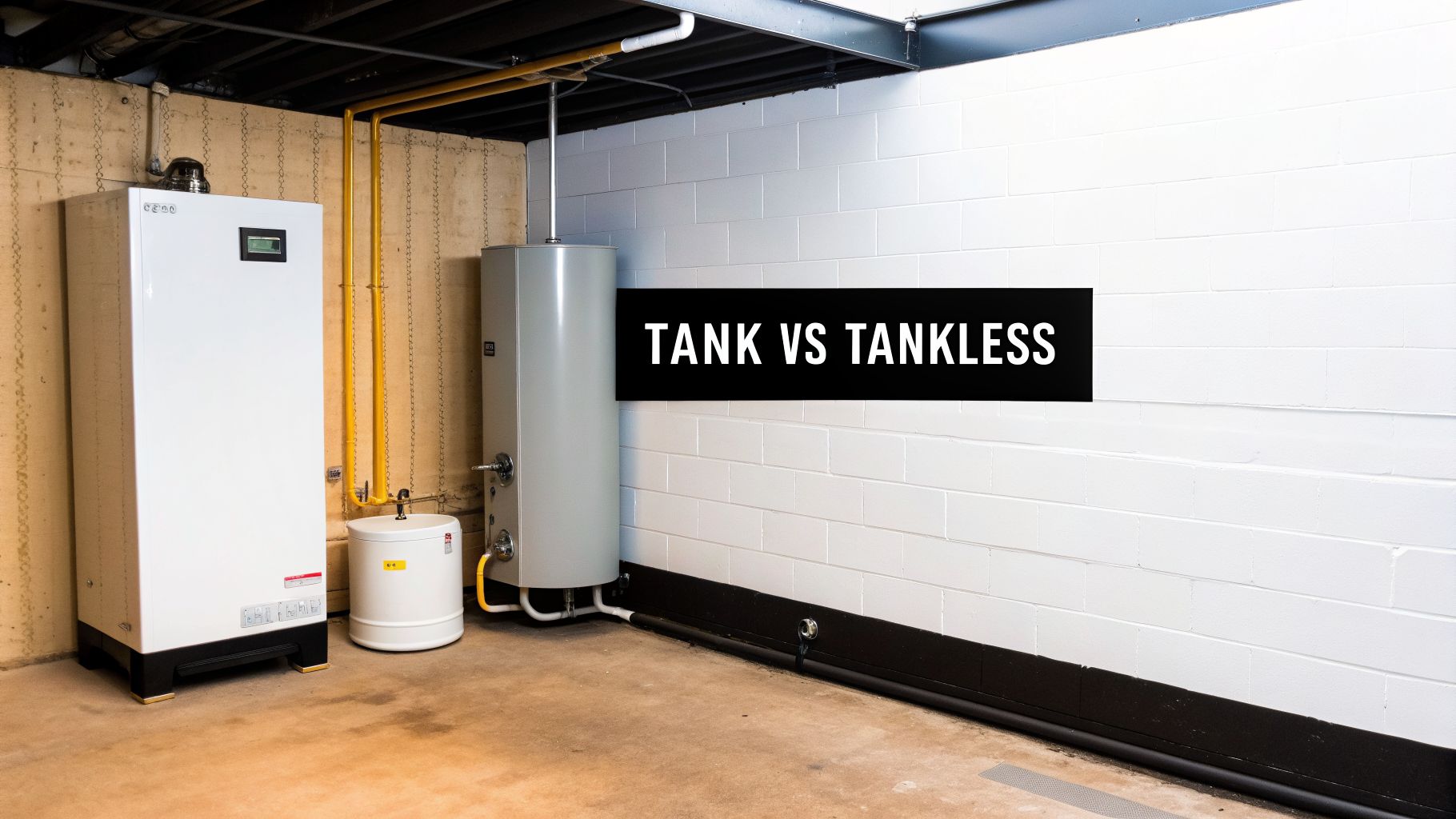
The Reliable Workhorse: Storage Tank Water Heaters
You've seen them a thousand times—the big, cylindrical tanks tucked away in basements and utility closets all over Cobb and Cherokee County. Storage tank water heaters are the industry's dependable workhorses. They work by keeping a large reservoir of water—usually 40, 50, or 80 gallons—constantly heated and ready for you at a moment's notice.
The main benefit here is the lower upfront cost, especially for a water heater replacement. If you already have a tank, putting a new one in its place is typically a straightforward job. The downside, however, is something called "standby heat loss." The unit has to burn energy around the clock just to keep that big tank of water hot, which can add up on your utility bills.
Key Features of Tank Heaters:
- Lower Upfront Cost: They are hands-down more affordable to buy and install than tankless models.
- Proven Technology: It's a simple, reliable design that has served homeowners well for decades.
- Limited Supply: The big drawback. Once the hot water is gone, it's gone. You have to wait for the tank to refill and reheat, which can be a real pain for larger families.
The On-Demand Choice: Tankless Water Heaters
Tankless water heaters completely change the game. Instead of storing hot water, these on-demand units use powerful burners or heating elements to heat water instantly as it passes through. The result? A virtually endless supply of hot water. No more racing to beat the shower rush.
Their biggest selling points are efficiency and longevity. Since they only fire up when you open a hot water tap, they can dramatically cut your water heating costs. We're seeing more and more customers in Acworth, Kennesaw, and Marietta asking for these as they prioritize lower bills. An electric tankless model, for example, can offer 24-34% energy savings over a standard tank.
The upfront investment for a tankless water heater is higher. The unit itself costs more, and installation can be more complex, sometimes requiring upgrades to your gas lines or electrical panel. However, with a lifespan of 20+ years—nearly double that of a tank—the long-term value is compelling.
Getting the most out of these advanced systems requires a bit of homework. Properly sizing the unit is critical, so be sure you understand how to choose a tankless water heater before making a final decision.
High-Efficiency Hybrid and Heat Pump Heaters
There’s a third option that’s been gaining a lot of traction in North Fulton and Forsyth County: the hybrid electric water heater, also called a heat pump water heater. Think of it as a refrigerator working in reverse. It pulls heat from the ambient air around it and transfers that heat into the water stored in its tank.
This technology makes them incredibly efficient—often 2-3 times more efficient than a standard electric tank. For them to work correctly, they need to be installed in a space with plenty of air, at least 1,000 cubic feet, which makes a basement or large garage the perfect spot.
- Pros: The energy savings are massive, and you could see your water heating bill cut by more than half. As a bonus, they also act as a dehumidifier for the space they're in.
- Cons: The initial cost is quite high. They're also taller than standard tanks and require a nearby drain for condensate. In colder spaces, their efficiency drops, and they have to rely on backup electric elements to keep up.
Choosing the right system comes down to balancing your family’s needs with your budget. After all, life can throw you a curveball like a sudden sewer backup or an unexpected burst pipe repair, so making a smart investment that balances upfront cost with long-term savings is key.
Thinking Past the Price Tag: Long-Term Costs and Energy Savings
It's easy to focus on the upfront cost of a new water heater, but that's just a small part of the story. The real investment isn't the price on the sticker; it's what you'll spend to run that unit over the next 10 to 20 years. Making a smart decision means looking at the total picture.
A cheaper model might seem like a win today, but if it's inefficient, it will quietly drain your wallet through higher utility bills month after month. Here in the Metro Atlanta area, where energy costs can be unpredictable, that difference adds up fast—we're talking hundreds, sometimes thousands, of dollars over the life of the heater.
How to Decode the EnergyGuide Label
When you're comparing models, your best friend is the yellow EnergyGuide label. This little sticker tells you exactly what to expect in terms of running costs. The most important number on it is the Uniform Energy Factor (UEF).
Simply put, a higher UEF rating means a more efficient heater and lower energy bills. It's the most direct way to compare apples to apples on efficiency.
- A standard electric tank heater usually has a UEF around 0.90.
- A decent gas tank heater might fall between 0.60 and 0.80.
- Gas tankless models often push past 0.90.
- Hybrid "heat pump" water heaters are the champions of efficiency, boasting a UEF of 3.0 or even higher.
For any homeowner in Woodstock or Roswell, grabbing a unit with a better UEF translates directly into real, noticeable savings every single month.
Calculating Your True Cost of Ownership
To see the real value, you have to think like an accountant for a minute and figure out the Total Cost of Ownership (TCO). This is just a simple formula: the purchase and installation price, plus the energy costs over the unit's entire lifespan.
Let's walk through a common scenario for a family in Marietta. They're trying to decide between two 50-gallon water heaters:
- Standard Electric Model: The upfront cost is $800 installed. It has a UEF of 0.93, and the estimated annual energy cost is $520.
- ENERGY STAR® Hybrid Model: This one is $2,000 installed. Its UEF is a massive 3.45, and it only costs about $140 a year to run.
The hybrid model costs $1,200 more at the outset. But here's the magic: it saves the family $380 every year in electricity costs ($520 – $140). That means the extra investment pays for itself in just over three years. Over its 13-year lifespan, this hybrid unit will save that Marietta family more than $4,900.
The payback period is what really matters here. A high-efficiency unit might feel expensive upfront, but when it pays you back in a few years and then keeps saving you money for another decade, you're not just buying an appliance—you're making a smart financial investment in your home.
Don't Forget About Rebates and Tax Credits in Georgia
Here's the best part: you often don't have to pay the full sticker price for these high-efficiency models. Both federal tax credits and local utility rebates can slash the cost of an ENERGY STAR® certified water heater.
These programs exist to give homeowners a nudge toward making greener choices. A federal tax credit, for example, could cover 30% of the cost of a new heat pump water heater. Suddenly, that "expensive" option looks a lot more manageable. Many of our local Georgia power companies offer their own rebates on top of that.
We've seen a huge shift toward high-efficiency models for a reason. Units with a UEF above 3.0 can save a household $400-$500 every year. For our customers in Marietta, Roswell, and Alpharetta, choosing ENERGY STAR units means cutting energy use by an average of 27%. You can dig deeper into these water heater market insights to see where the industry is heading.
Before you pull the trigger, always do a quick search on your utility provider's website and the ENERGY STAR site. You might find savings that make the best choice the easiest one, too. Our team stays up-to-date on these programs and can help you find and apply for every incentive you qualify for.
Why You Should Never DIY a Water Heater Installation
You’ve done your homework and picked the perfect water heater. Now comes the tempting part: thinking you can save a few hundred bucks by installing it yourself. I get it, but let me be direct—this is one job you absolutely must leave to a professional.
A water heater isn't like a new faucet. You're dealing with high-pressure water lines, high-voltage electricity, or even a live natural gas connection. One wrong move doesn’t just mean a messy leak; it can lead to catastrophic flooding, a fire, or a dangerous gas situation. For homeowners in North Metro Atlanta, hiring a licensed and insured plumber isn't just a recommendation; it’s essential for protecting your home and family.

Critical Questions for Any Plumbing Contractor
Finding the right plumber for a water heater replacement in Woodstock or Alpharetta means asking the right questions. Don't be shy about vetting a contractor. A true professional will welcome these questions and have the answers ready.
-
Are you licensed and insured in Georgia? This is non-negotiable. Ask to see their Georgia Master Plumber license and their certificate of insurance. This is your protection if anything goes sideways.
-
Can you give me a detailed, written quote? A simple number on a business card isn't enough. A proper estimate should break down all the costs: the unit itself, labor, new pipes or valves, permit fees, and the cost to haul away your old heater.
-
Do you handle the permit process? The answer should always be "yes." A pro will pull all necessary permits and schedule the final inspection. If a contractor tells you a permit isn't needed, that's a huge red flag. Run, don't walk.
-
Who will actually be doing the work? Will it be the experienced plumber you're talking to or a less-experienced technician? You have a right to know who will be in your home and to feel confident in their skill level.
Getting straight answers here helps you avoid surprise charges and ensures the job is done right from the start.
The Importance of Permits and Code Compliance
In Roswell, Marietta, and across Cobb, Cherokee, and North Fulton counties, a building permit is an absolute must for a water heater replacement. It's not just bureaucratic red tape; it's a critical safety check.
The permit triggers a final inspection from a local official who confirms the work meets all current safety codes. Think of it as a second set of expert eyes on your project.
An inspector is specifically looking for things like:
- Proper ventilation for gas models to prevent deadly carbon monoxide buildup.
- A correctly installed temperature and pressure (T&P) relief valve—your heater’s most important safety feature.
- Secure, leak-free gas and water connections.
- The right electrical wiring and breaker size for electric units.
What happens if you skip the permit? If a faulty installation causes a fire or flood, your homeowner's insurance could deny your claim. That small permit fee buys you an enormous amount of protection and peace of mind.
We see it all the time when we're out for another job, like a drain cleaning or a leak repair—a water heater tucked in a corner that was clearly installed without a permit. It’s a ticking time bomb. The only way to know the work is safe and correct is to hire a pro who insists on pulling a permit.
Understanding Installation Warranties
When you get a new water heater, you actually get two different warranties. The first is from the manufacturer, which covers the tank and its parts against defects.
The second is the plumber’s workmanship (or labor) warranty. This is just as important, as it covers the quality of the installation itself. A reputable plumber will stand behind their work for at least one year. This means if a pipe they connected starts to leak, they'll come back and fix it on their dime.
Always get the labor warranty terms in writing. It’s the clearest sign that a contractor is confident in their work and committed to your long-term satisfaction.
Common Water Heater Questions in Metro Atlanta
Even after you've compared models and crunched the numbers, a few questions always seem to pop up. It’s completely normal. To help you feel confident about your choice, we’ve put together answers to the questions we hear most often from homeowners in Woodstock, Roswell, and all across North Metro Atlanta.
These aren't generic answers. They're based on decades of our team's hands-on experience with our area's specific water quality, building codes, and common home layouts.
How Long Does a Water Heater Last in Georgia?
Around here, a traditional tank-style water heater will typically give you 8-12 years of service. A well-maintained tankless unit, on the other hand, can easily last 20 years or more.
The single biggest enemy of water heaters in our area is mineral buildup. Our moderately hard water leaves behind scale that settles at the bottom of the tank. This forces your heater to work overtime just to heat the water, leading to stress and premature failure.
To get the most out of your unit, we can't stress this enough: get it flushed annually to clear out that sediment. If you want the ultimate protection, a whole-home water filtration system stops scale before it ever starts, preserving your heater's efficiency for years to come.
Do I Need a Permit for Water Heater Replacement in Roswell or Marietta?
Yes, absolutely. Almost every city and county in North Metro Atlanta—including Roswell, Marietta, Canton, and Alpharetta—requires a permit for a water heater replacement. This isn’t just red tape; it’s a crucial safety check for your home.
A permit ensures the installation is done by a licensed pro and gets a final inspection to confirm it meets current safety codes. An inspector will check for critical things like:
- Proper venting on gas heaters to prevent dangerous carbon monoxide leaks.
- A correctly installed temperature and pressure (T&P) relief valve.
- Safe, secure gas line or electrical connections.
Any trustworthy plumbing contractor will handle the entire permit process for you. If a company ever tells you to skip the permit, that’s a huge red flag.
What Is the Cost to Upgrade from a Tank to a Tankless Water Heater?
Making the switch to a tankless water heater typically costs 2 to 3 times more upfront than just swapping out an old tank for a new one. The extra cost comes from the higher price of the unit itself and the necessary upgrades to your home's plumbing and electrical systems.
Often, this involves running a larger gas line to meet the higher BTU demand, installing a new dedicated circuit, or re-configuring the ventilation.
The upfront cost is higher, there's no doubt about it. But the long-term savings are real. A tankless heater can lower your water heating bills by over 30% and lasts nearly twice as long as a standard tank. We always provide a detailed on-site quote so you can see the exact costs and decide on the best value for your situation.
My Water Heater Is in the Attic. Does That Limit My Options?
It certainly can. An attic installation brings its own set of challenges, with the biggest worry being a potential leak. A small leak up there can quickly turn into a catastrophic amount of water damage to your ceilings and everything below. A search for "leak repair near me" can become a major project when the water source is in your attic.
Because of this risk, any heater in an attic must have a properly installed drain pan connected to a drain line that runs all the way to the outside of your house.
Space is another common issue. A tall, high-efficiency hybrid water heater might simply not fit. This is where tankless units really shine for attic spaces—they’re compact, light, and can be mounted right on a wall, freeing up floor space. Our technicians always do a full site check to figure out the safest and most practical options for your attic, whether you're in Cumming, Johns Creek, or anywhere in between.
When you’re facing a plumbing issue, from needing a new water heater to dealing with a sudden sewer backup or a burst pipe repair, you need a team you can trust. JMJ Plumbing has been the go-to expert for homeowners across North Metro Atlanta for over 25 years, offering 24/7 emergency service and transparent, reliable solutions. Contact us online or give us a call to get your expert on-site quote today!