That sinking feeling you get when a toilet backs up or a foul smell starts creeping into your yard is usually followed by one big question: "How much is this going to cost me?"
When it comes to sewer line repair in the North Metro Atlanta area, the answer can be anything from a few hundred dollars for a simple fix to over $10,000 for a full-blown replacement. It all depends on what’s really going on underground. If you're searching for "sewer repair near me" in Woodstock, Alpharetta, or anywhere in Cobb County, understanding the cost factors is the first step.
Your Guide to Sewer Line Repair Costs in North Atlanta
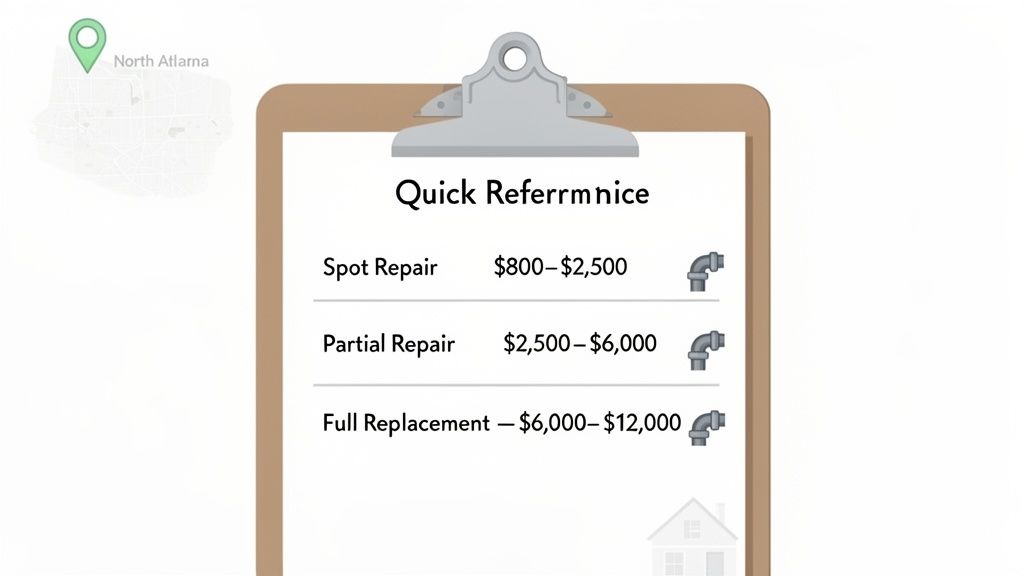
Let's be honest—nobody wants to deal with a sewer backup. It's stressful enough without the sticker shock of a surprise bill. Whether you're in Woodstock, Acworth, or Alpharetta, having a ballpark idea of the costs helps you prepare for what's ahead and make informed decisions, especially when you need a 24-hour plumber for an emergency.
Think of this guide as your starting point. The final price tag always comes after a professional diagnosis, but we can break down the major differences between a minor spot repair for a single crack and a complete sewer replacement for things like heavy root damage or a collapsed pipe.
Average Costs for North Metro Atlanta Homeowners
For homeowners from Marietta to Roswell, the cost of a sewer line fix can vary quite a bit. Based on recent figures, the average sewer line replacement hovers around $3,319. But that’s just an average—we’ve seen simple drain cleaning jobs cost as little as $225, while complex trenchless sewer replacement jobs can easily top $10,000.
If you need a full replacement, you're typically looking at $60 to $250 per linear foot. On the other hand, a simple spot repair to patch a small crack might only set you back between $600 and $1,050. You can see a more detailed breakdown of these national averages in this in-depth cost guide.
A Plumber's Advice: The only way to get a truly accurate quote is with a professional camera inspection. It's like sending a scout down the line to find the exact location and cause of the problem, whether it's slow drains, a sewage smell, or a full-blown sewer backup. This lets us recommend the smartest, most cost-effective fix, from a simple cleaning to a full sewer replacement in Canton.
Sewer Line Repair Cost Estimates for North Metro Atlanta
To give you a clearer picture, we've put together a quick-reference table. This helps set realistic expectations before you call for an emergency sewer backup or main water line repair in Johns Creek.
| Service Type | Average Cost Per Foot | Common Scenario Cost |
|---|---|---|
| Spot Repair (Traditional Dig) | N/A | $600 – $2,500 |
| CIPP Trenchless Lining | $90 – $250 | $4,000 – $15,000 |
| Pipe Bursting (Trenchless Replacement) | $60 – $200 | $3,500 – $12,000 |
| Traditional Open-Trench Replacement | $60 – $250 | $5,000 – $20,000+ |
These numbers give you a solid baseline, but every home and every sewer problem is unique.
At the end of the day, the best first step is to get a transparent, detailed quote from a trusted local plumber who serves your area—from Canton to Cumming. It’s the only way to be sure you understand all the factors at play before any work begins, whether you're facing a water line replacement or a simple leak repair.
What Drives Your Final Sewer Repair Bill
Ever wondered why your neighbor in Canton paid $1,500 for a sewer fix, while a family down the road in Cumming got a bill for $8,000? When it comes to sewer repair, there’s no single price tag. It’s a lot like fixing a car—swapping out brake pads is a completely different job, and cost, than rebuilding the entire engine. The same logic applies right under your lawn in Marietta.
The final quote you get depends on a handful of key factors. Getting a handle on these will help you make sense of any estimate a plumber in Cherokee County gives you. But before anyone can give you a real number, they have to figure out what's actually wrong.
That process starts with a professional sewer line inspection. Sending a camera down the pipe is the only way for a plumber to see the problem firsthand and develop a solid plan, taking all the guesswork out of it.
The Diagnostic Camera Inspection
Think of this as a fact-finding mission. Before a single shovel hits the dirt, a good plumber will run a high-resolution camera through your sewer line. This is how we pinpoint the exact location and see what we’re up against. Is it a simple clog causing low water pressure? A tangled mess of tree roots? A single crack in the pipe, or a total collapse requiring a full sewer replacement in Alpharetta?
This step is absolutely critical for an accurate quote. Without it, any price is just a shot in the dark. What we find on that camera feed directly shapes the repair strategy and, ultimately, how much it’s going to cost.
Key Factors That Influence Your Quote
Once we’ve diagnosed the issue, the real cost drivers come into focus. Each one of these can swing the price of a main sewer line repair up or down pretty significantly.
Here’s what a plumber in North Metro Atlanta is looking at:
- Pipe Material: A lot of older homes, say in Roswell or Acworth, still have original clay or cast iron pipes. These are brittle and notorious for cracking and rusting, making them much tougher (and more expensive) to work with than modern PVC.
- Accessibility of the Line: This is a big one. Where is the pipe? If the break is under an open patch of your lawn, access is simple. But if it’s buried under your concrete driveway, a stone patio, or right next to a 50-year-old oak tree, the job gets a lot more complex and costly. This is also a factor for a main water line repair.
- Length and Depth of the Pipe: A short, shallow repair is always going to be cheaper than a long, deep one. The deeper we have to dig, the more time, labor, and safety measures are involved, all of which add to the bottom line.
- The Extent of the Damage: Sometimes, a simple drain cleaning or a spot repair on a small crack is all you need. But if the damage is widespread—think multiple breaks or a pipe totally choked with roots—a full sewer replacement often becomes the only smart long-term solution.
For example, a homeowner in Johns Creek with a cracked PVC pipe just a few feet under their front yard might pay $1,500 for a spot repair. In contrast, a homeowner in Alpharetta with a collapsed cast iron line running 10 feet deep under a new concrete driveway could be looking at a $12,000+ bill for a trenchless replacement.
Hidden Costs to Consider
The main repair work isn't the only thing you'll see on the final invoice. A few other expenses can pop up, and knowing about them ahead of time helps you budget properly and avoids any sticker shock.
Watch out for these often-overlooked costs:
- City Permits: Most cities and counties, including Cherokee County and North Fulton County, require permits for this kind of work. The fees can run anywhere from a few hundred to over a thousand dollars depending on the municipality in Metro Atlanta.
- Landscaping and Hardscape Restoration: If your repair requires digging a trench, you’ll have to put everything back together afterward. This might mean laying new sod, replanting your garden, or even pouring a new section of your driveway. These restoration costs can add thousands to the total.
- Emergency Service Fees: A sudden sewer backup rarely happens at a convenient time. If you need a 24 hour plumber on a night or weekend for a burst pipe repair or because your toilet won't flush, expect to pay a premium for that immediate response.
By understanding all these pieces of the puzzle, you’ll be in a much better position to talk through your options with a plumber in Cumming and feel confident about the repair quote you choose.
Trenchless vs. Traditional Sewer Repair Methods
So, your plumber just told you the main sewer line is shot. Now what? You’re standing at a fork in the road, and the path you choose will have a huge effect on your property, your timeline, and the final cost to repair your sewer line. The two main options are old-school excavation and modern trenchless repair, and knowing the difference is everything.
Let's break it down with an analogy. Traditional repair is like open-heart surgery for your yard. It involves digging a massive trench to get to the damaged pipe. On the other hand, trenchless repair is more like arthroscopic surgery—it fixes the problem from the inside with just a couple of small access points.
For anyone with a home in Alpharetta, Johns Creek, or anywhere in North Fulton, this choice is a big deal. If you’ve invested in a beautiful lawn, a stone patio, or have a long driveway, a traditional dig for a sewer replacement or water line replacement can be a total nightmare.
The Traditional Approach: Digging It All Up
The traditional sewer replacement method, often called "open trench" or "dig-and-replace," is exactly what it sounds like. A backhoe rolls in and carves a path right over your sewer line, all the way from your house to the city main. We pull out the old, broken pipe and drop a new one in its place.
This method has been around forever, and sometimes, for a completely collapsed pipe, it's the only way. But the downsides are pretty steep.
- Total Disruption: It tears up everything in its path—your grass, flowerbeds, walkways, and even your driveway.
- Longer Project Time: The whole process of digging, repairing, filling the trench back in, and trying to put your yard back together can easily take several days, sometimes more than a week.
- Hidden Restoration Costs: The plumber's quote for the sewer repair doesn't cover the thousands of dollars you'll likely spend later on landscapers or concrete contractors to fix the damage.
While it's standard for new construction, this approach is brutally invasive for an established home. It can turn a straightforward main water line repair or sewer fix into a long, messy, and expensive landscaping project in Woodstock.
The Modern Solution: Trenchless Technology
Trenchless methods have completely changed the game. Instead of excavating your entire yard, we use some pretty slick technology to repair the pipe from the inside out. The two most popular techniques we use are CIPP lining and pipe bursting.
A Pro's Insight: Trenchless repair isn't just about avoiding a mess. It's a long-term investment that protects your property's value. You get a brand-new, seamless pipe that can last for 50 years or more, solving problems like a sewage smell or water in your yard, all while keeping your hardscaping intact.
Cured-in-Place Pipe (CIPP) Lining: Think of this as creating a brand-new pipe right inside the old one. We insert a flexible, resin-soaked liner into your existing sewer line. Once it's in place, we inflate it, pressing it tight against the walls of the old pipe. We then use heat or UV light to "cure" the resin, which hardens it into a tough, smooth, and joint-free pipe. It's a fantastic way to fix cracks, stop a leak repair, seal off root intrusions, and stop leaks without any serious digging.
Pipe Bursting: This is our go-to for a full sewer replacement in Marietta when the old pipe is too far gone to be lined. A powerful hydraulic machine pulls a new, high-density pipe through the old line. A "bursting head" on the front of the new pipe fractures the old clay or cast iron pipe, pushing the fragments into the surrounding soil while the new pipe slides into place. You end up with a completely new, often larger-diameter pipe, without the trench.
As you start to weigh these options, it’s helpful to see a direct comparison.
Comparing Trenchless and Traditional Sewer Repair
This table lays out the key differences to help you understand which method might be the best fit for your situation and budget.
| Factor | Trenchless Repair (Pipe Bursting/Lining) | Traditional Repair (Excavation) |
|---|---|---|
| Yard Disruption | Minimal. Only 1-2 small access pits are dug. | Maximum. A long, deep trench is dug across your yard. |
| Project Timeline | Fast. Usually completed in 1-2 days. | Slow. Can take 3-7 days or more. |
| Total Cost | Higher upfront cost, but often lower total cost. | Lower upfront cost, but high hidden restoration costs. |
| Landscaping Impact | Preserves lawns, gardens, driveways, and patios. | Destroys everything in the trench's path. |
| Pipe Durability | Creates a seamless, joint-free pipe rated for 50+ years. | New pipe with joints that can be future weak points. |
| Best For… | Homes with established landscaping, pipes under hardscaping. | Completely collapsed lines or new construction. |
At the end of the day, trenchless repair almost always offers a better value proposition by avoiding thousands in secondary costs for landscaping and hardscape replacement.
This decision tree gives you a visual for how a plumber thinks through the costs.
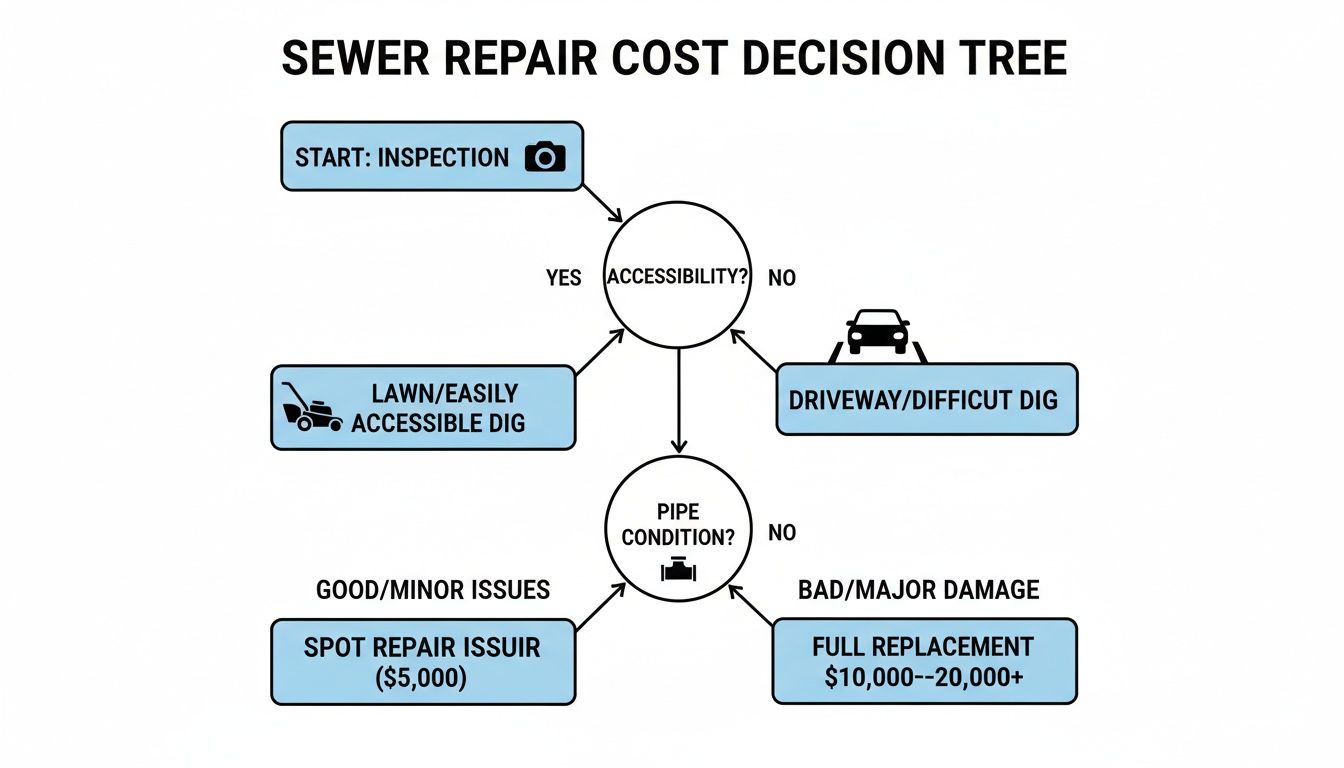
As you can see, the moment a repair has to go under a driveway or patio, the cost of a traditional dig skyrockets. That’s what makes a trenchless solution so appealing.
While the initial quote for a trenchless sewer repair near me in Roswell or Woodstock might look higher, the all-in cost is frequently lower. When you add up the money you save by not having to pour a new driveway or re-sod your entire front yard, the smarter choice becomes obvious. It’s faster, cleaner, and ultimately less of a headache for most homeowners dealing with a failing sewer line.
Warning Signs of a Failing Sewer Line
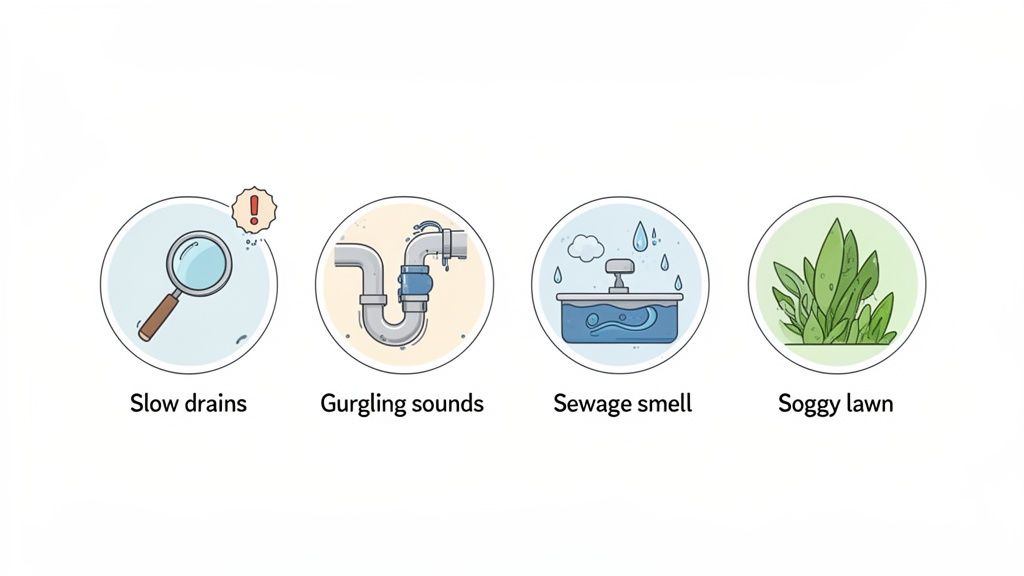
Catching a sewer line problem early can be the difference between a manageable repair and a full-blown catastrophe. Your home’s plumbing will almost always give you hints before it fails completely. Ignoring symptoms like slow drains, low water pressure, or no hot water is like putting tape over your car's check engine light—the problem is just getting bigger.
Think of it this way: a single clogged toilet that won’t flush is probably just a simple clog. But when several fixtures act up at the same time, your home is trying to tell you something serious. For homeowners from Woodstock to Marietta, spotting these symptoms early is the key to preventing a small crack from turning into a total pipe collapse, which sends the final cost to repair the sewer line through the roof.
Slow Drains and Frequent Backups
It often starts with your drains. If one sink is slow, it might be a local clog in that specific pipe. But if you notice the tub, toilets, and sinks are all draining sluggishly, the problem is almost certainly in your main sewer line.
This is your plumbing system waving a red flag. It means there's a significant blockage downstream—maybe from tree roots, years of grease buildup, or a pipe that’s starting to buckle. If you’re constantly fighting with backups, you need more than a bottle of drain cleaning solution. You need a professional camera inspection from an expert in sewer repair in Acworth.
Strange Noises and Foul Odors
Your plumbing shouldn't sound like a science experiment. Do you hear gurgling from the toilet when the washing machine drains? That’s a classic sign. It’s caused by air getting trapped in the blocked sewer line and being forced back up through your drains wherever it can escape.
Even more alarming is the unmistakable smell of raw sewage.
A healthy sewer line is airtight. If you can smell a sewage smell in your basement, yard, or anywhere else on your property, it means there’s a crack or break in the line that is leaking waste and hazardous sewer gas. This is a serious issue that demands an immediate call to an emergency plumber in Alpharetta.
Unexplained Changes in Your Yard
Your lawn itself can tell you what’s happening underground. Keep an eye out for these signs, especially in the path between your house and the street where the main line is buried:
- Soggy Patches or Puddles: If it hasn’t rained but you have a mysterious wet spot or water in your yard, it could be wastewater seeping up from a broken pipe. This is a common symptom when a burst pipe repair is needed on a sewer line.
- An Unusually Green Spot: A sewer leak is like a direct shot of fertilizer for your grass. If one patch of your lawn is suddenly greener and lusher than everything around it, a nutrient-rich leak is often the cause.
- Foundation Cracks or Sinkholes: This is a sign of a severe, long-term leak. The escaping water can erode the soil supporting your home's foundation, leading to cracks in the concrete slab, your patio, or driveway. In the worst cases, it can even create small sinkholes in the yard.
If you spot any of these symptoms, don't wait for them to get worse—because they will. Acting fast and calling a local plumber, whether you're in Acworth or Alpharetta, for a camera inspection can pinpoint the issue and save you from a far more destructive and costly emergency.
Smart Ways to Save Money on Your Sewer Repair
Let's be honest—nobody budgets for a water heater replacement or a sewer line repair. Seeing that final bill can be a real shock. But while the cost to repair a sewer line is never small, there are definitely smart ways to keep it under control without sacrificing the quality of the work. A little bit of know-how can save you a surprising amount of money.
The single best thing you can do is get multiple quotes. Never take the first offer you get. Instead, call at least three licensed and insured plumbers who work in your area, whether that's Roswell, Marietta, or Johns Creek. Any professional worth their salt will insist on a camera inspection before giving you a detailed, written quote—not just a vague guess over the phone for a sewer repair in Woodstock.
Compare Quotes Beyond the Bottom Line
When those quotes come in, it's tempting to just scan for the lowest number. Don't do it. A suspiciously cheap bid can be a red flag for an inexperienced crew, cheap materials that won't last, or a company that's cutting corners on insurance, which puts all the risk on you.
Look deeper and compare what you’re actually getting:
- The Proposed Method: Is one plumber suggesting a quick patch while another is calling for a full sewer replacement? Ask them to walk you through their reasoning and explain why their fix is the right long-term solution for your home.
- Materials Used: The quote should be specific. Are they using modern, durable PVC pipe or something less reliable? The materials make a huge difference in how long the repair will last.
- Warranty: What kind of guarantee are they offering on their workmanship and the parts they use? A strong warranty shows they’re confident in their work.
- Timeline and Scope: Does the quote cover everything, including pulling permits, backfilling the trench, and any necessary cleanup? A detailed scope of work protects you from surprise fees down the road.
Invest in Preventative Maintenance
You know the old saying: an ounce of prevention is worth a pound of cure. It’s especially true for your sewer lines. The cheapest repair is the one you don't have to make.
Regular drain cleaning in Cumming is the perfect example. If you have a professional cleaning done every 18-24 months, you can clear out grease buildup, scale, and tiny tree roots before they become a major blockage. It’s a small, predictable cost that prevents the kind of pressure that cracks old pipes.
Think of preventative maintenance as a small investment to avoid a massive, unexpected headache. For a fraction of the cost of an emergency sewer repair, you can keep your lines flowing and give them a much longer life, just like regular maintenance on your water heater prevents the shock of no hot water.
Understand Your Insurance and Financing Options
Before you pay a dime, figure out what your insurance might cover. Does your homeowners insurance covers sewer backup? Most standard policies won't cover problems from simple old age or neglect, but they might step in for a sudden and accidental break. It's also worth asking your agent about a "service line coverage" add-on; it's often an inexpensive rider that can be a real lifesaver.
Nationally, sewer repairs can run anywhere from $1,400 to $4,100, and sometimes more depending on the situation. You can learn more about these national cost averages and contributing factors on Angi.com. With those numbers in mind, knowing your coverage is key.
Finally, a sewer backup is an emergency, and we get that you can't always plan for it. That's why reputable companies like JMJ Plumbing offer flexible financing options. We want to help our North Metro Atlanta neighbors get the critical repairs they need without having to drain their savings accounts. Just ask us about it.
Why Is My Sewer Line a Problem Now?
If you’re dealing with a sewer line problem, you’re definitely not alone. That gurgling drain or foul smell in the yard is becoming an all-too-common headache for homeowners across North Metro Atlanta. It’s not just bad luck; it’s part of a much bigger story about our communities.
The biggest culprit is time itself. Many of our beautiful, established neighborhoods in places like Marietta, Roswell, and Canton were built decades ago. The sewer pipes installed back then were typically made of clay or cast iron, and frankly, they weren't built to last forever. After 50+ years in the ground, they’re reaching their breaking point, becoming brittle and prone to cracks, collapses, and relentless tree root invasions.
When you see a plumbing truck at a neighbor's house for a major sewer repair in your Forsyth County neighborhood, it’s often a preview of what's coming for the rest of the block.
Growth, Strain, and Smarter Homeowners
On top of our aging pipes, the rapid growth across areas like Cherokee and Forsyth counties is putting immense pressure on the entire system. Older sewer lines were never designed to handle the sheer volume of a modern, denser population. All that extra strain just speeds up their inevitable failure, leading to more calls for an emergency plumber in Metro Atlanta.
This isn't just happening in our backyards—it's a nationwide trend. The sewer repair market is expected to jump from $6,347.4 million in 2025 to an incredible $11,186.4 million by 2033. The main reasons are aging infrastructure, growing cities, and people becoming more aware of the risks. You can read more about these market trends and projections to see the full picture.
People are also more informed today. Homeowners in cities from Canton to Cumming know that a sewer backup isn't just messy—it's a serious health hazard, releasing harmful bacteria and gases into their homes. No one wants to "wait and see" anymore when they notice the first signs of trouble.
This proactive approach is driving more calls for services like:
- Sewer repair and sewer replacement
- Main water line repair and water line replacement
- 24 hour plumber services for urgent problems
- Preventative drain cleaning and leak detection
With demand on the rise, experienced plumbers with modern, trenchless technology are getting booked up fast. Investing in a solid, professional repair from a trusted team like JMJ Plumbing isn’t just about solving today’s problem. It’s a smart move to protect your home’s value and your family's health for years to come.
Frequently Asked Questions About Sewer Line Repair
When your sewer line is on the fritz, you’ve got questions. A lot of them. Getting straight answers can make a stressful situation feel much more manageable. Here’s a rundown of what we hear most often from homeowners in North Metro Atlanta when they’re facing a sewer problem.
How Long Does a Sewer Line Repair Usually Take?
This really comes down to the repair method. If we have to bring in an excavator for a traditional dig-and-replace job, it’s going to be a multi-day affair. It can easily take a week or more from start to finish, especially once you factor in restoring your lawn and landscaping.
On the other hand, modern trenchless methods like pipe lining or bursting are incredibly fast. An emergency plumber can often complete a full trenchless sewer replacement in Roswell in just a single day. Of course, things like tricky property access in a dense neighborhood or permit holdups in cities like Marietta or Alpharetta can add to the timeline.
Is It Better to Repair or Replace My Sewer Line?
That’s the million-dollar question, isn't it? The best answer depends on the age and condition of your pipes.
- Repair: If our camera inspection finds just one small crack or a single problem area in a newer PVC pipe, a targeted spot repair is almost always the way to go. It’s efficient and saves you money.
- Replace: But, if you have older clay or cast iron pipes with multiple breaks, extensive corrosion, or a serious tree root problem, a full sewer replacement is a smarter investment for the long haul. A full replacement is often the best solution for a collapsed pipe.
There’s no guessing here. A professional camera inspection is the only way to get the hard data needed to make the right call and avoid throwing money away on a temporary patch.
Can I Do a Sewer Line Repair Myself to Save Money?
Let's be blunt: absolutely not. Sewer line repair is a job for licensed professionals, period. It’s not a weekend DIY project. You need thousands of dollars in specialized equipment, a deep understanding of local plumbing codes in places like Cobb County or Cherokee County, and official permits from the city.
Attempting this on your own can lead to disaster. We’re talking about bad connections that leak raw sewage, causing more property damage, creating serious health hazards, and racking up huge fines for unpermitted work. The risk just isn't worth it. Always hire a licensed and insured plumber to make sure the job is done right.
Does Homeowners Insurance Cover Sewer Line Repair Costs?
This is a common point of confusion. Your standard homeowners insurance policy will not typically cover repairs for issues caused by normal aging, neglect, or gradual tree root damage. It's usually only covered if the damage was "sudden and accidental," like from a sudden ground shift.
The good news is that many insurance companies now offer an add-on policy—often called "service line coverage" or "water backup coverage"—that can be a real lifesaver. You have to check your specific policy and talk to your agent to know for sure what’s covered before you find yourself in a bind.
Facing a sewer backup, clogged toilet, or slow drains? Don't wait for the problem to get worse. The experts at JMJ Plumbing offer 24-hour emergency service across North Metro Atlanta, from Woodstock to Roswell. We use advanced camera diagnostics and trenchless technology to provide fast, effective, and lasting solutions for your sewer line. Contact JMJ Plumbing today for a transparent quote and expert service.