That weak trickle from your faucet is more than just annoying—it could be a sign of anything from a simple clog to a serious main water line leak. The list of potential culprits is long, including issues with the municipal supply, hidden leaks, corroded pipes, a bad pressure valve, or even sediment in your water heater.
The first step is always figuring out if the problem is just at one faucet or all over the house. That single clue will tell you where to look next.
Your Quick Guide to Diagnosing Low Water Pressure
When your shower feels more like a drizzle and your washing machine takes forever to fill, it's easy to get frustrated. But before you start searching for an "emergency plumber in Woodstock," a few simple checks can often point you right to the source of the problem.
Think of it as a little detective work. By running through these steps, you can either solve the issue yourself in minutes or give your plumber a head start, saving you time and money.
Below is a quick troubleshooting checklist to help you systematically pinpoint the problem. Follow these steps to narrow down the cause before making a call.
Quick Troubleshooting Checklist for Low Water Pressure
Follow these steps to identify the source of low water pressure before calling a plumber in Woodstock or Marietta.
| Check Point | What to Look For | Simple Fix or Next Step |
|---|---|---|
| Individual Faucets | Is the low pressure at just one sink or shower? | The fixture's aerator is likely clogged. Unscrew it, clean out the sediment, and screw it back on. |
| Hot Water Only | Does pressure drop only when you run hot water? No hot water? | This points to a problem with your water heater, likely sediment buildup. You may need a water heater replacement. |
| Entire Home | Is every faucet and shower in the house weak? | Check your main shut-off valve and pressure regulator. This could also indicate a bigger issue, like a main water line repair. |
| Neighbor Check | Ask a neighbor in Canton or your local area if their water pressure is low too. | If so, the issue is likely with the municipal water supply. |
This checklist gives you a clear, logical path to follow. By starting with the simplest potential issues, you can often find the culprit without needing any special tools.
Isolate the Problem Area
First things first, let's figure out how widespread the issue is. This one test is the key to knowing whether you have a small, localized clog or a much larger, system-wide problem requiring an emergency plumber in Alpharetta.
-
One Fixture: If it’s just one faucet or showerhead acting up, you’re probably looking at a clogged aerator. Good news—this is usually a quick and easy fix you can do yourself.
-
Hot Water Only: Does the pressure nosedive only when you ask for hot water? Or do you have no hot water at all? That’s a classic sign of trouble inside your water heater, often from sediment buildup. This is a common reason we see calls for water heater replacement in Cumming.
-
The Whole House: If every tap in your home is suffering, the problem is systemic. The cause could be your main shut-off valve, a failing pressure regulator, or a more serious problem needing a main water line repair.
This flowchart gives you a great visual for the diagnostic process, helping you trace the symptom back to the most likely cause.
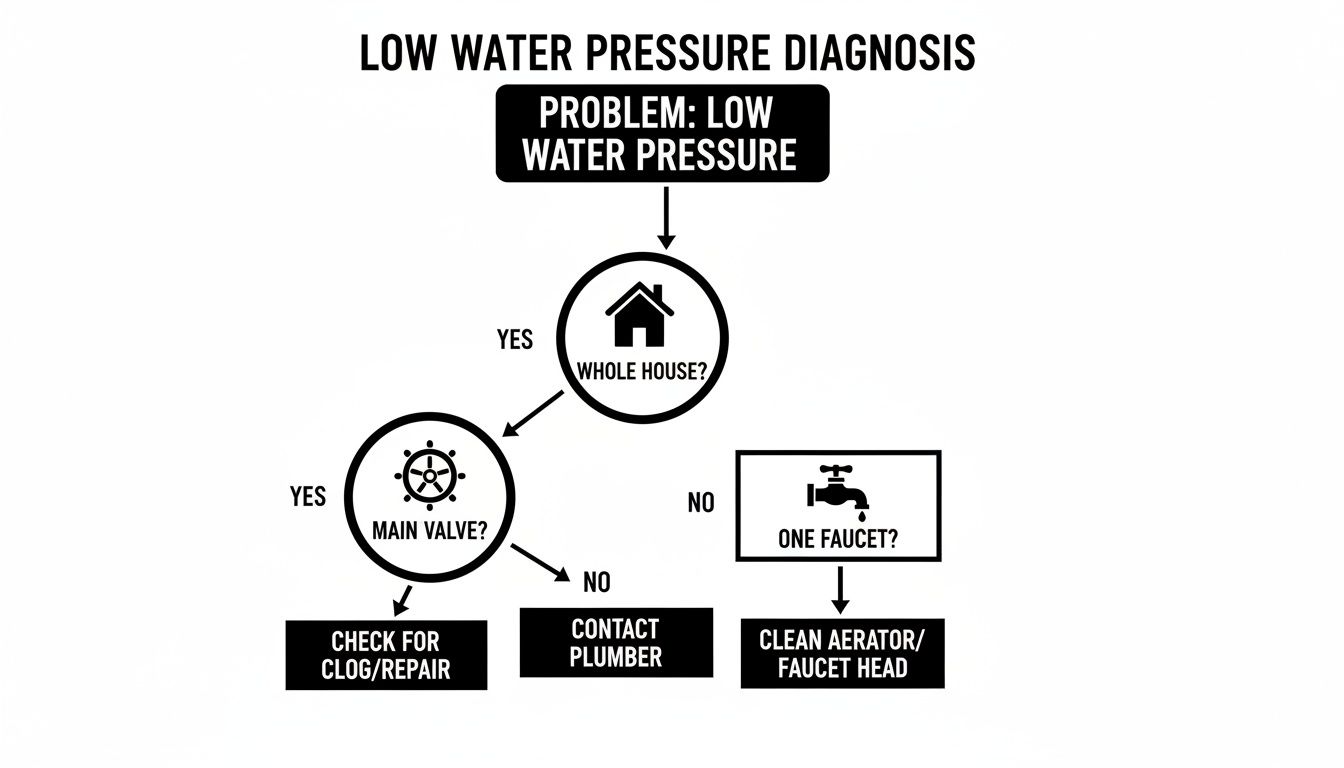
As you can see, figuring out the scope of the problem—one faucet versus the whole house—is the most important first step you can take.
Check Your Main Water Valves
If you've determined the pressure is low everywhere, the next thing to check is your main water valves. You have two to know about: the one at the street (the city's curb stop) and the one inside your house.
A partially closed valve is one of the most common—and overlooked—causes of house-wide low pressure. It can happen accidentally after maintenance work or by someone who doesn't realize its function.
Start with your home's main shut-off valve. You can usually find it in the basement, a crawlspace, or a utility closet, right where the main water pipe enters your house. Check the handle; if it's a wheel-style handle, it should be turned all the way counter-clockwise. For a lever-style handle, it should be parallel with the pipe.
If the valve was partly closed, opening it all the way might instantly bring your water pressure back to normal. It’s a simple fix that’s surprisingly common and can save you from calling a plumber in Roswell or Marietta.
Is a Hidden Water Leak the Culprit?
When your water pressure drops suddenly throughout the entire house, the problem might be something you can't even see. A hidden leak is a pressure killer. Unlike a nagging drip from a faucet, a crack in your main water line or a leak under your foundation siphons off water before it ever gets a chance to reach your taps.
Think of it like a major hole in a garden hose. The water escapes long before it gets to the nozzle, leaving you with just a weak, disappointing trickle.
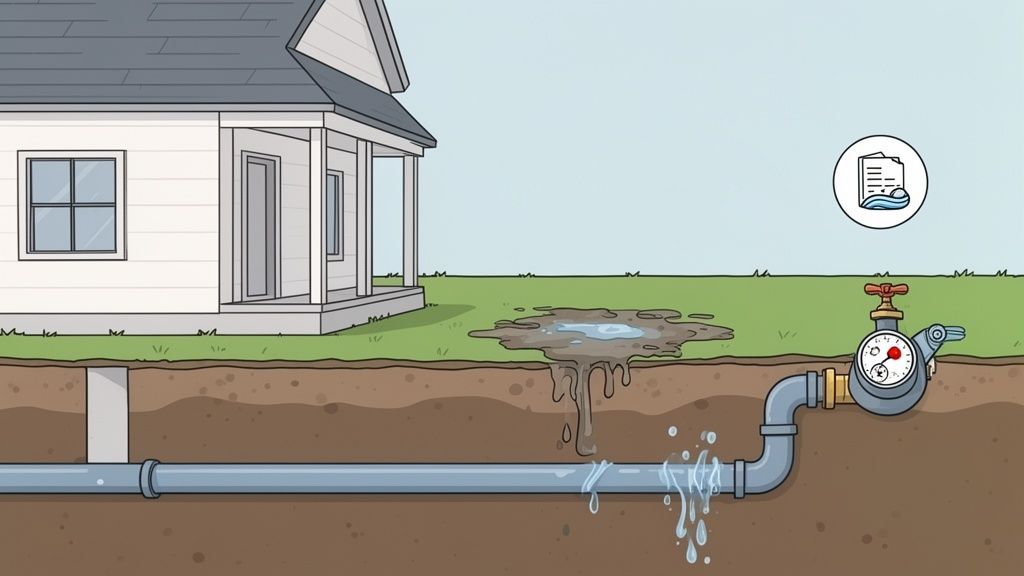
Even a tiny, pinhole-sized leak can cause a surprisingly big drop in pressure. This is one of those problems you can't afford to ignore, as even a small leak can quickly lead to serious water damage, mold, and a shockingly high water bill. For homeowners in growing areas like Alpharetta and Johns Creek, where older properties might have aging service lines, it’s smart to be on high alert for signs of a leak.
How to Check for Hidden Leaks
The good news is you don’t need any fancy equipment to do a quick check. This simple "water meter test" is your best first move to find out if you have a secret leak.
- Shut everything off. Make sure absolutely no water is being used inside or outside your house. That means no flushing toilets, no running dishwashers, and no sprinkler systems.
- Find your water meter. It's usually located in a concrete or plastic box near the curb at the front of your property. You might have to lift a heavy lid.
- Look for the leak indicator. Most meters have a small, sensitive dial—often a little triangle, star, or gear—that spins whenever water is flowing. If everything is off in the house but that little indicator is moving, you have a leak.
- No indicator? No problem. If your meter doesn't have one, just jot down the exact numbers on the main dial. Go back inside and wait for an hour or two (don't use any water!). If the reading has changed when you check it again, water is being lost somewhere.
If your water meter is spinning when all fixtures are off, it's a strong sign you need an emergency plumber. This indicates a constant flow of water, likely from a burst pipe repair or main water line repair situation that won't fix itself.
Other Telltale Signs of a Leak
Beyond the meter test, your house and yard might be giving you other clues. These symptoms are your property's way of telling you that a leak repair is needed, and fast.
- A sudden spike in your water bill: An unexpectedly high bill is often the first red flag homeowners notice.
- Water in yard or spongy spots: If you see puddles or patches of grass that are suspiciously green and lush between the street and your house, you could have a leak in the main water line.
- The sound of running water: Hearing water when everything is turned off is a dead giveaway. You might have to put your ear to a wall to notice it.
- Warm spots on the floor: A leak in a hot water line running under a concrete slab can create noticeable warm areas on your floor.
If you spot any of these signs, especially after a sudden drop in water pressure, it’s time to act. A hidden leak is not a DIY project. You’ll need to call in a professional with specialized equipment for leak repair near me to pinpoint the source without tearing up your property. A 24 hour plumber can respond right away to keep a bad situation from getting much worse.
How Mineral Buildup Restricts Your Water Flow
If you live in an older home and have noticed your water pressure getting weaker and weaker over the years, the problem might be lurking inside your pipes. It helps to think of your plumbing like the arteries in your body. Just as plaque can build up over time, the minerals in our water can slowly coat the inside of pipes, making the opening smaller and smaller.
This slow-moving process is called scaling, and it's a real pressure killer. With every layer of mineral deposit—mostly calcium and magnesium—the channel for water to flow through gets narrower. This forces your entire plumbing system to work harder just to get water to your faucets and showerheads. For those of us in North Metro Atlanta, this is a problem we see all the time.
The Impact of Hard Water on Older Pipes
This issue is especially common in homes with old galvanized steel pipes, the standard for houses built across Cherokee County and Cobb County before the 1970s. These pipes are a double-edged sword; they don't just scale, they also rust from the inside out. Over the decades, the protective zinc coating wears away, and the exposed steel starts to corrode, creating a rough, constricted surface that mineral buildup loves to cling to. The result is a frustrating, steady drop in water pressure.
Picture this: you go to turn on your kitchen faucet in Acworth, GA, expecting a strong stream, but all you get is a disappointing trickle. That’s often the handiwork of mineral buildup. It's a widespread problem affecting up to 85% of U.S. homes with hard water. Here in North Metro Atlanta areas like Marietta and Kennesaw, where our water is moderately hard to hard, it’s one of the top reasons people call a plumber. You can get a better sense of how local water issues fit into the bigger picture by reviewing comprehensive water stress data.
When Is the Damage Too Severe?
For pipes with minor to moderate buildup, professional drain cleaning techniques can work wonders. A plumber uses a specialized tool like a hydro-jetter to blast high-pressure water through the pipes, scouring away years of scale and rust without having to open up your walls. It’s a great way to restore flow. But for older, heavily corroded galvanized pipes, hydro-jetting can actually be too powerful and might damage the already fragile pipe walls.
In cases where pipes are severely clogged or corroded, the only permanent solution is a full water line replacement. This ensures your home has a reliable, high-flow system for decades to come. A professional can assess whether a repair or a full water line replacement is the more cost-effective choice for your home.
Of course, the best approach is to stop the problem before it starts. Installing a whole-home water filtration system treats water right as it enters your house, removing the hard minerals that cause all that scaling in the first place. Not only does this protect your pipes, but it also helps your dishwasher, water heater, and other appliances last longer. It's a smart investment in your home’s plumbing health and can help you avoid a costly main water line repair near you down the road.
Troubleshooting Your Water Heater and Fixtures
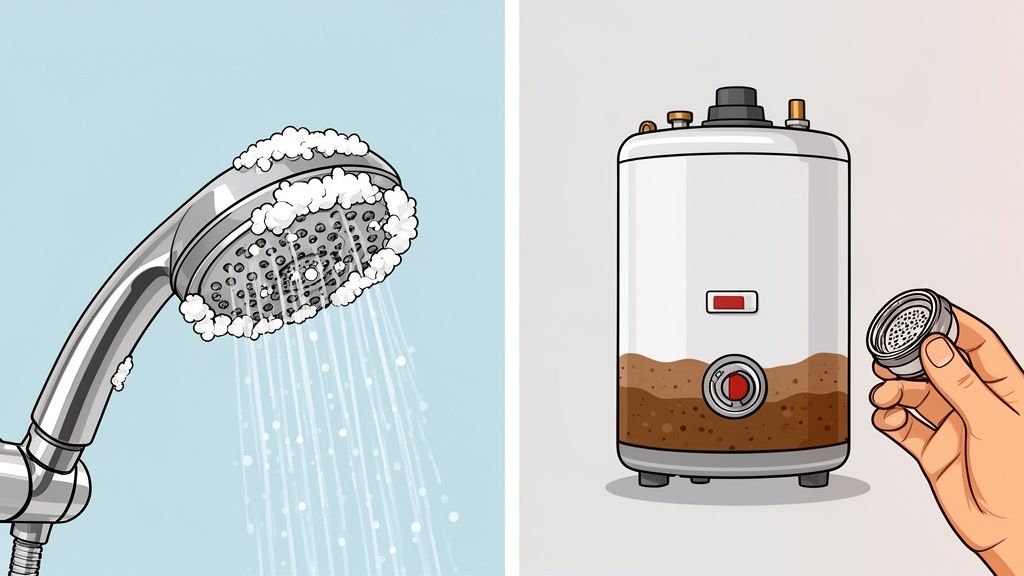
Sometimes the pressure problem isn't house-wide, but is actually hiding in plain sight. If you’ve noticed the water only slows to a trickle when you turn on the hot tap, then your water heater is almost certainly the culprit. This is a common issue that’s fairly easy to diagnose.
Think of your water heater tank like a giant kettle. Over the years, all the tiny bits of minerals and grit in our water supply slowly settle and build up a thick layer at the bottom. This gunk doesn't just make your heater work harder to heat the water; it can actually choke off the hot water outlet pipe, restricting the flow to every hot water faucet in your home.
If your hot water pressure suddenly tanks while your cold water is fine, that’s a huge red flag for serious sediment buildup. For homeowners in areas with hard water like Cumming or Johns Creek, this is often the last warning sign before you’re looking at a full water heater replacement. Letting it go can cause the unit to fail completely, leaving you with an icy surprise.
Checking Individual Fixtures
What if the pressure is only weak at one sink, or just in one shower? Good news—that usually points to a simple clog right at the fixture itself. The aerators on your faucets and the nozzles on your showerheads are designed to catch debris, and they can get blocked over time.
Luckily, cleaning them is a quick fix you can probably handle yourself.
- For Faucets: Just unscrew the little cap at the very tip of the faucet. You’ll find a small screen inside that’s likely full of tiny specks of sediment. Rinse it out, use an old toothbrush to scrub away any stubborn buildup, and screw it back on.
- For Showerheads: Most showerheads can be unscrewed from the pipe coming out of the wall. To dissolve the tough mineral scale clogging the nozzles, just soak the whole head in a bowl of white vinegar for a few hours. Afterward, give it a good scrub with a brush, rinse it clean, and reattach it.
A little bit of cleaning can often bring a fixture's water pressure right back to normal. If these steps don’t solve the problem, or if you’ve traced the issue back to your water heater, it's best to bring in a professional for a proper diagnosis.
When the Problem Is Outside Your Home
So, you’ve checked every faucet and fixture inside, and you’re still stumped by that weak water flow. Before you start thinking the worst, like a massive main water line repair bill, it’s time to look outside your four walls.
Sometimes, the culprit isn't in your plumbing at all. The issue could be coming from the city's supply system or a crucial valve right on your property. Figuring this out will tell you whether you need to call the city of Roswell or get a 24 hour plumber on the line.
Municipal Supply and Peak Demand Issues
Ever noticed your shower in Cumming or Alpharetta feels more like a trickle during that morning scramble to get everyone out the door? You’re not just imagining it. It’s a common issue for 20-25% of urban U.S. households facing drops in water pressure due to high demand.
This is especially true around here. The population in North Metro Atlanta grew by a staggering 15% between 2010 and 2023. When everyone turns on their water at once, the pressure in the whole system can take a nosedive. Global water trends also play a part, as you can see in the WMO's 2023 report on global water resources.
A quick, easy way to diagnose this is to just ask your neighbors. If they're dealing with the same weak flow, the problem is almost certainly on the city's end. It could be anything from planned maintenance to an emergency burst pipe repair down the street.
Your Pressure Reducing Valve (PRV)
A lot of homes in Cobb County and Forsyth County are equipped with a Pressure Reducing Valve, or PRV. It’s a bell-shaped device, usually located where the main water line enters your house. Its only job is to take the high-pressure water from the street and dial it down to a level that won’t damage your pipes and appliances.
A failing PRV is one of the most common reasons for a sudden, house-wide drop in water pressure. They typically last 10-15 years before the internal parts wear out, causing the valve to get stuck and essentially choke the water supply to your home.
If you suspect your PRV is the problem, you’ll need a licensed plumber to take a look. They have the right tools to test, adjust, or replace it. This is definitely not a DIY project. Messing with the PRV involves shutting off all water to your house and can cause even more serious plumbing damage if it isn't set correctly. It’s best to leave this one to the pros.
Alright, you've tried all the simple fixes. You've cleaned the aerators, fiddled with the shut-off valves, and your water pressure is still just… sad. When your troubleshooting efforts hit a wall, it’s time to start thinking about a bigger problem lurking behind the scenes.
Some issues are just beyond a simple DIY fix. In fact, they’re red flags warning you of a serious problem that needs a professional’s touch, and fast. Putting off the call can be the difference between a straightforward repair and a full-blown disaster involving ruined drywall, warped floors, and a massive bill. The key is knowing when to hang up your DIY hat and pick up the phone.
Red Flags That Demand a Plumber
If you notice any of these signs, don't wait. Procrastinating could turn a targeted leak repair into a major home renovation project you never wanted.
- A Spinning Water Meter: Go out to your water meter. Have you turned off every single faucet, shower, and water-using appliance in the house? If that little dial or triangle on the meter is still moving, you have an active leak somewhere. It's a dead giveaway that water is escaping the system, and you'll need a pro to hunt it down.
- Visible Water Damage or Pooling: This is an urgent one. Damp spots on the ceiling, soft patches on a wall, or a mysterious puddle on the floor are screaming for attention. For homeowners here in North Metro Atlanta, one of the most classic signs of a problem is an unexplainably soggy spot or water in yard when it hasn't rained. That often means you need main water line repair near you.
- A Persistent Sewage Smell: If you’re catching a foul, sewage smell inside or outside your home, take it seriously. It could be a sewer backup or even a broken sewer line. This isn't just unpleasant; it's a health hazard that requires an expert equipped for sewer repair.
- Multiple Clogged Drains: A single slow drain is an annoyance. But when you have a clogged toilet that won't flush and your shower is backing up at the same time? That’s a sign the blockage isn't in the fixture—it's deep in your main sewer line. This calls for a professional with powerful drain cleaning augers, not a bottle of chemicals from the store.
When you're staring down a potential burst pipe repair or a major leak, every minute counts. This is when you need a 24 hour plumber in Marietta or Acworth who can get there quickly and stop the damage in its tracks.
These are true plumbing emergencies. Trying to tackle a main line break or a major sewer problem on your own can easily lead to serious flooding and thousands in damages. A certified Master Plumber has the right diagnostic tools and, frankly, the experience to find the real source of the problem—whether it's a hidden leak, a tree root crushing a pipe, or something else entirely—and fix it safely and correctly the first time.
Frequently Asked Questions About Low Water pressure
Even after trying a few things yourself, it's normal to have some lingering questions. We hear these all the time from folks in Canton, Roswell, and the surrounding areas, so let's get you some straight answers.
How Much Pressure Is Considered Normal?
You're probably wondering what's even considered "normal" pressure to begin with. In a typical home, you want to see your water pressure sitting somewhere between 45 and 65 PSI (pounds per square inch).
If it dips below 40 PSI, you'll definitely feel it—that’s when you get those frustratingly weak showers. On the flip side, anything over 80 PSI is too high. That kind of force can seriously damage your pipes, fixtures, and appliances, which is exactly why most homes have a pressure-reducing valve installed.
Why Is Only My Hot Water Pressure Low?
Ah, the classic "hot water trickle." If this is happening at every faucet in your house, but the cold water is fine, the problem is almost certainly your water heater.
Over the years, sediment and mineral scale from our local water supply build up inside the tank. Eventually, this gunk can clog the hot water outlet pipe. If you ignore it for too long, you might find yourself needing a full water heater replacement near me just to get your hot water flowing freely again.
Can Clogged Pipes Really Cause Low Pressure?
Absolutely. In fact, if you're dealing with low water pressure in your Marietta home, there’s a good chance clogged pipes are the culprit. It's a leading cause behind 30-40% of residential complaints nationwide.
A lot of the plumbing in North Metro Atlanta dates back to the post-WWII housing boom. Decades later, these older pipes are often full of rust, mineral buildup, and even invasive tree roots, which can slash your water flow by as much as 70%. It's a widespread issue you can see reflected in global water resource reports that discuss aging infrastructure.
If you think old, clogged pipes are your problem, the only way to know for sure is with a professional camera inspection. It lets us see exactly what's going on inside and determine if a powerful drain cleaning will do the trick, or if you need a more permanent solution like a sewer replacement or water line replacement.
When Should I Call An Emergency Plumber?
Sometimes, low pressure is more than just an annoyance—it's an emergency. You should call a 24 hour plumber right away if you notice:
- A sudden, major drop in pressure throughout your entire house.
- Obvious signs of a leak, like damp drywall, a wildly spinning water meter, or the sound of water running when everything is off.
- A sewage backup or a strong sewer gas smell, which points to a serious main line blockage.
These are red flags for serious problems like a need for a burst pipe repair, and waiting can lead to thousands in water damage.
If you've tried the DIY route and your water pressure is still stubbornly low, it's time to bring in a professional. For trustworthy diagnostics and solutions that last in Acworth and beyond, you can count on the certified Master Plumbers at JMJ Plumbing. Visit us online at https://www.jmjplumbing.com to schedule your service today.