Before you even think about touching your gas water heater, we need to talk about safety. When the hot water goes out, the first impulse is often to start pressing buttons and turning dials. But with a gas appliance, that’s the last thing you should do.
Your first step is always a quick safety sweep. It only takes a minute and can tell you immediately if you have a simple fix on your hands or a serious emergency. If you even think you smell gas, stop what you're doing, get out of the house, and call for help.
Your First Safety Checks Before Troubleshooting
As plumbers serving homeowners across Woodstock, Roswell, and North Metro Atlanta, we can't stress this enough: a few basic safety checks are non-negotiable before you dive into troubleshooting. This isn't just about following rules; it's about keeping your family and your home safe.
Knowing how to detect gas leaks is crucial, but your own senses are your most powerful tool. Start by just looking and smelling around the unit.
The Initial Look and Sniff Test
Before touching a single thing on the water heater, take a moment to use your eyes and nose. They'll give you the most important clues.
- Do you smell gas? This is the most critical check. Gas companies add a foul, "rotten egg" smell to natural gas for this exact reason. If you catch even a faint whiff of it, don't use your phone, flip any light switches, or create any sparks. Get everyone out of the house immediately and call your gas provider or 911 from a safe distance. This is a top reason for calls to an emergency plumber in Woodstock.
- See any soot or black marks? Soot build-up on or above the heater is a major red flag. It means the gas isn't burning correctly, which could be creating dangerous carbon monoxide. This is a serious ventilation problem that needs a professional’s attention right away.
- Is there water on the floor? A puddle around the base of the unit can mean anything from a small, fixable drip to a completely failed tank. If the water is coming from a connecting pipe or valve, it might be a simple leak repair. But if you find water in your yard near the main line or a leak from the tank body itself, you're likely looking at a water heater replacement.
To make it even clearer, here’s a quick visual guide on how to react based on what you find.
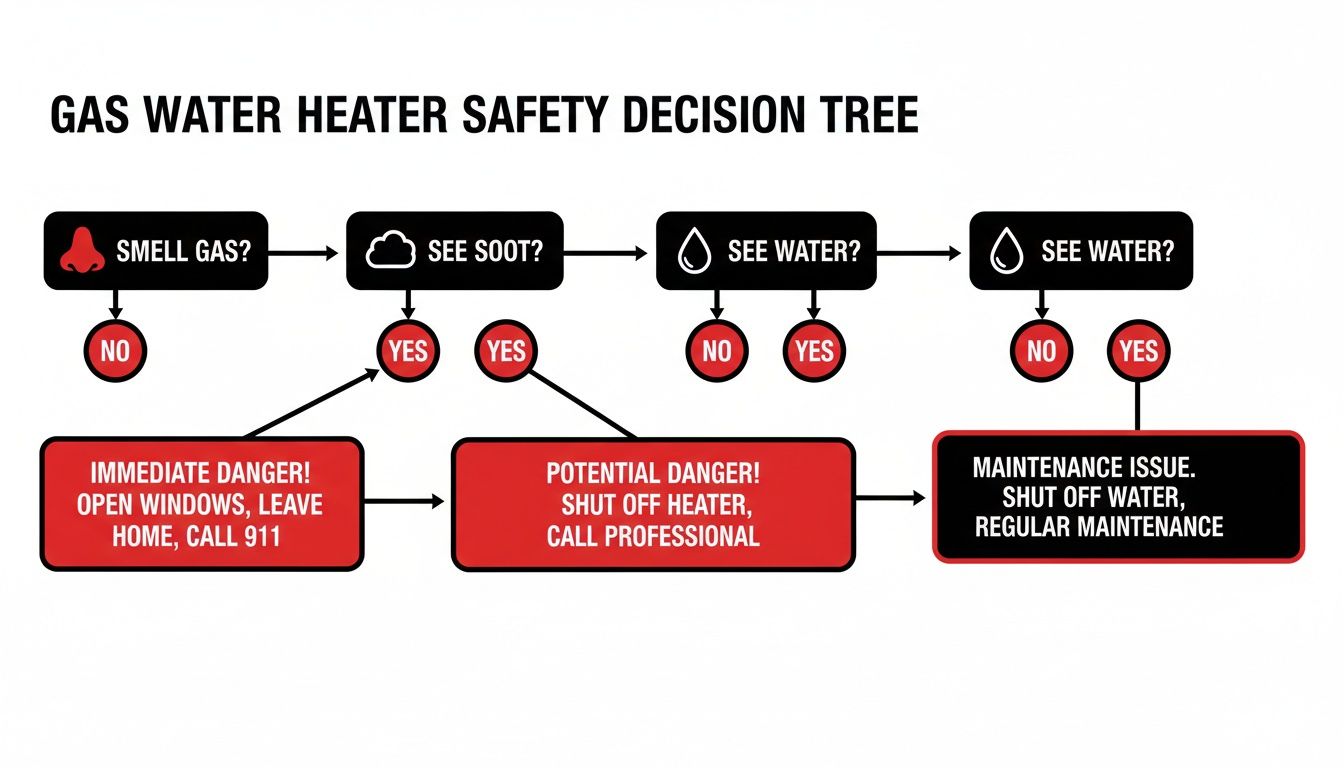
As the chart shows, a gas smell is an absolute emergency. Soot or major water leaks aren't far behind and are clear signs to call a plumber.
If you smell gas, your only move is to get everyone out of the house and call for help from a neighbor's home or your cell phone once you are safely outside. Do not risk trying to find the source yourself.
If that initial safety check comes up clean—no scary smells, soot, or puddles—then you can feel more confident moving on to some basic diagnostics.
Quick Troubleshooting Symptom Checker
Use this table to quickly match your water heater's symptoms to a potential cause and see what your immediate next step should be.
| Symptom | Potential Cause | What to Do First |
|---|---|---|
| Rotten egg or sewage smell | Gas leak or sewer backup | Evacuate the house, call your gas company/911 for gas smell. Call a plumber for sewer smell. |
| Soot/scorch marks | Improper combustion/venting | Turn off the gas supply and call a plumber. |
| Water puddle on floor | Leaking valve, pipe, or tank | Find the leak source. If it's the tank, call a plumber for water heater replacement in Alpharetta. |
| Pilot light won't stay lit | Dirty or faulty thermocouple | Attempt to relight; if it fails, call for service. |
| Odd noises (rumbling/popping) | Sediment buildup in the tank | This often requires a professional tank flush (drain cleaning). |
Remember, this table is just for a quick reference. Any sign of danger means it’s time to stop and get professional help. For our neighbors in Canton, Alpharetta, and Marietta, the JMJ Plumbing team is on call 24/7 for safe, reliable water heater repairs.
Figuring Out Pilot Light and Ignition Failures
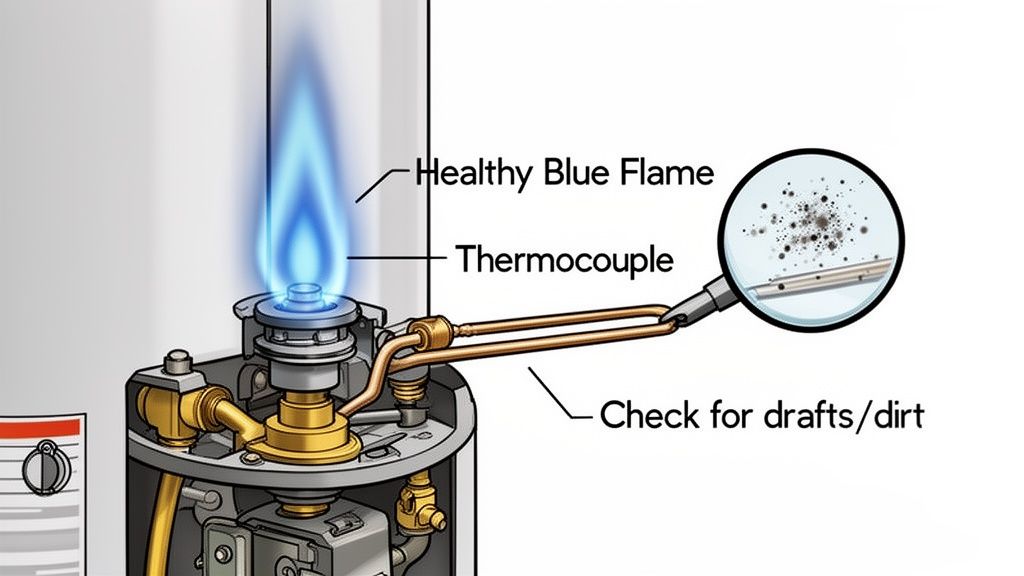
If your shower suddenly runs cold, the first suspect is often a pilot light that’s gone out. This is especially true for older gas water heaters. That tiny flame is the spark of life for your whole system; when it’s gone, you’ve got no heat. Learning how to check it safely is the first step in figuring out whether you have a quick fix on your hands or a bigger problem brewing.
Here in North Metro Atlanta, we see this all the time—pilot light issues probably account for a good 30% of our water heater service calls. A simple draft, a bit of soot, or a failing sensor can knock it out. Just this year, our team has handled over 500 of these calls in Acworth, Canton, and Marietta, and we've found that poor ventilation was the real culprit in 40% of those cases. There's a right way and a wrong way to relight a pilot, and doing it incorrectly is a risk you don't want to take. You can read more about common gas water heater problems from other industry pros to see just how frequent this is.
Finding and Checking the Pilot Light Assembly
So, where do you look? The pilot assembly is tucked away at the bottom of the water heater, typically behind a small metal cover. You’ll probably need a flashlight to see clearly inside the chamber.
What you’re hoping to see is a small, steady flame. A healthy pilot light should be a crisp, bright blue, maybe with a tiny bit of yellow at the very tip. If the flame looks weak, lazy, or mostly yellow and orange, that’s a red flag. It means the burner is likely dirty and starving for oxygen, which hurts efficiency and creates soot.
- Healthy Flame: Strong and consistently blue.
- Weak/Yellow Flame: Usually a sign of a dirty orifice or bad airflow.
- No Flame: The pilot is out. You'll need to go through the proper relighting procedure found on your unit's label.
A flame that flickers wildly or keeps going out is a classic sign that a specific part is failing.
What the Thermocouple Does
Working right beside the pilot light is a critical safety device called the thermocouple. It’s a small copper rod with its tip sitting right in the pilot flame. Its job is incredibly important: it senses the heat and generates a tiny bit of electricity, which tells the main gas valve that it's safe to open.
If the pilot flame goes out for any reason, the thermocouple cools down in seconds. That electrical signal stops, and the gas valve automatically snaps shut. This is a crucial safety feature that prevents your home from filling with raw, unburned gas.
Here's a pro tip: If you can relight the pilot, but it goes out the second you let go of the control knob, the thermocouple is almost always the problem. It’s either dirty, has been knocked out of the flame’s path, or has simply failed from age.
What About Electronic Ignition Systems?
Many newer water heaters have ditched the old-school standing pilot for a more efficient electronic ignition. These systems only create a spark to light the burner when you actually need hot water.
If you have one of these models, your troubleshooting process looks a little different.
- Listen for the Spark: When you turn on a hot water tap, you should hear a "tick-tick-tick" sound from the heater as the igniter tries to do its job.
- Look for Blinking Lights: Most modern gas control valves have an LED status light. A blinking pattern is an error code. Your owner's manual will tell you what the code means—it could be anything from a weak signal to a failed part.
- Check the Power: It sounds obvious, but these systems need electricity. Is it plugged in? Has a breaker tripped? No power means no spark.
While an error code might point to a simple fix, any problem with the igniter, the flame sensor, or the main control board is a job for a professional. If you live in Alpharetta or Johns Creek and your modern heater won't fire up, don't try to force it. It’s time to call a 24-hour plumber for a safe and accurate diagnosis. Never try to bypass these electronic safety controls.
No Hot Water? Let's Figure Out What's Going On
Nothing ruins a morning faster than turning the shower handle and getting a face full of ice-cold water. This symptom, no hot water, is one of the most common reasons homeowners in Cobb County search for an emergency plumber near me. If you’ve already confirmed the pilot light is on, but the water is still cold or just lukewarm, we can usually narrow it down to two likely culprits: the thermostat or the gas control valve.
Think of these two parts as the brains and the brawn of your heater. The thermostat is the brain, sensing the water temperature and telling the system when to heat. The gas control valve is the brawn, delivering the fuel to make that heat. If either one of them isn't doing its job, the whole operation comes to a grinding halt.
First Things First: Check Your Thermostat
Before you start worrying about a major repair, let's look at the easiest and most common fix. The temperature dial on the gas control valve is the source of more "no hot water" calls than you might think.
It’s incredibly easy to bump the dial by accident, or for someone to have turned it down without you knowing. I’ve seen it countless times in homes around Woodstock and Canton. A very common offender is the "Vacation" setting. If that dial is pointing to "VAC" or a very low temperature, your heater is only working to keep the pipes from freezing, not to give you a hot shower.
- Take a quick look at the dial. Make sure it’s pointing to a normal temperature, which is usually around 120°F.
- Don't crank it up. Setting it higher than 130°F is a serious scalding risk and just wastes gas and money.
- Be patient. After you adjust it, the heater needs time to work. Give it at least an hour before you test the water again.
If the dial was already on the right setting but the water is still just warm, you can do a quick diagnostic test. Run the hot water from a faucet closest to the heater for a minute. Catch some in a cup and check it with a cooking thermometer. If the temperature is way below what the dial is set to, it’s a strong hint that the thermostat sensor is starting to fail.
When the Gas Control Valve Is the Likely Suspect
Okay, so the thermostat is set correctly and the pilot light is definitely on, but you never hear that big "whoosh" of the main burner firing up. This scenario points straight to a faulty gas control valve. This is where things get more serious, and it’s not a DIY repair. The valve might be stuck, preventing gas from ever reaching the burner, even though the thermostat is calling for heat.
A failing gas control valve is a major problem, accounting for roughly 25% of all "no hot water" service calls. The integrated thermostat sensor can wear out and start misreading the water temperature, leading to lukewarm water that never reaches the standard 120°F. Based on our service data from communities like Roswell and Alpharetta, this is a frequent point of failure, sometimes made worse by low incoming gas pressure. While a plumber can run specific tests, you can learn more about these common water heater problems and their causes from industry findings.
CRITICAL SAFETY WARNING: Never, ever try to fix, take apart, or force a gas control valve on your own. It’s a sealed, factory-calibrated component. Messing with it can easily cause a dangerous gas leak or an uncontrolled fire.
Why This Is a Job for a Professional Plumber
Diagnosing a bad thermostat or gas control valve is not a simple DIY project. These components are tied directly into your home’s gas supply, and a single mistake can have devastating consequences. Here’s why this is the moment to call a pro for water heater replacement or repair.
- Specialized Tools: We use tools like a manometer to test the gas pressure coming into the valve. This is critical, especially in growing areas like Cumming and Johns Creek, where new construction can sometimes impact the local gas supply. Without this test, you're just guessing.
- Accurate Diagnosis: Is it the valve? The thermostat? Or is a weak signal from the thermocouple telling the valve to stay shut? A licensed plumber can figure it out fast, which saves you from buying and replacing parts you don't need, getting you the most value when weighing repair vs. replacement costs.
- Safety and Code Compliance: Any work involving a gas line is serious business and must be performed according to strict safety codes. We ensure the job is done right and perform a thorough leak test before we consider the work complete.
If you’re in Cherokee County, Cobb County, or anywhere in the North Metro Atlanta area and your hot water has gone cold, don't risk your safety. An emergency plumber from JMJ Plumbing has the tools and experience to give you a fast, safe diagnosis. Our 24-hour plumber service is here to get your hot water flowing again—the right way.
Tackling Strange Noises and Sediment Buildup
Started hearing a strange popping, rumbling, or even a whistling sound coming from your gas water heater? Don't ignore it. Your heater is trying to tell you something, and it's almost always a sign of sediment buildup inside the tank. This is an incredibly common issue we see in homes all across North Fulton and Forsyth County.
Here in our region, the water is "hard," meaning it’s packed with minerals like calcium and magnesium. Over the years, these minerals settle at the bottom of your water heater tank and bake into a thick, rocky layer of sediment. This creates a stubborn barrier right between the gas burner and the water it’s supposed to be heating.
Why Sediment Is a Problem
Once that layer of sediment gets thick enough, it makes your heater’s burner work overtime just to get the water hot. The burner ends up overheating the sediment and the little bit of water trapped underneath it, causing that water to boil and create steam bubbles. The "popping" or "rumbling" you’re hearing? That’s the sound of those steam bubbles bursting as they rise up through the rest of the water.
Letting this go on is asking for trouble. It's always worth figuring out if a noisy water heater is dangerous and what those specific sounds mean. While it’s not going to explode, the constant overheating from sediment puts a ton of stress on your unit.
Here’s what you’re up against:
- Skyrocketing Bills: Your heater burns more gas to do the same job, which you'll notice on your utility bills.
- Endless Waiting: It takes much longer for the heater to provide a full tank of hot water after you've run the shower or dishwasher.
- Tank Damage & Leaks: All that extra heat can weaken the tank’s metal over time, leading to cracks, leaks, and a much shorter lifespan.
The numbers don't lie. Sediment buildup is behind 40% of complaints about slow reheat times and is a key cause of low water pressure. In our area, it can slash a heater's efficiency by up to 25% and stretch recovery times by a frustrating 20-30%. We've seen this exact problem lead to 15% of premature tank failures well before the 10-year warranty is up.
How to Safely Flush Your Water Heater
The best way to get rid of that crunchy layer of sediment is to flush the tank. This is something a handy homeowner can often manage, but you have to be careful. If you’re at all unsure about the process, calling a professional for drain cleaning in Marietta is always the safest bet.
If you want to give it a try, here’s the general game plan:
- Kill the Power and Gas: First things first, turn the gas control knob on your heater to the "OFF" position. This is a non-negotiable safety step.
- Shut Off the Water: Find the cold water inlet valve—usually a handle on a pipe at the top of the heater—and turn it to the off position.
- Hook Up a Hose: Attach a regular garden hose to the drain valve spigot near the bottom of the tank. Run the other end of the hose outside or to a floor drain where it can empty safely.
- Open the Drain: Carefully open the drain valve. To help it drain faster, go turn on a hot water faucet somewhere in your house—this lets air into the tank.
- Stir and Flush: Once the tank is empty, briefly turn the cold water supply back on in short bursts. This will stir up the sediment at the bottom and help flush it out the hose. Do this a few times until the water coming out looks clear.
- Close and Refill: When you're done, close the drain valve, take the hose off, and turn the cold water supply back on to completely refill the tank. Only turn the gas back on after the tank is 100% full again.
Pro Tip: For anyone living in Cherokee County and North Fulton, we recommend flushing your tank at least once a year. If you have very hard water (think white, chalky spots on your faucets), you might want to do it even more often.
A Better Way: Preventing Sediment in the First Place
Flushing is a good fix, but preventing the problem is even better. The most effective way to stop sediment from ever forming is to treat your water before it even gets to the heater.
A whole-home water filtration system, like the HALO systems we often install for our customers, is the ultimate solution. It removes those hard minerals at the source. This protects not only your water heater but every single pipe and appliance in your home that uses water.
If you're tired of hearing strange noises or dealing with recurring slow drains and low water pressure, a filtration system is a smart long-term investment. Whether you need a hand with a tank flush or want to talk about a water filtration solution in Acworth or Alpharetta, the JMJ Plumbing team is here to help.
How to Identify and Address Water Leaks
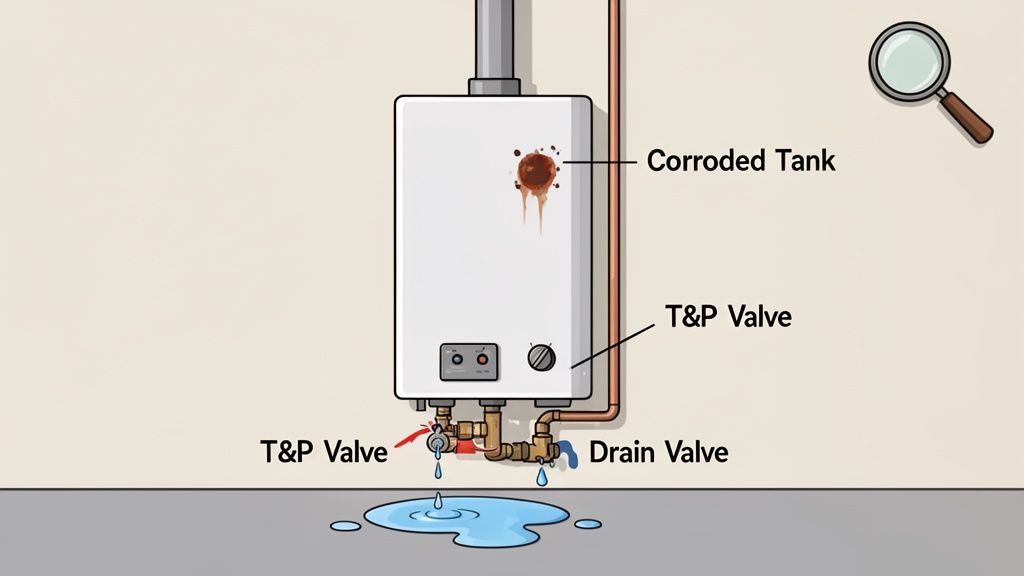
There's nothing quite like the sinking feeling of finding a puddle around your gas water heater. It's an instant red flag. Some leaks are a simple leak repair, but others can be a serious warning sign that you need a professional, and fast. The first thing you have to do is figure out where that water is coming from—the source tells the whole story.
But hold on. A bit of moisture doesn't automatically mean disaster. In humid spaces like basements, condensation can easily form on the cold pipes or the tank itself. Before you panic, grab a towel, dry the area completely, and then walk away for a few hours. If the puddle doesn't reappear, you probably just had a simple case of condensation.
Pinpointing the Leak Source
If the water is back, it's time to get a closer look. With a good flashlight, start at the very top of the unit and work your way down. Water always runs downhill, so starting high prevents you from misdiagnosing the problem.
Zero in on these common trouble spots for drips or moisture:
- Water Line Connections: Check the cold water inlet and hot water outlet pipes right on top of the tank. I've seen countless slow drips caused by nothing more than a loose fitting here.
- Temperature and Pressure (T&P) Relief Valve: This is a crucial safety device, usually found on the side or top of the tank. It has a discharge pipe that runs down toward the floor.
- Drain Valve: Look for the spigot near the bottom of the heater. This valve, used for flushing the tank, can sometimes leak from its handle or spout over time.
- The Tank Itself: This is the big one. Inspect the seams and the body of the tank for any rust streaks or water weeping directly from the metal.
What a Leaking T&P Valve Tells You
So, you found water coming from the T&P valve's discharge pipe. You need to pay close attention to this. That valve is designed to pop open and release water if the pressure or temperature inside the tank climbs to dangerous levels. A rare, tiny drip might not be an emergency, but a steady flow of water is a major warning.
A constantly leaking T&P valve means the tank is likely under too much pressure or is overheating. Whatever you do, do not try to cap or plug this valve. That is incredibly dangerous and can lead to the tank actually rupturing, a common reason for calls about burst pipe repair. This is a problem that requires a pro to diagnose immediately. The valve itself could be bad, or it could be pointing to a more severe issue with your home's water pressure.
Expert Insight: When a T&P valve is leaking, it's screaming for help. It’s doing its job by signaling dangerous pressure buildup. I see this a lot, and it often points to an underlying issue beyond the heater itself, sometimes requiring a main water line repair if the pressure from the city is just too high.
The Point of No Return: A Corroded Tank
Now for the worst-case scenario: you find water leaking from the body of the tank. If you see distinct rust trails snaking down the side or notice water bubbling from a seam, the tank has failed from the inside out. Internal corrosion has eaten right through the steel wall.
I'm sorry to say, this is not fixable. A corroded tank is a total structural failure. No amount of patch or sealant can safely contain the pressure. The only solution here is an immediate water heater replacement. A leaking tank is a ticking time bomb—it will only get worse, and the risk of a catastrophic burst that floods your home goes up every single day.
If you find a tank leak in your Roswell or Cumming home, don't hesitate. This is a true plumbing emergency. Shut off the water supply to the heater and call a 24-hour plumber right away. At JMJ Plumbing, we prioritize these emergency calls. If you're searching for water heater replacement near me in the North Metro Atlanta area, including Cobb and Forsyth counties, we'll get a certified plumber out to you to stop the damage and get your hot water back on safely.
When to Call a Professional Plumber in North Metro Atlanta
I’m all for a good DIY project, and honestly, a lot of minor home repairs are perfectly manageable. But when we start talking about gas water heaters, the game changes. Knowing when to put the tools down and pick up the phone is the most important skill you can have.
Making the wrong call can turn a simple fix into a dangerous situation or a much more expensive repair down the road. There are a few red flags that are absolute deal-breakers for any DIY attempt. If you see, smell, or hear any of the following, your next step should be calling a certified plumber, especially if you need an emergency plumber in Woodstock or the surrounding areas.
Red Flags That Mean It's Time to Call a Pro
If your water heater is showing any of these signs, please stop what you’re doing and call a professional. These aren't just suggestions—they are serious warnings that require an expert's attention.
-
You Smell Gas: This is the big one. There's no gray area here. That distinct "rotten egg" smell is a serious danger signal. Don't try to find the leak or mess with the unit. Get everyone out of the house, and from a safe distance, call your gas company or a 24-hour plumber in Roswell immediately.
-
The Pilot Light Won’t Stay Lit: You’ve followed the instructions, you’ve relit it once or twice, but it just won't stay on. This isn't just an annoyance; it points to a problem with the thermocouple or the gas valve itself. Continuing to force it is pointless and potentially unsafe. It needs a professional diagnosis.
-
A Significant Water Leak: We’re not talking about a little drip from a pipe fitting you might be able to tighten. If you see a puddle forming around the base of your water heater, or worse, water actively leaking from the tank itself, you have an emergency. A tank leak almost always means the unit has failed and you need an immediate water heater replacement in Acworth to prevent a full-blown flood.
-
Problems with the Gas Control Valve: The gas control valve and thermostat assembly is the brain of your water heater. It's a sealed, complex component. If you have any reason to believe it's malfunctioning, this is a hands-off situation for homeowners. It requires specialized knowledge to test, repair, or replace safely.
When your water heater is screaming for help with a major leak or a gas smell, it’s no longer a repair job—it’s a safety crisis. These are the moments that demand an immediate response from a 24 hour plumber to protect your home and family from serious damage.
If you’re in Alpharetta, Canton, Roswell, Marietta, Cumming, or Johns Creek and facing one of these critical issues, don't take a chance. Calling a certified Master Plumber from JMJ Plumbing is the smartest, safest move you can make. We have the experience to handle everything from a stubborn sewer backup to a sudden burst pipe repair, and we'll get your gas water heater running safely again.
Got Questions About Your Gas Water Heater? We've Got Answers.
Over the years, we've found that most homeowners in North Metro Atlanta run into the same few water heater headaches. Here are the questions we hear all the time, along with some straight-to-the-point answers from our experience in the field.
How Often Should I Really Get My Water Heater Serviced Here in Georgia?
We can't stress this enough: get it checked out at least once a year. For homes in places like Woodstock and Canton, the local water is packed with minerals. That stuff settles in your tank, creating a thick layer of sediment that kills efficiency and can lead to a total breakdown.
An annual inspection and tank flush from a professional plumber is your best defense. It's a simple, affordable step that helps you avoid a frantic call for an emergency burst pipe repair down the line and can add years to your heater's life.
Is It Cheaper to Fix My Old Water Heater or Just Replace It?
This is the big question, and it really comes down to age and cost. Our rule of thumb is pretty simple: if the repair quote is 50% or more of what a brand-new unit would cost, and your heater is already past the 8-10 year mark, water heater replacement is the smarter move. An older heater that needs one big repair is almost guaranteed to need another one soon.
When our team visits a home in Roswell or Cumming, we'll always give you clear, honest pricing for both the repair and a full replacement. We lay out the options so you can make the right call for your budget, no pressure.
Why Does My Hot Water Disappear So Fast?
A shower that goes from hot to lukewarm in minutes is incredibly frustrating. Nine times out of ten, it’s one of a few culprits. The most common offender is that sediment buildup we mentioned—it literally steals space inside your tank, leaving less room for hot water.
We also see a lot of broken dip tubes. It’s a simple plastic tube that's supposed to push incoming cold water to the bottom of the tank. When it cracks, that cold water mixes right in at the top, and your hot water supply gets diluted. Of course, it's also possible your family has just outgrown your tank's capacity. A quick diagnostic can pinpoint the exact problem.
Whether you're dealing with a clogged toilet won’t flush or need emergency sewer repair in Alpharetta, the certified experts at JMJ Plumbing provide honest answers and reliable solutions. We also specialize in sewer replacement, water line replacement, and main water line repair across Metro Atlanta. Schedule your service today by visiting us at https://www.jmjplumbing.com.