How to Shut Off Water Fast in a North Atlanta Emergency
When you see water gushing from a burst pipe or an overflowing toilet, your first move is always the same: stop the flow at its source. Knowing how to shut off the water right at the fixture is your fastest and most effective first defense. It’s a simple skill that can instantly turn a potential catastrophe into a much more manageable problem, especially when you need an emergency plumber in Woodstock or Acworth.
Your First Move When a Pipe Bursts
There's a unique sense of panic that sets in when you see water spreading across your floor. Whether it's a supply line under the sink that suddenly let go or a clogged toilet won’t flush and starts overflowing, those first few moments are absolutely critical. Before you even think about calling us for a burst pipe repair in Woodstock, your top priority has to be stopping the water.
This is your immediate action plan. We’re going to focus on the quickest and easiest fix: shutting off the water at the specific appliance or fixture that's causing the trouble. Think of it as your first line of defense—often, it’s all you need to do to get the situation under control before calling for a professional leak repair in Canton.
Locate the Fixture Shutoff Valve
The good news is that nearly every toilet, sink, and washing machine has its own dedicated shutoff valve located just a few inches away. Just knowing where to look is half the battle.
-
For Toilets: Check the wall directly behind the toilet, usually near the floor. You're looking for a small handle connected to the flexible water line that runs up to the tank. It might be an oval-shaped handle (quarter-turn valve) or a more traditional round one that you have to turn several times. This is your first step for a toilet that won't stop running.
-
For Sinks: Simply open the cabinet underneath the sink. You should spot two separate shutoff valves—one for the hot water and one for the cold—leading up to the faucet. If you have no hot water, the problem might be your water heater, but a leak under the sink requires you to shut these valves off first.
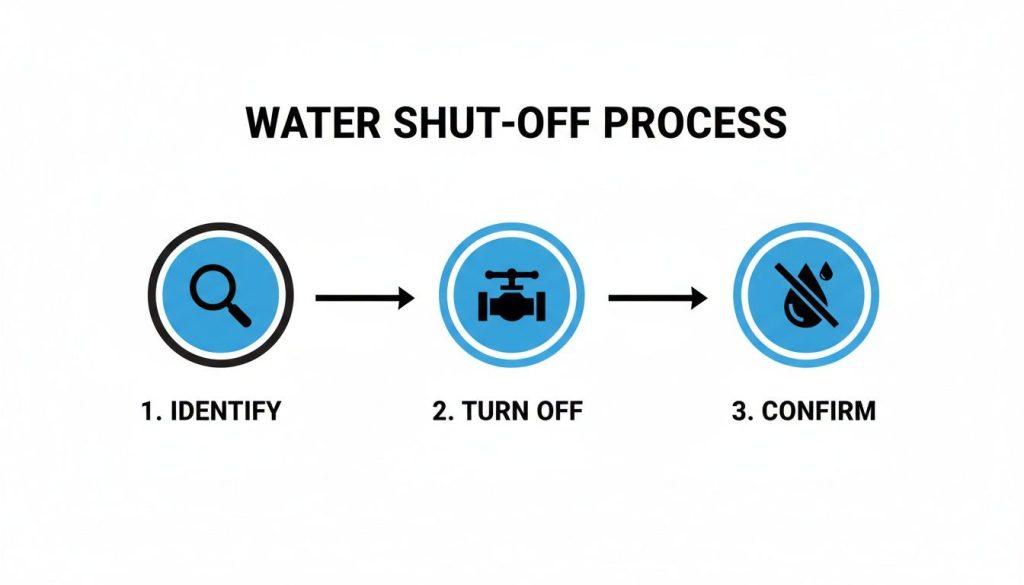
This quick visual guide breaks down the process for you. In an emergency, it's all about identifying the right valve and turning it off.
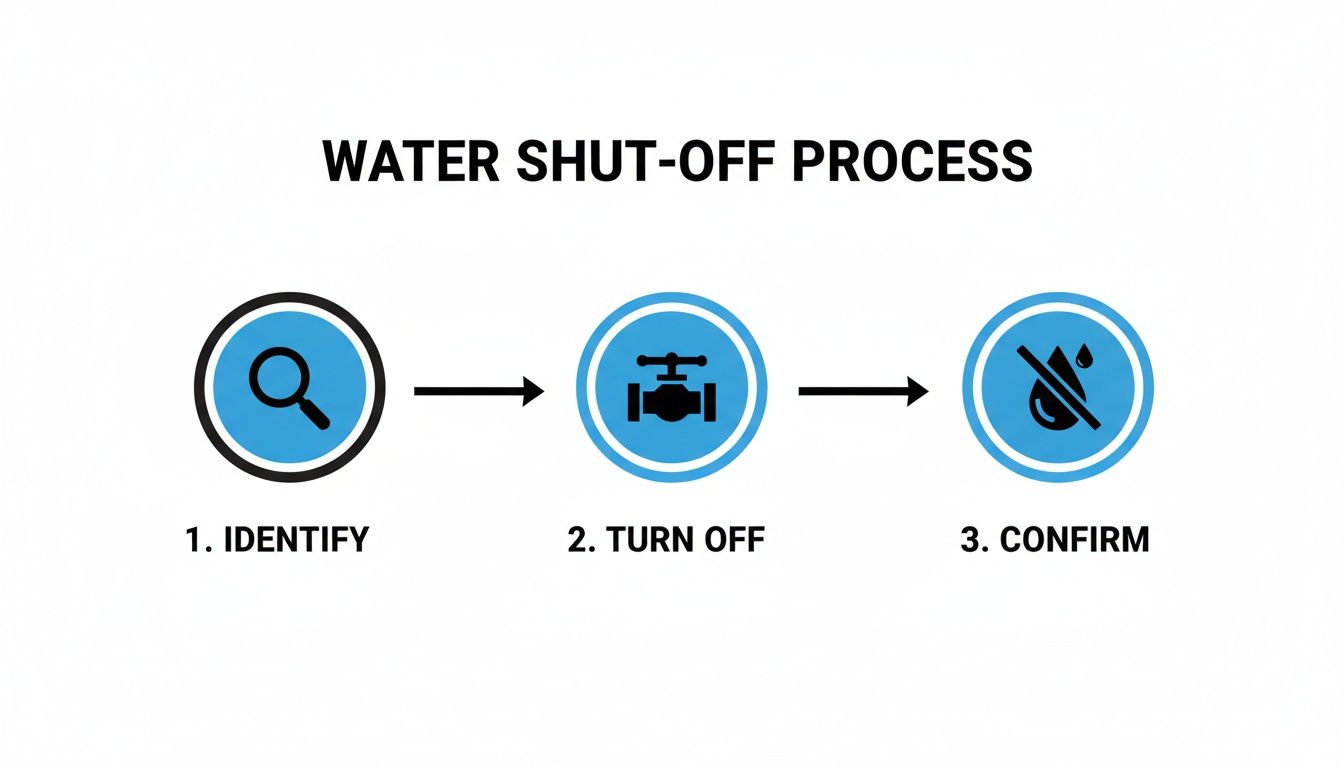
The main thing is to act calmly but quickly. Find the valve, and turn it all the way off.
A Quick Guide to Common Shutoff Valves
To help you out, here’s a quick rundown of the valves you're most likely to encounter in your home. Knowing what you're looking at can save you precious seconds.
| Valve Type | Appearance | How to Turn Off | Common Location |
|---|---|---|---|
| Quarter-Turn Ball Valve | A lever-style handle on a brass body. | Turn the handle 90 degrees. The handle will be perpendicular to the pipe when off. | Under sinks, behind toilets, main water lines. |
| Multi-Turn Gate Valve | A round, wheel-like handle. | Turn clockwise ("righty-tighty") several times until it stops. | Older homes, main shutoffs, outdoor spigots. |
| Multi-Turn Globe Valve | Similar to a gate valve, but often more bulbous. | Turn clockwise until it feels tight. Don't overtighten. | Under sinks, toilets, and other fixtures. |
These are the three main players. The quarter-turn valves are the most modern and easiest to use, but you'll still find plenty of the older multi-turn styles out there in homes across Cherokee County and Forsyth County.
Turning the Valve Correctly
Once you've found the valve, turn the handle clockwise—remember, "righty-tighty"—until it stops moving. If you have a modern quarter-turn lever, you just need to rotate it 90 degrees so the handle is perpendicular to the pipe it's on.
This simple action cuts the water supply to that one fixture, letting you deal with the leak without shutting down water to the entire house. After stopping the immediate flood, you can start thinking about next steps, like a potential ruptured pipe insurance claim.
Of course, if the valve is seized up or you can't get the leak to stop, you'll have to escalate. Your next step is to find the main house shutoff, which we'll cover in the next section.
Finding and Using Your Main Water Shutoff Valve
So, you've got a leak that isn't stopping at the sink or toilet, or maybe you see water in yard and have no idea where it's from. This is when you need to go to the source: the main water shutoff valve for your entire house. Knowing how to find and use this valve isn't just a handy homeowner tip—it's your first line of defense against a full-blown plumbing disaster, like a major leak repair situation.
Finding this valve quickly can mean the difference between a simple cleanup and a catastrophic flood. This is especially critical when you're dealing with something like a burst pipe repair and need to call an emergency plumber in Alpharetta or Roswell. Shutting off the water protects your property from further damage while you wait for a pro to arrive.
Common Hiding Spots in North Metro Atlanta Homes
Think of the main water shutoff as the master switch for all the water flowing into your home. Its location often depends on the age and layout of your house, which is why it's a good idea to locate it before an emergency strikes.
Here are the most common places I see them in North Metro Atlanta homes:
- Basement or Crawl Space: Start by looking for the water pipe that comes into your house through the foundation. This is usually on the side of your home that faces the street. The valve will be right there on that pipe, often close to the water meter.
- Garage: In newer homes especially, the garage is a go-to spot. You'll often find the valve on a wall near your water heater, which makes sense as a central plumbing hub. This is critical to know for a water heater replacement in Johns Creek.
- Utility Closet: If you don't have a basement or garage, check any closets that house your furnace or water heater. It's often tucked in there.
- Outside Wall: For homes built on a slab, check the exterior of your house. Look for a small access panel or even an exposed pipe and valve on the wall facing the street.
Finding your main shutoff is one of the most important things you can do as a homeowner. It's the one action that stops a problem like a main water line repair leak from causing thousands of dollars in water damage.
For a more in-depth look at how these valves function and why they're so important, check out this Your Essential Guide to the Shut Off Valve for some great additional info.
Gate Valves vs. Ball Valves: How to Turn Them Off
Once you've found the valve, you'll see one of two types. It’s important to know which one you're dealing with, as they operate differently. We see both kinds all over Cobb County and Cherokee County.
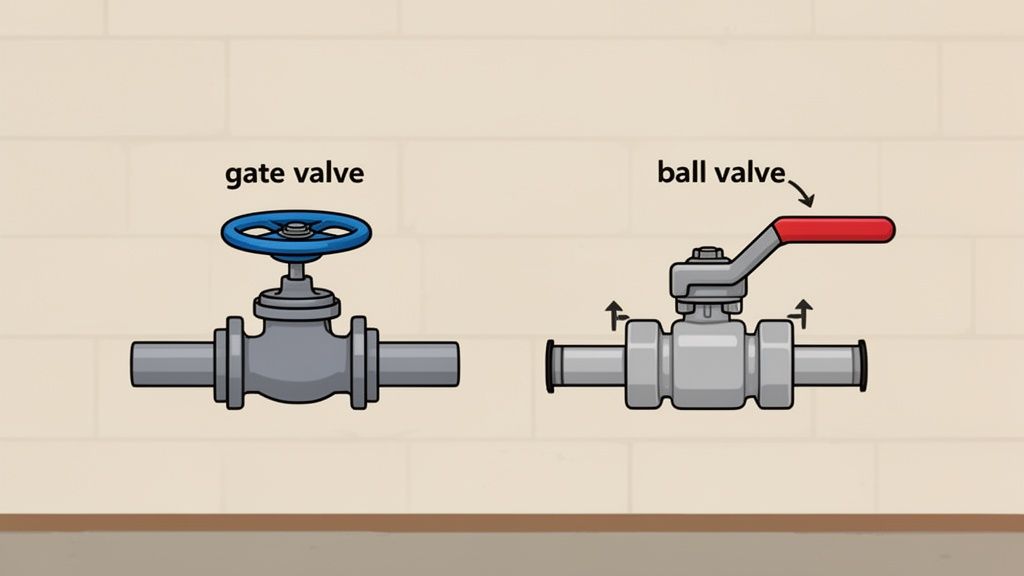
A Gate Valve has a round, wheel-like handle, similar to what you'd see on an outdoor hose spigot. To shut it off, you have to turn it clockwise multiple times. Just remember the old saying, "righty-tighty," until it stops. Don't crank on it, but make sure it's fully closed. These are typical in older homes.
A Ball Valve is the more modern option and features a single lever handle. You’ll find these in most newer homes across Johns Creek and Marietta. They're incredibly simple: just give the lever a quarter turn (90 degrees). When the handle is parallel with the pipe, water is flowing. When it’s perpendicular to the pipe, the water is off.
Knowing your valve type is key. If you find your valve is stuck, rusted shut, or just won't budge, don't force it. You could easily break it and turn a controlled situation into a geyser. In that case, your next step should be to call a 24 hour plumber near me like JMJ Plumbing right away.
The Final Option: The Curb Stop Shutoff
There are plumbing problems, and then there are plumbing disasters. Imagine this: you've sprinted to your main shutoff valve and cranked it closed, but the sound of rushing water doesn't stop. Or worse, you look out the window and see a new, unwanted water feature bubbling up in your front yard.
When this happens, you’re dealing with a different beast entirely. It means the break is in the main water line, the pipe running underground from the street to your house. Your indoor valve is completely useless. You have one last move: the curb stop shutoff.
Think of the curb stop as the ultimate kill switch for your property's water. It’s located near the property line, usually in a small box set into the ground and marked "WATER." But this isn't a valve you should ever try to turn yourself.
Don't Touch That Valve: A Job for the Pros
Unlike the friendly, hand-operated valves inside your home, the curb stop isn't designed for easy or frequent use. It’s often old, buried, and requires a special long-handled tool called a curb key to operate.
Trying to force it with a pair of pliers or a standard wrench is a recipe for disaster. I've seen it happen countless times—a homeowner tries to be a hero and ends up snapping the valve stem. That single mistake can turn a straightforward main water line repair in Cumming into a massive, expensive headache involving the city.
A homeowner in Acworth or Alpharetta who spots water in yard has a main water line leak, plain and simple. The curb stop is the only way to stop the gushing water, but calling a 24 hour plumber is the only safe way to get it turned off.
These valves can be especially fragile in places like Cobb County and Forsyth County, where soil and older infrastructure make them prone to seizing up. Breaking one might not just flood your yard—it could cut off water to your neighbors and leave you on the hook for municipal repairs.
Why Speed (and a Pro) Matters
A broken main water line is a true emergency. Every minute that water flows, it's eroding the soil under your driveway, your walkway, and potentially even your home's foundation. The clock is ticking, and the costs are adding up.
The scale of water loss from these types of leaks is staggering. Across the country, utilities lose a massive amount of treated water before it ever gets to a home. Some studies show this costs U.S. utilities $6.4 billion annually. You can learn more about the impact of water loss on utilities to see just how serious it is.
When you're facing this situation, getting a professional on-site fast is everything. Here’s why it’s not a DIY job:
- The Right Tools: An emergency plumber in Canton arrives with a curb key and the experience to know exactly how much force to use on an old, stubborn valve.
- Liability: That curb stop is technically municipal property. If you break it, the city will bill you for the repair. It’s a risk you don’t want to take.
- Quick Diagnosis: We can shut off the water and immediately start figuring out the problem, whether it’s a small crack or a full water line replacement.
If you're in Roswell, Johns Creek, or anywhere in North Metro Atlanta and think you need a main water line repair near me, don't hesitate. Your first and only call should be to JMJ Plumbing. We have the tools and expertise to shut the water down safely and get to work on a solution right away.
What to Do After You Shut the Water Off
Okay, the water is off. Good job. In a plumbing emergency, that's the single most important thing you can do to stop a bad situation from turning into a catastrophe. Take a second to breathe. Now, let's deal with what comes next to get things ready for a proper repair.
Even though you’ve closed the main valve, your work isn’t quite done. There’s still a surprising amount of water just sitting in the pipes throughout your house. Getting that water out is crucial, especially if you're facing a burst pipe repair and want to prevent any more water from seeping into your floors and walls.
Drain the Remaining Water From Your Pipes
Think of your home's plumbing like a giant, full drinking straw. Even after you stop sipping, there's still liquid inside. You need to empty it.
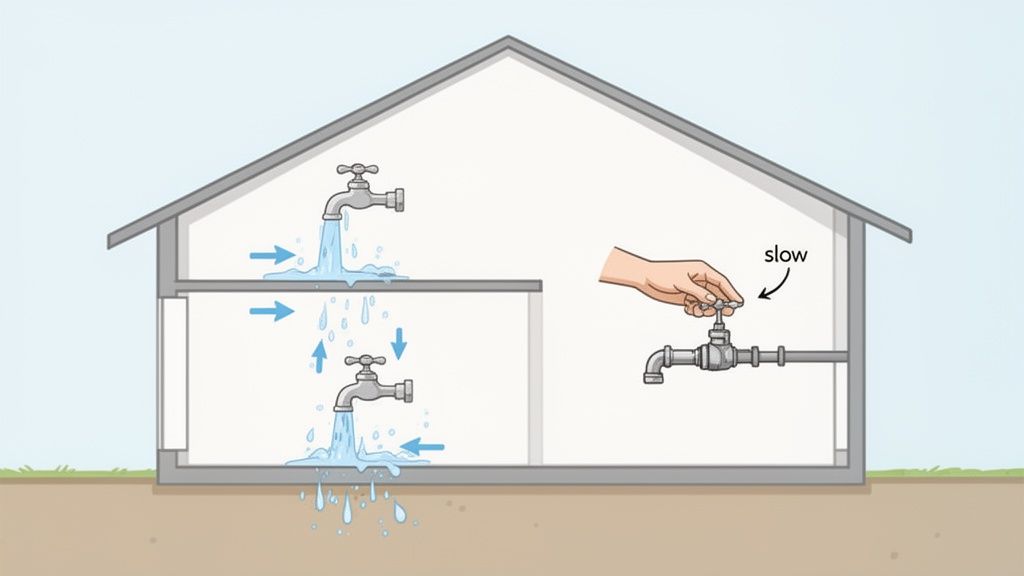
We can use a little gravity to help us out. First, go to the highest point in your house and open a faucet—an upstairs shower or sink is perfect. This introduces air into the lines, breaking the vacuum seal and letting the water flow out freely from below.
Next, find the lowest faucet in your home. This is usually in the basement, on the ground floor, or even an outdoor hose spigot. Open the cold tap all the way. You’ll probably hear some gurgling sounds as water sputters and then drains out. Letting the pipes empty like this depressurizes the whole system, which is exactly what a plumber needs before starting a leak repair.
Turning the Water Back On Safely
Once the repair is finished—whether it was a simple drain cleaning or a bigger job like a water heater replacement in Cumming or a full water line replacement in Marietta—don't be tempted to just crank the main valve back open. This is a common mistake that can cause a nasty jolt to your system known as water hammer.
Water hammer is a powerful hydraulic shockwave created when water moving at high speed is suddenly forced to stop or change direction. It can sound like someone is banging on your pipes with a hammer, and that powerful jolt can damage fittings, connections, and even your appliances.
To avoid this, you have to reintroduce water to your pipes slowly and gently.
- Turn the main valve (either a gate or ball valve) just a quarter of the way open. Let it sit like that for a few minutes.
- You’ll hear hissing and spitting from the faucets you left open. That’s just air being pushed out of the lines, which is exactly what you want.
- Once the water is flowing in a steady, bubble-free stream from those open faucets, you can head back to the main valve and open it the rest of the way.
- Finally, walk through the house and turn off all the faucets.
This careful process protects your entire plumbing system, something we always emphasize to homeowners from North Fulton to Forsyth County.
If you've done all this and you're still running into trouble—maybe you have low water pressure, the water looks rusty, or you hear water running when everything is off—it’s time to call a professional. A 24 hour plumber can track down hidden issues you can’t see. For anyone in Acworth, Canton, or across Metro Atlanta, the team at JMJ Plumbing is always ready to step in and get your home back to normal, safely and correctly.
When to Call an Emergency Plumber in Metro Atlanta
Look, knowing your way around a shutoff valve is a fantastic skill for any homeowner. But I've been doing this for years, and I can tell you, there are times when the best tool in your box is your phone. Recognizing when a problem has graduated from a simple DIY fix to a full-blown emergency is just as important.
Some situations are simply too risky or complex to handle on your own. These are the moments that require an immediate call to a 24 hour plumber. Acting fast isn’t just about preventing a mess—it’s about stopping a small headache from turning into a four-figure repair bill.
The Water Won't Stop
This is the big one. You've got water pouring out, and nothing you do is stopping it. You've tried the valve under the sink, you've scrambled to find the main shutoff, but the water just keeps coming.
It’s a scenario we see all the time. Maybe the valve is old and rusted solid, refusing to budge. Or worse, you turn the handle and it just spins freely, the internal parts having given up the ghost long ago. Sometimes, you just can't find the main shutoff at all.
Whatever the reason, if you can't get the water to stop, your job is done. It's time to call us. An emergency plumber in Woodstock has specialty tools to shut the water off from the street or tackle a broken valve without making things worse.
Red Flags From Outside the House
Some of the sneakiest and most destructive plumbing problems don't start with a bang inside. They begin silently, underground. You need to know what to look for.
If you notice a perpetually soggy patch in your yard that never dries out, see water pooling on the lawn for no reason (water in yard), or experience a sudden drop in low water pressure across your entire house, you’re likely looking at a main water line repair issue. Don't wait on this. That leaking water can wash away the soil supporting your driveway, your walkway, or even the foundation of your home.
It’s the same with your sewer line. A persistent sewage smell, gurgling noises from multiple drains at once, or a dreaded sewer backup in your tubs and showers are all major warning signs. This isn't just a plumbing problem; it's a serious health hazard. You need an expert for sewer repair in Acworth or sewer replacement in Alpharetta right away.
When Small Symptoms Point to a Big Problem
Sometimes an emergency isn't a geyser. It's a combination of smaller issues that are telling you something bigger is wrong. Keep an eye out for these tell-tale signs:
- No Hot Water: If your water heater is leaking or just won't heat up, it might be time for a water heater replacement in Roswell.
- A Stubborn Clogged Toilet: Plunging is your first line of defense, but if a clogged toilet won't flush, the clog could be deep in your main drain line, requiring professional drain cleaning.
- Slow Drains or Low Pressure Everywhere: A sudden, house-wide drop in pressure is a classic symptom of a hidden leak in the main water line. Multiple slow drains could signal an impending sewer backup.
Ignoring these clues can cost you dearly. To put it in perspective, property monitoring data shows that nearly 772 million liters of water can be lost from leaks in a single year across monitored properties. You can discover more insights about these water loss findings and see just how fast a "minor" leak adds up.
For our customers in Cumming, Marietta, or Roswell, the best thing you can do is have your information ready when you search for a 24 hour plumber near me and make the call. Tell us your address, give a clear description of the problem (e.g., "There's a sewage smell in my basement," or "I've got a puddle forming in the front yard"), and let us know what you've already tried. The more we know upfront, the faster we can solve your emergency.
Common Questions About Shutting Off Your Water
Even with the best instructions, things can go wrong. When you're staring at a spreading puddle, a lot of questions can pop into your head. Here are some of the most common ones we hear from homeowners in Cobb County and Cherokee County, along with some straight answers from our experience in the field.
What If a Shutoff Valve Is Rusted and Won’t Budge?
This is a classic problem, especially in older homes around Marietta and Roswell. You’ve found the right valve, but it’s completely seized with corrosion and refuses to move an inch.
First thing's first: do not force it with a big wrench. We see this all the time. Many older gate valves have a soft brass stem inside. If you crank on it too hard, that stem can snap right off, and your small, manageable leak just turned into an absolute gusher.
Instead, try gently tapping the body of the valve—not the handle—with a small hammer. Sometimes, that's enough to break the corrosion's grip. If it's still stuck, grab a can of penetrating oil like WD-40 and spray it right where the handle's stem goes into the valve. Give it about 15 minutes to work its magic. If you still can't turn it with firm hand pressure, it’s time to stop. Move on to the main house shutoff. If that’s also not an option, you need to call a pro for an emergency leak repair.
It’s a story we’ve seen play out dozens of times. A homeowner tries to fix a running toilet, gets aggressive with a stuck valve, and suddenly they're dealing with a burst pipe repair. Knowing when to throw in the towel is just as important as knowing what to do.
How Can I Test My Main Shutoff Valve Before an Emergency?
Testing your main valve is one of the smartest five-minute jobs you can do. You really don't want to find out it’s broken when water is actively flooding your basement. Here’s how to check it.
- First, give everyone in the house a heads-up that the water will be off for a few minutes.
- Find your main shutoff valve and turn it all the way to the "off" position.
- Walk over to a faucet—the kitchen sink works well—and turn on the cold water. You should see the flow slow to a trickle and then stop completely within a minute.
If the water keeps running at full blast, your main valve isn't working. This is something you'll want to get fixed sooner rather than later. Give a plumber a call to schedule a repair or replacement before you need it for a real main water line repair emergency.
Is It Safe to Turn Off the Water for a Long Vacation?
Absolutely. In fact, we highly recommend it. Shutting off the main water supply before a long trip is the best way to guarantee you won't come home to a nasty surprise like a sewer backup or a burst washing machine hose. It’s total peace of mind.
Just turn the main valve off. Then, to relieve pressure, open a faucet on the lowest floor of your home (like a basement sink) and another on the highest floor (like an upstairs shower). This will let the pipes drain out. One more tip: switch your water heater to the "pilot" or "vacation" setting. This saves energy and prevents the unit from trying to heat an empty tank, which can damage the appliance and lead to needing a water heater replacement. When you get back, just reverse the process, turning the water on slowly to prevent water hammer.
If you run into a plumbing emergency you can't solve—from a clogged toilet won’t flush to a shutoff valve that’s failed you—the licensed experts at JMJ Plumbing are on call 24/7. We offer fast, reliable help across North Metro Atlanta. Contact us for immediate assistance at https://www.jmjplumbing.com.