Expert Sewer Pipe Replacement in North Atlanta

A sewer problem usually does not start with a disaster. It starts with something easy to dismiss. The toilet gurgles once. The shower drains slower than usual. There is a faint sewage smell near the laundry room, or a damp patch in the yard that never seems to dry out.
That is the point where most homeowners in Woodstock, Marietta, Acworth, and nearby areas start wondering if they need drain cleaning, sewer repair, or full sewer pipe replacement. The honest answer is that you do not know until the line is inspected properly. Some problems are a clog. Some are a cracked pipe. Some are a failed line that has reached the end of its useful life.
The good news is this is a solvable problem. A sewer line can be diagnosed, the right repair method can be chosen, and the work can be done without guessing. The key is not wasting time on repeated temporary fixes when the symptoms are pointing to a larger failure underground.
That Unmistakable Sign Something is Wrong with Your Sewer
A homeowner might first notice it during a normal weekday morning. One bathroom seems slow. Then the kitchen sink burps air. Later that evening, the toilet backs up after a shower runs. By the next day, there is a sewage smell outside near the side yard.
That pattern matters. One isolated slow drain can be a local clog. Multiple fixtures acting up at once usually point to a problem farther down the line, often in the main sewer.
What homeowners usually notice first
The first signs are often subtle:
- Toilets that gurgle: Air is getting trapped or displaced in the drain system.
- Slow drains in more than one room: The blockage is likely beyond a single branch line.
- Bad odor indoors or in the yard: Wastewater may not be moving out the way it should.
- Water showing up where it should not: A soggy strip in the yard can point to an underground leak or break.
When those symptoms show up together, it is time to stop treating it like a simple clog.
Why fast diagnosis matters
Sewer problems rarely improve on their own. The line can continue to catch paper, grease, and waste until backups become more frequent and more severe. If the pipe is cracked, offset, sagging, or invaded by roots, repeated snaking may buy a little time without fixing the cause.
Practical advice: If more than one fixture is backing up, avoid running more water until the line is inspected. Every shower, laundry load, and dishwasher cycle adds more volume to a system that may already be failing.
Homeowners looking for an emergency plumber in North Metro Atlanta often call when the backup has already happened. It is much easier, and usually less disruptive, to diagnose the line when the warning signs first appear.
Warning Signs You Need Sewer Line Replacement Not Just Repair
Not every sewer problem calls for full replacement. A localized crack, a root intrusion at one joint, or a blockage near a cleanout can often be repaired. But certain warning signs usually tell a different story. They point to a line that is deteriorated in multiple places or one that has a structural problem a spot repair will not solve.
Aging infrastructure is a major reason this keeps coming up. The global sewer repair services market is projected to reach $6,347.4 million by the end of 2025, and in the U.S. vitrified clay pipes common in homes built before 1940 often require 100% replacement in priority areas due to deterioration. The same source notes that replacement costs in older homes run 1.5 times higher than in modern constructions because access and upgrades are harder to handle (Cognitive Market Research sewer repair services market report).
Signs that point to a failing main sewer line
Here are the symptoms that raise concern for full sewer pipe replacement:
- Recurring backups: If the line is cleared and then backs up again, the pipe may be broken, crushed, offset, or full of root intrusion at several points.
- Multiple slow drains at once: One bathroom clog is one thing. A whole-house drainage issue suggests trouble in the main line.
- Sewage smell outside: When homeowners in Alpharetta or Canton notice odor in the yard, it often means wastewater is escaping before it reaches the city connection.
- Unusually green or wet grass over the sewer path: Nutrient-rich leakage can feed that patch of lawn while also damaging the pipe trench and surrounding soil.
- Frequent toilet gurgling: That sound often shows restricted flow or poor venting tied to a deeper sewer issue.
- Older pipe material: Homes with aging clay or cast iron lines tend to develop cracks, corrosion, root entry points, and joint failures.
What each symptom usually means underground
A symptom is only useful if you connect it to the likely pipe failure.
A repeated backup often means solids are hitting a physical defect. That could be a collapsed section, a major offset, or a belly where waste and paper settle instead of flowing.
A sewage odor in the yard usually means the pipe is no longer sealed. Cracks, broken joints, or separated fittings can all allow wastewater or sewer gas to escape into the soil.
A wet area over the line may also show that the pipe is leaking enough to change the condition of the ground above it. In Georgia clay soil, that can become a cycle. The soil shifts, the pipe loses support, and the problem gets worse.
When repair stops making sense
Repair is the right choice when the problem is limited and the rest of the line is sound. Replacement becomes the smarter choice when:
- the pipe has failed in more than one location
- the material is deteriorating along the run
- the line has slope or alignment issues
- root intrusion keeps coming back because the joints are compromised
- the pipe diameter or material no longer fits the property’s needs
Key takeaway: If you have had the same sewer problem more than once, ask for a camera inspection before paying for another basic drain cleaning. The camera usually answers whether you need a repair, a targeted excavation, or a complete replacement.
Sewer Replacement Methods Traditional vs Trenchless
Choosing the method is not about what sounds cleaner or newer. It comes down to the specific problem with the line, how the pipe was installed, and what sits above it. In North Metro Atlanta, that decision often gets shaped by Georgia clay soil, mature trees, and tight access around driveways, patios, and established landscaping.
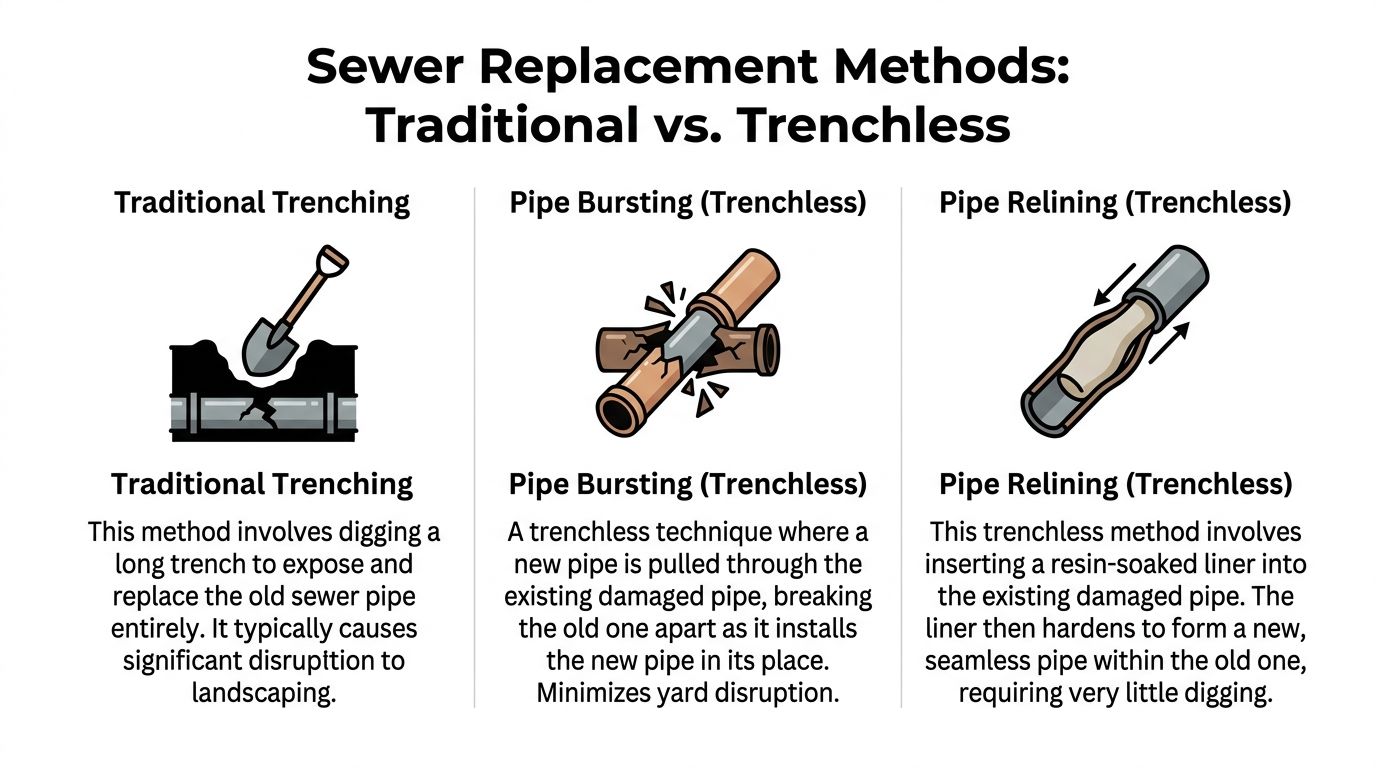
A camera inspection matters more than sales language for this reason. Some lines need full excavation so the grade can be rebuilt correctly. Others can be replaced or restored with far less surface damage if the existing path is still usable.
Traditional open-cut replacement
Open-cut replacement means excavating down to the sewer line, removing the failed pipe, installing new pipe at the proper slope, testing it, and backfilling the trench. If the line runs under a sidewalk, driveway, retaining wall, or planting bed, restoration usually becomes part of the job.
This is often the right method when the pipe has collapsed, shifted badly, or lost grade. In clay-heavy North Atlanta soil, movement over time can leave sections without proper support. When that happens, trenchless options may leave the underlying slope problem in place, while open-cut replacement lets the crew rebuild the line correctly from the bottom up.
Best fit
- lines with serious misalignment
- collapsed sections
- bellies or slope problems
- situations where exact grade must be rebuilt
Main trade-offs
- More digging
- More disruption to yard or hardscape
- More restoration afterward
Pipe lining or relining
Pipe lining creates a new interior wall inside the old pipe. The installer inserts a liner through the existing run and expands it against the host pipe. That can limit excavation and preserve the surface above, which matters when the sewer runs under landscaping, decorative concrete, or other finished areas.
The method has clear limits. The host pipe still needs to be structurally continuous enough to accept the liner. Technical specifications for IPEX NovaForm liner systems describe use in larger pipe ranges and outline expected flow and deflection performance, but for a homeowner the practical point is simpler. Lining is usually a good option when the pipe has cracks, leaking joints, or root entry points, and the overall shape of the line is still serviceable.
It will not correct a belly. It also will not rebuild a line that has major alignment failure.
Best fit
- structurally continuous pipe
- cracks and joint problems
- root intrusion in an otherwise usable line
- lines under landscaping or hardscape where digging would be disruptive
Main trade-offs
- Not the right fix for every sag or collapse
- Requires a host pipe suitable for lining
- May not solve alignment and grade defects
Pipe bursting
Pipe bursting replaces the old line by breaking it outward while pulling a new HDPE pipe into place. It is a full replacement method, not just an interior patch. That makes it useful when the existing sewer is too deteriorated for lining but the route itself still works.
According to PIM Corporation pipe bursting specifications, this method can reduce excavation compared with full open-cut replacement and may allow upsizing under the right conditions. In older North Atlanta neighborhoods with brittle clay sewer lines, that can be a practical option, especially where preserving a driveway, front walk, or established yard matters.
Straight runs are usually better candidates. Tight bends, offset connections, and lines with grade problems can rule it out.
Best fit
- replacement of old clay or similar brittle pipe
- jobs where surface disruption needs to be limited
- situations where a stronger new HDPE line is desired
- projects where upsizing may help
Main trade-offs
- Not ideal for all curves, angle changes, or slope defects
- Access pits are still required
- The existing run and surrounding conditions must support the method
Side-by-side comparison
| Method | Process Overview | Best For | Pros | Cons |
|---|---|---|---|---|
| Traditional trenching | Digs down the length of the line to remove and replace pipe directly | Collapsed pipe, severe offsets, belly correction, grade rebuild | Direct access, full correction of line and slope, works in complex failures | Most disruptive to landscaping, driveways, and surfaces |
| Pipe relining | Installs a new inner liner inside the existing pipe | Cracks, wear, root intrusion in a structurally usable pipe | Minimal digging, protects yard and hardscape, creates a seamless inner wall | Not suitable for every collapse or slope issue |
| Pipe bursting | Breaks old pipe while pulling in new HDPE pipe | Full replacement where trenchless access is practical and the run is suitable | Much less excavation, durable HDPE replacement, can upsize pipe | Can struggle with difficult angles, slope problems, or certain site constraints |
What works and what does not
Trenchless methods can save a yard. They do not automatically fix a bad layout underground.
A sagging sewer line is the clearest example. If wastewater is already pooling in a low spot, lining that section usually leaves the low spot there. Bursting can install a new pipe along much of the same path, which may still leave the grade wrong if the route itself is the problem.
That is why method selection should follow the inspection, not the sales pitch. On some properties, trenchless is the smart choice because it avoids tearing up a driveway or cutting through tree-heavy landscaping. On others, especially where clay soil movement or root damage has changed the line’s shape, open-cut replacement is the only method that provides a lasting fix.
What Sewer Pipe Replacement Costs in North Metro Atlanta
Cost is the question every homeowner asks first, and it should be. Sewer work is a major repair. The price depends on method, length, depth, access, pipe material, and how much restoration is needed after the plumbing work is done.
The national average for sewer line replacement is $3,320, with most homeowners paying between $1,390 and $5,320. For a typical 100-foot line, traditional excavation runs $5,000 to $20,000, or $50 to $200 per linear foot. Trenchless options such as CIPP lining run $7,000 to $15,000, or $70 to $150 per foot. In the Lower South, which includes Atlanta, costs are among the lowest nationally at $2,450 to $2,800 per 100 feet (This Old House sewer line replacement cost guide).
Why one house costs more than another
Two homes on the same street can have very different sewer replacement costs.
Here are the main cost drivers:
- Line length: More pipe means more labor, more material, and more setup time.
- Depth: A deeper line is harder to expose safely and usually takes longer to replace.
- Access: A line under a driveway, patio, retaining wall, or tight side yard can change the method and the labor involved.
- Replacement method: Open-cut often starts with a lower pipe-cost range, while trenchless can reduce restoration work.
- Material choice: The source data lists material costs such as PVC at $4.50 per linear foot, ABS at $6, cast iron at $50, and copper at $85.
- Age of the home: Pre-1940 homes can cost 1.5 times more than post-2000 homes because access, deterioration, and code upgrades are more involved.
Why trenchless is not always the expensive option
Some homeowners see a higher trenchless quote and assume it costs more overall. Not always.
If traditional trenching means cutting a driveway, rebuilding planted areas, replacing sod, or disturbing hardscape, the final bill can shift quickly. Trenchless often has a higher per-foot installation figure, but it may reduce the restoration portion of the job.
That is why an honest quote should look beyond pipe installation alone. The true comparison is total project cost.
What a clear estimate should include
A useful sewer replacement estimate should spell out:
| Cost Item | Why It Matters |
|---|---|
| Method used | Open-cut, lining, or bursting changes labor and restoration |
| Approximate footage | Helps explain material and labor scope |
| Access conditions | Driveways, fences, trees, and depth affect the plan |
| Permit and inspection requirements | Local approvals can add steps and scheduling |
| Surface restoration | Yard, concrete, or landscaping repairs should not be an afterthought |
Cost tip: If one estimate sounds much cheaper than the others, ask what is excluded. Sewer jobs often become expensive when cleanup, restoration, or code-required work was never included in the first place.
For homeowners in Cobb County, Cherokee County, North Fulton, and Forsyth County, the best next step is a camera inspection followed by a written quote tied to the actual condition of the line. That is how you separate a realistic project budget from a guess.
The Sewer Replacement Process from Inspection to Completion
Most homeowners feel better once they know how the job unfolds. Sewer replacement sounds overwhelming when it is just a phrase. It becomes manageable when you break it into steps.
Step one is the camera inspection
The first job is not digging. It is diagnosis.
A sewer camera inspection shows where the pipe runs, where the failure sits, what material is in the ground, and whether the issue is a break, root intrusion, offset joint, collapse, or belly. This step matters because different problems need different repairs.
A sewer line belly is a sagging section that causes blockages. Trenchless methods like pipe bursting often cannot correct the slope issue. A camera inspection helps identify whether the better fix is a hybrid approach with targeted spot excavation to rebuild support and restore the proper 1/4-inch-per-foot slope, which can be 50% cheaper than a full unnecessary replacement (Pipe Spy guide to sewer line belly repair).
What happens after the inspection
Once the line is scoped, the plumber can recommend the right path.
That usually falls into one of these categories:
- Localized repair if the damage is limited.
- Hybrid correction if part of the line needs excavation to fix slope or support.
- Full sewer pipe replacement if the pipe has broad failure, advanced deterioration, or multiple defects.
The estimate should match what the camera found. If the recommendation is replacement, the homeowner should understand why repair is no longer the economical option.
Permits, scheduling, and site prep
Before work begins, the replacement plan has to fit local rules and the site conditions.
The crew may need to:
- mark utilities
- secure permits
- identify entry and exit points for trenchless work
- plan excavation paths if open-cut is required
- protect surrounding areas such as walkways, irrigation lines, and outdoor features
In North Metro Atlanta, permit timing and inspection scheduling can influence when the work starts and when it wraps up.
The installation phase
What the job looks like on site depends on the chosen method.
For open-cut replacement, the crew excavates to expose the pipe, removes the damaged sections, installs new piping at proper grade, and checks the system before backfilling.
For relining, the line is cleaned and prepared first. Then the liner is inserted and expanded inside the old pipe to create the new interior wall.
For pipe bursting, access pits are prepared, the bursting head is pulled through the old line, and the new HDPE pipe follows behind it into place.
Final testing and cleanup
The last stage matters just as much as the first.
A proper completion should include:
- confirmation the line is flowing correctly
- verification that connections are sound
- cleanup of the work area
- backfill and surface restoration appropriate to the job
- final inspection when required by the local authority
Homeowner tip: Ask for the post-repair camera footage if practical. It gives you a clear record of the new line or repaired section and helps if you ever sell the home.
A well-run sewer replacement project should leave you with fewer surprises at the end than you had at the beginning.
North Atlanta's Unique Challenges Clay Soil and Tree Roots
Sewer work in North Metro Atlanta is not the same as sewer work in flat, sandy ground. Local conditions change both the diagnosis and the repair method.
Clay soil changes the job
Georgia clay holds water, shifts with moisture changes, and can put stress on buried lines. When the soil expands and contracts, sewer pipes can lose support, joints can separate, and low spots can form. That is one reason a line can look fine from the surface while failing below grade.
Clay also affects excavation. Digging, shoring, and backfilling have to be handled carefully so the new pipe is supported properly and the trench does not become the next problem.
Tree roots are not just a blockage problem
Roots go where moisture is. Once they find a compromised joint or crack, they keep growing into that opening. Homeowners often first notice the issue as a recurring backup, but by the time roots are removed, the pipe may already have structural damage.
If you are trying to understand root management from the landscaping side, this guide on getting rid of tree roots without damaging your property is a useful companion resource. It helps homeowners think about the root issue beyond the drain line itself.
Hills, curves, and odd tie-ins matter
North Metro properties are not all level. In hilly areas such as Marietta and Roswell, trenchless methods like pipe bursting can struggle with significant curves and slope changes. Real-world repairs sometimes require combinations of 22.5 and 45-degree fittings or flexible rubber unions to match the existing layout, and HD camera inspections can help plan those details before repair (video reference on non-standard pipe angles and repair adjustments).
That matters because a sewer line on paper may look simple, while the buried route may bend around additions, trees, old foundations, or grade changes.
Permitting is part of the repair
Homeowners usually focus on the pipe. The job also has to satisfy local inspection and permitting requirements.
In places like Kennesaw, Acworth, and Forsyth County, the timeline can depend on:
- municipal permit approval
- inspection availability
- right-of-way considerations if the line ties near public infrastructure
- how much of the line lies on private property versus near the street
That is one reason local experience matters. The plumbing side and the paperwork side have to work together.
Local reality: In North Atlanta, the smartest sewer replacement plan is the one that fits the soil, the slope, the roots, and the municipality. A generic national answer often misses at least one of those.
Why Your Plumber's License Matters and The JMJ Promise
A homeowner usually checks a plumber’s license after the sewer has already backed up, the yard smells, and someone is asking for a signature. That is late. Sewer replacement affects grade, pipe connections, inspection approval, and the part homeowners care about most. Whether the problem stays fixed after the yard is closed up.
In North Metro Atlanta, licensing matters for practical reasons. Georgia clay shifts. Tree roots find weak joints. Older homes in Marietta, Roswell, and Smyrna often have a mix of original pipe and later tie-ins that need careful judgment at the connection points. A licensed master plumber is trained to diagnose the line, install it to code, and deal with the inspection process that comes with permitted sewer work.
What to verify before you hire anyone
Check four things before work starts.
- State plumbing license: Confirm the contractor is legally qualified to perform sewer replacement.
- Insurance coverage: Ask for proof, not a verbal yes.
- Written scope of work: It should spell out the method, what is being replaced, what is excluded, and who handles restoration.
- Recent local reviews: Look for comments about diagnosis, cleanup, communication, and whether the repair held up.
A good contractor should also explain the trade-off between repair and replacement in plain language. If the answer is vague, rushed, or changes once digging starts, that is a warning sign.
Why license and experience affect the outcome
Sewer work can fail even when the pipe itself is new. The usual causes are poor fall, bad connections, shortcuts at transitions, or missed inspection steps. Those mistakes are expensive because the yard gets disturbed twice.
That is why I tell homeowners to pay attention to who is making the call, not just the price on the estimate.
JMJ Plumbing operates in North Metro Atlanta under Georgia Master Plumber license MP210218. The company serves Acworth, Alpharetta, Canton, Cumming, Johns Creek, Kennesaw, Marietta, Roswell, Sandy Springs, Smyrna, and Woodstock, and handles sewer line repair and replacement with inspection equipment, emergency service, and on-site diagnosis.
The promise that matters
Homeowners do not need inflated claims during a sewer problem. They need straight answers.
The JMJ promise is simple:
- honest diagnosis based on the condition of the line
- code-compliant installation
- clear on-site pricing before the job proceeds
- a repair or replacement method that fits the property
- respect for the home, yard, and cleanup
Insurance questions also come up during these calls, especially after backups inside the house. For a plain-english overview, review Does Homeowners Insurance Cover Sewer Backup? before you speak with your carrier.
A licensed plumber cannot promise that every sewer job will be cheap or fast. Any plumber who does is selling comfort, not accuracy. What a licensed master plumber can do is diagnose the problem correctly, explain the trade-offs clearly, handle the permit and inspection requirements, and install a line that is built to last in North Atlanta conditions.
Frequently Asked Questions About Sewer Replacement
A few questions come up on almost every sewer replacement call. Short, direct answers usually help homeowners make the next decision.
| Question | Answer |
|---|---|
| Can I keep using my plumbing if the sewer line is backing up? | It is safer to limit water use until the line is inspected. Running showers, toilets, laundry, or the dishwasher can make a backup worse. |
| Is a sewer backup always a full replacement? | No. Some backups come from localized clogs or repairable defects. A camera inspection is what separates a repair job from a replacement job. |
| Will trenchless sewer replacement work on every house? | No. Trenchless methods are excellent in the right conditions, but they are not ideal for every collapse, every curve, or every slope problem. |
| How long does sewer replacement take? | The timeline depends on the method, access, permit scheduling, and whether restoration is needed. A straightforward job moves much faster than one involving deep excavation or difficult access. |
| Does homeowners insurance cover sewer problems? | Coverage depends on the policy and cause of loss. For a useful plain-English overview, review Does Homeowners Insurance Cover Sewer Backup? before you call your carrier. |
| What is the first step if I smell sewage in the yard? | Stop assuming it is just a drain clog. Call for an inspection, especially if the smell is paired with slow drains, gurgling toilets, or wet ground. |
One final point. If you are comparing estimates, ask each plumber the same question: “What exactly did the camera show that makes this method the right one?” That answer usually tells you a lot about the quality of the contractor.
If you are dealing with slow drains, a sewer backup, sewage smell, water in the yard, or you need straight answers about sewer pipe replacement in Acworth, Marietta, Roswell, Woodstock, Alpharetta, Canton, Cumming, or Johns Creek, contact JMJ Plumbing. Schedule an inspection, get a clear on-site quote, and find out whether your line needs cleaning, repair, or full replacement.