Protect Your Home: Halo Whole House Water Filter

If you're in Woodstock, Roswell, Marietta, or anywhere around North Metro Atlanta, you may already know the routine. White film on faucets. Glasses that look cloudy even after the dishwasher runs. A shower that leaves your skin feeling dry. Then the bigger worry shows up. Is that sediment a warning sign? Is your water heater wearing out faster than it should? Is low pressure just a nuisance, or the start of a much larger plumbing repair?
I talk to homeowners who start with a taste or comfort complaint and end up realizing the water is affecting the entire house. That includes fixtures, water heaters, valves, supply lines, and the appliances that depend on clean water moving through them every day.
A halo whole house water filter matters because it treats the problem at the point where water enters the home, before that water reaches your shower, kitchen sink, laundry, and plumbing system. For many homeowners, that makes it less of a luxury upgrade and more of a practical form of preventative plumbing care.
Is Your Atlanta Water Ruining Your Home
A homeowner in Woodstock called after noticing crusty buildup around the shower trim and a decline in hot water performance. At first, they thought they were headed toward a water heater replacement. Then they noticed more signs. The dishwasher left spots. Faucets collected scale. The washing machine hoses looked older than they should.
None of those symptoms felt like an emergency by themselves. Together, they told a different story.
The signs most homeowners notice first
Homeowners often don't start by thinking about water treatment. They start by noticing everyday frustrations:
- Cloudy dishes: You wash them, dry them, and they still look dirty.
- Soap scum on fixtures: The bathroom never seems fully clean.
- Dry skin and rough hair: Showers don't feel as comfortable as they used to.
- Stiff laundry: Towels feel scratchy instead of soft.
- Sediment concerns: You see particles in aerators or around fixtures and wonder what's going on inside the pipes.
Those are the visible signs. The hidden issue is that treated and mineral-heavy water can keep working on the plumbing long after you've wiped down the sink.
The damage you don't see
Inside the home, the same water touches supply lines, shutoff valves, appliance connections, and the water heater. When scale and chemical exposure keep building, small efficiency problems can turn into service calls. That's when homeowners begin searching things like clogged toilet won't flush, leak repair near me, emergency plumber, or main water line repair.
If you've already started wondering whether your low pressure points to a larger pipe issue, it's worth understanding how your incoming water affects the system as a whole. This is the same reason many homeowners looking into water line repair and replacement also ask whether poor water quality is shortening the life of everything connected to that line.
Water problems rarely stay in one room. If the water coming into the house is harsh, every fixture and appliance pays for it.
In North Metro Atlanta, that concern is practical, not theoretical. Homeowners in Acworth, Canton, Alpharetta, and Cumming often don't need more proof that their water is hard on plumbing. They can already see it on fixtures and feel it in daily use.
What Is a HALO Whole House Water Filter
A HALO whole house water filter is a point-of-entry water treatment system. That means it treats water as it enters your home, not after it reaches a single faucet.
Consider it a security gate for your plumbing. Instead of fixing taste at one sink, it screens water before it travels through the house.
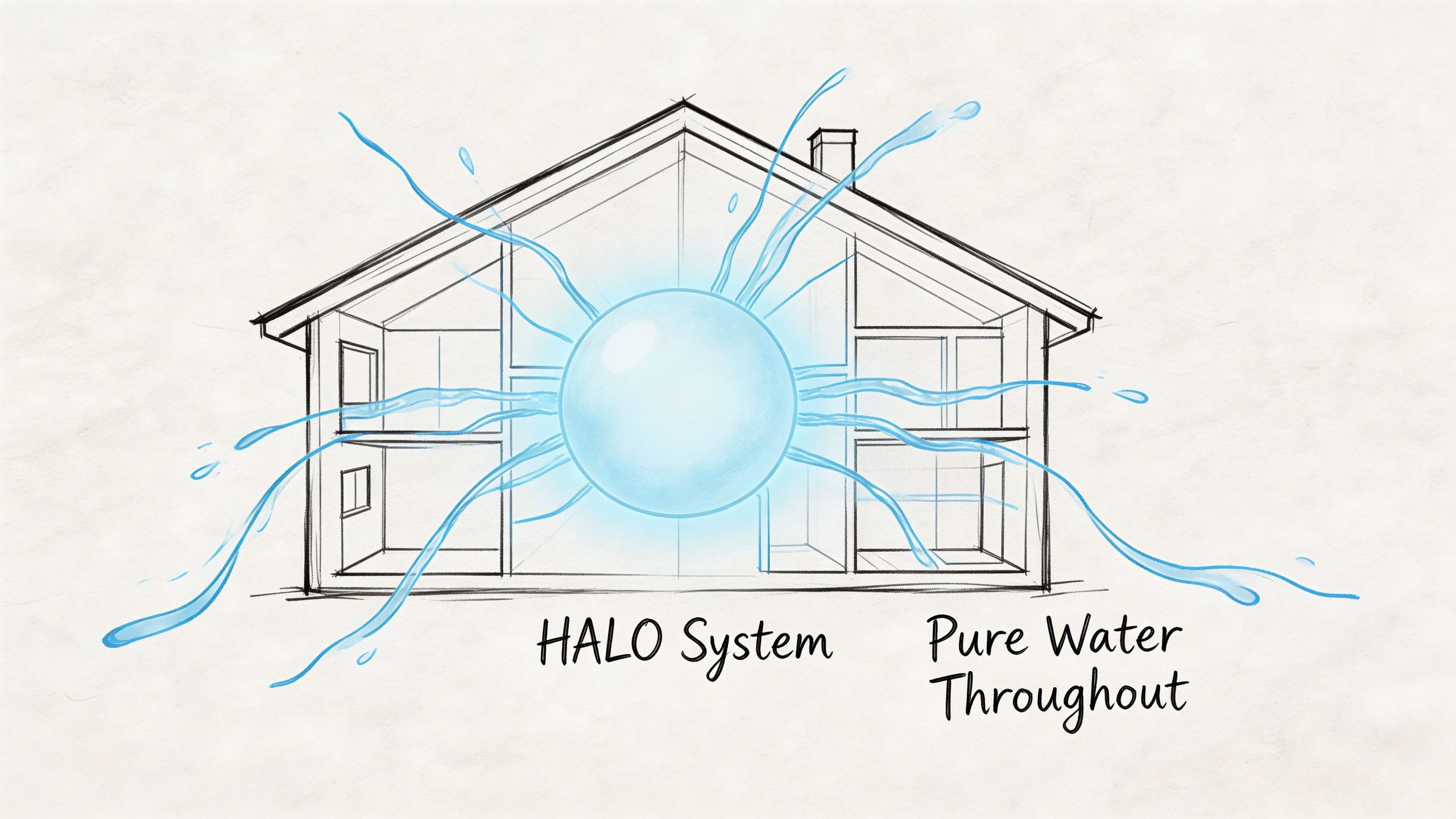
Whole-house protection versus single-faucet filtering
A pitcher filter or faucet attachment helps at one location. That's useful if your only concern is drinking water at the kitchen sink.
A whole-house system does something different. It protects:
- Showers and tubs: Better water quality where your family bathes
- Water-using appliances: Dishwashers, washing machines, and water heaters
- Fixtures and valves: Less harsh water moving through the plumbing
- Everyday comfort: Taste, odor, and general water feel throughout the home
That broader protection is why homeowners often choose a whole-home system when they're thinking beyond taste and looking at long-term plumbing wear.
Why HALO stands out
The HALO 5 whole-house system is designed to do more than basic filtering. It combines multiple treatment stages in one system, and it's built for long-term use.
According to this HALO 5 overview from Jim's Plumbing Now, the system is backed by a 10-year warranty and designed as a maintenance-free operation. For homeowners, that matters because many traditional systems come with regular filter swaps, salt refills, and recurring maintenance tasks.
That difference can be easier to understand with a simple comparison:
| System type | What the homeowner usually deals with |
|---|---|
| Faucet or pitcher filter | Protection at one spot only |
| Traditional softener | Salt, regeneration, and ongoing upkeep |
| HALO whole-house system | Whole-home treatment with maintenance-free operation |
Practical rule: If the problem shows up in more than one room, a single-faucet filter won't solve it.
For homes in Canton, Marietta, Johns Creek, and surrounding areas, the main appeal is simple. Water enters once. If you treat it there, you protect the house from the main line forward.
How The 5-Stage Filtration Process Works
A lot of North Metro Atlanta homeowners hear "5-stage filtration" and assume it is marketing language. In practice, it works more like a series of checkpoints at your main water entry. Each stage handles a different problem before that water reaches your fixtures, valves, appliances, and water heater.

Stage one and stage two reduce chlorine, chloramines, and harsh taste
The first two stages focus on what many homeowners notice right away. According to the HALO 5 spec sheet, the system uses acid-washed granular activated carbon first, then catalytic high-activity carbon.
Plain English helps here. City water can be safe to drink and still be rough on the home. Chlorine and chloramines are added for disinfection, but they can leave that pool-like smell at the tap and in the shower. Carbon media helps reduce those chemicals before they circulate through the house.
That matters for comfort, but it also matters for wear. Water that smells harsh often gets homeowners thinking about taste only. A plumber looks one step further. Better-treated incoming water can be easier on the parts that use it every day, especially in homes already trying to extend the life of water heaters and related plumbing equipment.
The middle stages catch sediment and fine debris
The next stages handle the grit and fine particles that cause quieter problems. The spec sheet notes HALO AG Plus filtration media and garnet media, with filtration down to 5 microns.
A simple comparison helps. If chlorine is the chemical side of the problem, sediment is the wear-and-tear side. Fine debris can collect in aerators, clog appliance screens, interfere with valves, and keep fixtures from performing the way they should.
In real homes, this is the kind of issue that builds slowly. You may first notice lower flow at one faucet. Then a showerhead starts spraying unevenly. Later, an appliance inlet screen plugs up. Catching that material at the point where water enters the house helps protect the plumbing system before those small annoyances become service calls.
The final conditioning stage addresses scale behavior without salt
This is the part that confuses homeowners most, because filtration and conditioning are not the same job.
Filtration removes or reduces unwanted material in the water. Conditioning addresses how minerals behave once the water is inside the plumbing. HALO includes magnetic water conditioning technology without adding sodium or requiring electricity, as noted in the spec sheet.
That distinction matters in Georgia homes with mineral-related buildup. Scale does not usually announce itself with one dramatic failure. It forms little by little on heating elements, inside pipes, and on the working parts of fixtures and appliances. Over time, that buildup can push a water heater to work harder, shorten its service life, and contribute to the kind of replacement homeowners were hoping to avoid.
Homeowners who are comparing HALO with water softener installation and repair should pay attention to that difference. A softener and a conditioner do not work the same way, and the right fit depends on the water issue you are trying to address.
Why all five stages matter together
The system's primary value is not one media type by itself. It is the order of the treatment.
First, the system reduces chemical taste and odor. Then it captures sediment and finer particles. Then it helps address the mineral behavior that can leave scale behind inside the plumbing. That sequence is what makes a HALO system useful as preventative maintenance, not just a water quality upgrade.
From a plumber's point of view, that is the key benefit. You are not waiting until a tankless unit scales up, a standard water heater loses efficiency, or a valve gets packed with debris. You are treating the water at the front door of the house so the plumbing system has less to fight with every day.
Key Benefits for Your Plumbing and Family
A lot of North Metro Atlanta homeowners first notice water problems in the bathroom or kitchen. White crust shows up on fixtures. The water heater starts taking longer to recover. A dishwasher that should have years left begins acting older than it is. Those are not random annoyances. They are often early signs that the house plumbing is dealing with untreated water every day.
That is why the benefit of a HALO system goes beyond cleaner-tasting water. From a plumber's point of view, it works like preventative maintenance at the main water entry, helping protect the parts of the home you do not see until there is a repair bill attached to them.
What your family notices day to day
The day-to-day improvements are usually the easiest to spot. Water can taste cleaner. Chemical odor at the tap is reduced. Showers often feel less harsh on skin and hair. Fixtures and glass can stay cleaner longer instead of collecting residue so quickly.
Those changes matter because your family uses water all day, not just during a plumbing emergency.
What your plumbing notices over the years
The larger payoff often shows up in the equipment that costs the most to repair or replace. In Georgia homes, mineral-heavy water and disinfectant-related wear can slowly stress valves, supply lines, fixtures, and appliance internals. The process is gradual, which is exactly why homeowners miss it until performance drops.
A HALO system helps by treating the water before it spreads through the house. That can reduce the kind of buildup and water-related wear that pushes systems toward failure earlier than expected.
For many families, that means fewer chances of dealing with problems such as:
- Water heater trouble: Scale buildup can insulate heating surfaces and force the unit to run longer
- Fixture and valve wear: Debris and water quality issues can shorten the life of working parts
- Appliance strain: Dishwashers, washing machines, and ice makers all perform better with cleaner incoming water
- Main line and whole-home plumbing stress: Better water quality at the entry point supports the system from the start
If you are weighing filtration against water softener installation and repair, the practical question is simple. Are you only trying to change how water feels, or are you trying to reduce sediment, chemical taste and odor, and scale-related wear throughout the house?
Why flow rate matters in a busy home
A whole-house system has to protect the plumbing without making the house feel starved for water. That matters in homes where someone is showering upstairs while the washing machine and dishwasher are both running.
The HALO Defender specification sheet lists 4 GPM continuous flow for lead and PFAS reduction with a cartridge life of 84,480 gallons. The same specification sheet also lists peak flow rates of 13 GPM for chlorine and 7 GPM for chloramine, which helps explain why the system can keep up with normal family demand while still treating the incoming water.
Contaminants Addressed by HALO Filtration
| Contaminant / Issue | Effect on Your Home | How HALO Solves It |
|---|---|---|
| Chlorine | Unpleasant taste and odor, harsher water at taps and showers | Carbon-based filtration reduces chlorine in the incoming supply |
| Chloramines | Lingering chemical smell and taste | Specialized carbon media helps reduce chloramines |
| Sediment and particulates | Debris in aerators, wear on fixtures and appliances | Multi-stage media captures unwanted particles |
| Fine contaminants down to 5 microns | More material moving through the home's plumbing | HALO AG Plus filtration media removes contaminants down to 5 microns |
| Scale-related hard water effects | Buildup on fixtures, strain on water heaters and appliances | Conditioning technology helps reduce scale formation without salt |
In real plumbing service calls, the water heater is often where water quality problems become obvious first. If your home already has inconsistent hot water, noisy heating cycles, or signs of mineral buildup, it makes sense to review water heater repair and replacement options before a smaller water-quality issue turns into a full equipment failure.
Professional Installation and Care with JMJ Plumbing
A lot of North Metro Atlanta homeowners start looking at water treatment after the damage is already expensive. The water heater starts popping and rumbling. Shower valves get stiff. A small leak shows up at an old connection. In some homes, scale and debris also add stress to fixtures and appliances long before anyone realizes the incoming water is part of the problem.
A HALO system does its best work when the installation is planned like preventative maintenance for the whole plumbing system. Good placement, correct sizing, proper shutoffs, and clean connections all affect how well the unit protects your pipes, fixtures, and water heater over time.
The installation point matters because the filter has to treat water before it spreads through the house.

What a professional install should include
A proper install starts with an on-site look at how your home is plumbed. In the field, no two houses are exactly alike, even in the same neighborhood. Main line entry points, garage access, crawl space conditions, pressure concerns, and water heater location all affect the final setup.
A plumber should confirm:
- Main water line location: The system needs to be installed where it protects the full house
- Available service space: Filters need room for safe access, maintenance, and future service
- Code-compliant connections: Shutoffs, fittings, and bypass options should be installed correctly
- Startup and testing: The system should be flushed, checked for leaks, and placed into service the right way
That work helps prevent avoidable problems. A poor installation can leave you with pressure complaints, hard-to-service equipment, or connection leaks that have nothing to do with the HALO unit itself.
For homeowners comparing filtration with other forms of preventative plumbing care, this overview of general plumbing services helps show how water quality fits into the bigger picture.
The follow-up step that protects the water heater
The install is only part of the job.
After a HALO system is added, the water heater often needs attention because older scale and sediment inside the tank can break loose as water conditions change. In plain terms, the filter helps protect the house going forward, but the water heater may still be holding years of buildup from before the system was installed. If that material stays in the tank, you can still end up with noisy operation, poor heating performance, or an early replacement.
That is why a post-install water heater flush matters. It is one of the clearest examples of filtration working as preventative maintenance instead of a one-day upgrade.
Planning the work before you need an emergency call
Homeowners usually get the best result when they install a HALO system before the warning signs turn into a crisis. That means acting before sediment shortens water heater life, before scale puts extra strain on valves and supply lines, and before a stressed plumbing system contributes to leaks or larger repair bills.
JMJ Plumbing installs HALO systems as part of residential plumbing service in North Metro Atlanta, with attention to placement, service access, and the follow-up care that protects the rest of the home. If you want a recommendation based on your plumbing layout and household water use, schedule a HALO installation consultation with JMJ Plumbing.
HALO Water Filter FAQs for Georgia Homeowners
Is a HALO system the same as a salt-based water softener
No. A HALO system is built as a whole-home filtration and conditioning system, not just a salt softener.
That distinction matters if you want help with taste, odor, sediment, and plumbing protection across the whole house. Homeowners often use the term "softener" for any water treatment equipment, but the goals are different.
Will a halo whole house water filter lower my water pressure
Pressure loss is a fair concern, especially in larger households where showers, laundry, and dishwashing often happen at the same time.
HALO systems are designed for residential flow demands, and the Defender specifications discussed earlier show flow rates built for multi-fixture use. In real homes, proper sizing and professional installation matter just as much as the equipment itself. A system that matches the house is less likely to create performance complaints.
Is this mostly about comfort, or does it really help plumbing
It helps with both.
Comfort is what people notice first. Plumbing protection is usually the more important long-term benefit. If incoming water is rough on fixtures, appliances, and heating equipment, that wear adds up. That's why many homeowners start looking into filtration before they need emergency leak repair, sewer backup cleanup from unrelated system stress, or an urgent water heater replacement.
Better water quality isn't just about what you drink. It's also about what your pipes, fixtures, and appliances have to survive every day.
How long does a HALO 5 system last
The standard HALO 5 is rated for 10 years for an average family, but real-world lifespan can vary based on household demand and local water conditions, according to the HALO FAQ page.
That matters in larger homes in Roswell, Johns Creek, or Marietta where water use may be higher. The same source notes that larger households of 6+ people or homes with heavier water usage can affect carbon media lifespan. It recommends a custom audit based on local water quality and household demand.
Do larger North Metro Atlanta homes need special planning
Yes. Not every house should be treated as if it has the same occupancy, plumbing layout, and daily demand.
A few examples where planning matters:
- Bigger families: More showers, laundry, and dishwasher cycles increase water use
- High-demand homes: Heavy daily use changes how the system is expected to perform over time
- Older plumbing: Existing scale or aging valves may need attention during installation planning
That doesn't mean the system won't work well. It means the recommendation should fit the house.
Will this replace other plumbing maintenance
No. It reduces a major source of wear, but it doesn't replace normal plumbing care.
You'll still want to respond quickly if you notice low water pressure, water in the yard, a sewage smell, a slow drain, or a clogged toilet that won't flush. Water treatment helps protect the system. It doesn't fix a broken sewer line, a hidden leak, or an aging shutoff valve.
Is it worth considering before a plumbing emergency happens
Yes, especially if you already see signs that your water is hard on the house.
Most homeowners don't regret acting early. They regret waiting until the water heater struggles, fixtures scale up badly, or a small issue turns into a larger repair call. Preventative work isn't flashy, but it often gives homeowners more control over timing, budget, and disruption.
If you're dealing with harsh water, scale on fixtures, low hot water performance, or you're trying to protect your home before bigger plumbing problems start, JMJ Plumbing can inspect your water setup, review your plumbing layout, and help you decide whether a HALO whole-house system fits your home in Acworth, Woodstock, Roswell, Marietta, Alpharetta, Canton, Cumming, Johns Creek, or the surrounding North Metro Atlanta area.