Tankless Water Heater: Is It Worth It?
You usually start looking into tankless water heaters after the same kind of morning. One person gets a hot shower. The next person gets warm water for a minute, then a blast of cold. Or the unit in the garage starts leaking, the pilot won’t stay lit, the water looks rusty, or your hot water pressure drops and you’re wondering whether this is a repair call or a full replacement.
That’s the core question behind tankless water heater is it worth it. Not the sales version. The homeowner version. If you live in Woodstock, Cumming, Roswell, or Marietta, you’re usually choosing between three paths: fix the old heater, replace it with another tank, or upgrade to tankless.
Most homeowners don’t need more marketing. They need a straight answer about cost, flow rate, maintenance, and whether the switch makes sense for the way their house uses hot water. A good starting point is a broader homeowner's guide to hot water system replacement, but local conditions matter. North Metro Atlanta homes tend to have bigger footprints, multiple bathrooms, and busy morning demand. That changes the decision.
No Hot Water Again? When to Consider a Water Heater Upgrade
A failing water heater rarely fails at a convenient time. It shows up as a lukewarm shower before work, a puddle near the tank, or a complaint from the back bathroom that there’s “no hot water again.” In Acworth and Canton, I also see homeowners call after they notice rumbling from the tank, inconsistent water temperature, or low hot water pressure at fixtures that used to run fine.
Repair or replace
Sometimes a repair is the right call. If the issue is isolated and the unit is otherwise in solid shape, repairing it can buy time. But when the heater is leaking from the tank body, struggling to keep up, or showing multiple symptoms at once, replacement usually makes more sense than stacking repair on repair.
The decision gets more important when the house itself puts higher demand on the system. A smaller home with one bathroom can live with a lot of heater limitations that become obvious in a larger home with two or three bathrooms.
A water heater problem often starts as a comfort issue and turns into a damage issue if a leak gets ignored.
Signs you’ve outgrown the current setup
A replacement conversation is worth having if you’re dealing with:
- Hot water that runs out fast even though your household routine hasn’t changed
- Visible leaking water heater issues around the base or at connections
- Temperature swings from one fixture to another
- Pressure complaints on the hot side that aren’t showing on the cold side
- A remodel or addition that added another bathroom or larger tub
If you’re searching for water heater replacement because the old unit is done, that’s when tankless enters the conversation. It can be a smart upgrade. It can also be the wrong fit. The difference comes down to how the house is built, how long you’ll stay there, and how many fixtures you expect to run at once.
Tank vs Tankless Heaters The Fundamental Differences
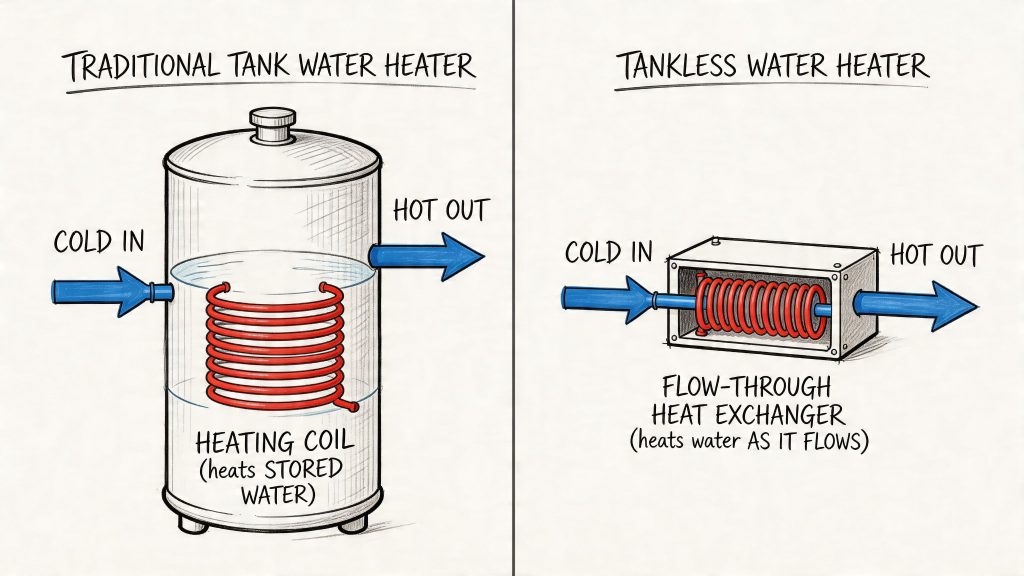
A tank heater and a tankless heater solve the same problem in two very different ways. For North Metro Atlanta homeowners, that difference shows up fastest in two places: how many fixtures can run hot at the same time, and how long it takes the higher tankless install cost to pay back in a mild Georgia climate.
Here’s the visual difference.
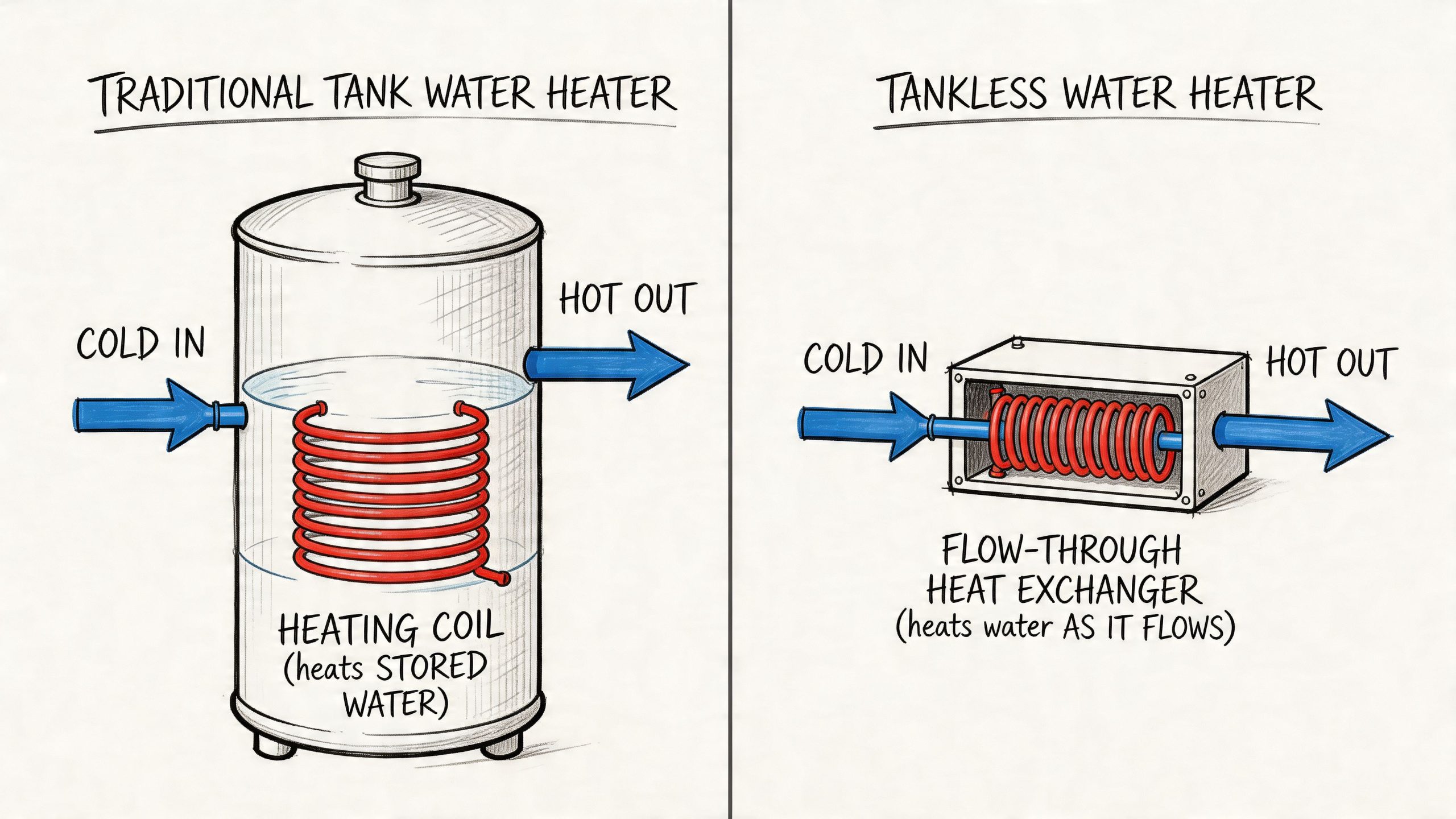
How a tank heater works
A tank heater stores a set volume of water, heats it, and keeps that water ready for use. As the water inside cools between uses, the burner or elements cycle back on to maintain temperature. That ongoing reheating is standby heat loss.
The main strength of a tank is simple delivery. It already has hot water sitting there, so it can handle a short burst of demand well. In a typical Acworth or Canton home, that often means one shower, a dishwasher cycle, and normal sink use without much drama, at least until the stored supply starts running low.
The limit is storage and recovery. Once the hot water in the tank is used up, the heater has to catch back up.
How a tankless heater works
A tankless unit does not store hot water. Cold water passes through a heat exchanger, the burner or electric elements fire, and the unit heats water as it moves through. If you want a closer look at system types and service options, see JMJ Plumbing’s residential water heater services.
That design avoids standby loss, which is the main efficiency advantage. It also creates a fixed output ceiling. A tankless unit can only raise the temperature of so much water at one time, so performance is tied to flow rate, measured in gallons per minute.
That point gets missed in a lot of online advice.
In Alpharetta, Roswell, and other areas with larger homes, I see homeowners assume tankless means endless hot water for every fixture in the house at once. What it really means is continuous hot water within the unit’s capacity. If two showers are running and someone starts a washing machine or fills a soaking tub, the unit may be asked to do more than it can deliver. Then you get lower outlet temperature, reduced hot-side performance, or both.
Why the difference matters in real houses
The basic trade-off is straightforward. A tank can give you a larger initial reserve, then run out. A tankless unit can run much longer, but only up to its flow limit at that moment.
| Feature | Traditional tank heater | Tankless water heater |
|---|---|---|
| Hot water delivery | Stored hot water | On-demand heating |
| Main limitation | Can run out of stored water | Can reach flow-rate limit |
| Energy behavior | Reheats water between uses | Heats during active use |
| Footprint | Larger floor space | Smaller wall-mounted form |
| Common fit in North Metro Atlanta | Straightforward replacement in many homes | Better fit when sizing, gas supply, and venting all work |
Three terms matter here:
- Standby heat loss is the energy used to keep stored water hot between uses.
- Flow rate is how much hot water the system can produce at one time.
- Recovery is how quickly a tank system reheats after hot water is drawn down.
For many North Metro Atlanta homes, the decision starts with fixture count, bathroom count, and gas capacity, not marketing claims. A one-bath ranch in Woodstock has very different hot water demands from a newer two-story in Milton with three bathrooms and a large tub. That is the difference between tank and tankless in the field.
Detailed Cost Comparison Upfront vs Long-Term Savings
A homeowner in Acworth replaces a failed tank heater and gets hot water back the same day for a lower upfront cost. A homeowner in Alpharetta chooses tankless, then finds out the job also needs a larger gas line, new venting, and electrical work for the controls. Both made reasonable choices. The difference is in the install conditions, how long they plan to stay in the house, and how their family uses hot water.
That is the part many generic tankless articles skip. In North Metro Atlanta, the key cost question is not just energy savings. It is whether the house can accept tankless without expensive retrofit work, and whether those savings will show up fast enough to matter to you.
2026 Cost Snapshot: Tank vs. Tankless in North Metro Atlanta
| Cost Factor | Traditional Tank Heater (50-Gallon Gas) | Tankless Heater (Gas) |
|---|---|---|
| Equipment and installation profile | Lower complexity in most replacements | Higher complexity in many retrofits |
| Venting changes | Often limited if replacing like for like | May require venting updates |
| Gas line needs | Often already adequate | May require gas line upgrades |
| Electrical work | Usually limited | May need electrical work for controls and accessories |
| Operating efficiency | Lower than tankless | Higher than tank in many homes |
| Best financial fit | Shorter ownership horizon | Longer ownership horizon |
What pushes tankless pricing higher
In the field, the unit itself is only part of the bill.
A standard tank swap is often straightforward because the connections, venting path, and gas supply are already close to what the new heater needs. Tankless changes that. In older homes around Marietta, Roswell, and Woodstock, I often see one or more upgrades before the new unit can be installed correctly and pass inspection.
Common cost drivers include:
- Gas line sizing: Many gas tankless units need more gas volume than the old tank heater.
- Venting changes: Manufacturer vent requirements are different from many older tank setups.
- Electrical work: Gas tankless units still need power for ignition and controls. Electric tankless units can trigger major panel and circuit upgrades.
- Access and layout: Tight utility spaces, finished rooms, and long pipe runs add labor.
- Permits and code corrections: Older installations sometimes need updates before a replacement can be signed off.
That is why two tankless quotes can be far apart and both still be legitimate. If you are comparing water heater installation and replacement options, the quote should explain the gas work, venting, condensate handling if required, and any electrical changes. A low number that ignores those items usually does not stay low.
Energy savings are real, but they are usually modest in Georgia homes
Tankless can cut operating cost because it does not keep a full tank of water hot all day. The U.S. Department of Energy says tankless water heaters are 24% to 34% more energy efficient in homes with lower daily hot water use and 8% to 14% more efficient in higher-use homes. That same guidance also notes lower annual operating costs in the right usage pattern because tankless units avoid standby heat loss from stored water (U.S. Department of Energy guidance on tankless water heaters).
Those savings matter, but North Metro Atlanta is not Minneapolis. Our incoming groundwater is not as cold for as much of the year, so many homes do not see the dramatic before-and-after numbers that show up in national marketing. The climate helps tankless performance. It does not automatically create a fast payback.
Where payback gets real in Acworth, Alpharetta, and Canton
The payback period depends on two local factors. First, how expensive the retrofit is. Second, whether the unit can serve your daily hot water pattern without adding a second unit or accepting some fixture limits.
Consumer Reports notes that tankless heaters can take a long time to pay back their higher installed cost, especially when the old setup needs modifications and household hot water use is not unusually high (Consumer Reports tank vs. tankless cost guidance).
That lines up with what we see in North Metro Atlanta. In a one-bath or two-bath home with a simple replacement path, tankless has a better financial case. In larger suburban homes with multiple bathrooms, bigger tubs, and stacked morning demand, the equipment may work well but the dollars often take longer to make sense.
A homeowner staying in a Canton house for 12 to 15 years may decide that slower payback is acceptable because they want the space savings and longer service life potential. A homeowner in Johns Creek who expects to move in five years usually has a different answer.
Cost decisions should include performance, not just utility bills
This is another place where homeowners get tripped up. A tankless system that saves some energy but struggles during a busy morning is not a good value for a larger family.
In many North Metro Atlanta homes, especially newer two-story houses with three or more bathrooms, the primary cost comparison includes flow capacity. If one properly sized tankless unit cannot cover the way the house uses hot water, the fix may be a larger model, better distribution planning, or more than one unit. That changes the payback fast.
A practical way to size up the decision:
-
Start with the installation scope.
Ask what gas, venting, electrical, and code work is needed. -
Match the system to your usage pattern.
Spread-out use favors tankless more than stacked, multi-fixture demand. -
Be honest about how long you will stay.
Long-term owners are more likely to recover the higher upfront cost. -
Separate comfort goals from return-on-investment goals.
Some homeowners want longer showers and floor-space savings. Others want the lowest replacement bill and solid performance.
For many North Metro Atlanta homeowners, tankless is worth it when the house is a clean fit and the owner plans to stay put. If the install turns into a gas-line, venting, and electrical retrofit, a quality tank replacement is often the smarter financial choice.
Performance and Lifestyle Fit for Atlanta Households
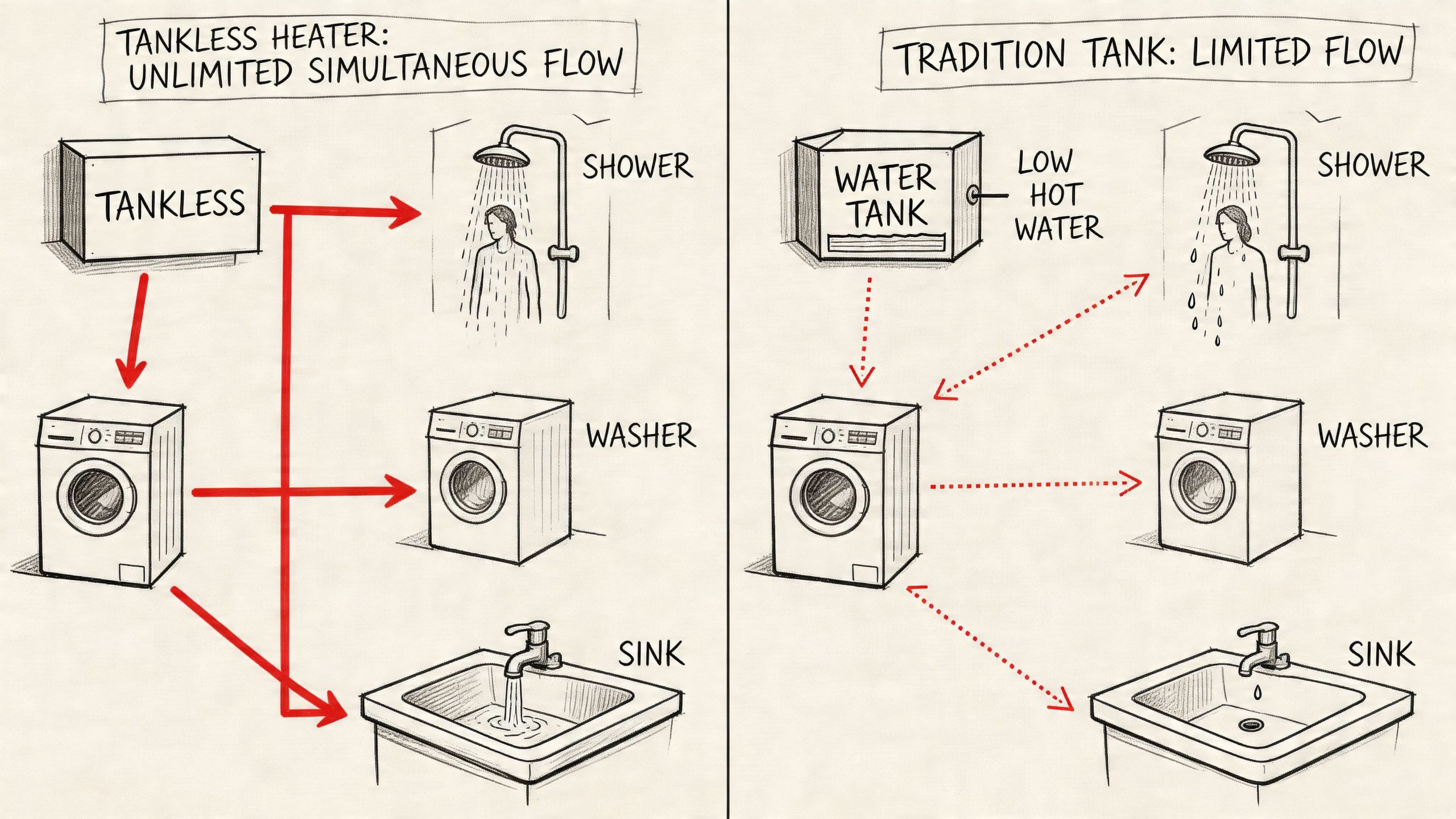
Performance is where homeowners either love tankless or regret it. The right system feels great every day. The wrong system gets blamed every morning when two showers, the dishwasher, and the washing machine all compete for hot water.
Here’s the side-by-side issue that is important to consider.
Endless hot water has a limit
The biggest selling point of tankless is real. If demand stays within the unit’s capacity, you can keep getting hot water without emptying a storage tank. That’s a strong fit for couples, smaller families, and homes where hot water use is spread out instead of stacked all at once.
But “endless” doesn’t mean “everything at once.”
Gas-fired tankless water heaters can deliver 5+ GPM, but even that may not be enough to serve multiple fixtures in larger homes at the same time, which is a serious limitation for multi-bathroom households common in North Metro Atlanta suburbs. In some cases, that leads to installing multiple units and higher upfront cost (tankless flow rate limitations for larger homes).
Where tankless works well
Tankless usually fits these situations well:
- Smaller households: One shower running, plus a sink or dishwasher, is often manageable.
- Staggered schedules: If people shower at different times, the system has an easier job.
- Space-sensitive installs: Wall-mounted units free up room in utility areas.
- Long shower users: You won’t “run out” the way a tank can.
A lot of homeowners in condos, townhomes, or smaller detached houses like tankless for exactly those reasons.
Where homeowners get surprised
Larger homes in Alpharetta, Roswell, Milton, and Johns Creek often have multiple bathrooms and more simultaneous use. That’s where a single tankless unit can feel undersized even if it’s operating properly.
Watch for these patterns:
- Morning bottlenecks: Two showers and a washing machine can push the unit hard.
- Big soaking tubs: Filling a tub while someone else uses hot water elsewhere can expose flow limits.
- Teenagers and guests: High overlap use changes the whole performance picture.
- Additions and remodels: The old water-heating plan may not fit the new house layout.
In larger suburban homes, sizing is everything. A bad tankless experience is often a sizing problem, not a technology problem.
Electric versus gas in our area
North Metro Atlanta’s climate is more forgiving than colder northern regions, and that helps electric tankless units make more sense here than they do in harsher groundwater conditions. But that doesn’t mean electric is automatically the answer for every whole-house job.
The practical difference is usually this:
| Household pattern | What tends to fit better |
|---|---|
| Lower simultaneous demand | Electric tankless may be workable |
| Higher simultaneous demand | Gas tankless usually handles it better |
| Large multi-bathroom home | Careful flow assessment is required |
| Light hot water use | Tankless value gets easier to justify |
The right question to ask before buying
Don’t ask only, “Will tankless give me endless hot water?”
Ask, “What will happen in my house when these run together?”
- Primary shower
- Second shower
- Dishwasher or washing machine
- Kitchen sink
- Tub fill
That’s the true field test. If the home regularly stacks demand, you need an honest sizing discussion. Sometimes that means a larger gas tankless system. Sometimes it means multiple units. Sometimes it means a standard tank is still the better choice for the way the home lives.
Lifespan Maintenance and Long-Term Reliability
A homeowner in Alpharetta replaces an aging tank with tankless, expects lower hassle, then calls a year later because the unit is throwing a scale code and the showers are running cooler. That is a common misunderstanding. Tankless can last longer, but only if the system is sized correctly and serviced on schedule.
The long service life is real. So is the upkeep. A tankless unit usually avoids the rust-through failure that kills many storage tanks, but it adds parts and maintenance demands that some homeowners do not plan for. In North Metro Atlanta, that matters because many homes in Acworth, Canton, and surrounding areas have two or three bathrooms, and those houses tend to put more strain on a poorly matched unit.
What maintenance looks like in practice
Tankless heaters have tight internal water passages and a heat exchanger that does not tolerate mineral buildup for long. Once scale starts collecting, performance drops in ways homeowners notice fast. Hot water can swing in temperature, flow can feel weaker at fixtures, and parts like sensors or the heat exchanger work harder than they should.
A standard tank needs maintenance too. It should still be flushed and inspected. The difference is simpler: many tank heaters will keep limping along while efficiency drops, while a neglected tankless unit is more likely to complain early with error codes or uneven performance.
For many homes here, annual descaling is the right baseline. Homes with heavier use or water conditions that promote faster buildup may need attention sooner. If the goal is long-term reliability, schedule a proper tankless flush service before the unit starts showing symptoms.
Reliability depends on the house, not just the heater
I would rather install a correctly sized tank than force a tankless unit into a house that regularly overwhelms it.
That comes up a lot in North Metro Atlanta. A smaller ranch in Acworth with one or two people can be a solid tankless fit and stay reliable for years with routine service. A larger Alpharetta or Canton home with multiple bathrooms, a soaking tub, and frequent overlap between showers, laundry, and kitchen use needs a much closer look. If the unit is undersized, homeowners often blame reliability when the actual problem is that the heater is being asked to deliver more hot water than it can produce at one time.
A few common patterns show up in the field:
- Stronger tankless fit: long-term owner, moderate overlap in hot water use, willingness to keep up with yearly service
- Weaker tankless fit: large family, frequent multi-fixture demand, little interest in maintenance
- Stronger tank fit: homeowner wants simpler replacement, lower installation complexity, and better buffering during heavy overlap use
Long-term reliability also depends on ownership habits
The financial commitment discussed earlier ties back to maintenance in a practical way. Tankless rewards homeowners who plan to keep the house, keep the unit serviced, and live within the system’s flow limits. It is a poor fit for anyone who wants to install it and ignore it.
That is the honest trade-off. If you maintain a tankless unit and it is matched to the house, it can be a durable piece of equipment. If the home has heavy simultaneous demand or the owner skips service, a standard tank often ends up being the steadier and less frustrating choice.
JMJ Plumbing’s Recommendation When Tankless Is Worth It
Here’s the straight answer. A tankless water heater is worth it for some North Metro Atlanta homes, but not for all of them. The sales pitch usually focuses on endless hot water and energy savings. The field decision comes down to ownership timeline, demand pattern, and installation complexity.
When tankless usually makes sense
Tankless is usually the better fit when the homeowner checks most of these boxes:
-
You expect to stay put for the long term.
The longer you stay, the easier it is to justify the higher install cost and maintenance. -
Your household doesn’t overload the unit with simultaneous demand.
One or two overlapping uses is a very different job than three bathrooms running at once. -
You want efficiency and space savings.
The wall-mounted form and on-demand design are real advantages. -
You’re already remodeling or replacing infrastructure.
If venting, piping, or gas work is already part of the project, tankless becomes easier to justify. -
You’ll keep up with service.
Owners who stay on top of descaling usually get a much better experience.
When a traditional tank is the smarter call
A standard tank often wins when the household is trying to solve a practical problem without creating a more expensive one.
That’s especially true if:
| Situation | Smarter choice |
|---|---|
| You may move before long | Traditional tank |
| You need lower installation complexity | Traditional tank |
| Your house has heavy simultaneous hot water use | Often traditional tank, or a more involved tankless design |
| You want the lowest-friction replacement | Traditional tank |
What works in real North Metro Atlanta homes
In smaller homes or households with staggered schedules, tankless can be a strong upgrade. In larger homes with several bathrooms and high overlap use, the answer gets more technical fast. That’s where a good plumber should be honest if the house needs a more advanced setup or if a tank heater is the more sensible fit.
JMJ Plumbing installs tank and tankless systems, including brands such as AO Smith, Rheem, Rinnai, and Navien, so the recommendation should start with the house and usage pattern, not with pushing one category over the other.
If your main goal is lower energy waste and you’ll stay in the house a long time, tankless has a solid case. If your main goal is straightforward replacement and strong multi-fixture performance, a tank often wins.
For homeowners asking “tankless water heater is it worth it,” the cleanest answer is this: it’s worth it when the house, the budget, and the ownership timeline all line up at the same time.
Emergency Water Heater Service in North Metro Atlanta
If you have no hot water, a leaking tank, water pooling in the garage, or a unit that won’t fire, stop comparing models for a minute and deal with the immediate risk first. Shut off power or gas to the unit if it’s safe to do so, shut off the water supply if the heater is actively leaking, and call an emergency plumber.
A water heater leak can damage flooring, drywall, trim, and anything stored nearby. If you’re dealing with active damage, this overview of what happens after a water heater leak is useful for understanding the cleanup side once the plumbing issue is under control.
When to call right away
Call for immediate help if you notice:
- No hot water at all and the unit won’t restart
- Water leaking from the tank body
- Burning smells or unusual sounds
- Sudden loss of hot water pressure
- Water spreading into finished areas
Homeowners searching for emergency plumber Acworth, 24 hour plumber near me, no hot water Marietta, or leaking water heater repair Roswell are usually dealing with a same-day issue. The right move is fast diagnosis first, then replacement planning after the home is safe. For urgent response, use JMJ’s emergency plumbing service if you’re in Woodstock, Acworth, Alpharetta, Canton, Roswell, Marietta, Cumming, Johns Creek, or surrounding parts of Cobb County, Cherokee County, North Fulton, and Forsyth County.
Frequently Asked Questions About Tankless Water Heaters
Do tankless water heaters work during a power outage
Usually, no. Even gas tankless units rely on electricity for the controls, ignition, and fan, so a storm outage in Acworth or Canton can leave you without hot water unless the unit is tied to backup power.
That surprises a lot of homeowners who assume gas means it will keep running no matter what. Ask that question before install, especially if your area sees frequent outages from summer storms or winter ice.
Are high-efficiency gas tankless models significantly better than gas tanks
They are more efficient, but efficiency is only part of the decision. A high-efficiency gas tankless can lower fuel use, but the main question for a North Metro Atlanta homeowner is whether the savings will repay the higher install cost in a reasonable time.
In this area, that payback often depends on the house and your hot water habits more than the brochure. A smaller home in Alpharetta with moderate usage may take a long time to recover the upgrade cost. A larger household with daily back-to-back showers, laundry, and dishwasher use may see better long-term value, provided the gas line, venting, and unit size are right.
Should I pair a tankless heater with water treatment
If your water is hard enough to leave scale, water treatment helps. Scale builds up inside the heat exchanger, cuts performance, and makes annual flushing more important.
I tell homeowners to look at the whole system, not just the heater. If you are already seeing mineral buildup on fixtures, a tankless unit will benefit from protection.
Is tankless always the best upgrade if I’m replacing an old heater
No. Some North Metro Atlanta homes are better served by a tank, especially if the budget is tight or the house regularly runs two or three hot water fixtures at once.
Flow rate is important. A tankless unit has to keep up in real time. In a larger family home in Roswell, Woodstock, or Johns Creek, a single unit may struggle if two showers, a washing machine, and a kitchen faucet are all calling for hot water at once. That does not mean tankless is a bad product. It means sizing has to match the house, and sometimes a tank replacement is the more practical choice.
If your home in North Metro Atlanta has no hot water, a leaking heater, low pressure, or you’re weighing repair versus replacement, JMJ Plumbing can inspect the setup, explain the actual trade-offs, and recommend the right path for your house. That includes tank and tankless water heater service, plus the broader plumbing issues that often show up at the same time, like leak repair, drain cleaning, water line problems, and emergency response.