Can a Hot Water Heater Explode? Yes—Here’s Why & What to Do
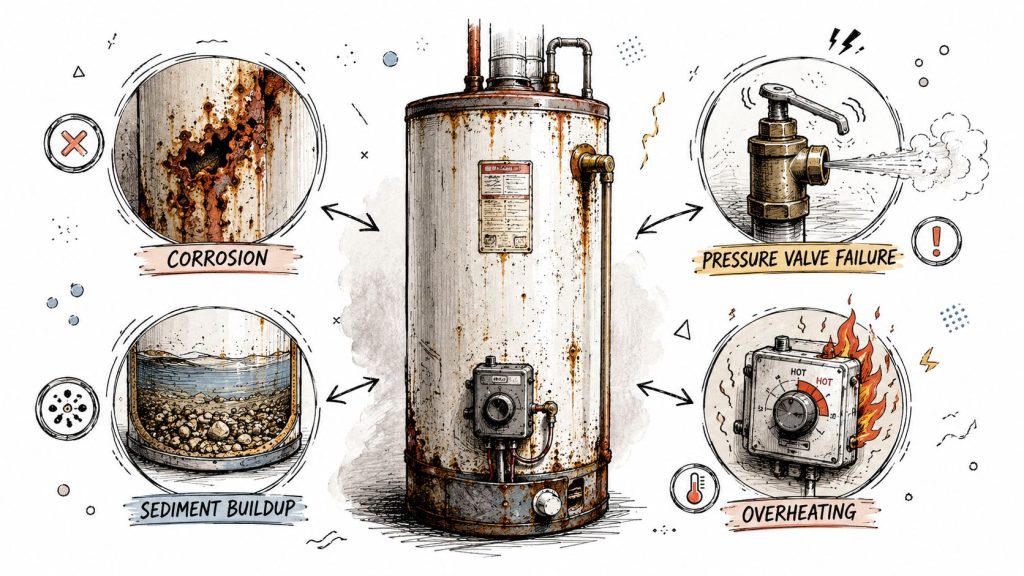
You hear a bang from the garage or basement. Then maybe a hiss. Maybe the hot water smells odd, or the shower keeps going from warm to too hot. At that point, most homeowners ask the same question: can a hot water heater explode?
The honest answer is yes, it can. But for modern units, it's rare.
That combination confuses people. Rare doesn't mean impossible. It means you shouldn't panic at every pop or drip, but you also shouldn't ignore warning signs and hope they go away. A water heater is a pressurized appliance. When it works properly, it heats water safely every day. When key safety parts fail, pressure and heat can build in ways that need fast attention.
The good news is that most water heater problems are not true explosion scenarios. They're more often leaks, steam release, overheating, scalding risk, or fire risk. That's important, because the right response depends on which problem you're seeing.
Is Your Water Heater a Ticking Time Bomb
Those asking this question are already uneasy. They heard rumbling. They saw water near the tank. Or they noticed the relief valve dripping and went straight to the worst conclusion.
A calm answer helps here. Yes, a hot water heater can explode, but modern water-heater explosions are rare. One source citing archived U.S. Consumer Product Safety Commission incident data says there were 19,959 incident reports in 2021, with about 58 involving water heaters and 4 involving water-heater explosions, roughly 0.02% of all reported incidents in that dataset, as explained in this water heater explosion overview. That same source says the main cause is excess internal pressure when the temperature-and-pressure relief valve, often called the T&P valve, fails to vent as designed.
That safety valve is the key reason modern tank-style heaters are much safer than older ones. It functions similarly to the release valve on a pressure cooker. If heat keeps building inside a sealed container, pressure rises. The release valve is there to let that pressure out before the tank becomes dangerous.
Bottom line: A working water heater should control both temperature and pressure. If it can't, the problem moves from inconvenience to safety issue.
Where homeowners get tripped up is assuming every strange sound means "explosion risk." It doesn't. Sediment can pop. A small leak can cause water damage without any blast risk. A failing thermostat can create scalding danger even if the tank never ruptures.
So the better question isn't only "Can a hot water heater explode?" It's also, "What kind of failure am I dealing with right now?"
That's the distinction that protects your home and helps you respond the right way.
The Four Main Reasons a Water Heater Fails
A tank water heater isn't mysterious once you break it into basic parts. It stores water, heats it, and holds it under pressure. Problems start when one of those controls stops doing its job.
Here's the visual most homeowners need first.
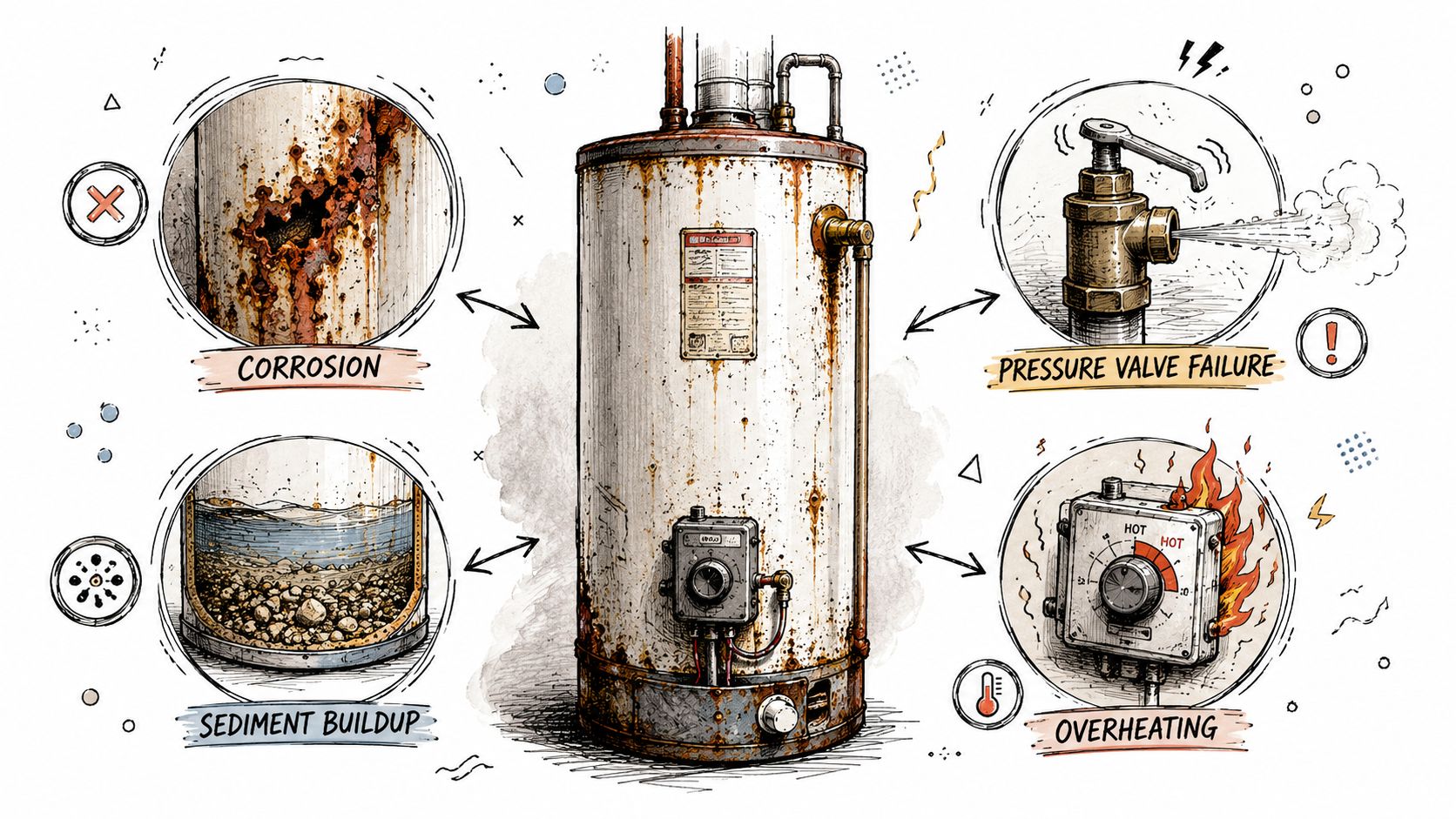
Pressure with nowhere to go
This is the big one. If you put a pot of water on the stove, cover it tightly, and keep turning up the heat, pressure builds. A water heater does the same thing inside a steel tank.
Normally, the T&P valve opens if pressure or temperature gets too high. If that valve is blocked, stuck, misfitted, or otherwise not doing its job, pressure can keep climbing. That's when a rare catastrophic rupture becomes possible.
This is also why homeowners shouldn't cap, plug, or tamper with anything connected to that relief valve discharge line.
Runaway heat from a bad control
A thermostat or heating control can fail in a way that lets water get too hot. That creates two hazards at once. First, hotter water raises pressure inside the tank. Second, it raises the chance of a scalding injury at fixtures.
You might notice this as water that swings from normal to painfully hot without warning. On an electric unit, a faulty element can contribute. On a gas unit, burner problems can play a role.
Sediment buildup that traps heat
Water carries minerals. Over time, those minerals settle in the tank. That sediment layer acts like insulation between the burner or heating element and the water you're trying to heat.
When that happens, the heater has to work harder. Localized hot spots can develop on the tank bottom. Homeowners often hear this as popping, crackling, or rumbling.
Sediment by itself doesn't automatically mean explosion danger. But it can push the unit toward overheating, efficiency loss, and early tank damage.
A lot of "my water heater is about to blow" calls turn out to be a tank full of sediment. That's still serious, just a different kind of serious.
Gas, ignition, and fire-related issues
Not every dangerous water-heater failure is a pressure event. Fire risk matters too, especially with poor installation, bad clearance, or nearby combustible storage.
One summary citing the National Fire Protection Association says water heaters caused nearly 6,000 home fires, with 80 deaths and over 200 injuries, and that during 2006 to 2010 water heaters accounted for 11% of all home heating fires and 7% of home heating fire deaths, according to this fire risk summary about water heaters. That matters because the actual hazard often comes from heat, ignition sources, venting issues, or combustibles stored too close to the unit.
If you've got cardboard boxes, paint cans, cleaning chemicals, or stacked storage crowded around a gas water heater, move them. Proper clearance isn't optional.
Warning Signs Your Water Heater Needs Immediate Attention
The hardest part for homeowners isn't knowing that water heaters can fail. It's figuring out whether today's symptom means "schedule service soon" or "get out of the area now."
A true explosion is a worst-case, multi-failure scenario. Far more common failures involve basement flooding, steam release, or scalding events, and myth-busting demonstrations emphasize that the T&P relief valve is designed to vent pressure before catastrophic rupture, as shown in this water heater safety demonstration.
That means you need triage, not panic.
Sounds and sights that matter
Some warning signs are early-stage problems. Others suggest pressure or temperature may be getting out of control.
Watch and listen for these:
- Popping or rumbling: Often points to sediment buildup.
- A steady hiss with very hot conditions nearby: Can suggest steam or relief-valve activity.
- Water on the floor: Could be a supply leak, valve leak, or a failing tank.
- Rust, corrosion, or staining: Often means the unit is deteriorating.
- A leaning or unstable tank: Needs prompt professional attention.
- Hot water that turns unusually hot: Can point to a control problem.
- No hot water or inconsistent hot water: Often means a failing element, burner issue, or thermostat problem.
Use this simple rule
If the unit is making noise but otherwise stable, that's usually an urgent plumbing problem, not an evacuation event.
If you have loud rumbling, visible steam, active hissing from the relief area, extreme heat around the tank, or signs of gas trouble, treat that as a safety emergency.
If you're asking whether it's "probably okay" while standing next to a steaming tank, stop troubleshooting and create distance.
| Warning Sign | Urgency Level | What to Do Immediately |
|---|---|---|
| Popping or light rumbling | Urgent, but usually not evacuation-level | Stop ignoring it. Arrange professional inspection soon and limit hot water use until the cause is checked. |
| Small puddle near fittings or valve | Urgent | Check whether water is coming from a pipe connection, relief discharge, or the tank body. Call a plumber before water damage spreads. |
| Rusty tank exterior or corrosion at connections | Urgent | Avoid bumping or moving the unit. Have it evaluated for leak risk and structural deterioration. |
| Water suddenly much hotter than normal | High urgency | Reduce use to avoid scalding and schedule immediate service for thermostat or control issues. |
| Hissing, steam, or relief-valve discharge with overheating signs | Emergency | Do not touch the valve. Move away, shut off power or gas only if it is safe to do so, and call for emergency plumbing help. |
| Strong gas smell near a gas unit | Emergency | Leave the area and follow gas emergency safety practices. Don’t operate switches or flames nearby. |
| Water leaking from the tank body itself | Emergency plumbing issue | Shut off the water supply if safe, protect the area from flooding, and call for urgent replacement assessment. |
Where people often misread the danger
A leaking tank may be a water-damage emergency without being an explosion emergency. A sticking relief valve may be messy, noisy, and hot, but it's also doing the job it was designed to do by releasing pressure.
The trouble starts when safety parts fail without warning, or when several problems stack up together.
Emergency Safety Steps If You Suspect Danger
If you think the water heater may be overheating, venting steam, or building dangerous pressure, keep your actions simple. This isn't the time for DIY diagnosis.
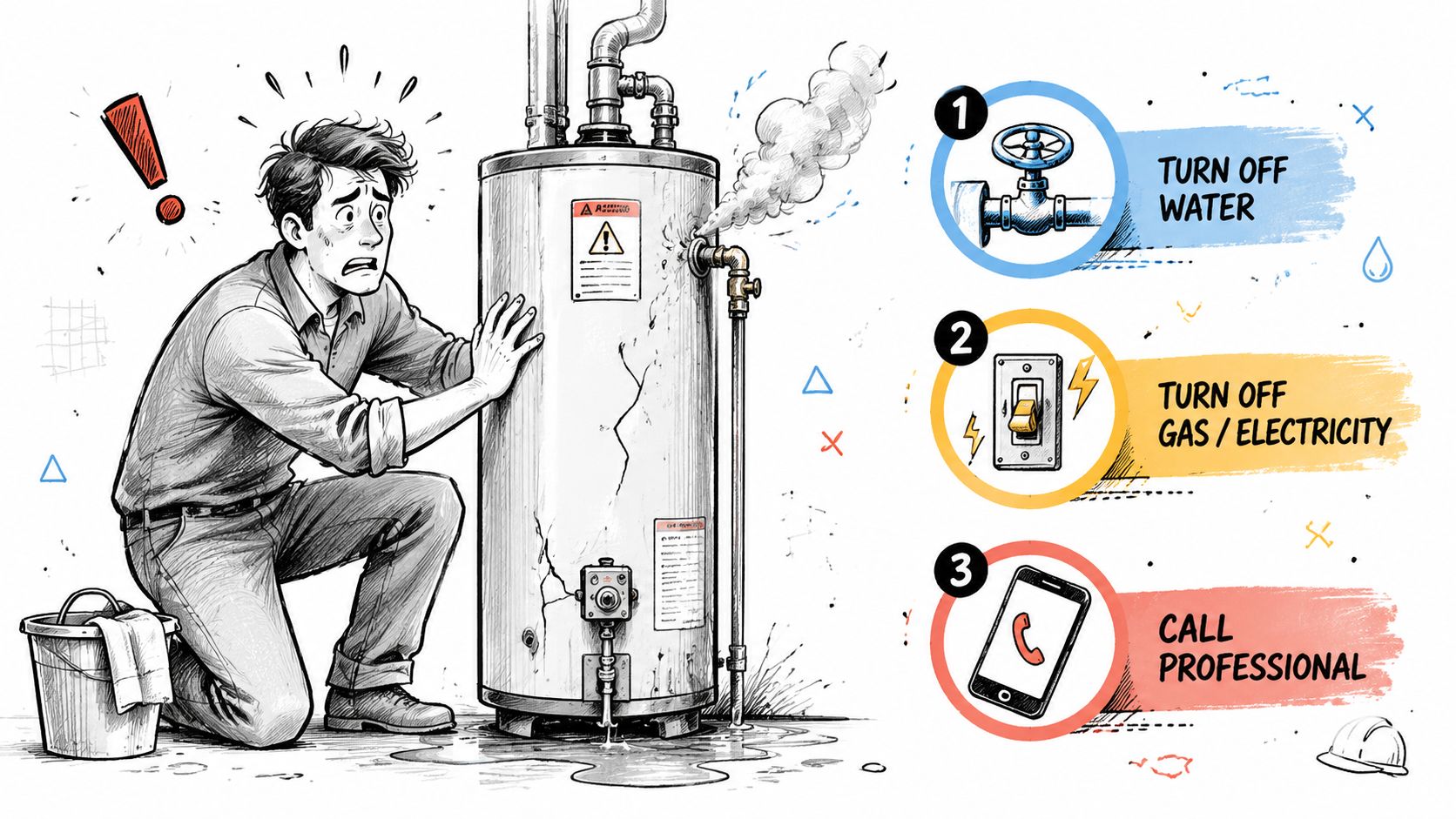
What to do right away
-
Don't touch the T&P valve
That valve may be releasing very hot water or steam. Pulling it, testing it, or trying to "see if it's working" can cause burns. -
Shut off the fuel or power if it's safe
For an electric heater, turn off the circuit breaker. For a gas heater, shut off the gas supply at the appliance only if you can do it safely and without leaning into a dangerous area. -
Shut off the cold water supply to the tank
This can help stop more water from feeding the problem. Use the shutoff on the cold inlet line if you can reach it safely. -
Clear the area
Move family members away from the room or immediate area. Don't stand next to the heater listening for changes. -
Call for help from a safe distance
If the issue includes active leaking but not obvious overheating, this guide on what to do when your water heater is leaking is a useful next step. If you suspect overheating, steam, or pressure trouble, call an emergency plumber immediately.
What not to do
- Don't try to drain the tank yourself
- Don't remove pipes or fittings
- Don't relight a gas unit
- Don't keep running hot water to "bleed off" the problem
When a heater shows true danger signs, your job is not to fix it. Your job is to reduce risk until a licensed plumber takes over.
How to Prevent Water Heater Problems with Routine Maintenance
Most dangerous water-heater problems start small. Sediment collects slowly. Corrosion grows over time. Valves stick after years of not being checked. Prevention works because it catches those problems before they pile on each other.
For homeowners, that means maintenance isn't busywork. It's the direct way to lower the chance of leaks, overheating, scalding, and sudden failure.
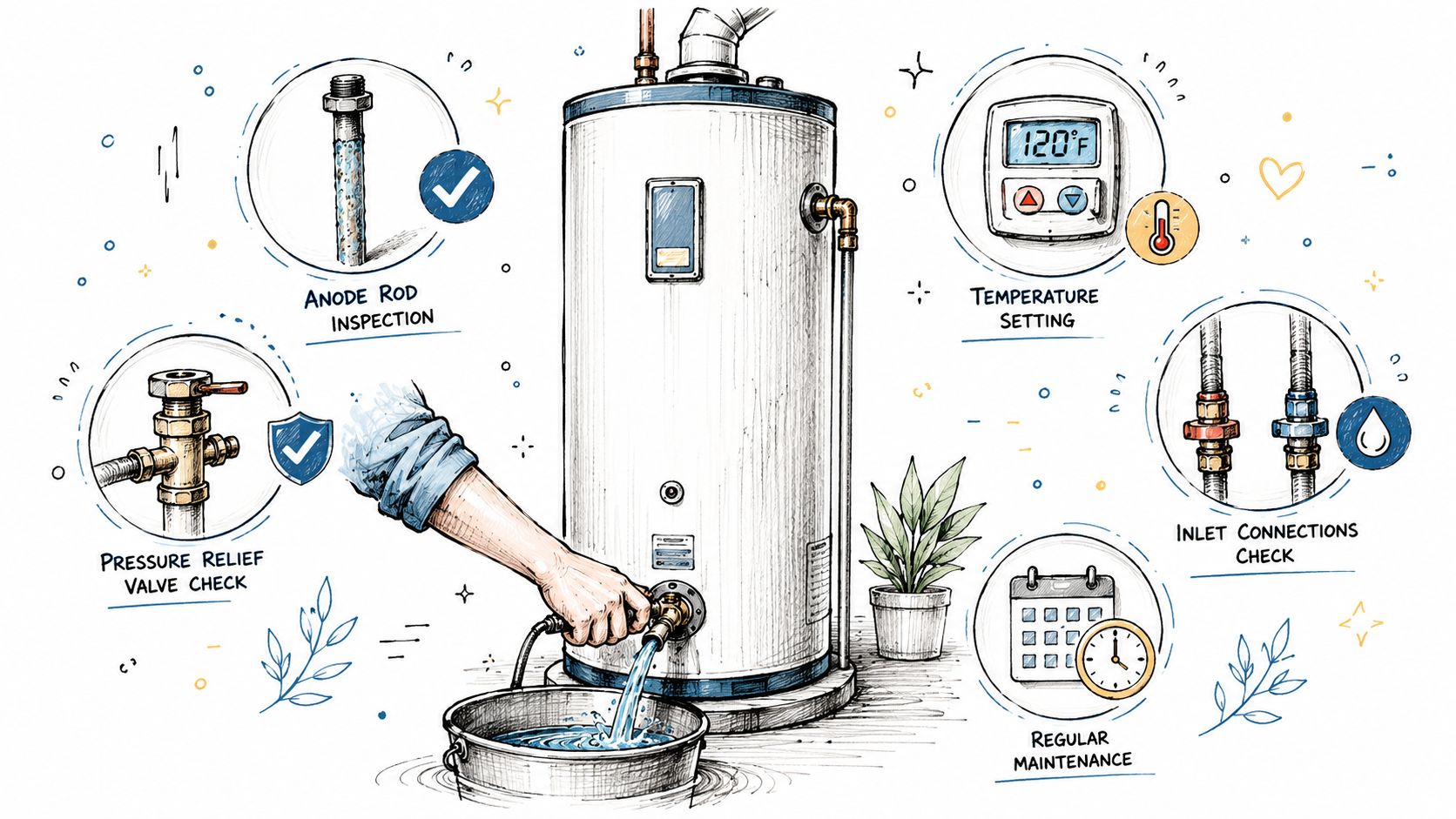
The maintenance items that matter most
A few checks do most of the heavy lifting:
- Flush sediment from the tank: This helps reduce popping, overheating at the tank bottom, and premature wear.
- Inspect the T&P relief valve and discharge pipe: You're looking for signs of leakage, corrosion, blockage, or improper setup.
- Check the anode rod: This sacrificial rod helps slow tank corrosion.
- Inspect supply connections and shutoff valves: Small drips often start here.
- Confirm the thermostat setting: A common target is 120°F, which balances comfort and scald prevention.
- Look around the heater: Keep storage, chemicals, boxes, and clutter away from the unit.
Why professional service is safer
Some homeowners can handle light visual checks. But anything involving pressure relief, draining, gas components, heating elements, or temperature verification is better handled by a licensed plumber.
That's especially true if you're already searching for help with water heater maintenance in Canton, water heater replacement near me, or related plumbing issues like drain cleaning in Alpharetta, leak repair in Roswell, or main water line repair after noticing low water pressure or water in the yard. Plumbing systems tend to reveal problems in clusters. A home with hard water and neglected maintenance often has more than one issue brewing.
A practical homeowner resource on how to prevent costly hot water repairs explains why routine service helps catch minor faults before they turn into outages and property damage.
A simple annual habit
Schedule a yearly inspection. Put it on the calendar the same way you would HVAC service.
If you want a homeowner-friendly checklist before booking service, these water heater maintenance tips are a good starting point.
Regular maintenance does two things. It protects the tank itself, and it gives you a better chance of catching problems while they still look boring.
When to Repair vs Replace Your Water Heater in North Atlanta
Many homeowners face a dilemma. The unit still makes hot water sometimes, so replacement feels premature. But repeated repairs on a failing tank can turn into wasted money fast.
The right choice depends less on one symptom and more on the pattern.
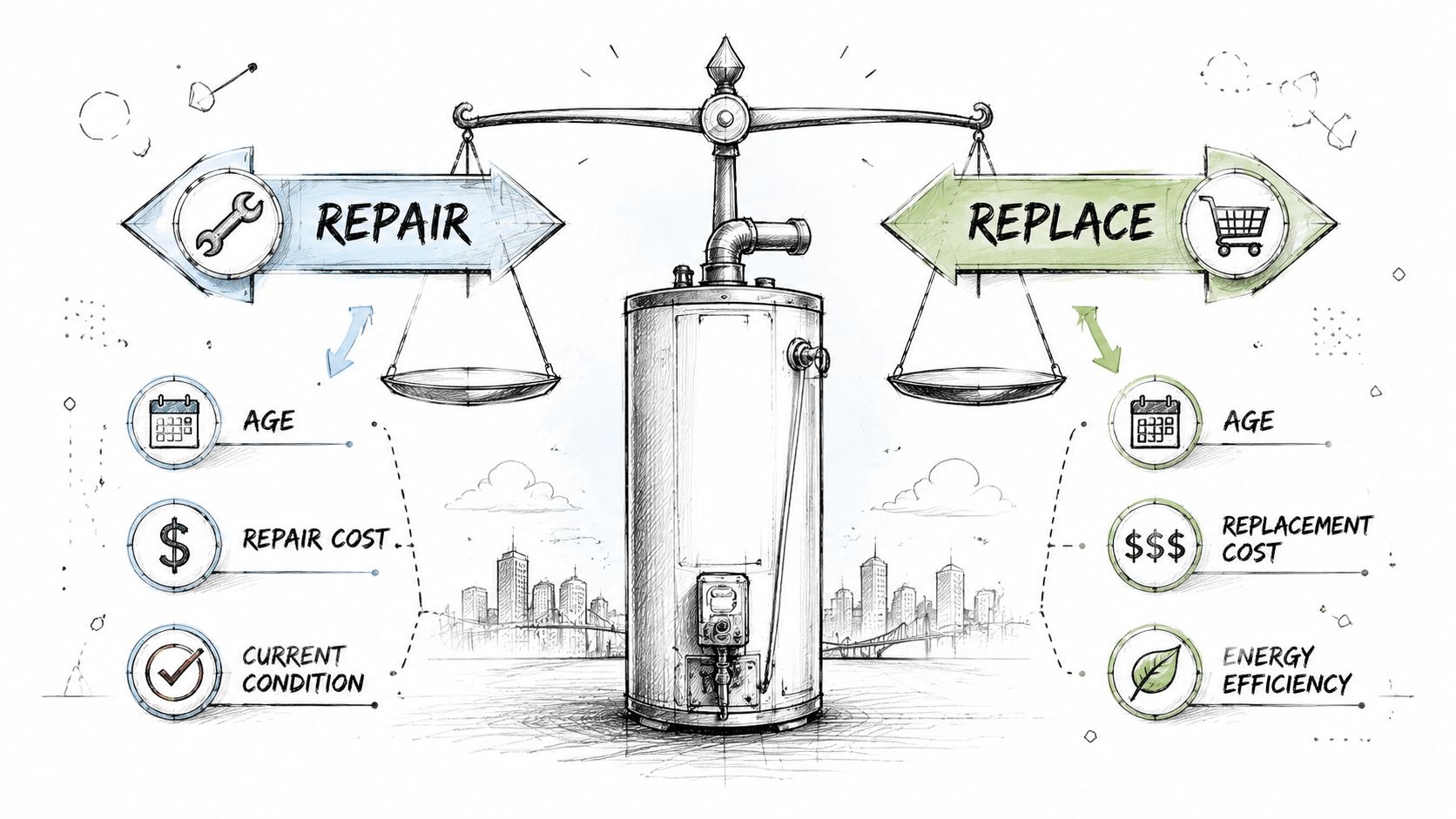
Repair usually makes sense when
A repair is often the better move if the problem is isolated and the tank body is still sound.
Examples include:
- A failed thermostat or heating element
- A burner or ignition issue on a gas unit
- A leaking connection or valve outside the tank
- Sediment-related performance problems caught early
If the unit has been reliable, the fix is targeted, and the tank itself isn't rusting through, repair is often reasonable.
Replacement usually makes sense when
Replacement moves to the front of the line when the steel tank itself is deteriorating or the unit keeps having one issue after another.
Watch for these patterns:
- Tank-body leakage
- Visible corrosion and structural decline
- Repeated service calls in a short span
- Poor performance combined with age
- A heater that can't keep up reliably with household demand
A common rule of thumb people use is the 8 to 12 year range for tank water heaters, but that's still only a guideline, not a diagnosis. Condition matters more than calendar age.
How homeowners in North Metro Atlanta should think about it
If you're comparing water heater repair in Woodstock against water heater replacement in Roswell, ask a plumber to answer three practical questions:
- Is the problem inside a replaceable part, or is the tank itself failing?
- Will this repair likely stabilize the unit, or just buy a little time?
- Is the new unit a better long-term fit for your home's water quality and usage?
That last point matters in places where mineral-heavy water can be hard on plumbing fixtures and tanks. If you're replacing a heater, it may also be a good time to consider broader system protection such as filtration. Many homeowners also discover related issues during replacement, including shutoff valve failure, aging supply lines, or even main water line repair needs.
If tank leakage is part of your decision, this explanation of what causes a water heater to leak can help you sort out whether you're dealing with a repairable connection or a replacement-level failure.
Your Trusted 24/7 Plumber in Acworth and Metro Atlanta
A water heater can explode, but that isn't the most likely problem most homeowners face. More often, the main danger is a leaking tank, released steam, overheating, scalding water, fire risk, or major property damage from a failure that started with a small warning sign.
The key is to respond based on the symptom in front of you. Strange noises need attention. Leaks need quick action. Steam, hissing, overheating, or gas concerns need emergency response.
For homeowners in Acworth, Woodstock, Alpharetta, Canton, Roswell, Marietta, Cumming, and Johns Creek, it helps to have one licensed plumbing company you can call for both urgent problems and long-term prevention. That matters whether you're dealing with no hot water, a water heater replacement near me search, burst pipe repair, sewer backup, sewer repair, sewer replacement, drain cleaning, leak repair, or a clogged toilet that won't flush in the middle of the night.
Trust also matters because plumbing work affects safety, insurance, and code compliance. If you've ever wondered why contractor credentials and coverage matter so much, this guide to insurance requirements for general contractors gives useful background on why proper licensing and protection aren't details to overlook.
If your water heater is acting up, don't wait for a dramatic failure to force the decision. Get it inspected, get a clear answer, and deal with the problem while it's still manageable.
If you need fast, licensed help in North Metro Atlanta, JMJ Plumbing is available 24/7 for water heater repair and replacement, leak repair, drain cleaning, sewer backup service, main water line repair, and other emergency plumbing needs. Whether you're in Acworth, Marietta, Woodstock, Roswell, Alpharetta, Canton, Cumming, or Johns Creek, you can call for prompt service or book online for a professional inspection.