
JMJ Plumbing provides professional tankless water heater maintenance services to keep your system operating efficiently and reliably. Hard water scale is one of the leading causes of reduced performance, temperature fluctuations, and premature failure in tankless water heaters. We perform manufacturer-recommended descaling and flushing services, clean inlet screens and filters, and verify proper system operation. Regular maintenance helps improve efficiency, reduce unexpected breakdowns, maintain consistent hot water delivery, and extend the life of your investment.
Signs You Need a Tankless Flush
A tankless heater rarely quits without warning. It tells you it is scaling up first, if you know what to listen and look for:
- Error codes on the display or remote — many common codes are triggered by restricted flow or overheating caused by scale.
- Hot water temperature swings during a shower — deposits in the heat exchanger are interfering with heat transfer and flow sensing.
- Reduced flow from hot taps — the passages inside the exchanger or the inlet filter screen are partly blocked.
- The unit shuts down mid-use or short-cycles — the high-limit safety is tripping as the exchanger overheats.
- Rumbling, whistling or crackling from the unit — classic sounds of scale on hot exchanger surfaces.
- Chalky white deposits at fixtures — visible evidence of hard water, which means the same minerals are collecting inside the heater.
- It has been more than a year since the last service — most manufacturers call for annual descaling.
What Scale Does to a Tankless Water Heater
Hard water carries dissolved calcium and magnesium. When that water is heated rapidly, the minerals come out of solution and bond to the hottest surfaces they touch — which, in a tankless heater, are the interior walls of the heat exchanger. The deposit builds slowly and behaves like insulation, forcing the burner to fire longer and hotter to deliver the same output while simultaneously narrowing the water passage it is trying to heat.
Parts of Cherokee and Cobb County have hard water, and homes on private wells commonly have harder water still, so this is not a theoretical problem in North Metro Atlanta. Descaling reverses the buildup before it does permanent damage. A proper service visit also covers the parts that fail alongside the exchanger: the inlet water filter screen, the air intake and burner, the condensate neutralizer on condensing models, and the venting.
Our Tankless Flush and Service Process
- Inspect and read the diagnostics — we pull the unit’s error history and check the venting, gas connection, condensate line and combustion air before touching anything.
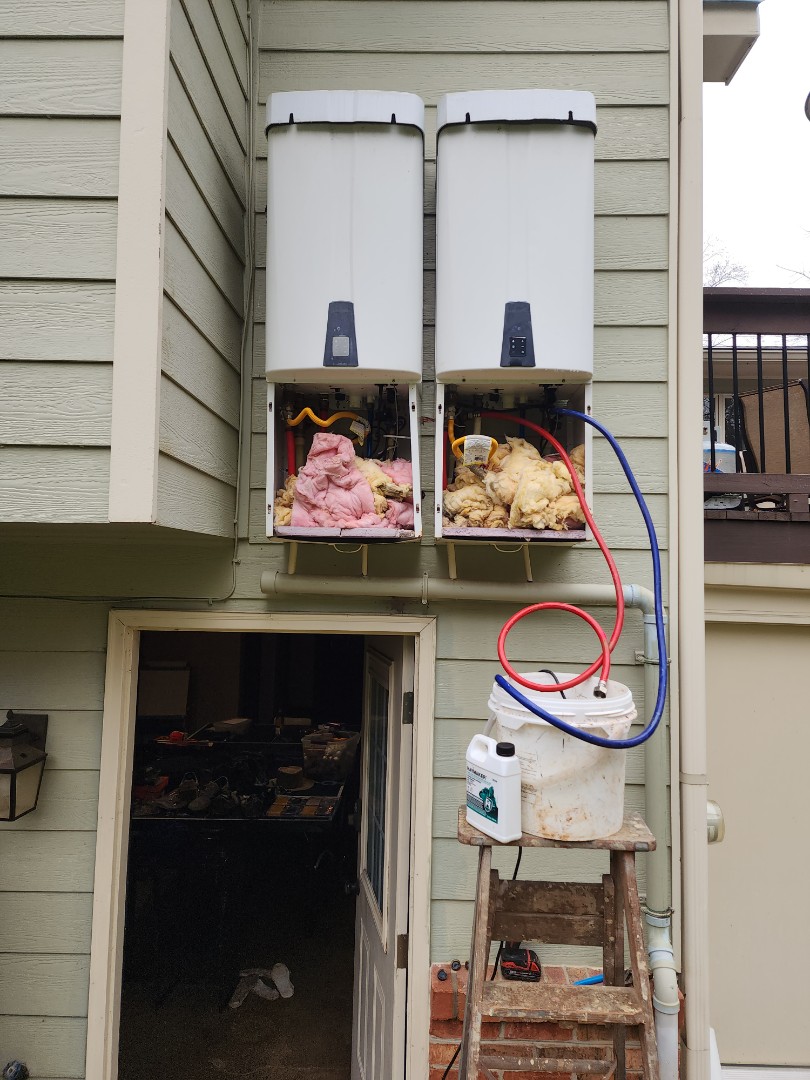
- Shut down and isolate — we power down the unit, close the service valves and connect our pump and hoses. If the heater has no isolation valves, we can install them.
- Circulate descaling solution — the solution is pumped through the heat exchanger in a closed loop long enough to dissolve accumulated mineral scale.
- Clean the filter and components — we remove and clean the inlet water filter screen, check the air intake and burner, and inspect the condensate neutralizer media where one is fitted.
- Rinse and reassemble — we flush the unit with clean water, reopen the service valves, and confirm there are no leaks at any connection.
- Restart and verify — we fire the unit, confirm the temperature rise and flow at the fixtures, clear any resolved codes, and record the service for your maintenance history.
Tankless Flush Service Across North Metro Atlanta
Serving North Metro Atlanta since 1996, JMJ Plumbing services tankless water heaters throughout North Metro Atlanta, including Acworth, Alpharetta, Canton, Cumming, Dunwoody, Hickory Flat, Holly Springs, Johns Creek, Kennesaw, Marietta, Milton, Roswell, Sandy Springs, Smyrna, and Woodstock. We flush and maintain the units we install and units installed by others, we handle full tankless water heater replacement when an exchanger is beyond saving, we still service and replace conventional tank water heaters, and we correct undersized gas lines that leave a tankless unit starved for fuel.
Tankless Flush FAQs
How often should a tankless water heater be flushed?
Once a year is the standard recommendation, and most manufacturers specify annual descaling in their maintenance requirements. Homes with hard water or well water often need it more frequently, because scale forms faster where mineral content is high. If your unit has never been flushed and it is several years old, schedule service now rather than waiting for the anniversary.
What happens if you never flush a tankless water heater?
Mineral scale accumulates inside the heat exchanger and acts as insulation. The unit has to fire harder to hit the same output temperature, flow through the exchanger drops, temperatures start swinging, and error codes appear. Left long enough, the heat exchanger overheats and fails — and that is the most expensive component in the appliance.
How long does a tankless flush take?
Most flush and service visits run about an hour to ninety minutes. The descaling solution is circulated through the heat exchanger for roughly forty-five minutes to an hour, and the rest of the time goes to isolating the unit, cleaning the inlet filter screen, checking venting and combustion, and restarting and verifying performance.
Can I flush my tankless water heater myself?
It is possible if your unit has isolation service valves installed and you have a circulating pump, hoses and descaling solution. The parts most homeowners skip are the ones that matter: inspecting the burner and venting, cleaning the air intake, checking the condensate neutralizer, and reading the diagnostic history. Those are what catch problems before they become failures.
Does flushing fix tankless error codes?
Sometimes. Codes tied to scale buildup, restricted flow, overheating or ignition trouble often clear once the heat exchanger and filter screen are clean. Codes pointing to a failed sensor, control board, fan or gas supply problem will not. We read the unit’s diagnostics first so we are not flushing a heater that needs a different repair.
Does hard water damage a tankless water heater?
Yes, hard water is the single biggest threat to a tankless unit. Dissolved calcium and magnesium precipitate out on the hottest surfaces inside the heat exchanger and build an insulating crust. Parts of Cherokee and Cobb County have noticeably hard water, and homes on wells often more so, which makes regular descaling essential rather than optional.
Do electric tankless water heaters need flushing too?
Yes. Electric tankless heaters scale up just like gas models, because the problem is mineral deposition on hot surfaces, not the fuel source. Their heating elements and internal passages need the same periodic descaling and filter cleaning. They skip the combustion and venting portion of a service visit, so the work is somewhat shorter.
Will skipping maintenance void my tankless warranty?
It can. Many manufacturers make their heat exchanger coverage conditional on documented annual maintenance, particularly in hard water areas, and they can deny a claim when scale damage is evident. Read the terms that came with your specific unit. Keeping a service record is the simplest way to protect the coverage you already paid for.
Annual descaling is the cheapest insurance a tankless heater has. Book a tankless flush online or call JMJ Plumbing at (770) 966-9654. We have served North Metro Atlanta since 1996 and offer 24/7 emergency service, with financing available through GreenSky.