Atlanta Water Heater Repair: Your 2026 Homeowner Guide
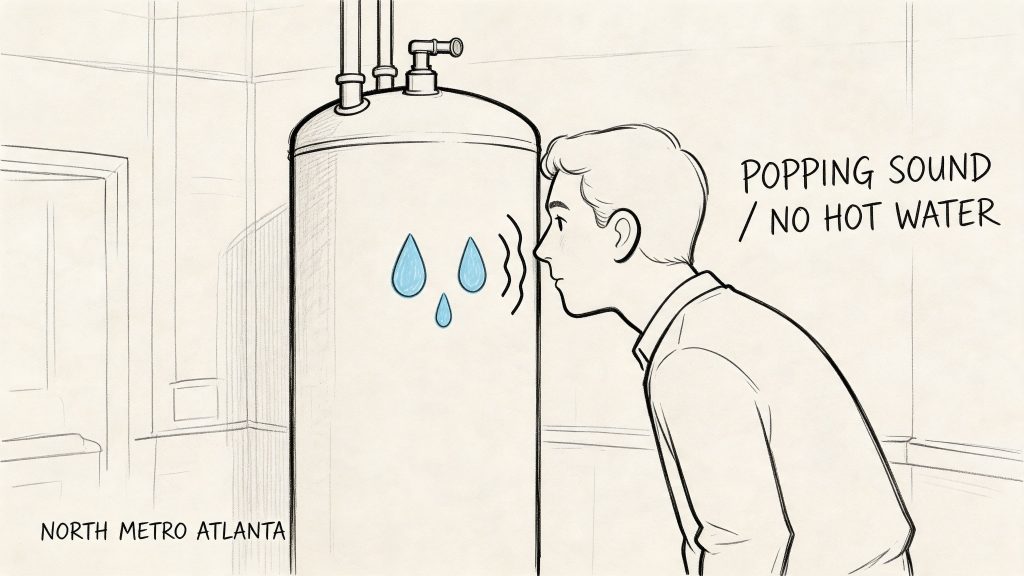
Cold water at 6 a.m. gets your attention fast. So does a puddle around the tank in the garage, a rumbling heater in the basement, or rusty hot water right before guests come over. Anyone searching for atlanta water heater repair isn't browsing. They need an answer now, and they need to know whether this is a quick fix, a replacement, or a bigger plumbing problem hiding underneath.
In North Metro Atlanta, the answer often comes down to two local realities. First, hard water beats up water heaters faster than many homeowners expect. Second, the right repair has to be done to code, especially when gas, electrical connections, pressure relief components, and drainage are involved. If you're in Woodstock, Acworth, Alpharetta, Canton, Roswell, Marietta, Cumming, or Johns Creek, the symptoms usually tell a pretty clear story once you know how to read them.
Is Your Water Heater Crying for Help
A water heater usually doesn't fail without warning. It starts talking first. The problem is that it talks in weird ways: popping sounds, lukewarm showers, rusty water, a drip you keep meaning to check next weekend.
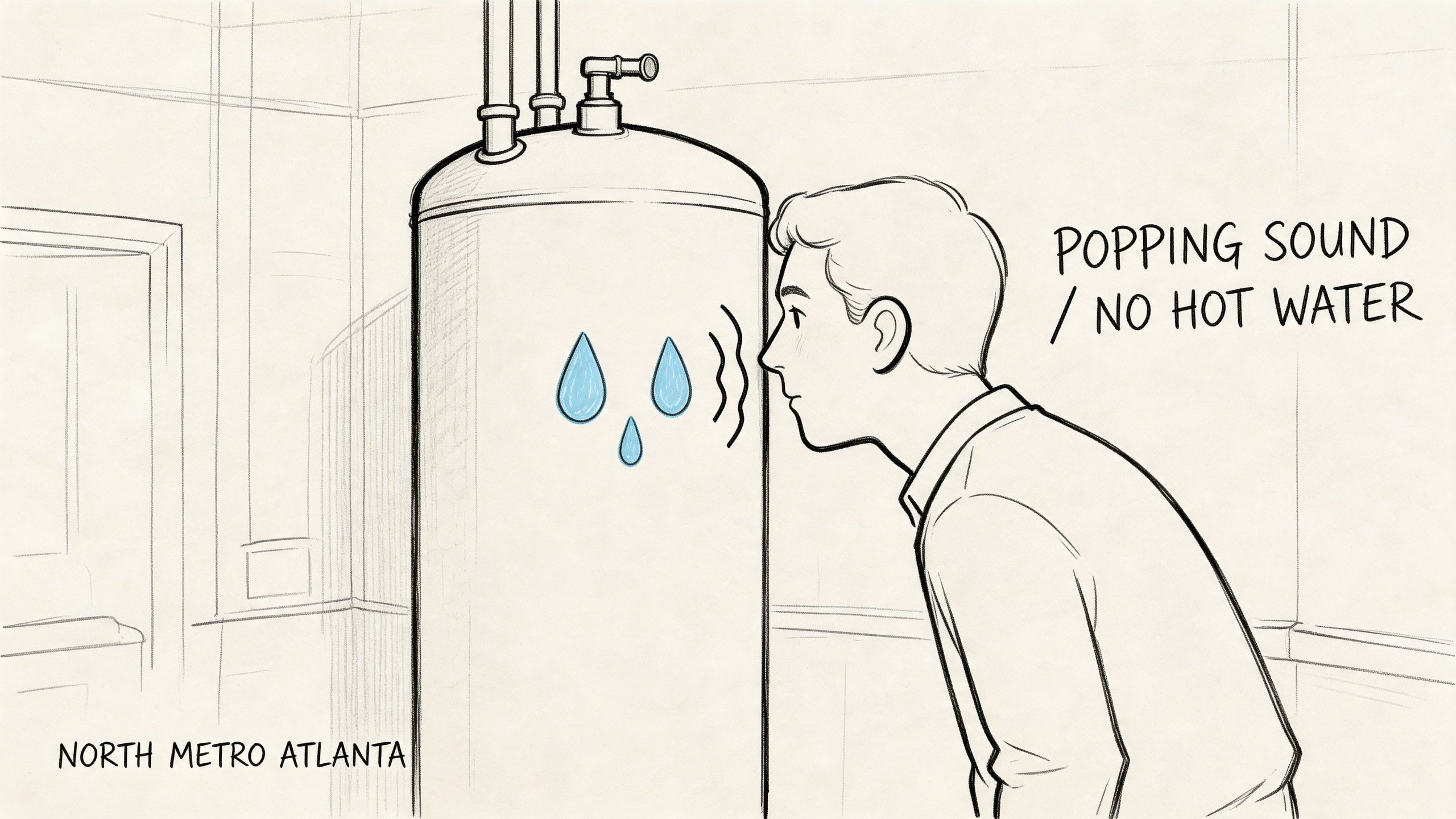
If you've ever heard the tank making a rumbling or popping noise in a garage in Marietta or a basement in Woodstock, that sound isn't random. It's usually a sign that sediment has settled in the bottom of the tank and the burner or element is heating through that layer. The heater still works for a while, but it has to work harder to do a basic job.
When the noise gets louder
A little crackling after a heating cycle can happen. A deep popping, knocking, or rumbling sound that keeps showing up is different. In Cherokee County and Forsyth County homes, hard water often leaves mineral buildup inside the tank. That buildup acts like insulation between the heat source and the water.
What that means in plain language:
- The heater runs longer: More energy goes into heating the scale before it heats the water you use.
- Parts wear out sooner: Burners, elements, and tank surfaces take more stress.
- You get less comfort: Showers may start hot, then turn lukewarm quicker than they used to.
A noisy tank isn't always an emergency. It is a sign that you shouldn't ignore.
Practical rule: Strange sounds that get worse over time usually mean the problem is getting more expensive, not less.
No hot water or not enough hot water
This is the search homeowners make from the driveway or utility room. "No hot water in Roswell." "Water heater repair near me." "Emergency plumber Alpharetta."
The symptom matters. No hot water at all points one direction. Some hot water, but not enough, points another. With electric units, one failed component can leave you with partial performance that feels confusing. With gas units, ignition or burner issues can leave the whole tank cold.
A few common patterns show up in real homes:
- Water starts warm, then goes cold fast: The tank may be heating poorly, recovering slowly, or losing usable capacity because of buildup.
- Only lukewarm water all day: A thermostat, heating issue, or gas burner problem may be limiting output.
- No hot water anywhere in the house: Start thinking power, fuel, ignition, or a failed heating component.
Leaks are not all the same
A leak at a water heater doesn't always mean the tank itself is split. That's an important distinction because some leaks are repairable and some aren't.
Look at where the water appears to be coming from:
- At the top connections: Sometimes it's a loose fitting, aging connector, or supply issue.
- At the relief valve or discharge area: Pressure or temperature problems may be pushing water out through a safety device.
- From the bottom of the tank: This is the one homeowners hate to see. It may mean internal tank failure.
If the floor is wet, don't assume it's just the heater. In North Metro Atlanta homes, an exterior leak, a nearby drain issue, or even condensation from another line can fool people. The source has to be confirmed before anyone gives honest advice.
Discolored or smelly hot water
When only the hot side looks rusty or smells off, the water heater becomes the prime suspect. That can point to corrosion inside the tank, a worn anode rod, or buildup that's been sitting too long. If both hot and cold water look bad, the problem may be elsewhere in the plumbing system.
A heater that's sending these signals isn't being dramatic. It's asking for diagnosis before you end up with water damage, no hot water, or a forced replacement on the worst possible day.
Common Water Heater Problems in North Georgia Homes
Some failures are random. Most aren't. In North Georgia homes, the same trouble spots show up again and again because the water quality, age of housing stock, and equipment types are pretty consistent from Acworth to Johns Creek.
Electric heaters and burned out elements
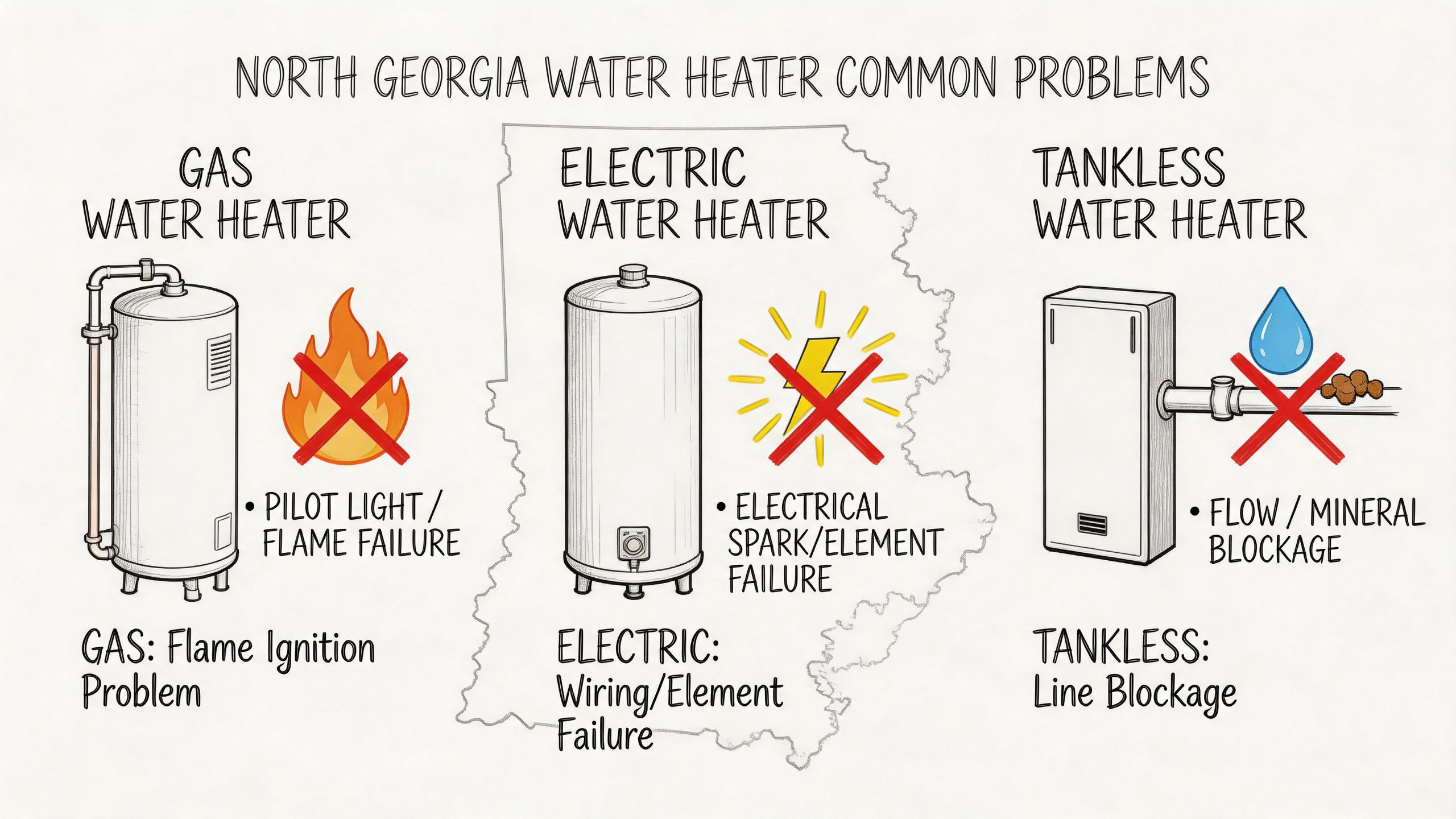
Electric tank heaters are common across North Metro Atlanta, and one issue shows up more than most. In electric water heaters prevalent in Atlanta homes, a malfunctioning heating element, typically two 4500W elements, often causes no hot water because sediment leads to overheating and burnout. That failure tends to accelerate after 5 to 7 years under hard water conditions common in North Metro Atlanta, and field diagnostics show 60% to 70% of "no heat" calls trace to this single issue, according to United Air Temp's Atlanta water heater repair guidance.
That tracks with what plumbers see in homes around Canton, Cumming, and North Fulton. Sediment collects in the tank. The lower element gets buried in it. The element runs too hot trying to heat through mineral scale. Then the homeowner gets a cold shower and assumes the whole water heater died overnight.
Here’s what usually works:
- Element testing before replacement: Guessing wastes time. A meter and a proper diagnosis tell you whether the element, thermostat, or wiring is the actual problem.
- Tank flushing when the unit is still salvageable: If you replace the failed part but leave heavy sediment behind, the new part gets punished by the same conditions.
- Looking at the unit’s overall condition: If the tank is already corroded, replacing parts only buys a little time.
What doesn't work is treating every no-hot-water call like it's the same problem. Electric units can have simple failures, but the cause still matters.
Gas heaters and ignition trouble
Gas heaters fail differently. The homeowner may notice the pilot won't stay lit, the burner won't fire, or the water goes from hot to cool with no pattern. In older units, a small part like a thermocouple can be the culprit. In other cases, airflow, venting, gas control issues, or sediment around the burner area can be involved.
Gas work is where experience really matters. A heater can appear to have a simple ignition issue when the underlying concern is poor combustion, a venting defect, or a failing control assembly. That's not a place for trial and error.
A gas water heater should never be "figured out" by smell, guesswork, or repeated resets.
If you're getting ready for a cold snap, basic home prep matters too. Good winterization tips for homeowners can help reduce stress on plumbing systems and catch seasonal issues before they become emergency calls.
Tankless units and scale problems
Tankless water heaters solve some problems and create their own maintenance demands. They don't store hot water in a tank, so they avoid some tank corrosion issues. But they still react badly to mineral-heavy water.
Common tankless problems include:
- Ignition failures: The unit tries to fire and doesn't complete the cycle.
- Flow sensor issues: The heater doesn't recognize demand properly.
- Scale inside the heat exchanger: Water flow and heat transfer both suffer.
In Alpharetta and Roswell, homeowners often like tankless systems for space savings and steady hot water. That's a good fit when the unit is sized right and maintained. It's a bad fit when nobody services it and the water quality is rough.
The local factor most guides skip
A generic plumbing article might tell you what part breaks. It usually doesn't connect the part failure to the water in your area. In North Georgia, hard water doesn't just leave spots on fixtures. It shortens the useful life of heating components, fills tanks with scale, and turns a routine maintenance item into a repair call.
That’s why the cause matters just as much as the symptom. Fixing the failed part gets hot water back. Fixing the reason it failed keeps you from calling again soon.
Your Emergency Water Heater Troubleshooting Checklist
When the hot water quits, do the safe checks first. A few basic steps can tell you whether the problem is minor, whether you need same-day service, or whether you need to stop immediately and call for help.
Start with the simple checks
For an electric water heater, check the breaker first. If it has tripped, don't keep resetting it over and over. One reset to confirm is reasonable. Repeated trips usually mean a real electrical problem.
For a gas water heater, see whether the pilot is out if your model has one you can visually inspect. If it won't stay lit, stop there. Don't keep relighting a unit that may have a deeper issue.
Then check the thermostat setting on the heater. Sometimes a setting gets bumped lower during cleaning, storage, or other work in the utility area.
A quick homeowner checklist:
- Look for obvious leaking: Check around the base, the shutoff area, and nearby piping.
- Confirm power or fuel status: Breaker for electric, pilot condition for gas.
- Check whether the issue is house-wide: Run hot water at more than one fixture.
- Listen to the unit: Silence, clicking, rumbling, or repeated attempts to fire all tell a different story.
What you should not do
There are a few things homeowners in Woodstock, Acworth, and Marietta should avoid when they're stressed and trying to get the shower back on.
- Don't remove access panels and start touching wiring unless you're trained and know the circuit is safely handled.
- Don't force valves that haven't been moved in years.
- Don't ignore water on the floor because you hope it's condensation.
- Don't keep relighting a gas unit if something seems off.
Stop and call now
Some situations are not troubleshooting situations. They're emergency calls.
Call right away if you have:
- Any smell of gas
- Significant pooling water or active flooding
- Sparking, burning smells, or signs of electrical arcing
- Water leaking onto electrical components
- A burst pipe or fast-moving leak near the heater
If that's your situation, contact a licensed team for 24 hour emergency plumbing help and get the area secured.
Shut off water to the heater if you can do it safely. If you can't reach the shutoff without stepping into water near electrical equipment, wait for a plumber.
What to tell the plumber
The fastest service calls start with clear information. When you call, be ready to say:
- What you noticed first: No hot water, leak, noise, smell, breaker trip
- Where the unit is located: Garage, attic, basement, closet
- What type of unit you have: Gas, electric, or tankless
- Whether the problem is getting worse: Drip, puddle, full leak, no heat at all
That short description helps the plumber show up prepared instead of using your house as the first look.
Water Heater Repair vs Replacement Cost in Atlanta
This is the question that matters most once the diagnosis is in. Can this unit be repaired responsibly, or are you about to spend good money on a heater that's near the end anyway?
Atlanta gives homeowners a useful cost baseline. The average cost of water heater repair is $570, with most repairs falling between $237 and $904, and licensed Georgia plumbers' labor rates average $45 to $90 per hour, according to Angi's Atlanta water heater repair cost guide. That same guide also notes a practical rule homeowners should use: think hard about replacement when a repair goes over 50% of a new unit's cost.
What pushes repair cost up or down
A small repair isn't priced like a major failure. The final number usually depends on the part involved, how easy the unit is to access, whether corrosion has spread, and whether the heater has one issue or several stacked together.
For example, a straightforward component repair is one thing. A leaking older heater with scale, corrosion, and declining performance is another. The labor may not be extreme, but the money still doesn't make sense if the tank itself is near failure.
A few cost drivers show up often:
- Type of heater: Gas, electric, and tankless systems fail differently and require different parts and diagnostics.
- Age and condition: Older heaters often reveal extra problems once the first repair starts.
- Access: Tight closets, attic installs, and code corrections can change the scope.
- Water damage risk: A leaking unit raises the stakes quickly, especially on finished floors.
The 50 percent rule is useful, but not enough by itself
The 50% rule is a solid starting point. If the repair is more than half the cost of a new unit, replacement deserves serious consideration. But smart homeowners in Roswell, Canton, and Alpharetta also look at the tank's age, how the heater has been performing, and whether the repair solves the whole problem or just today's symptom.
If a unit has been giving you lukewarm water, odd noises, and visible corrosion, a single repair doesn't erase the underlying wear. If the heater is otherwise sound and the failure is isolated, repair often makes sense.
The right question isn't "Can this be fixed?" Most things can. The better question is "Does fixing it still make financial sense six months from now?"
Repair or Replace Your Water Heater A Quick Guide
| Factor | Consider Repairing If… | Consider Replacing If… |
|---|---|---|
| Current issue | The problem appears limited to one serviceable part | The tank itself is leaking or multiple parts are failing |
| Repair cost | The quote stays comfortably below the 50% threshold | The repair approaches or exceeds 50% of a new unit cost |
| Unit condition | The heater has been reliable and shows no major corrosion | Performance has been declining and signs of wear are piling up |
| Water quality impact | Sediment can still be addressed with service and maintenance | Hard water has already done long-term damage inside the system |
| Long-term plan | You need a practical short-term fix on a sound unit | You want better efficiency, steadier hot water, or a different setup |
When replacement is the stronger call
Replacement usually wins when the tank is leaking, corrosion is advanced, or repair money would only postpone the inevitable. It also makes sense when your household needs have changed. A larger family, a bathroom addition, or repeated complaints about running out of hot water can justify moving to a different type of system.
Some homeowners use that moment to consider tankless options for endless hot water and space savings. If you want to compare formats before deciding, this overview of tankless water heater options can help frame the conversation.
What homeowners often get wrong
The most common mistake isn't choosing repair when replacement was needed. It's waiting too long to make either decision. A heater that's limping along can still flood a garage, utility room, or finished area. Delaying the call often shrinks your options.
A good diagnosis should tell you three things plainly: what failed, what it will take to fix it, and whether the unit is worth further investment. That's the difference between a repair bill and a plan.
Why a Master Plumber is Your Best Bet for Atlanta Repairs
A water heater isn't just an appliance. It's a pressurized plumbing fixture tied into your home's water lines, energy source, venting or electrical system, shutoffs, drainage, and safety controls. That's why training matters more here than it does with a simple fixture swap.
In Georgia, licensed work matters because code details matter. A heater can heat water and still be installed wrong. Relief valve discharge issues, venting problems, improper connections, missing safety items, and bad drain pan setups aren't always obvious to a homeowner. They are obvious to a plumber who's seen them repeatedly in North Metro Atlanta homes.
What a Master Plumber changes
A certified Master Plumber brings a different level of judgment to the call. That includes diagnosis, code compliance, safety awareness, and knowing when a symptom points beyond the heater itself.
That matters in homes where the water heater complaint is only part of the story. Low hot water pressure might involve a valve issue, a supply restriction, or heavy scale. Water in the yard near a slab house may point to something far beyond the heater. A sewer backup or exterior leak can muddy the diagnosis if the service call is rushed.
A homeowner usually benefits from four things:
- Clear diagnosis: You want the failed part identified, not a guess based on the most common repair.
- Code-compliant work: Safety devices and connections need to be installed correctly, not just made to fit.
- Full-system awareness: Good plumbers look at the surrounding plumbing, not just the tank.
- Emergency readiness: When the heater failure comes with flooding or a burst line, the job can widen fast.
Why hard water changes the conversation
One angle gets skipped in a lot of water heater repair advice. The repair may be correct, but if hard water keeps feeding sediment into the system, the same home can end up repeating the cycle.
A key angle often missed is integrating whole-home water filtration with water heater maintenance. Hard Atlanta water accelerates sediment buildup, causing 40% of common failures. Installing a system like HALO can extend heater life by 30% to 50% and reduce repair calls by 25% annually, according to Reliable Heating & Air's water heater repair page. For homeowners dealing with chronic scale, pairing a repair with water-quality prevention can be more practical than replacing elements and flushing the tank over and over.
That's one reason some local plumbers, including JMJ Plumbing's team and service background, handle both water heater work and whole-home filtration. The benefit isn't branding. It's that the repair and the underlying cause can be addressed together.
If your heater keeps building scale, the "fix" may need to happen upstream, not just at the tank.
Local experience matters on older and newer homes
North Metro Atlanta isn't one uniform housing market. Marietta has older homes with aging plumbing. Milton and Alpharetta have newer builds with different layouts and fixture loads. Woodstock and Canton often have expanding households that put more demand on hot water systems than the original setup anticipated.
A plumber who works these areas regularly knows what tends to show up:
- Garage heaters with neglected maintenance
- Closet installs with poor access
- Units stressed by hard water and long service life
- Emergency calls tied to broader plumbing issues like leaks or pressure problems
That local repetition builds speed and judgment. When a heater is failing, that matters as much as the wrench work.
Your North Metro Atlanta Plumbing Questions Answered
How much does water heater repair usually cost in Atlanta
Atlanta water heater repairs typically fall between $237 and $904, according to Homeyou's Atlanta plumbing repair cost overview. That same source notes unclogging drains can cost up to $450 and main line snaking can reach $1,000, which is a good reminder that water heater issues don't live in isolation. A delay can turn one repair into a larger plumbing bill if leaking water, pressure problems, or drain issues get involved.
Should I call for repair if I only have lukewarm water
Yes. Lukewarm water is one of the most useful early warning signs. It often means the heater is still operating, but not correctly. That's a better time to diagnose the problem than after a complete failure.
If you wait until there's no hot water at all, you may lose the chance for a simpler repair.
Can a bad water heater affect water pressure
It can, especially on the hot side. Sediment, failing valves, scale, or restrictions at the heater can reduce flow. But low pressure can also point to a wider plumbing issue, including leaks, aging lines, or water service problems.
If both hot and cold pressure are low, don't assume the heater is the cause.
Is a leaking water heater always a replacement
No. A leak from a connection or valve may be repairable. A leak from the tank body is a different story and usually points toward replacement.
The key is finding the exact source. Homeowners often see water near the heater and guess wrong about where it started.
Do I need an emergency plumber for no hot water
Sometimes yes, sometimes no. If the problem is only loss of hot water and there's no leak, gas smell, or electrical concern, it may be urgent but not dangerous. If the heater is actively leaking, tripping electrical components, or tied to a burst pipe, it becomes an emergency call.
This is especially true in homes with finished floors, attic plumbing, or utility closets near living areas.
Can hard water really do that much damage
Yes. In North Metro Atlanta, it shows up as scale, shortened part life, noisy tanks, and repeat service calls. Homeowners usually notice the symptom first, but the water quality is often the reason the symptom keeps returning.
That’s also why some plumbing calls start as water heater repair and end with a wider conversation about filtration, line condition, or fixture protection.
Could my water heater issue be related to another plumbing problem
Absolutely. A water heater complaint sometimes overlaps with:
- Leak repair: Water around the unit may come from nearby piping
- Drain cleaning: A utility room floor drain problem can make a heater area look like it's leaking
- Water line repair: Pressure and flow complaints may not start at the heater
- Sewer backup: In some utility spaces, multiple plumbing symptoms show up together
- Clogged fixtures: A homeowner may focus on no hot water when the house also has slow drains or a toilet that won't flush
That broader view matters if you're trying to protect the house, not just get through tonight's shower.
What should I do before the plumber arrives
Keep the path clear to the unit. Move storage away from the heater. If there's a safe water shutoff and active leaking, turn it off. If there is any gas odor or electrical hazard, leave the area alone and make that clear when you call.
A short video of the leak, sound, or error behavior can also help if the symptom isn't constant.
If you need a clear answer on whether your unit should be repaired or replaced, contact JMJ Plumbing. They serve North Metro Atlanta communities including Acworth, Alpharetta, Canton, Cumming, Johns Creek, Marietta, Roswell, and Woodstock, and handle water heaters along with leak repair, drain cleaning, sewer work, and emergency plumbing when the problem turns into more than just no hot water.