Sewer Line Repair Without Digging: Trenchless Solutions
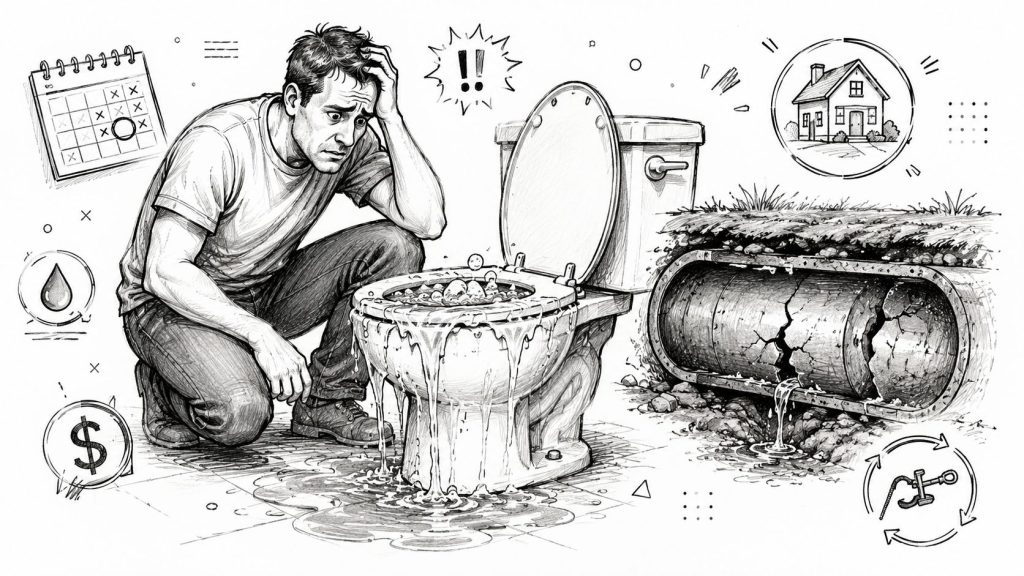
If you're dealing with slow drains, a toilet that gurgles, sewage smell in the yard, or a backup that keeps coming back, you're probably worried about two things at once. First, is this a sewer line problem? Second, are you about to lose your lawn, driveway, or patio to a long trench?
For many homeowners in Woodstock, Acworth, Alpharetta, Canton, Roswell, Marietta, Cumming, and Johns Creek, that's the moment they start searching for sewer line repair without digging. The good news is that modern trenchless repair can often solve the problem with far less disruption than the old dig-and-replace approach. The key word is "often." It works very well in the right situation, and it isn't the right fix in every situation.
North Metro Atlanta homes bring some real-world variables into the decision. Some properties have mature trees near the sewer route. Some have long driveways, finished patios, or tight side yards. Some older homes have aging sewer lines that have cracked, shifted, or picked up root intrusion over time. In those cases, the best repair choice usually comes down to three things: the actual condition of the pipe, what sits above it, and whether repair or full replacement makes more sense for the long term.
Signs Your Sewer Line Is Failing
Most sewer problems don't start with a dramatic collapse. They start with repeated warnings that homeowners try to work around.
A tub drains slowly. Then a toilet starts bubbling. Then the lowest shower or floor drain backs up when the washing machine empties. If you've cleared individual fixtures before and the problem keeps returning, that usually points to a deeper issue in the main sewer line rather than a simple local clog.
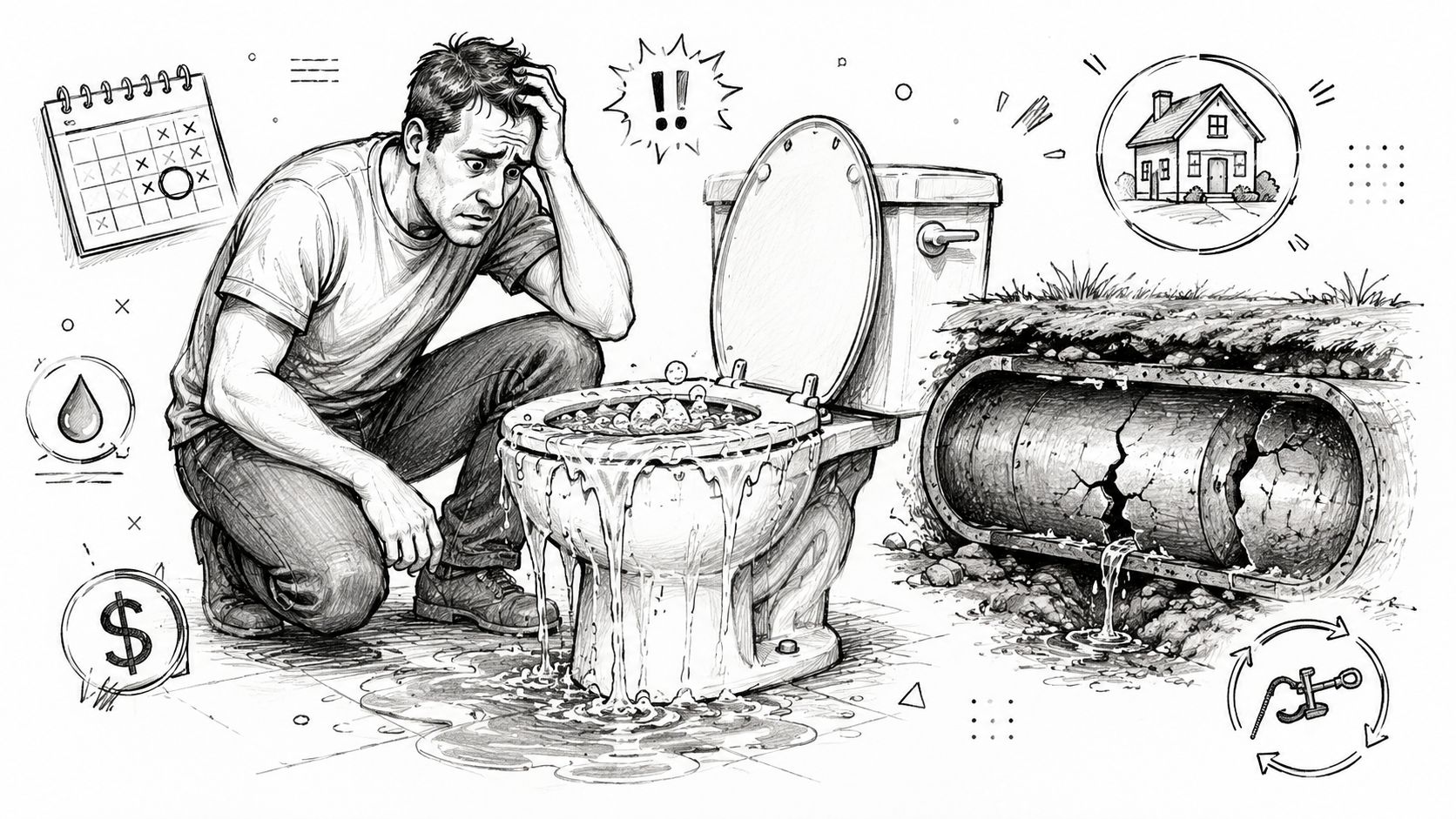
Symptoms that usually mean more than a simple clog
Here are the signs I tell homeowners not to ignore:
- Recurring backups: If the toilet, tub, or shower backs up more than once, especially after drain cleaning, the line may be cracked, narrowed by roots, or partially blocked farther out.
- Gurgling fixtures: Air gets trapped when wastewater can't move the way it should. Toilets and drains often make noise before they fully back up.
- Sewage odor: A persistent sewer smell inside the house or out in the yard often means waste isn't moving cleanly through the line.
- Wet or sunken spots in the yard: If part of the lawn stays soggy or starts settling for no clear reason, an underground leak is one possibility.
- Multiple drains acting up at once: One clogged sink is usually a fixture problem. Several fixtures struggling together is different.
Those are the house's warning lights. They don't tell you exactly what's wrong, but they do tell you it's time to stop guessing.
Why homeowners ask about no-dig options
The old picture of sewer repair was a trench cut across the yard, under the sidewalk, and sometimes through the driveway. Modern trenchless repair changed that. As explained in this overview of what trenchless sewer repair is, it typically uses one or two small access points instead of a long trench, with the main methods being CIPP, pipe bursting, and sometimes slip lining.
That matters because a sewer line can often be restored with minimal surface disruption to lawns, driveways, and patios. For a homeowner in Marietta with mature landscaping or in Johns Creek with finished hardscape, that can make a major difference in the overall job.
Practical rule: If the same sewer symptom keeps coming back, stop treating it like a one-time clog.
A lot of calls that start as "my clogged toilet won't flush" or "I need drain cleaning near me" turn out to be sewer line issues once the pattern becomes clear. The smart move is to confirm the problem before anybody talks repair method.
How We Diagnose Sewer Problems Without Guesswork
No licensed plumber should recommend trenchless repair, traditional excavation, or full sewer replacement based on symptoms alone. Backups, odors, and wet spots tell you something is wrong. They don't tell you whether the pipe is cracked, offset, root-filled, grease-blocked, or collapsed.
The camera inspection is the starting point
The first step is a proper sewer camera inspection. A camera is fed through the line so the plumber can see the inside of the pipe in real time. If you want to understand what that process looks like, a sewer camera inspection gives a clear picture of how professionals locate damage without tearing up the yard first.
That inspection answers the questions that matter:
- Where is the problem? Under the yard, driveway, slab edge, or near the street.
- What kind of problem is it? Crack, root intrusion, separation, corrosion, belly, blockage, or structural failure.
- How long is the affected section? A short isolated defect is different from a line that's failing end to end.
What we're looking for inside the pipe
A camera inspection usually reveals one of a few common patterns.
You may see roots entering through joints or cracks. You may find corrosion or worn interior walls in an older line. You may also find a misaligned section where one piece of pipe has shifted enough to catch paper and waste over and over.
Some lines look rough but still have enough structure for trenchless repair. Others don't.
A good diagnosis saves more money than a fast guess. The wrong repair on the wrong pipe usually means paying twice.
Why this step isn't optional
Trenchless methods depend on the existing pipe condition. If the host pipe can support lining, one option may make sense. If the pipe is too damaged or out of alignment, another option may be better. In some cases, excavation is the only honest recommendation.
That's why I tell homeowners in Roswell, Canton, and Cumming the same thing. Before you compare sewer repair vs sewer replacement, or before you call for an emergency plumber because of a sewer backup, get eyes on the line. A camera turns a stressful mystery into a clear decision.
Your Guide to Trenchless Sewer Repair Methods
Once the line has been inspected, the repair method becomes much easier to explain. Trenchless doesn't mean "one magic fix." It means a group of repair methods that avoid a full open trench when the pipe condition allows it.
CIPP lining for cracks leaks and root damage
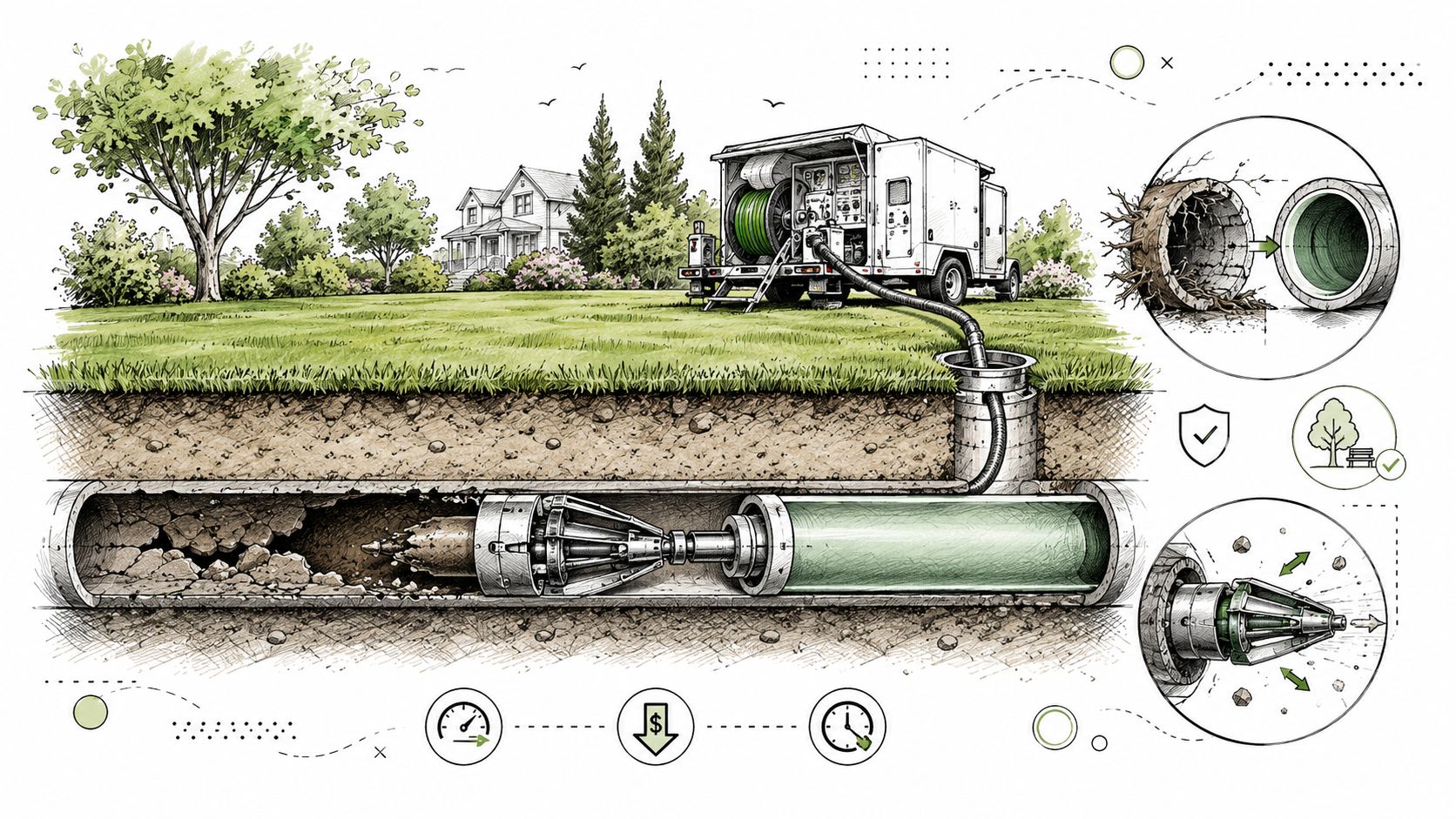
Cured-in-place pipe, or CIPP, is the most widely used no-dig repair for structurally compromised sewer laterals, according to Baethke Plumbing's trenchless repair guide. A resin-saturated liner is inserted through a small access point, inflated against the existing pipe, and cured so it forms a jointless new pipe inside the old one.
For a homeowner, the simplest way to think about it is this. The damaged pipe becomes the shell, and the liner becomes the new working pipe inside it.
CIPP is usually a strong option when the line has:
- Cracks and leaks
- Corrosion
- Many root-intrusion failures
- General wall deterioration without full collapse
It isn't the best fit when the host pipe is fully collapsed or severely offset. In those cases, another trenchless method may be the better choice.
Pipe bursting for lines that need replacement
Pipe bursting is different from lining. Instead of creating a new pipe inside the old one, this method breaks the old pipe apart and pulls a replacement pipe into place.
This is often the better trenchless choice when the original line is too damaged for lining but the route still allows replacement from access points rather than a full trench. If CIPP is repair-inside-the-pipe, pipe bursting is replacement-through-the-old-path.
That distinction matters for North Atlanta properties with driveways, retaining walls, patios, or established landscaping above the line. If the pipe needs to be replaced, trenchless replacement can still avoid the mess of open-cut excavation in many cases.
Spot repairs and prep work
Not every sewer problem involves the full length of pipe. A localized defect can sometimes be addressed with a spot repair, where only the affected section is rehabilitated instead of lining or replacing the whole run.
Before any lining work, the pipe also has to be properly cleaned. That's where tools like commercial hydro jetting come into the conversation. Hydro jetting isn't a repair by itself, but it can remove roots, sludge, and heavy buildup so the repair method has a clean path to work with.
The method should match the pipe not the sales pitch
Homeowners sometimes ask which trenchless method is "best." That's not the right question. The right question is which method fits the line you have underground.
A straight run with cracks and root intrusion may be a good candidate for lining. A badly deteriorated line that still follows a usable path may point toward pipe bursting. A small isolated failure may not justify a full-length repair.
The best trenchless job is the one that solves the actual defect and doesn't ask you to pay for more work than the line needs.
Trenchless Repair vs Traditional Digging in North Atlanta
A North Atlanta homeowner calls after a backup, and the camera shows the sewer line runs under a long driveway, past a retaining wall, and through a planted side yard. At that point, the repair method affects more than the pipe. It affects concrete, drainage, plants, access, and how long the property stays torn up.
That is why this decision needs a full-property view, not just a pipe-repair price.
In North Metro Atlanta, the right choice often depends on what sits above the line and what the ground is like around it. Older homes in Roswell or Marietta may have mature trees and root-heavy yards. Newer properties in Alpharetta or Johns Creek may have long concrete drives, patios, and tighter side-yard access. Clay-heavy soil can also make open excavation messier and harder to restore cleanly after rain.
Trenchless vs Traditional Sewer Repair at a Glance
| Factor | Trenchless Repair (CIPP/Bursting) | Traditional Excavation |
|---|---|---|
| Access | Usually done through limited access points | Requires opening a trench along the pipe route |
| Impact on yard and hardscape | Lower surface disruption in many cases | Higher disruption to lawn, beds, concrete, and other surfaces |
| Best fit | Useful when the line condition supports no-dig repair | Necessary when the line is collapsed, severely misaligned, or otherwise unsuitable for trenchless work |
| Timeline | Often faster once access and prep are in place | Often takes longer because digging and restoration are part of the job |
| Total project cost | Often compares well when restoration is part of the quote | Surface restoration can add substantially to the final bill |
| Property restoration | Usually limited compared with open trench work | Often includes rebuilding disturbed landscaping or concrete |
What changes the decision in North Atlanta
If the sewer line crosses open lawn with good machine access, traditional digging can be a reasonable approach. It gives direct access to the pipe, and in some cases that is the cleanest fix.
The calculation changes fast when the line runs under a driveway, brick walkway, irrigation system, or terraced yard. On those properties, trenchless repair often makes more sense because it avoids a lot of demolition and reconstruction that has nothing to do with the pipe itself.
I also tell homeowners to look past the first number on the estimate. A lower digging price can rise quickly once concrete replacement, grading, sod, plantings, and cleanup are added back in. That is where many North Atlanta homeowners see the actual difference between the two approaches.
What I tell North Atlanta homeowners
Choose based on the condition of the pipe, the route of the line, and the cost to put the property back together afterward.
If the pipe is a good trenchless candidate and it runs beneath expensive improvements, no-dig repair usually protects more of the home's value and causes less disruption. If the pipe has major structural failure and the yard is easy to open, excavation may be the more practical path.
Homeowners should compare estimates with one question in mind. Does the traditional dig quote also account for the full cost of rebuilding the driveway, landscaping, or other surfaces above the line?
Understanding the Cost of No-Dig Sewer Repair
A North Atlanta homeowner usually asks the same question after the camera inspection. What is this going to cost me, and why does one house get a very different number than the one down the street?
There is no flat price for sewer line repair without digging. The quote depends on the length of pipe involved, the trenchless method that fits the line, how hard the system is to access, and what the camera shows once the pipe is cleaned and inspected.
Two numbers homeowners should know
A common planning range for trenchless sewer repair is about $60 to $250 per linear foot, according to this Angi overview of no-dig sewer pipe repair costs. That helps set expectations, but it does not replace an inspection.
National pricing guides also put many trenchless sewer replacement jobs in the $1,900 to $6,000 range and note that the work is often completed in a single day, as described in Mr. Pipey's trenchless sewer line replacement cost guide. For a homeowner, that matters because time, access, and cleanup all affect the final bill.
Why one quote can be thousands apart
In North Metro Atlanta, price changes for practical reasons, not random ones. Older homes in East Cobb, Roswell, and parts of Marietta may have aging cast iron or clay lines with multiple problem spots. Newer subdivisions in places like Acworth, Canton, and Woodstock often have long runs that pass under driveways, retaining walls, irrigation, or tight side yards. Those details change labor, setup, and the repair method.
These factors usually drive the cost:
- Length of the affected line: Repairing a short section near the house is different from rehabilitating a long run toward the tap.
- Repair method: Pipe lining, pipe bursting, and spot repair each use different equipment and involve different preparation.
- Access to the line: Limited entry points, fenced backyards, steep grades, and hard surfaces above the pipe all affect labor.
- Cleaning and prep work: Some lines need heavy root removal or clearing before repair can start. In some homes, professional drain cleaning for sewer backups and severe clogs is part of getting an accurate diagnosis and a workable repair plan.
- Condition of the host pipe: A line that still has enough shape for trenchless work prices differently than one with major offsets or advanced deterioration.
The final bill for a project often exceeds the cheapest initial line item once cleanup and property restoration are included. That is the part many homeowners miss when they compare a low excavation number to a higher trenchless number.
What a proper estimate should include
A real estimate starts after a camera inspection, not with a rough guess over the phone. When requesting a quote for sewer replacement in Acworth, sewer repair in Woodstock, or a sewer backup in Canton, ask exactly what is included.
The estimate should spell out the diagnosis, any cleaning or prep, the repair method being proposed, access points, permit needs if they apply, and what surface repair is still your responsibility afterward. A clear quote makes it much easier to compare options fairly and avoid surprises once the job starts.
When Trenchless Repair Is Not the Right Choice
Trenchless repair is a strong solution. It is not the answer to every sewer problem.
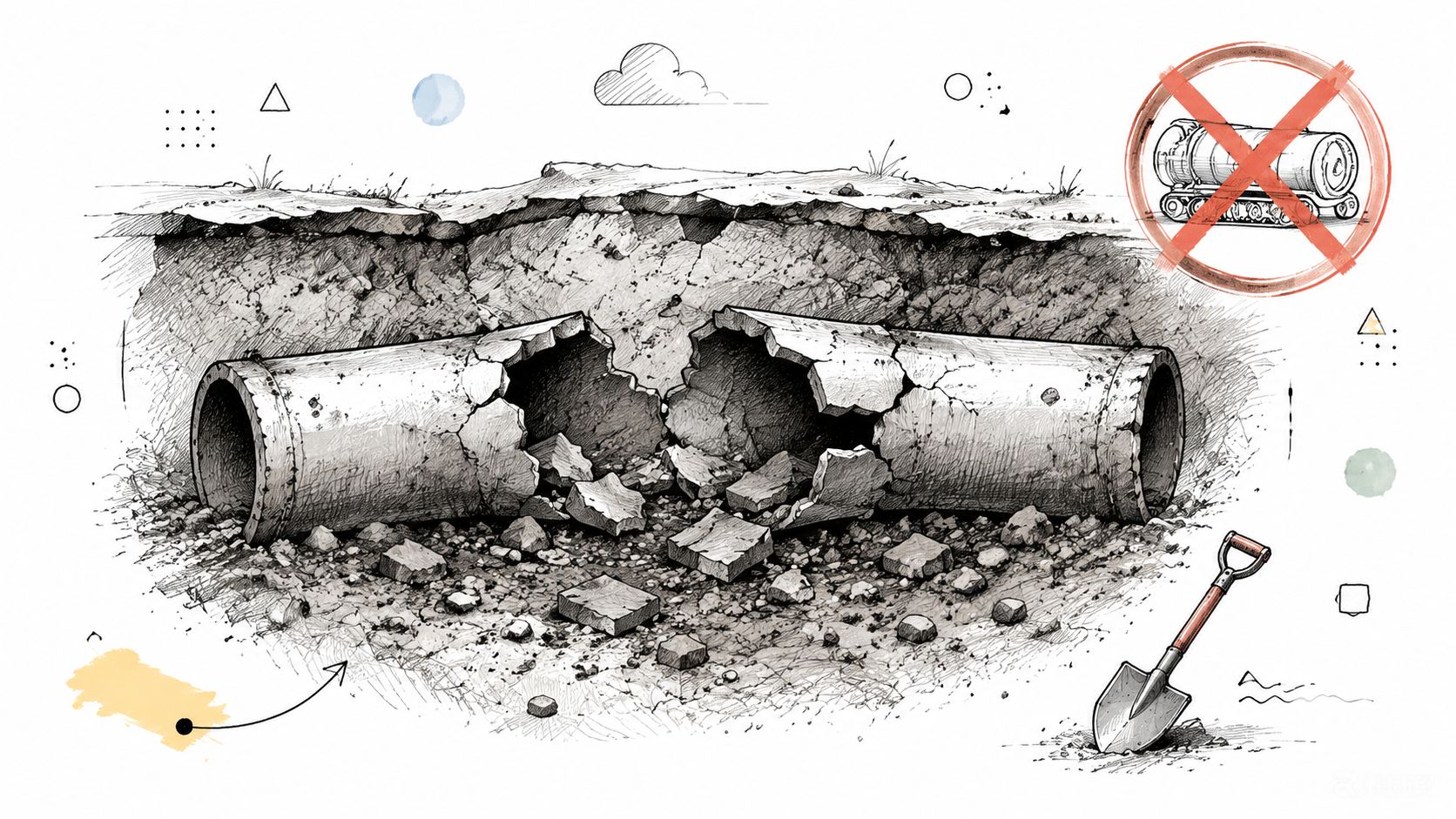
The situations where digging may still be necessary
Some sewer lines are too damaged for a no-dig approach. As noted in this discussion of when sewer repair without destroying property is possible, collapsed pipes, severe structural failure, or certain alignments may still require excavation.
Here are the common red-flag cases:
- Collapsed pipe: Trenchless methods are not designed to fix a line that has caved in on itself.
- Severe structural failure: If the pipe has lost too much shape or stability, there may not be enough structure to work with.
- Problem alignment: Some lines have offsets or routing conditions that make trenchless repair unsuitable.
- Heavy blockage plus major damage: A line may need cleaning first, but if inspection shows major failure after that, cleaning alone won't save it.
If you're dealing with repeated backups, a drain cleaning and toilet clog service may help with symptoms in the short term. But if the camera shows structural failure, the permanent fix may still involve excavation.
Honest advice beats a no-dig promise
A trustworthy plumber shouldn't force trenchless onto a bad candidate just because homeowners understandably want to avoid digging. The better answer is the one that will still be working years from now.
Sometimes trenchless is the smart move. Sometimes sewer replacement with excavation is the right call. The camera decides that, not the marketing.
Choosing a Licensed Plumber in North Metro Atlanta
If you're comparing plumbers for sewer line repair without digging, look past the ad and ask better questions. Trenchless work takes the right equipment, a real diagnosis, and judgment about when not to use it.
What to check before you hire anyone
Use this list when you're talking to plumbing companies in Cobb County, Cherokee County, North Fulton, Forsyth County, and the rest of Metro Atlanta:
- License first: Ask if the company is properly licensed in Georgia and whether the work is being directed by a qualified plumber.
- Camera inspection process: If they skip inspection and jump straight to a repair pitch, that's a warning sign.
- Specific trenchless capability: Ask whether they perform CIPP, pipe bursting, or related sewer rehabilitation work, not just general plumbing.
- Insurance and written estimate: Get the scope in writing so you know what's included and what isn't.
- Repair vs replacement judgment: The best contractor will explain both options if both are realistic.
Local conditions matter more than generic advice
North Metro Atlanta properties aren't all the same. A sewer route under a long suburban driveway in Cumming presents a different challenge than a line crossing an older yard in Marietta. A home with mature trees in Roswell may have recurring root pressure. A tight-lot property in Johns Creek may have limited access for excavation.
That's why broad online advice only gets you so far. You need someone who can read the line, the lot, and the consequences of each repair choice.
For commercial owners or mixed-use property managers trying to think beyond a one-time emergency, this guide on Northpoint Construction for commercial plumbing is a useful resource because it puts maintenance planning into a bigger property-management context.
The right plumber should make the decision clearer
You shouldn't come away from an estimate feeling pressured or confused. You should know what the camera found, whether trenchless is appropriate, what the likely disruption will be, and what the long-term fix is meant to accomplish.
That matters whether you're searching for an emergency plumber in Alpharetta, a 24 hour plumber near me in Woodstock, or a sewer replacement contractor in Acworth. The problem is stressful enough. The explanation shouldn't be.
If you need a clear answer on whether your sewer line can be repaired without digging, JMJ Plumbing serves North Metro Atlanta with licensed diagnostics, sewer camera inspections, trenchless guidance, and 24/7 plumbing support. Whether you're dealing with a sewer backup, recurring drain problems, a sewage smell, or signs of a failing main line, their team can inspect the line, explain your options plainly, and recommend the repair that fits your home instead of forcing a one-size-fits-all solution.