Stop Leaks: How To Fix A Running Toilet Fast
A running toilet usually starts as background noise. You hear a faint hiss after a flush, tell yourself you’ll deal with it later, and move on.
Then the sound keeps showing up at night, in a guest bath nobody uses much, or in the hall bathroom your kids flush all day. In Acworth, Marietta, Woodstock, and the rest of North Metro Atlanta, I see the same pattern all the time. The toilet still works, so people let it slide. That’s the mistake.
Most of the time, how to fix a running toilet comes down to a few parts inside the tank. The trick is knowing which part is causing the leak, and when a simple repair has crossed into a problem that can damage flooring, waste water, or point to something bigger in the plumbing system.
That Phantom Hissing Sound Your Wallet Hates
That little refill sound after every flush has a way of blending into the house. Homeowners get used to it. Then they get the water bill.
A running toilet can waste about 200 gallons of water per day, and the U.S. EPA says it can account for up to 20% of total household water use. For Atlanta homeowners, where water rates rose 8% in 2023, fixing this issue can prevent more than 73,000 gallons of waste and save hundreds of dollars annually, as noted in Fluidmaster’s running toilet guide.
That’s why I never treat a running toilet as a minor annoyance. It’s a leak. It just happens inside the tank where you can’t see it.
What’s usually making the noise
In most homes, the problem is one of three things:
- A worn flapper that isn’t sealing at the bottom of the tank
- A fill valve that keeps feeding water when it should shut off
- A float setting that lets the water level rise too high
Older toilets around Cobb County and Cherokee County also tend to stack problems. The flapper gets stiff, the chain hangs wrong, and mineral buildup roughens the sealing surface. You replace one piece, but the toilet still whispers because the underlying issue wasn’t just the rubber part.
Practical rule: If a toilet keeps refilling when nobody has touched it, water is escaping somewhere inside the tank.
Why fast action matters
A running toilet isn’t in the same category as a burst pipe repair or a sewer backup. But it can turn into a bigger service call if it’s ignored. I’ve seen homeowners focus on the sound and miss the wobble at the base, loose tank bolts, or slow seepage that had already started staining the floor.
If the toilet runs, you may be able to handle it yourself in one trip. If it runs and rocks, leaks outside the bowl, or won’t flush correctly, stop thinking of it as a small parts problem.
Your 5-Minute Toilet Autopsy Before You Begin
Don’t buy parts first. Diagnose first.
That saves money, but more important, it keeps you from replacing a perfectly good flapper when the actual issue is a fill valve or a crack you can’t see at a glance.
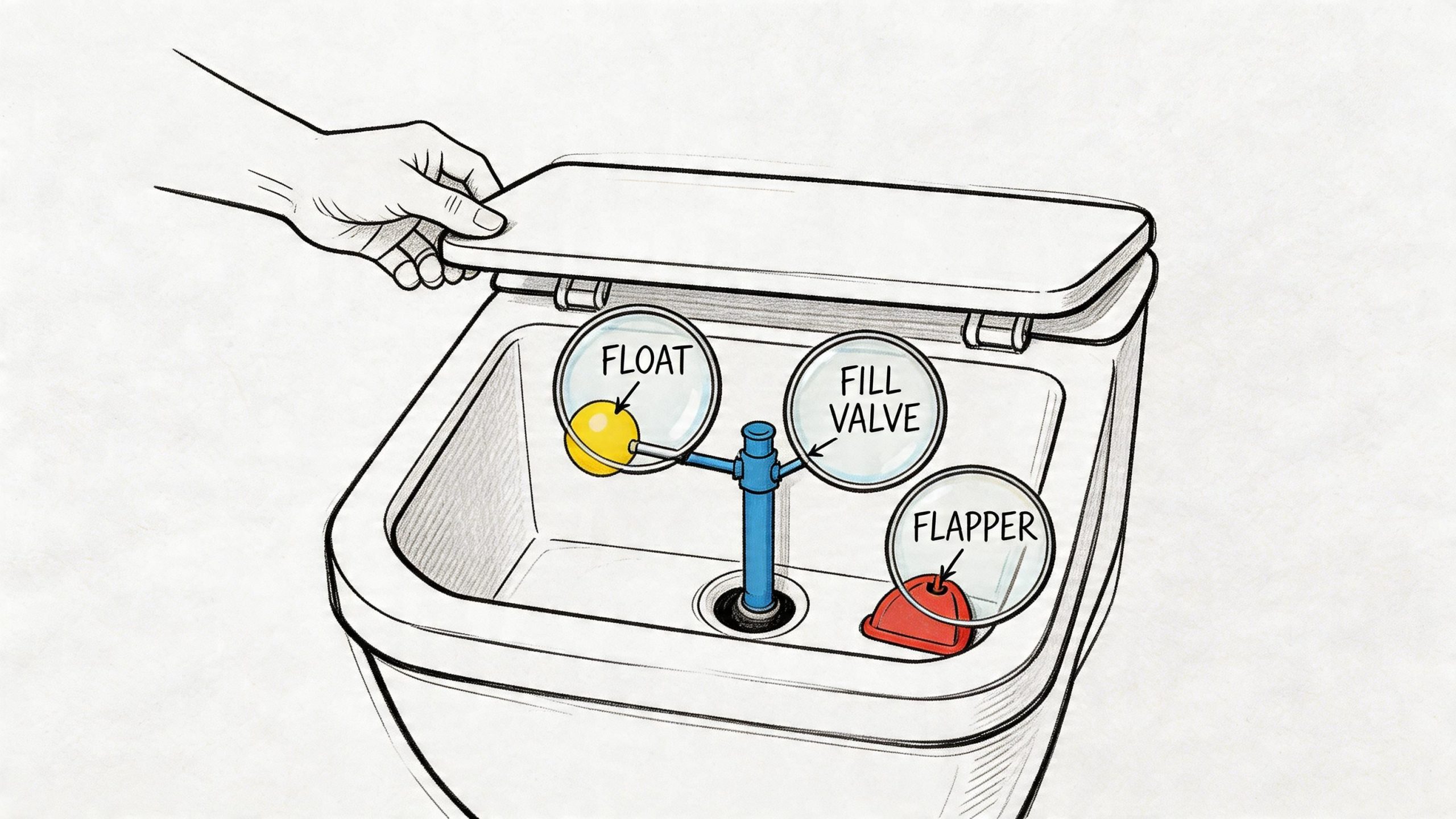
Start with a simple leak check
Take the tank lid off and flush once. Then watch what happens.
If the water level settles and stays put, the flapper may be okay. If the water slowly drops and the fill valve kicks back on, the tank is leaking into the bowl.
A quick dye test helps confirm it. Put a few drops of food coloring in the tank water, wait a bit, and check the bowl. If color shows up there without flushing, you’ve got an internal leak.
Put a towel on the floor before you start. Porcelain lids are slippery, and a dropped tank lid turns a small repair into a replacement decision.
What to look at inside the tank
Here’s the fast visual checklist I use before touching anything:
-
Flapper condition
Look for rubber that’s stiff, warped, cracked, or slimy with buildup. If it doesn’t sit flat on the flush valve opening, it won’t seal. -
Chain position
If the chain is too tight, the flapper can’t close all the way. If it’s too loose, it can get under the flapper and hold it open. -
Fill valve behavior
If water keeps entering from the left side or center assembly and never fully stops, the fill valve may be sticking or failing. -
Water level
If water is spilling into the overflow tube, the toilet isn’t really “leaking” through the flapper alone. It may be overfilling. -
Float movement
The float should move freely. If it catches, rubs the tank wall, or sits too high, the valve may stay open.
Keep these tools nearby
You don’t need a full truck setup for a basic toilet repair. Most homeowners can get through the inspection with:
| Tool or part | Why it helps |
|---|---|
| Adjustable wrench | Loosens supply connections if you need to replace the fill valve |
| Sponge or small cup | Removes leftover water from the tank |
| Old towel | Protects the floor and catches drips |
| Universal flapper | Common first replacement part |
| Fill valve kit | Good to have if the valve won’t shut off |
| Fine sandpaper or a non-scratching pad | Cleans mineral buildup from the valve seat |
If the toilet is also slow, backs up, or gives you the classic clogged toilet won’t flush problem, that’s a different repair path than a running tank issue. For that side of the problem, JMJ has a local page on drain cleaning and toilet clogs that covers when a simple plunger job stops being enough.
Know what not to force
Don’t crank the shutoff valve hard if it feels stuck. Don’t bend metal parts aggressively. And don’t assume every running toilet needs a full toilet replacement.
Most mistakes happen when someone rushes past the inspection and starts swapping parts. Five minutes of careful looking usually tells you whether this is a quick Saturday fix or a call you should hand off.
Mastering the Flapper Fix The 80 Percent Solution
If I had to bet on one part causing a running toilet, I’d bet on the flapper.
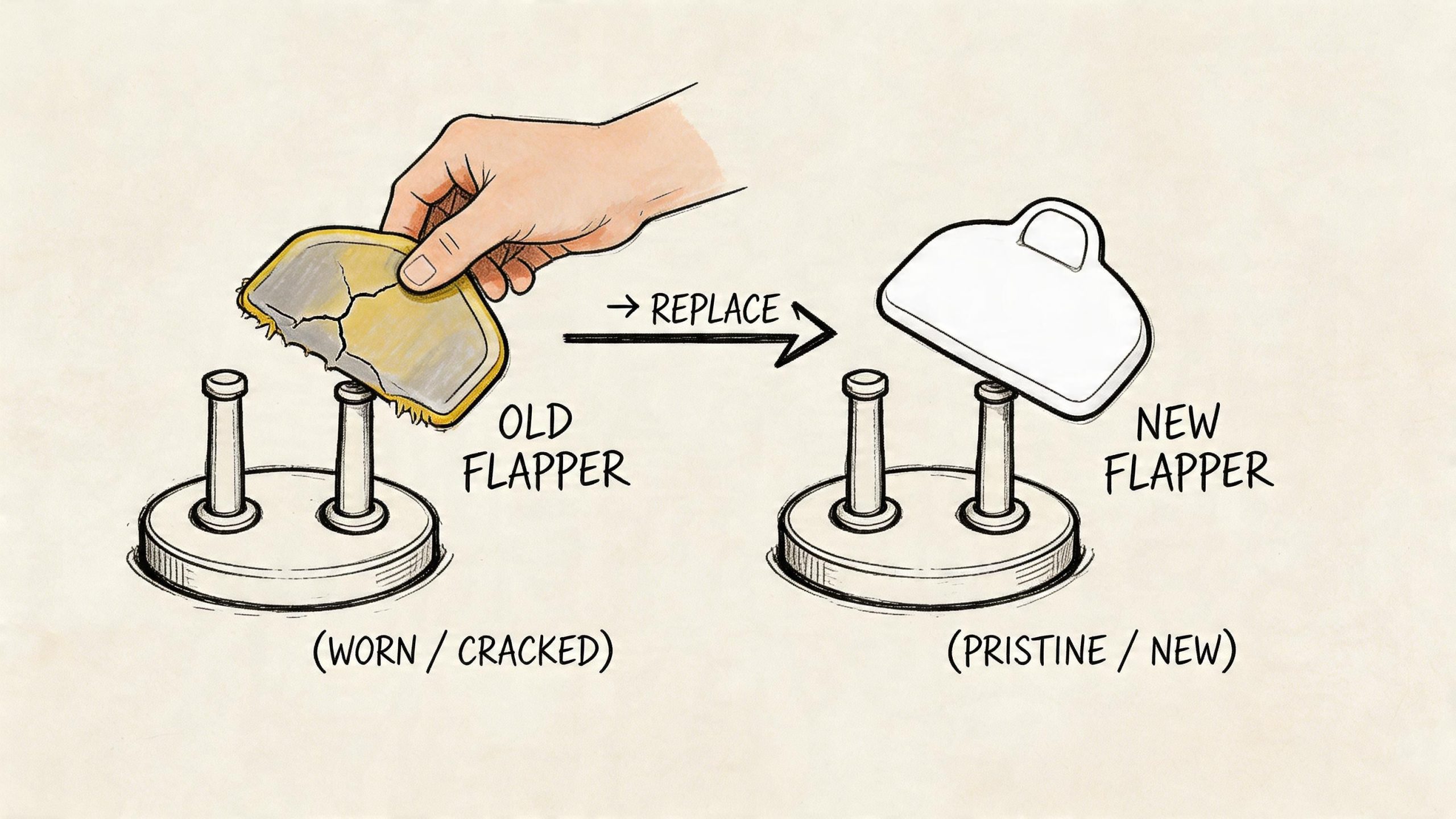
Flapper replacement resolves approximately 80% of running toilet issues, and the repair succeeds or fails on details many DIY jobs miss, especially cleaning the valve seat and setting the chain with 0.5-inch of slack, according to Apollo Home’s running toilet repair guide.
Shut the water off and clear the tank
Turn the shutoff valve clockwise. Go easy. A small turn is usually all it takes, and forcing an old valve can create a second repair.
Flush the toilet and hold the handle down so as much water as possible leaves the tank. Use a sponge or towel to remove what’s left at the bottom. You want the flapper area dry enough to inspect clearly.
Remove the old flapper the right way
The flapper usually hooks onto pegs on the overflow tube and connects to the flush arm by a chain.
Before removing it, notice how the chain is attached. That matters later. Then unhook the chain and pinch the flapper ears off the pegs. If the rubber looks bent, brittle, or rough, you’ve found a likely cause.
A lot of homeowners stop here, snap a new flapper on, and wonder why the toilet still runs.
Clean the sealing surface
The flush valve seat is where the flapper lands. If that rim has mineral crust, slime, or rough spots, the new flapper won’t seal well.
Use fine sandpaper or a non-scratching pad and clean the seat gently. If you see stubborn mineral buildup, wipe it down carefully until the surface feels smooth. This step is boring, but it’s the difference between a repair that lasts and one that fails by bedtime.
A new flapper on a dirty valve seat is like new weatherstripping on a warped door. The part isn’t the whole repair.
Match the replacement part
Most toilets use a 2-inch or 3-inch flapper. Bring the old one with you if you’re shopping locally in Acworth, Kennesaw, or Woodstock. Universal flappers work well in many gravity-fed toilets, but only if the size matches and the shape sits flat on the seat.
When you install the new one, make sure it centers cleanly over the opening. Don’t twist it. Don’t let one side ride up.
Set the chain with some slack
Many DIY fixes encounter problems at this stage.
You want the chain loose enough for the flapper to close fully, but not so loose that it tangles under the flapper. A good target is 0.5-inch of slack. If the chain is too tight, the flapper hangs open. If it’s too loose, it can interfere with the seal.
Here’s a simple way to test it:
-
Flush once and watch the lift
The flapper should rise cleanly without the chain pulling sideways. -
Watch the drop
It should fall straight back into place without hesitation. -
Listen after refill
If you hear a faint hiss after the tank fills, recheck the chain and seat before blaming the new part.
Test it more than once
Turn the water back on slowly and let the tank refill. Then flush the toilet several times.
You’re looking for consistent shutoff. Not one perfect flush. A toilet that works once and leaks on the third or fourth cycle usually still has a chain issue, a dirty seat, or the wrong flapper fit.
What works and what doesn’t
A few trade-level observations make this job go smoother:
| Works | Usually fails |
|---|---|
| Cleaning the valve seat before installing the new flapper | Installing a new flapper over mineral buildup |
| Matching the flapper size to the flush valve opening | Assuming every toilet uses the same flapper |
| Adjusting chain slack carefully | Leaving the old chain too tight or too long |
| Testing multiple flushes | Flushing once and calling it fixed |
If the toilet stops running after this repair, you’re done. If it still refills on its own, move past the flapper and start looking at the fill valve, float, or hidden tank problems.
Beyond the Flapper Tackling Fill Valves and Floats
A new flapper that doesn’t solve the problem tells you something useful. The leak path may not be at the bottom of the tank, or the tank may be overfilling.
Homeowners often get frustrated. The toilet sounds the same, but the fix is different.
Check whether water is entering the overflow tube
Take the lid off and let the tank fill. Then look at the overflow tube.
If water is running into that tube, the tank level is too high or the fill valve isn’t shutting off properly. In that case, the toilet may keep cycling even with a brand-new flapper installed correctly.
There are two common setups:
- Cup-style float on a vertical fill valve shaft
- Ball float on an older metal or plastic arm
For a cup-style float, adjust it downward using the built-in clip or adjustment point. For a ball float, make a small downward adjustment to lower the shutoff point. Small changes matter here. Go little by little, then retest.
Signs the fill valve is the real culprit
Sometimes the float is set fine, but the valve itself won’t close cleanly. You may hear a steady hiss, see water continuing to move, or notice the tank takes too long to stop filling.
A faulty fill valve usually shows itself in one of these ways:
- It keeps running even after the float rises
- It shuts off, then restarts without a flush
- It sticks intermittently
- It sprays unevenly or makes a sharp squeal
At that point, replacing the fill valve makes more sense than fiddling with it over and over. Shut off the water, disconnect the supply line, remove the old valve, and install the replacement according to the manufacturer’s instructions. Make sure the refill tube is positioned correctly and not shoved too far down into the overflow tube.
If the refill tube is inserted wrong, the toilet can siphon and act like another part is failing.
When the problem is hidden
Some running toilets fool people because the usual parts look fine.
When basic fixes fail, the cause can be a hidden crack in the overflow tube or a faulty tank-to-bowl gasket, problems found in up to 25% of persistent leak cases, especially in older homes common in Marietta and Woodstock, according to this video breakdown of persistent toilet leak issues. These issues often aren’t visible without careful inspection and may require professional tools to repair without creating water damage.
That matters in older North Metro Atlanta homes where settling, age, and repeated overtightening can stress porcelain or distort connections.
A quick decision guide
Here’s the simplest way to separate a DIY-friendly problem from a deeper repair:
| If you see this | Likely direction |
|---|---|
| Flapper looks worn and seat is dirty | Replace flapper and clean seat |
| Water level rises into overflow tube | Adjust float or replace fill valve |
| Toilet still runs after both repairs | Inspect for overflow tube damage or gasket issues |
| Tank wobbles or hardware is corroded | Move carefully, or call a plumber before disassembly |
If you need to pull the tank, replace a tank-to-bowl gasket, or work around old brittle hardware, that’s where many homeowners crack porcelain or create a leak onto the floor. A running toilet is one thing. A bathroom ceiling stain below it is another.
Stop Future Toilet Troubles The Proactive Homeowner’s Guide
A lot of toilet repairs in North Metro Atlanta fail for one simple reason. The part got replaced, but the water conditions that damaged the old part never changed.
In Acworth and Kennesaw, hard water causes calcium deposits that warp flappers and clog fill valves prematurely, and when water quality isn’t addressed, “fixed” running toilets often recur within 6 months, increasing repair costs. Proactive filtration can help prevent those repeated failures, as noted in Lowe’s toilet repair guidance.
Why local water matters
Hard water leaves deposits on the flapper seat, around the fill valve, and on moving parts that are supposed to slide freely. That buildup changes how the toilet shuts off.
The homeowner sees a repeat failure and assumes the replacement part was junk. Sometimes the part was fine. The mineral load in the water wore it down early or kept it from sealing in the first place.
Small habits that prevent repeat calls
You don’t need a complicated maintenance plan. A few habits go a long way:
-
Lift the tank lid occasionally
Look for white or chalky buildup on rubber and plastic parts. -
Clean deposits before they harden
Light mineral accumulation is easier to remove than thick crust around the valve seat. -
Skip harsh in-tank chemicals
Those products often shorten the life of rubber components. -
Pay attention to repeat symptoms
If the same toilet keeps running every few months, think beyond the flapper.
The long-term fix for repeat mineral problems
If you’re dealing with hard water throughout the house, the smarter move is often upstream. Whole-home filtration can reduce the mineral-related wear that shows up first in toilets, but also affects faucets, shower valves, water heaters, and appliances.
For homeowners comparing repair options, toilet repair and replacement service is one route when a fixture keeps failing, and whole-home systems such as HALO filtration are another factual option when the bigger issue is water quality rather than the toilet itself.
Replacing the same toilet parts again and again usually means the toilet isn’t the only problem.
Know When to Call for Backup JMJ Plumbing to the Rescue
A homeowner can absolutely handle some running toilet repairs. If the problem is a worn flapper, a misadjusted chain, or a straightforward fill valve issue, a careful DIY fix makes sense.
The line gets clearer when the symptoms spread beyond the tank.
Stop and call for help when you notice these signs
- The toilet still runs after you’ve handled the basic repairs
- The base moves or rocks when you sit down
- You see cracks in the tank or bowl
- Water is showing up on the floor
- The toilet issue comes with sewage smell, slow drains, or a backup
- You’re also seeing water in the yard or other signs of a larger line problem
At that point, you may not be dealing with a simple toilet repair at all. It could overlap with drain cleaning, leak repair, sewer repair, sewer replacement, main water line repair, or another issue that needs real diagnostics.
Why emergency judgment matters
A running toilet by itself usually isn’t a middle-of-the-night disaster. A running toilet tied to overflow, contamination, or a sewer backup can be.
If a bathroom has backed up and left contaminated material behind, plumbing repair is only one part of the cleanup. Homeowners in that situation may also need professional biological cleanup services to handle sanitation safely after the plumbing issue is contained.
For urgent plumbing problems across Acworth, Woodstock, Roswell, Marietta, Alpharetta, Canton, Cumming, and Johns Creek, JMJ has a page for 24 hour emergency plumbing when the job has moved past a simple DIY repair and needs a licensed plumber on site.
If the toilet is just running, try the easy fixes first. If it’s running and showing you any sign of structural damage, hidden leakage, drain trouble, or sewer trouble, don’t keep guessing inside the tank.
If your toilet won’t stop running, or the problem looks bigger than a flapper or fill valve, JMJ Plumbing serves North Metro Atlanta with licensed repair help for toilets, leaks, drains, sewer lines, water lines, water heaters, and emergency plumbing.