Plumbing Inspection for Home Purchase: Your Buyer’s Guide
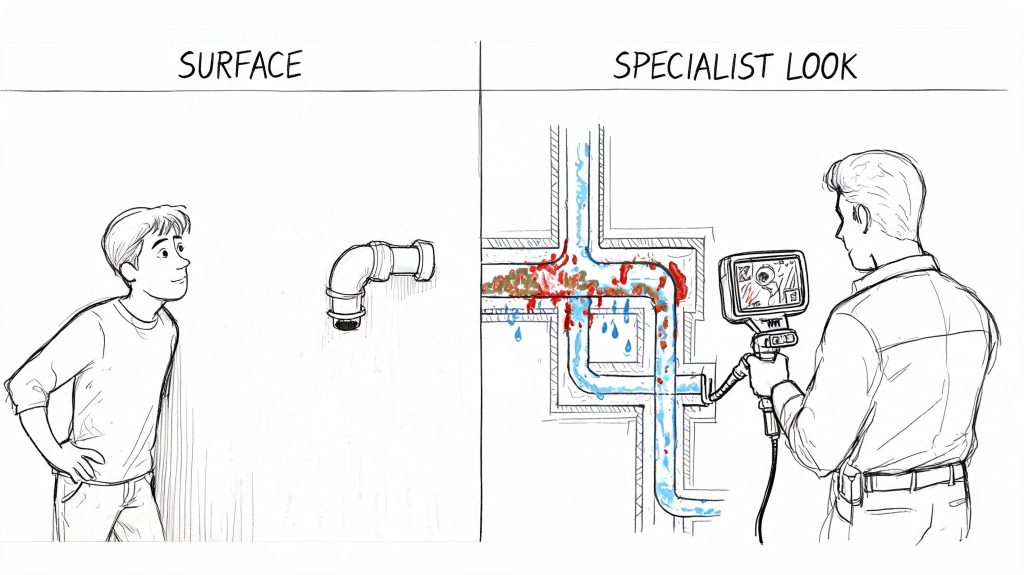
You've found the house. The kitchen looks updated, the floors are clean, and the yard in Roswell has just enough shade to feel established without looking overgrown. Then you get to inspection week and start hearing phrases like low water pressure, slow drain, sewer smell, water heater at end of service life, or possible leak under slab.
That's when a lot of first-time buyers learn a hard truth. A home can look move-in ready and still have plumbing problems buried in walls, under the yard, or inside old pipes. Paint hides stains. New vanities hide patched drains. A quiet showing doesn't tell you what happens when two showers, a washing machine, and a dishwasher run at the same time.
A proper plumbing inspection for home purchase is about finding the expensive problems before they become your problems. In North Metro Atlanta, that matters even more. Older pipe materials, shifting red clay, root intrusion, water quality concerns, and neglected water heaters can turn a good deal into a repair project fast.
Why Your Dream Home Could Have a Nightmare Below
A buyer usually notices what's easy to see first. Fresh tile. New faucets. A clean basement. A staged laundry room. Plumbing failures don't announce themselves that way.
In Roswell, Marietta, Woodstock, and Alpharetta, I've seen homes where everything looked polished above ground while the actual trouble sat underground in the sewer line. I've also seen houses with decent cosmetic updates but old galvanized water lines still restricting flow and leaving the buyer wondering why the upstairs shower feels weak.
The problem is simple. Plumbing is partly hidden by design. Supply lines run behind walls. Drain lines run under floors. Sewer problems can exist far from the bathroom that seems to work fine during a quick walkthrough. If you don't inspect beyond the surface, you're guessing.
What buyers miss during a showing
A showing won't tell you whether the main line has root intrusion. It won't tell you whether an older water heater is close to failure. It won't tell you whether a sewer backup is one heavy rain away, or whether that wet patch in the yard points to a water line replacement instead of a sprinkler issue.
Common warning signs include:
- Slow drains: A tub or sink that drains slowly may point to buildup, damage, or a larger sewer issue.
- Low water pressure: Weak flow at one fixture can be local. Weak flow across the house can suggest pipe sizing, corrosion, or supply line trouble.
- No hot water: A water heater may still produce hot water during a showing and still be near failure.
- Sewage smell: That odor should never be brushed off as “just an older house.”
- Water in yard: Soft ground or persistent wet spots can point to a hidden exterior leak.
Buy the house for its layout if you want. But inspect the plumbing like you'll be the one paying for every surprise after closing.
That's the mindset that protects buyers. Not fear. Due diligence.
What a Specialist Plumbing Inspection Uncovers
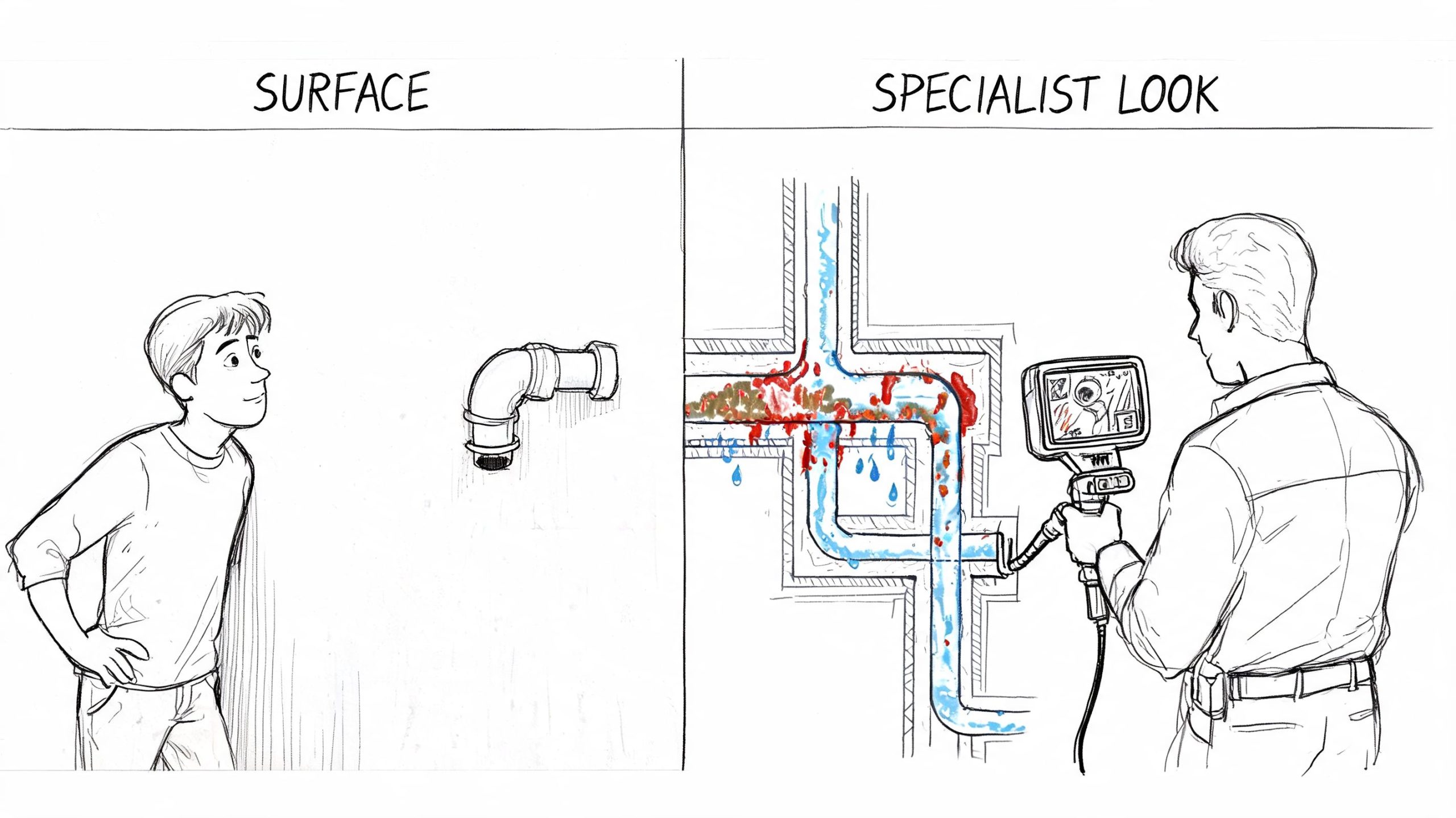
A lot of buyers assume the general home inspection already covers plumbing in enough detail. It usually doesn't. A general inspector may run faucets, flush toilets, and note visible leaks. That's useful, but it's not the same as diagnostic plumbing work.
Home inspections identify plumbing-related issues in 13.6% of checks and water heater problems in 12.2%, making them frequent concerns. A 2019 survey also found that 27.94% of homeowners reported plumbing as their most common home repair according to home inspection statistics research. That tells you plumbing problems aren't rare side notes. They're common enough to justify a closer look before you sign.
General inspection versus plumbing inspection
A specialist plumber goes deeper in the places where buyers get hurt financially.
A dedicated inspection may include:
- Pressure evaluation: Not just “water came out of the faucet,” but whether pressure behaves properly when multiple fixtures run.
- Pipe material identification: Finding galvanized steel, polybutylene, aging copper, patched sections, and questionable transitions.
- Drain performance testing: Looking at how fixtures drain under actual use.
- Water heater evaluation: Checking visible condition, age-related wear, corrosion signs, venting, shutoffs, and overall replacement risk.
- Sewer camera scoping: A direct look into the line instead of guessing from symptoms alone.
If you want a strong primer on surface-level warning signs before inspection day, the Pinnacle Property Media home inspection guide is worth reading. It helps buyers spot water damage clues that often lead back to hidden plumbing issues.
Why sewer diagnostics change the conversation
The biggest gap in many transactions is the sewer line. That line can be failing while every toilet still flushes during a short visit.
A camera inspection changes that. It shows root intrusion, offsets, sagging sections, buildup, cracks, and corrosion inside the actual pipe. If you're comparing inspection options, a dedicated sewer camera inspection service is the kind of add-on that can prevent a brutal surprise after move-in.
A toilet that flushes during a five-minute walkthrough does not prove the sewer line is healthy.
That's the trade-off buyers need to understand. A general inspection is broad. A specialist plumbing inspection is targeted. For high-cost systems, targeted wins.
Your Pre-Purchase Plumbing Inspection Checklist
Buyers don't need to know how to rebuild a valve or replace a flange. You do need to know what should be checked, and why it matters. This is the practical checklist I'd want any first-time buyer in Roswell, Johns Creek, Canton, or Cumming to carry into inspection week.
Water supply lines and pressure
Low water pressure complaints often start at this point. Inspectors should verify that main water lines are ¾- to 1-inch and branch lines are at least ½-inch to maintain optimal water pressure of 40-80 PSI. They also check for outdated materials like galvanized steel, which can corrode and reduce effective diameter by 50% over 20-30 years based on plumbing inspection guidance on pipe sizing and materials.
What to check:
- Pipe material: Ask whether the house has galvanized steel, copper, PEX, CPVC, or mixed materials.
- Visible corrosion: Look under sinks, at shutoff valves, around hose bibs, and where pipes enter mechanical areas.
- Pressure consistency: A house can feel fine at one bathroom sink and still struggle when two fixtures run together.
- Main shutoff and isolation valves: If valves are frozen, leaking, or missing where they should be, repairs get harder during an emergency.
Water heater condition
Water heaters cause problems in two ways. They fail outright, or they age into unreliable operation and weak performance.
Ask the inspector or plumber to evaluate:
- Leak signs: Rust streaks, moisture at the base, corrosion at fittings, or staining around the pan.
- Recovery issues: If a seller says the house “sometimes runs out of hot water,” pay attention.
- Noise and sediment clues: Rumbling or popping often points to scale or internal wear.
- Installation quality: Venting, gas connections, drain setup, and shutoff access all matter.
If your search history already includes “water heater replacement Roswell” or “no hot water near me,” you're asking the right questions.
Drains, fixtures, and bathroom performance
A clogged toilet won't flush, a shower that backs up, or a vanity drain that gurgles may seem like small annoyances. Sometimes they are. Sometimes they're early warnings of a drain cleaning problem that reaches far beyond one room.
Pay attention to:
- Drain speed: Kitchen sink, tubs, showers, lavatories, and laundry standpipes should clear normally.
- Toilet stability: A rocking toilet can mean flange trouble, floor damage, or poor installation.
- Trap and arm leaks: Cabinet floors tell the truth even when fixtures look new.
- Simultaneous use problems: Run more than one fixture if possible.
Practical rule: Don't let staged finishes distract you from utility spaces. Laundry rooms, basements, crawl spaces, and water heater closets often reveal the real history of the plumbing system.
Main sewer line and exterior warning signs
This is the part many buyers skip, and it's often the costliest one to miss.
Check for:
- Cleanout access: If there's no usable access, ask how the sewer line will be evaluated.
- Trees near the line path: Roots and older piping are a bad combination.
- Sewage odor: Indoors or outdoors, that smell deserves an answer.
- Wet areas in the yard: Could be drainage, could be a broken line, could be a hidden leak.
Common plumbing red flags and potential costs
| Red Flag | What It Means | Potential Cost / Implication |
|---|---|---|
| Slow drains in multiple fixtures | Possible main drain or sewer issue | May require drain cleaning, camera scoping, sewer repair, or sewer replacement |
| Low water pressure throughout house | Corroded lines, undersized piping, or supply issue | May lead to main water line repair or water line replacement |
| Rusty water or visible galvanized pipe | Aging supply system restricting flow | Replacement may be more practical than repeated leak repair |
| Water heater corrosion or leaking pan | Unit may be near failure | May require water heater replacement soon after closing |
| Sewage smell inside or outside | Trap, vent, or sewer line problem | Can signal sewer backup risk or hidden drain failure |
| Wet spot in yard | Exterior leak or line break | May point to main water line repair or underground sewer work |
| Gurgling toilet or clogged toilet won't flush | Venting issue, blockage, or line restriction | Could be simple drain cleaning or a larger sewer problem |
| Fresh paint over patched drywall near plumbing walls | Possible concealed leak history | Further leak detection may be needed before closing |
Decoding Major Problems and Their Hidden Costs
Some inspection findings are maintenance items. Others are budget changers. Buyers need to know the difference fast.
The three issues that deserve the most attention are failing sewer lines, old supply piping, and water heaters that are one hard week away from quitting. These are the items that can turn a calm move-in into an emergency plumber call.

Sewer trouble below the yard
In older Atlanta-area neighborhoods, sewer lines often fail without warning. Camera inspections can reveal that pipes over 30-50 years old have a 40-60% failure risk, and tree roots common in Atlanta's clay soil can grow 1-2 inches per year inside pipes, causing backups that cost $4,000-$12,000 or more to repair according to this sewer inspection overview.
That matters in places like Marietta, Canton, and parts of Roswell where mature trees and older lines often share the same yard. A buyer may think they need drain cleaning. The camera may show the actual issue is a damaged section, a belly in the line, or roots entering at a joint.
What works:
- Targeted repair when damage is isolated
- Full sewer replacement when the line is failing in multiple sections
- Clearing roots only when the pipe itself is still structurally sound
What doesn't:
- Treating repeated backups like a one-time clog
- Assuming a plunging problem indoors means the trouble is only indoors
Water line and pipe material problems
Old supply lines don't always burst first. They often decline first. Pressure drops. Water quality changes. Fixtures clog. Small leaks start around weak points.
Galvanized piping is a classic example. It can still be in service and still be a poor system to inherit. If an inspection finds widespread corrosion or poor flow, repeated spot repair often becomes wasted money. In that situation, water line replacement can make more sense than chasing one leak after another.
For buyers also thinking about water quality, the Water Filter Advisor insights offer a helpful consumer-level look at whole-home filtration decisions that often come up once an inspector finds aging pipes or water issues. And if the home has any sign of movement-related leakage, it's smart to understand how slab leak symptoms and repair options fit into the bigger picture.
Water heaters that fail on your watch
A water heater can look ordinary and still be a problem. Many buyers focus on whether there is hot water today, not whether the unit is at the point where replacement is the smarter move than repair.
That decision depends on visible condition, leakage, performance, installation quality, and the broader plumbing picture in the home. If a water heater sits in a garage with rust at the base, poor drainage around it, and other deferred plumbing maintenance nearby, I'd treat that as a warning sign, not an isolated issue.
Your Action Plan for a Flawless Inspection
The best inspection results don't happen by accident. Buyers who get useful answers usually do four things right. They hire the right person, prepare the house correctly, attend the inspection, and use the findings well during negotiation.
Hire a plumber, not just an inspector
A broad home inspector has value. But if you're worried about sewer repair, low water pressure, old supply lines, leak repair history, or a suspicious water heater, bring in a plumber who handles those systems every day.
That matters because a 2025 ASHI study found that 28% of homes had hidden plumbing defects missed by general inspectors. Dedicated plumbing scopes costing $300 to $500 identified 85% of these issues, enabling negotiations that saved buyers an average of $7,200 according to the ASHI-based inspection analysis.
If the home is older, has trees near the sewer path, has visible pipe updates mixed with old materials, or shows any sign of prior water damage, a specialist isn't overkill. It's the correct move.
Set the house up for a real inspection
Before the appointment, make sure the basics are handled:
- Utilities must be on: No water, no gas where applicable, no useful inspection.
- Access has to be clear: Water heater closets, crawl spaces, mechanical rooms, cleanouts, and sinks can't be blocked by storage.
- Ask for seller disclosures early: Any history of sewer backup, burst pipe repair, recurring clogs, or no hot water matters.
- Request prior repair invoices: If there was a main water line repair or emergency plumber visit, the paperwork helps.
Be present and ask direct questions
Attend if you can. Buyers learn more in twenty minutes on site than from reading a summary later.
Ask questions like:
- If this were your house, would you repair or replace this section?
- Is this a symptom problem or a system problem?
- Could this become an emergency in the first year?
- What should be handled before closing?
The report matters. The conversation on site matters too, because that's where you hear how a plumber reads risk.
Use the report as leverage, not decoration
A plumbing report should support a decision. You can ask the seller for repairs, request a credit, renegotiate based on likely replacement needs, or walk away if the risk is too high.
The strongest requests are specific. “Repair plumbing” is weak. “Address active leak at water heater connection, provide sewer scope findings, and resolve documented low-pressure supply issue” is much harder to ignore.
Plumbing Considerations for North Metro Atlanta Homes
North Metro Atlanta homes don't all fail the same way. Local conditions shape plumbing problems, and buyers should understand that before they close.
In this region, two issues stand out. Red clay soil affects underground lines, and water quality can shorten the life of plumbing components. That means the same house that seems fine on a quick tour can carry very different risks in Roswell, Acworth, Cumming, or Alpharetta.
Red clay and shifting sewer lines
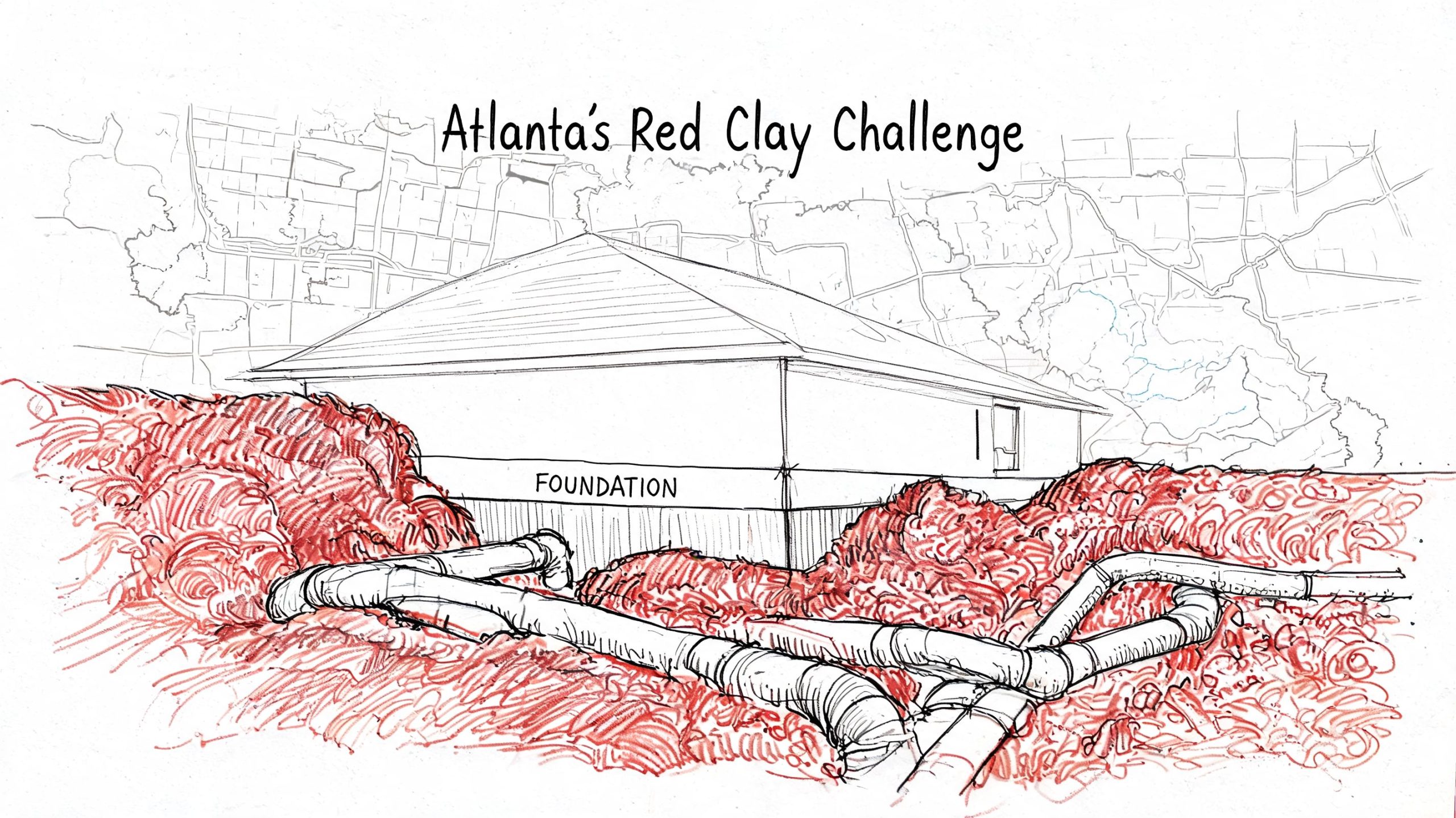
Atlanta-area clay expands and contracts with moisture changes. Underground piping doesn't always tolerate that movement well. In practical terms, buyers in older neighborhoods should pay close attention to sewer alignment, root intrusion, and any sign of repeated backup history.
This is one reason sewer replacement shows up in older parts of Cobb County and Cherokee County more often than first-time buyers expect. It's not always dramatic pipe collapse. Sometimes it's years of movement, offsets, and partial restrictions finally catching up with the house.
Water quality and filtration concerns
Water quality is no longer a side topic. Recent USGS data shows a rise in contaminants in municipal water supplies, including in Georgia's Cobb and Fulton counties. An all-inclusive inspection can include water testing, as corrosive water in some older Atlanta homes accelerates pipe failure, making whole-home filtration systems a key protective measure as discussed in this regional water quality and inspection overview.
That matters for two reasons. First, corrosive water can shorten the life of existing pipes and fixtures. Second, if you're buying a home with aging plumbing, filtration can become part of the long-term protection plan, not just a comfort upgrade.
For buyers narrowing a search in North Fulton, it also helps to understand area-specific service expectations and local plumbing conditions through a city page like plumbing service in Alpharetta.
Different neighborhoods, different risks
A newer home in Cumming may not have old cast iron, but it can still have installation shortcuts, pressure issues, or drain layout problems. An older Marietta home may have stronger build quality overall but need serious work on sewer or water lines. A Roswell house with mature landscaping may have the exact look buyers want and the exact root conditions plumbers worry about.
Local knowledge matters because plumbing risk isn't random. It follows patterns.
Protect Your Investment and Schedule Your Inspection Today
A plumbing inspection for home purchase isn't a box to check. It's one of the few chances you get to test the house before the repair bills become yours.
If the inspection finds nothing major, that's valuable. You buy with more confidence. If it finds a failing sewer, a weak water line, a tired water heater, or active leaks, that's valuable too. You still have options before closing. After closing, your options usually cost more and feel more urgent.
First-time buyers in Roswell, Woodstock, Acworth, Marietta, Johns Creek, Canton, and Cumming often spend a lot of energy on mortgage terms, insurance, and paint colors. All of that matters. But plumbing is the system that can force an emergency plumber call on day one, flood a room, shut down hot water, or leave you dealing with a sewer backup before the boxes are unpacked.
The smartest approach is straightforward. Get the house inspected by someone who knows how to diagnose real plumbing risk, not just spot obvious defects. Ask direct questions. Read the report carefully. Negotiate from facts. If the system needs repair or replacement, know that before you sign, not after.
If you're buying in Roswell, Alpharetta, Marietta, Woodstock, Canton, Cumming, Johns Creek, or anywhere in North Metro Atlanta, JMJ Plumbing can help you make that decision with confidence. JMJ is a licensed Master Plumber serving the area for over 25 years, with 24/7 availability for everything from sewer camera inspections and leak detection to water heater replacement, drain cleaning, sewer repair, sewer replacement, main water line repair, and burst pipe repair. If you want a straight answer before closing, schedule an inspection and get a clear picture of what you're buying.