Bathroom Mixing Valve: A Guide for Atlanta Homeowners
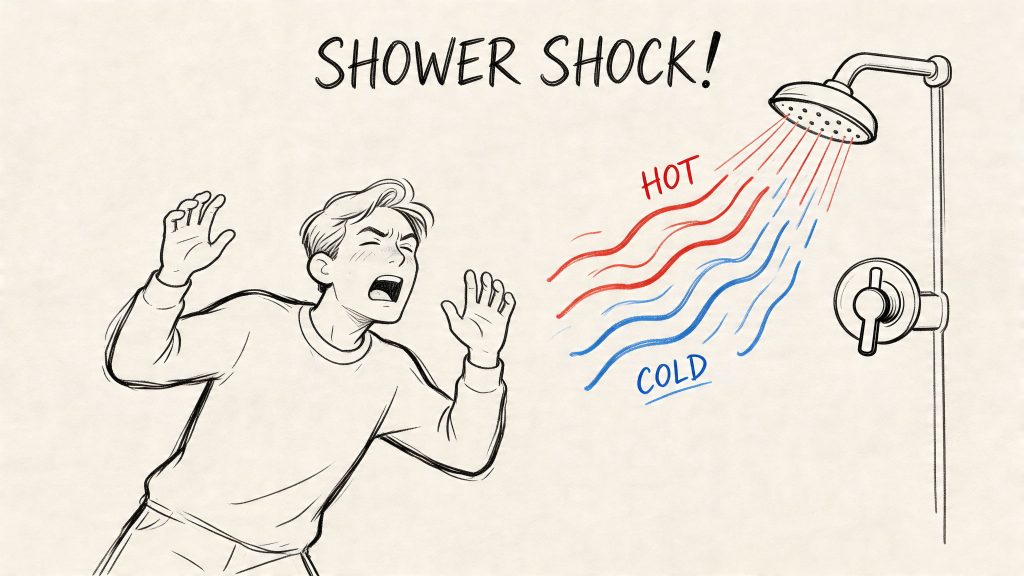
A lot of homeowners find out what a bathroom mixing valve does the hard way. Someone starts a shower in Woodstock or Marietta, the water feels fine for a second, then a toilet flushes, a washing machine kicks on, or the handle shifts a little too far. Suddenly the shower goes icy cold or painfully hot.
That moment isn't just annoying. It's a safety issue.
A bathroom mixing valve is one of the most important protection devices in your plumbing system because it helps control how hot and cold water blend before that water reaches your body. When it works properly, the shower feels stable and predictable. When it starts failing, you can see symptoms that look like low pressure, no hot water, a dripping shower, or a handle that won't cooperate.
For North Metro Atlanta homeowners, this matters even more in older homes, remodeled bathrooms, and houses with changing water pressure. It's also a place where water quality deserves more attention than it usually gets. Sediment and mineral buildup don't just affect faucets and water heaters. They can also interfere with how a mixing valve moves and regulates temperature.
Your Guide to a Safe and Comfortable Shower
A mixing valve typically isn't top of mind until the shower turns on the bather.
A child steps into the tub in Acworth. An older parent showers in Roswell. A busy family in Cumming runs two fixtures at once and the person in the bathroom gets hit with a sharp temperature swing. That kind of shower shock is exactly what the valve is there to prevent.
In practical terms, the mixing valve is the part that helps your shower stay usable when conditions change inside the plumbing system. If your bathroom fixture doesn't respond correctly, the result can be more than discomfort. It can become a burn risk, a slip hazard, or a sign that the valve cartridge or internal balancing parts are wearing out.
Why homeowners notice it late
The problem is that a failing valve often starts small. The handle gets stiffer. The shower takes longer to reach the temperature you want. Hot water seems inconsistent in just one bathroom, even though the rest of the house is fine. Many people assume the water heater is the issue first.
Sometimes it is. But often the problem is at the shower valve itself.
A stable shower temperature isn't a luxury feature. In a family home, it's part of basic plumbing safety.
If you're dealing with a shower that won't hold temperature, it helps to understand how shower valve repair and replacement services fit into the bigger picture. The valve behind the wall has a direct effect on daily comfort, fixture performance, and code-level safety.
What a Bathroom Mixing Valve Does
A bathroom mixing valve controls the blend of hot and cold water before that water reaches your showerhead, tub spout, or sink. The easiest way to think about it is as a traffic controller. It manages two incoming water supplies and adjusts the flow so the output stays safer and more consistent.
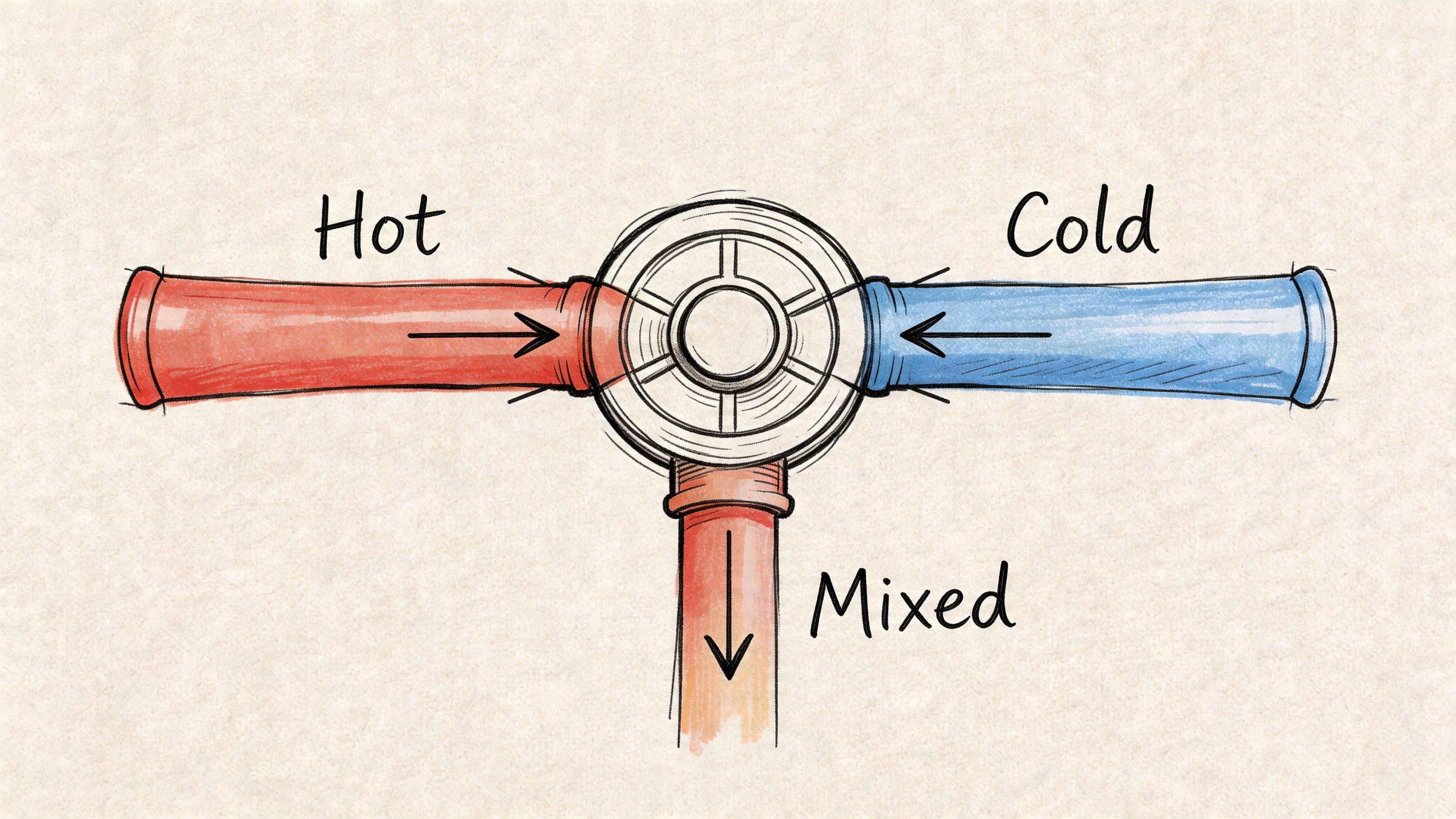
Without that control, water temperature would depend too much on manual handle position and changing pressure in the plumbing lines. That's unreliable. It also becomes dangerous fast in a busy household where fixtures are running at the same time.
The valve's real job is safety
Comfort matters, but safety comes first.
If the cold side drops unexpectedly, the valve must respond so the hot side doesn't surge and scald the person in the shower. If incoming temperatures shift, a thermostatic valve must compensate so the outlet stays close to the intended setting. Good valves are designed around this protection role, not just around convenience.
This isn't a new idea in plumbing. In 1911, Frederick Leonard invented the world's first thermostatic mixing valve after a barber shop hot towel caused severe burns, and that design changed hot water safety in plumbing systems. Leonard's early valve used two metals with different thermal expansion rates to regulate mixed water temperature. The technology later evolved into modern thermostatic mixing valves, with standards such as ASSE 1017 for hot water distribution systems and ASSE 1016 for shower and tub protection. Modern master mixers can support 14 to 51 US gallons per minute at 45 psi for household distribution, according to Leonard Valve's history of thermostatic mixing valves.
What it controls inside the wall
A bathroom mixing valve usually handles these tasks:
- Blending hot and cold supplies so the outlet temperature lands in a safe, usable range
- Reacting to changes in the plumbing system when another fixture turns on
- Limiting temperature spikes that can cause scalding or thermal shock
- Helping fixtures operate consistently so one shower doesn't feel different every day
Some homeowners start researching finishes, trims, and fixture style before they look at the valve body itself. That's backwards. The trim is what you see. The valve is what protects you. If you're comparing fixture hardware during a bath update, looking at different types of valves can help you understand how much the hidden plumbing matters compared with the visible parts.
If a shower looks new but still delivers unstable water temperature, the trim kit wasn't the real problem.
Pressure-Balancing vs Thermostatic Mixing Valves
Not all mixing valves work the same way. The two types homeowners usually need to understand are pressure-balancing valves and thermostatic mixing valves.
A lot of bathrooms in Metro Atlanta have pressure-balancing valves because they're common and practical. Thermostatic valves are often chosen for better control, especially in primary bathrooms or higher-end remodels. The right choice depends on how you use the bathroom, how stable your water pressure is, and whether you're replacing an older valve or rebuilding the shower system from scratch.
How pressure-balancing valves work
A pressure-balancing valve doesn't directly measure the outlet temperature. It reacts to changes in pressure between the hot and cold supply lines.
If someone flushes a toilet and cold water pressure drops, the valve reduces the hot side to match. That helps prevent a burst of very hot water. This makes pressure-balancing valves a solid safety upgrade over older manual valves.
They're often a good fit for:
- Standard hall bathrooms where the goal is safe, reliable operation
- Straightforward replacements when the existing plumbing layout is limited
- Budget-conscious repairs where major reworking behind the wall isn't ideal
How thermostatic valves work
A thermostatic valve focuses on the mixed water temperature itself. It senses the outlet temperature and adjusts the hot and cold proportions to hold the setting more precisely.
That usually means a more stable shower experience, especially in homes where pressure changes happen often or where people want finer control. In a larger master bath in Alpharetta or Johns Creek, that's often worth it.
Thermostatic valves are often chosen for:
- Primary showers used every day
- Homes with children or older adults where tighter temperature control matters
- Bathroom remodels where the homeowner wants performance and comfort, not just a basic replacement
Mixing Valve Comparison Pressure-Balancing vs Thermostatic
| Feature | Pressure-Balancing Valve | Thermostatic Valve |
|---|---|---|
| Main function | Reacts to hot and cold pressure changes | Reacts to actual mixed water temperature |
| Best safety role | Helps prevent sudden scalding during pressure drops | Helps maintain a more exact shower temperature |
| User experience | Safe and serviceable, but less precise | More controlled and more comfortable |
| Typical fit | Guest baths, standard replacements, simpler repairs | Master baths, premium upgrades, comfort-focused remodels |
| Plumbing complexity | Often simpler to replace | May involve a more specialized installation approach |
| Cost factors | Usually lower equipment and labor complexity | Usually higher equipment cost and more involved setup |
What works and what doesn't
A pressure-balancing valve works well when the homeowner wants safer shower performance without turning a basic valve replacement into a full custom project. It doesn't hold a precise number on the temperature scale, but it does reduce the risk of major swings caused by pressure changes.
A thermostatic valve works better when comfort matters as much as safety. It gives more control and usually feels more refined in everyday use. Where some installations go wrong is mismatching the valve to the house. A premium valve won't solve broader pressure issues by itself if the home already has unstable incoming pressure.
That's why it's smart to consider the house-wide pressure picture too. If pressure problems are part of the complaint, understanding water pressure reducing valve service and pressure control can help explain whether the shower valve is the only issue or just one part of it.
A shower valve can only do its job if the rest of the plumbing system gives it a fair chance.
Warning Signs Your Mixing Valve Is Failing
A failing mixing valve rarely announces itself with one clean symptom. More often, homeowners notice a pattern of small frustrations that start showing up in one bathroom.
The shower in Canton takes forever to warm up. A tub in Acworth won't get hot enough. A bathroom in Marietta has weak flow from the showerhead, but the sink in the same room seems normal. These aren't random annoyances. They often point back to the valve body or cartridge.
Symptoms that deserve a closer look
Watch for these common warning signs:
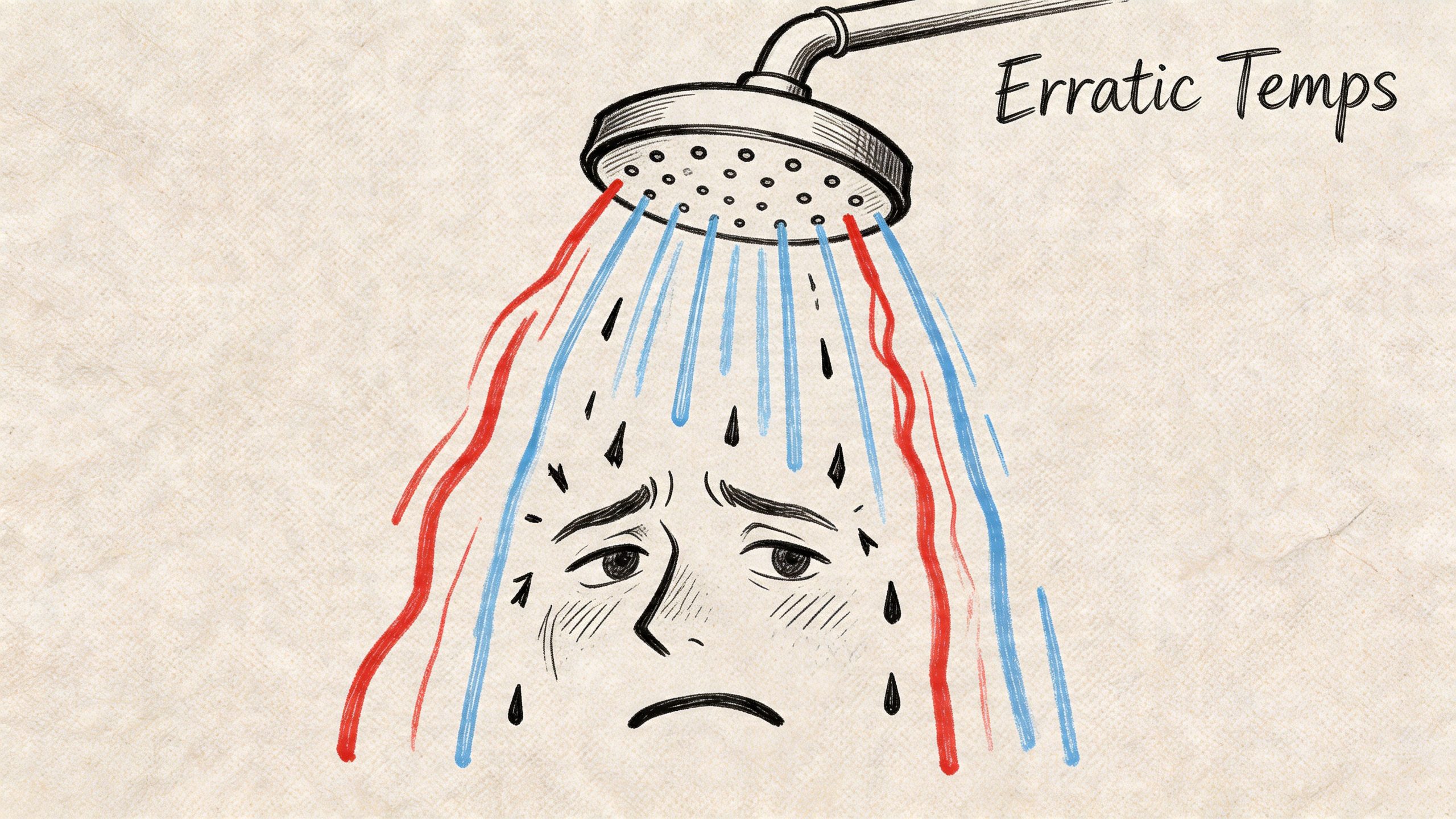
- Sudden temperature swings. The water jumps hot or cold even though nobody touched the handle.
- Only hot or only cold output. The valve may be sticking internally and no longer blending properly.
- Weak flow at one shower. A clogged or restricted cartridge can reduce fixture performance even when the rest of the home seems fine.
- Dripping from the showerhead or tub spout. Internal wear can keep the valve from closing cleanly.
- A stiff, gritty, or hard-to-turn handle. Mineral deposits and worn internal parts often show up first as poor handle movement.
- The bathroom never reaches a comfortable temperature. If the water heater is operating normally, the mixing valve becomes a prime suspect.
Why these signs get misdiagnosed
Homeowners often blame the water heater first, especially when the complaint sounds like "no hot water in the shower." Sometimes that diagnosis is correct. But if hot water is available elsewhere in the home, the problem is often local to that bathroom.
The same goes for low pressure. A single weak shower doesn't always mean a house-wide pressure issue. It can mean the shower valve is restricted internally by debris, age, or wear.
One bad shower doesn't automatically mean one bad water heater.
There is also a practical knowledge gap here. Maintenance and lifespan expectations for mixing valves remain largely undocumented, which makes it harder for homeowners to know when age alone becomes a concern. Available guidance discusses problems like inconsistent temperatures and leaks, and notes that an old or damaged valve may stick, but it doesn't provide clear schedules for preventive maintenance or expected service life. That gap is especially relevant in older Atlanta-area homes, as noted in this discussion of common shower mixing valve issues and undocumented lifespan guidance.
When symptoms are urgent
Some signs call for quick action, not watchful waiting:
- Scalding bursts or severe cold shocks
- A leak behind the trim plate or into the wall
- A handle that locks up completely
- No usable water from the shower at all
At that point, the valve isn't just inconvenient. It can lead to water damage, unsafe bathing conditions, or a bathroom that can't be used.
Plumbing Code and Safe Temperature Settings
Plumbing code around mixing valves exists for a reason. It translates injury prevention into equipment standards and installation rules.
For homeowners, the most important idea is simple. Water can be stored hot enough to support system hygiene, but it shouldn't reach the shower or tap at a temperature that creates a serious burn risk. That balancing act is where mixing valves matter.
Why 120°F matters at the fixture
According to guidance summarized in Consulting-Specifying Engineer's explanation of mixing valves and ASSE standards, an ASSE 1017 master thermostatic mixing valve installed at the water heater allows hot water to be stored at 140°F or higher to help inhibit Legionella bacteria growth, while delivering tempered water at approximately 120°F into the distribution system.
That same source explains why the fixture-side temperature limit matters so much. Direct 140°F water can cause third-degree burns in 6 seconds, while 120°F water takes over 10 seconds under ASSE guidance. That's still hot, but it's materially safer than untempered delivery from a high-temperature storage tank.
Why fixture standards matter in the shower
At the shower or tub, ASSE 1016 comes into play. These valves are designed to reduce thermal shock when pressure changes happen. The standard requires compensation within 1 second for sudden changes and limits outlet temperature swings to ±3.6°F at flows up to 2.5 GPM, with a 120°F limit stop. The same source notes that type TP valves combine both pressure and temperature control.
That level of control matters in real homes. If pressure drops unexpectedly, the bather shouldn't be the one discovering it first.
| Safety point | Why it matters |
|---|---|
| 140°F or higher at storage | Supports hot water storage conditions used to inhibit Legionella |
| Approximately 120°F to distribution | Reduces scald risk before water reaches fixtures |
| ASSE 1016 limit stop at 120°F | Helps keep shower outlet temperatures in a safer range |
| Fast compensation requirement | Reduces shock from sudden supply changes |
Installation details also count
Code compliance isn't only about buying the correct valve. Placement and setup matter.
For thermostatic mixing valve installs, rough-in height is commonly standardized at 51 inches, with a 48 to 54 inch range, to support accessibility and internal clearance. In neighborhoods across Cobb County and North Fulton, that kind of detail is one reason bathroom valve work shouldn't be treated as guesswork.
If you're adjusting storage temperature, replacing a water heater, or trying to solve a shower safety problem, it helps to view the fixture and the heater as one system. Homeowners comparing those issues together can learn more from water heater repair and replacement guidance.
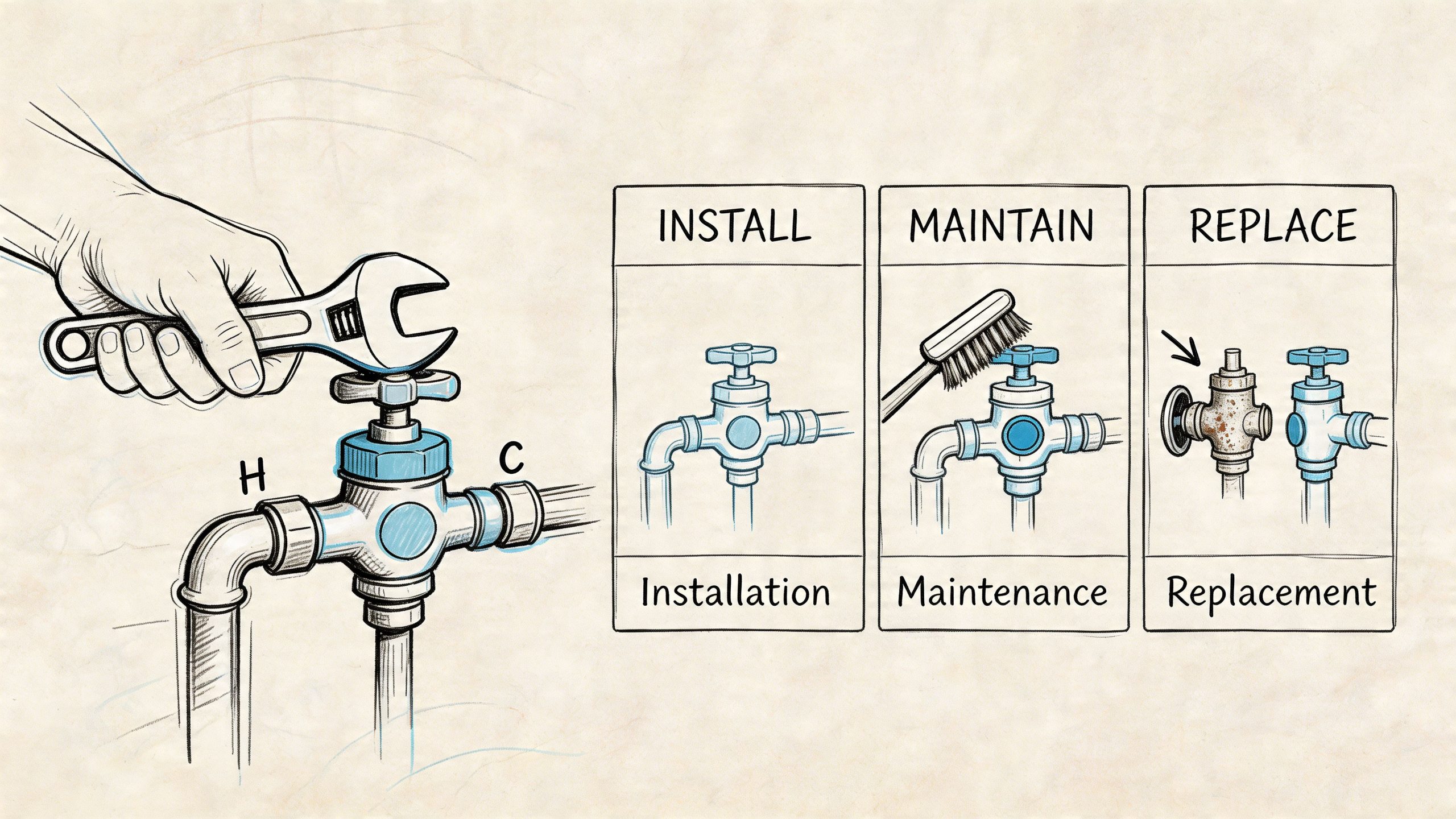
Mixing Valve Installation Replacement and Maintenance
Most bathroom mixing valve problems come down to three realities. The valve was installed years ago, the water moving through it isn't perfectly clean, or the internal parts have worn enough that adjustment no longer works the way it should.
Replacement isn't always the first step, but it often becomes the right one when the valve is buried behind finished wall surfaces, the cartridge is seized, or temperature control has become unreliable. In other cases, a repair is reasonable if parts are available and the valve body is still in good shape.
What affects installation and replacement work
Homeowners often ask what drives the cost of replacing a bathroom mixing valve. The biggest factors are usually the valve type, how accessible it is, whether tile or finished surfaces complicate access, and the condition of the surrounding plumbing.
A simple cartridge replacement in an accessible valve is one kind of job. Opening a wall, replacing an outdated valve body, updating trim compatibility, and correcting old piping conditions is a very different job.
Here are the trade-offs plumbers look at on site:
- Valve type. Pressure-balancing replacements are usually more straightforward than converting to a thermostatic setup.
- Access behind the wall. A valve on an exterior wall or behind finished stone takes a different approach than one with a rear access panel.
- Existing plumbing condition. Corrosion, old solder joints, or incompatible trim can expand the scope.
- Remodel timing. During a bathroom renovation, replacing the valve proactively is usually smarter than keeping an older one buried in a new wall.
For homeowners planning a larger bathroom update, a realistic bathroom renovation cost breakdown can help frame where valve replacement fits into the broader project.
The Atlanta water quality angle most people miss
This is the part many articles skip.
The integration of mixing valves with whole-home water quality systems receives no coverage in most general discussions, even though sediment and mineral buildup can affect valve performance and longevity. Existing content explains what valves do, but doesn't address how hard water deposits or debris may accelerate wear, or whether filtered water may help reduce those problems. That gap is highlighted in this overview of mixing valves and the missing discussion around water quality interaction.
In real plumbing work around North Metro Atlanta, water quality matters. If a home has sediment, scale, or recurring mineral buildup, those conditions don't stop at the showerhead. They move through cartridges, balancing spools, seals, and thermostatic elements. Over time, that can make a valve sluggish, inaccurate, or difficult to turn.
Field rule: when a shower valve keeps sticking or losing smooth control, look beyond the trim. The water running through it may be part of the problem.
What maintenance actually looks like
Because there isn't a well-documented universal schedule for mixing valve maintenance, practical maintenance is mostly symptom-driven. That means paying attention to performance and acting before a minor issue becomes a wall-opening repair.
Good habits include:
- Notice changes early. A handle that gets tighter over time is often an early warning.
- Address one-fixture problems quickly. If one bathroom acts up while the rest of the house is normal, don't ignore it.
- Replace during remodels. If the wall is already open, that's often the best time to update an aging valve.
- Think system-wide. If water quality is rough on faucets, ice makers, and showerheads, it's also affecting internal valve parts.
For homeowners looking at broader plumbing protection, a whole-home filtration approach can make sense alongside fixture work. One option in that category is JMJ Plumbing's HALO whole-home water filtration service, which is used to address water quality concerns at the system level rather than only reacting fixture by fixture.
When to Call a Plumber for Mixing Valve Service
Some plumbing jobs are reasonable for a handy homeowner. A bathroom mixing valve usually isn't one of them.
This work involves shutoffs, trim removal, cartridge identification, temperature setting, code compliance, and sometimes opening the wall or sweating in a new valve body. If the repair is done poorly, the result can be hidden leaks, unsafe temperatures, or a shower that still doesn't work correctly.
Call for service in these situations
You should call a licensed plumber when:
- The shower swings from hot to cold without warning
- You have water leaking from the valve area or behind the wall
- The handle is frozen, stripped, or won't regulate temperature
- You're upgrading from an older valve to a thermostatic model
- A bathroom remodel is exposing the wall anyway
- One shower has no hot water, weak flow, or unreliable temperature
- You want a diagnostic opinion before deciding on repair versus replacement
This also matters during related plumbing work. If you're replacing a water heater, solving pressure issues, or dealing with repeated fixture complaints in an older home, checking the valve at the same time can prevent repeat service calls.
The broader market also points in the same direction. The global thermostatic mixing valve market is projected to grow from USD 1,315 million in 2025 to USD 1,984 million by 2035, at a projected CAGR of 4.2%, according to Fact.MR's thermostatic mixing valve market projection. That projection doesn't make your shower safer by itself, but it does reflect how widely these valves are being used in modern plumbing for safety, code compliance, and reliable hot water control.
If the issue becomes urgent and ties into a larger plumbing failure, the same call may overlap with emergency needs such as leak repair, burst pipe repair, or water heater problems.
Frequently Asked Questions About Mixing Valves
Can I replace a bathroom mixing valve myself
It's not a good DIY project for most homeowners. Even a cartridge swap can turn complicated if the valve is old, seized, incorrectly identified, or already leaking behind the wall. Full valve replacement is even more technical because it may involve piping work, temperature calibration, and code-related fixture protection.
How long should a mixing valve last
There's no reliable universal lifespan you can apply to every home. Age matters, but performance matters more. If the valve gives stable temperature, smooth control, and no leak symptoms, age alone doesn't force replacement. If it sticks, swings, drips, or restricts flow, it needs professional evaluation.
Does a bathroom mixing valve save money
Its main job is safety, not utility savings. Any efficiency benefit is secondary. Its primary value is controlling temperature properly, protecting users from scalding or thermal shock, and helping the bathroom fixture work the way it should.
Is the mixing valve the same thing as the shower handle
No. The handle and trim are the visible control parts. The mixing valve is the working assembly inside the wall. Replacing trim won't fix an internal valve problem if the cartridge or balancing parts are worn out.
Should I replace the valve during a bathroom remodel
In many cases, yes. If the wall is already open, that is often the smartest time to replace an aging valve body, especially if the existing fixture has shown any history of leaks, stiffness, or poor temperature control.
If your shower temperature is unpredictable, one bathroom has weak flow, or you're planning a remodel in Woodstock, Acworth, Alpharetta, Canton, Roswell, Marietta, Cumming, or Johns Creek, JMJ Plumbing can inspect the valve, identify whether the problem is repairable or replacement makes more sense, and address related issues such as water heater performance, pressure problems, leak repair, and whole-home filtration.