Why Is My Faucet Dripping? A Plumber’s Guide for Atlanta

That sound usually shows up at the worst time. The house is quiet, everyone’s asleep, and then you hear it. Drip. Drip. Drip.
Most homeowners in Acworth, Marietta, Roswell, Woodstock, and the rest of North Metro Atlanta start in the same place. They want to know why is my faucet dripping, and they want the answer without getting buried in plumbing terms that don’t help.
A dripping faucet is rarely random. Something inside the faucet isn’t sealing the way it should. Sometimes it’s a worn washer. Sometimes it’s an O-ring, a cartridge, corrosion, mineral buildup, or pressure that’s harder on the plumbing system than it ought to be. The drip is the symptom. The actual issue is the part that failed, and sometimes the system around it.
After more than 25 years serving North Metro Atlanta homes, I can tell you this: the faucet itself is often only part of the story. In this area, I see hard water wear, pressure problems, aging shutoff valves, old water heaters affecting fixture performance, and leaks that start small at a sink and end up revealing a bigger plumbing repair.
That Drip Is More Than Just Annoying
A faucet drip feels small because the amount of water looks small.
That’s why people live with it for weeks or months. They jiggle the handle, tighten it a little more, toss a towel in the sink to mute the sound, and tell themselves they’ll deal with it later.
In real homes, that’s usually how it starts. A bathroom faucet drips only after hot water use. A kitchen faucet leaks from the spout at night but seems fine during the day. A utility sink in the garage starts with an occasional drip and turns into a steady one. Those patterns matter because they point to different failures.
What the drip is telling you
A faucet only drips when water finds a path through a seal that should be closed.
That can happen when:
- A washer wears down and no longer presses tight enough
- An O-ring cracks or flattens
- A cartridge gets rough inside from sediment or age
- Mineral buildup interferes with moving parts
- Water pressure runs too high and pushes past seals
Some leaks come out of the spout. Others show up around the handle base. That difference matters. A spout drip usually points to a sealing problem inside the valve. A handle leak often points to O-rings, packing, or loosened internal parts.
Practical rule: If the faucet keeps dripping after you fully shut it off, the problem won’t fix itself. It usually gets worse with normal use.
Why Atlanta area homes see this so often
North Metro Atlanta homes deal with a mix of older fixtures, newer builder-grade fixtures, hard water effects, and pressure issues. In Acworth, Canton, Alpharetta, Johns Creek, and Cumming, I’ve seen plenty of homes where the faucet drip was the first visible sign that the plumbing system was under stress.
That’s why I never treat a drip as just noise. It’s often an early warning. Catch it early, and the repair stays small. Ignore it, and you can end up chasing cabinet damage, a failed shutoff, fixture replacement, or a wider leak repair problem elsewhere in the house.
The Hidden Costs of an Ignored Faucet Drip
A lot of people wait because the faucet still “works.”
That’s the trap. A dripping faucet can keep running for a long time while wasting water, pushing up the bill, and leaving moisture where it doesn’t belong.

What a drip can cost
A slow drip of 10 drips per minute wastes about 1 gallon per day or 30 gallons per month, while a faster drip of 120 drips per minute can waste up to 11 gallons daily or 330 gallons monthly. In some cases, that can add over 10% to a monthly water bill. A single drip per second can waste over 3,000 gallons yearly, enough for 180 showers, according to this breakdown of how a leaky faucet raises your water bill.
Those numbers surprise homeowners because the sink never looks flooded. But the meter keeps counting.
The damage isn’t only on the water bill
Some faucet drips land straight into the drain. Others don’t.
When water slips around the base of the faucet, under the escutcheon, or down from the handle, it can sit inside the vanity cabinet or beneath the sink deck. That’s where serious headaches start.
Common secondary problems include:
- Cabinet damage that swells particle board and stains wood
- Subfloor moisture that lingers under bathrooms and kitchens
- Mold concerns in dark sink bases with poor airflow
- Rust and corrosion around supply lines and shutoff valves
- Recurring odors from damp materials under the sink
A homeowner may call for faucet repair and end up needing more extensive leak repair because the drip was ignored too long.
A faucet leak that stays contained in the sink is one problem. A leak that gets into the cabinet becomes a different kind of repair.
Why small leaks deserve fast attention
In the trade, small visible leaks often point to wear that’s happening in more than one spot.
If one washer is worn out, the shutoff valves may be aged too. If pressure is high enough to push through a faucet seal, that same pressure can be hard on ice maker lines, toilet fill valves, washing machine hoses, and water heater connections. That’s part of why a faucet drip can be the first clue before a larger plumbing service call for a burst pipe repair, main water line repair, or water heater issue.
For homeowners trying to decide whether to deal with it now or later, the practical answer is simple. Later usually costs more.
How to Identify Your Faucet Type
Before you buy parts or start taking anything apart, identify the faucet type.
That step saves time and prevents one of the most common DIY mistakes. Homeowners pull apart a faucet assuming it uses a washer, then find out it uses a cartridge. Or they buy a universal repair kit and discover none of the parts match.
Start with how the handle moves
You can identify most faucets by the number of handles and how they operate.
-
Compression faucet
Usually has two handles. You turn the handles and tighten them down to stop the water. -
Cartridge faucet
Can be single-handle or two-handle. The movement feels smoother than a compression faucet, and it doesn’t rely on that firm “tighten to close” feel. -
Ball faucet
Usually a single-handle kitchen faucet. The handle moves in multiple directions and often has a cap and cam assembly under it. -
Ceramic disc faucet
Usually feels solid and smooth in operation. These often have a wider body at the base and use ceramic discs instead of a rubber washer as the main sealing surface.
Quick visual clues around the sink
If you’re standing at the sink right now, look for these clues.
Compression signs
Older bathroom sinks and older homes often have them. If you have to twist the handle firmly to shut the water off, that’s the biggest clue.
These are the faucets where worn washers and valve seat issues show up often.
Cartridge signs
A cartridge faucet usually has a more controlled, smooth feel. The handle may lift and turn, or each handle may rotate with less tightening effort than a compression faucet.
If the faucet drips from the spout or leaks around the handle, the cartridge or O-rings are common suspects.
Ball faucet signs
These are common in kitchens. One handle controls temperature and flow together. They often have more internal parts than homeowners expect, which makes diagnosis a little trickier.
Ceramic disc signs
These are often found in newer or upgraded fixtures. They feel sturdy and usually don’t need much force to turn on or off.
When they leak, debris or worn seals are often involved.
Faucet Type Identification and Common Drip Causes
| Faucet Type | How to Identify It | Most Common Drip Cause |
|---|---|---|
| Compression | Two handles that tighten down to shut off | Worn washer or corroded valve seat |
| Cartridge | One or two handles with smooth movement | Worn cartridge or damaged O-rings |
| Ball | Single-handle kitchen faucet with multi-direction movement | Worn seals, springs, or internal parts |
| Ceramic disc | Smooth operation, often wider faucet body | Debris, seal wear, or damaged disc assembly |
Why this matters before any repair
The faucet type tells you what parts you’re likely dealing with.
It also tells you whether the repair is simple or likely to turn into a fight. Compression faucets are often straightforward if the screw comes loose and the seat isn’t badly corroded. Cartridge faucets can be easy, unless mineral buildup has locked the cartridge in place. Ball faucets have more small parts to track. Ceramic disc faucets usually need careful handling, not force.
If you don’t know the faucet type, don’t start with a wrench. Start with identification, a flashlight, and the faucet brand if you can find it.
A good repair starts with the right diagnosis. That’s true whether you’re fixing a dripping bathroom sink in Woodstock or trying to solve a kitchen faucet leak in Alpharetta before it turns into a larger leak repair call.
The Mechanical Failures Behind the Drip
Once you know the faucet type, the leak starts to make sense.
Inside every faucet, there’s a part that stops water by sealing against another surface. When one of those parts wears out, water slips through. The faucet may still look fine from the outside, but the failure is happening where rubber, metal, ceramic, and mineral deposits meet.

Compression faucets and the worn washer problem
Compression faucets are the classic drip producers.
The handle turns a stem down onto a rubber washer. That washer presses against the valve seat to stop water. Over time, the washer flattens, hardens, cracks, or wears unevenly. Then the seal isn’t complete anymore.
Worn washers and O-rings are among the primary causes of dripping faucets, failing after months to years of use from wear, poor installation, or mineral corrosion from hard water, as described in this overview of common causes of water dripping from faucets.
In real terms, that means the faucet may need more force to shut off, then it starts dripping even when the handle feels tight.
When the washer isn’t the whole problem
A lot of homeowners replace the washer and expect the leak to stop. Sometimes it does.
Sometimes the issue is the valve seat, which is the metal surface the washer presses against. If that seat is pitted, rough, or corroded, a brand-new washer still can’t seal properly. That’s why some drips come right back after a DIY fix.
If you replace the washer and the faucet still drips, don’t assume you bought the wrong washer. The metal surface may be damaged.
Cartridge faucets and seal failure
Cartridge faucets don’t shut off the same way a compression faucet does.
Instead of a simple rubber washer pressing down, they use a cartridge assembly with internal seals and moving parts. When the cartridge wears out, or when the O-rings around it lose shape, water bypasses the closed position and escapes through the spout or around the handle.
Hot water often makes these leaks easier to notice. Heat expands and stresses seals. In many homes, the faucet drips more after hot water use because those seals have already lost their flexibility.
Common cartridge symptoms include:
- Drip from the spout after the handle is shut off
- Leak around the handle base
- Stiff handle movement
- Uneven flow or reduced flow
- A handle that feels loose or wobbly
Loose handles can also interfere with full valve closure. Sometimes tightening the screw under the hot/cold cap helps. Sometimes that only hides a worn cartridge that still needs replacement.
Ball faucets and small internal parts
Ball faucets are common in kitchens, and they have more going on inside than is generally expected.
They use a ball assembly, springs, seals, and seats that all have to work together. If one seal wears out or a spring weakens, the faucet can drip. These are repairable, but they’re less forgiving for DIY work because there are several small parts to match and reinstall correctly.
A ball faucet can also leak from different places for different reasons. A spout drip points one direction. A leak under the handle points another. That’s why careful diagnosis matters before parts get ordered.
Ceramic disc faucets and debris issues
Ceramic disc faucets are durable, but they’re not immune to leaks.
They use smooth ceramic surfaces to control water flow. If sediment or mineral grit gets between those surfaces, or if the seals at the base wear out, the faucet can start leaking even though the discs themselves are still in decent shape.
These faucets don’t respond well to rough handling. Overtightening, prying, or forcing the assembly can create a more expensive repair than the original drip.
Hard water and pressure make every faucet age faster
In North Metro Atlanta, hard water is one of the biggest reasons faucet parts fail earlier than homeowners expect.
Minerals build up on cartridges, stems, seats, and seals. Rubber parts get cut or distorted. Metal parts corrode. Handles stiffen up, then people use more force, which adds more wear.
Pressure is the other big factor. Residential water pressure is ideally 45 to 55 psi, and when it runs high, it can force water through gaps and wear parts faster, according to this guide on pressure-reducing valves and residential water pressure.
High pressure doesn’t always announce itself with one big leak. Often it shows up first as repeated fixture failures.
That’s why a dripping faucet can be a local problem or a house-wide clue. If multiple faucets drip, toilet parts fail often, or appliance valves don’t seem to last, the faucet may be reporting a pressure problem that needs attention at the system level.
DIY Fixes You Can Tackle and When to Call a Plumber
Some dripping faucets are reasonable DIY jobs.
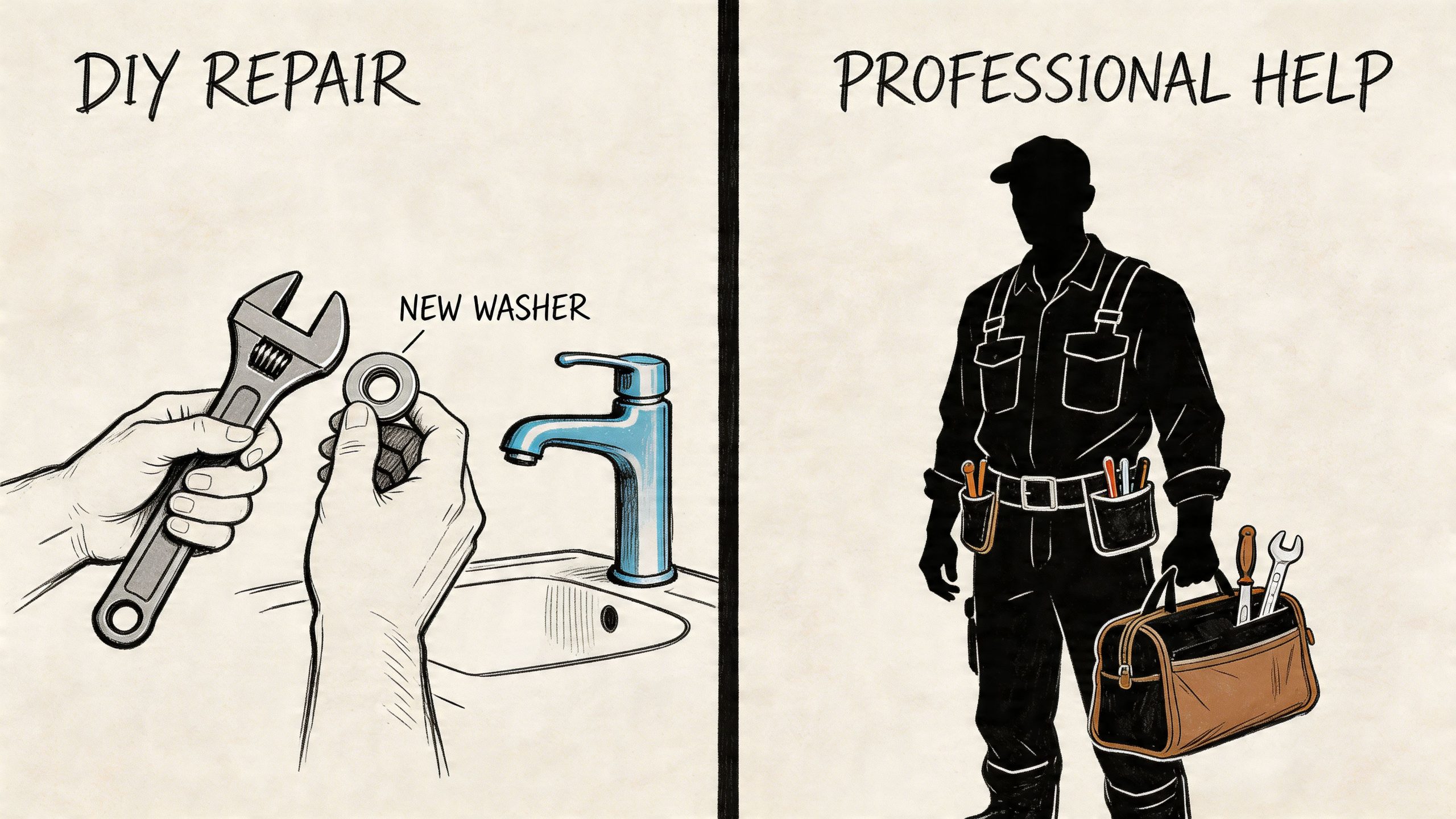
Some aren’t. Knowing the difference can save you from snapping a handle, stripping a screw, breaking a shutoff valve, or turning a simple faucet repair into a bigger leak under the sink.
Good DIY jobs
If the faucet is accessible, the shutoff valves work, and the parts come apart without force, these are often manageable:
- Replacing a compression faucet washer if you can match the size exactly
- Tightening a loose handle screw that’s preventing full closure
- Replacing a visible O-ring when you can clearly identify the part
- Cleaning light mineral buildup from non-electronic faucet components
Basic tools usually include a screwdriver, adjustable wrench, Allen key set, needle-nose pliers, a rag, and plumber’s grease rated for faucet components.
Take pictures as you disassemble. Lay parts out in order. Keep the old part for matching.
Repairs that stop being DIY fast
Some jobs look simple until the faucet is apart.
A stuck cartridge is a good example. Mineral buildup can lock it in place so tightly that pulling harder only damages the faucet body. The same goes for corroded valve seats, seized bonnet nuts, stripped stems, and old shutoff valves that won’t close completely.
Call a plumber when you run into any of these:
- The shutoff valve won’t shut off the water
- The cartridge won’t come out without force
- You see corrosion on the valve seat or stem
- Water is leaking below the sink or into the cabinet
- More than one fixture is showing the same symptoms
- The faucet drips at odd times and pressure seems inconsistent
Those last two matter because the problem may not be only the faucet. High pressure, water quality issues, or trouble on the main water line can shorten fixture life across the house. In the worst cases, unresolved pressure problems can contribute to leaks elsewhere that turn into a burst pipe repair or main water line repair call.
Smart faucets and touchless models are different
Newer touchless and smart faucets add another wrinkle.
An underserved cause of drips is hard water mineral buildup in modern touchless or smart faucets, where limescale interferes with electronic sensors and causes false drips. In North Metro Atlanta, that matters. Data from JMJ Plumbing shows that a HALO whole-home filtration system can reduce hardness by 90% and extend faucet life by 2 to 3 years, as noted in this discussion of common leaky faucet causes and filtration-related prevention.
That’s one reason a standard DIY repair doesn’t always solve a repeat drip. If the water quality is causing buildup, replacing one part may only buy time. For homeowners weighing repair against replacement, this overview of faucet repair and replacement options helps frame what usually makes sense.
Don’t force a faucet apart just because you’re close. Most expensive faucet repairs start with “I almost had it.”
Your 24/7 Emergency Plumber for North Metro Atlanta
A dripping faucet at noon is one thing. A leak under the sink at night is another.
Homeowners across Woodstock, Acworth, Alpharetta, Canton, Roswell, Marietta, Cumming, and Johns Creek often start with a faucet problem and then discover the issue reaches farther. The shutoff won’t close. The cabinet is wet. The pressure is too high. The water heater is acting up too. A simple fixture call can turn into an urgent plumbing repair quickly.
When a faucet drip becomes an emergency call
Not every faucet leak needs a same-night visit.
Some do. Fast help matters when:
- Water is leaking into cabinets, floors, or walls
- A shutoff valve fails
- The leak is tied to high pressure throughout the home
- The fixture won’t stop running
- You’ve lost hot water along with the faucet issue
- The problem is part of a wider plumbing event, such as a sewer backup, clogged drain, or water line issue
In those moments, homeowners aren’t searching for general advice. They’re searching for an emergency plumber, a 24 hour plumber, or a plumber near me who can diagnose the actual cause and stop the damage.
Local work needs local judgment
North Metro Atlanta homes aren’t all built the same.
Older homes in Cobb County and Cherokee County often have different fixture wear patterns than newer homes in North Fulton or Forsyth County. Some properties deal with aging shutoffs and older water lines. Others have newer fixtures but recurring hard water buildup or pressure problems that wear parts out sooner than expected.
That’s where local diagnosis matters. A faucet drip in Marietta may be a fixture repair. A faucet drip in Cumming with repeated pressure complaints may lead to wider system checks. A Roswell homeowner with low hot water and a leaking faucet may also need water heater replacement or water heater repair. A Johns Creek property manager may start with faucet complaints and end up scheduling drain cleaning, leak repair, or sewer repair after a full inspection.
What homeowners should expect
You should expect a plumber to do more than swap a part and leave.
A proper visit checks the leak source, verifies shutoffs, looks at fixture condition, considers pressure, and rules out related issues. If the home has broader symptoms like low water pressure, no hot water, sewage smell, water in the yard, or repeated drain backups, those need to be addressed as part of the bigger picture.
For urgent service in North Metro Atlanta, homeowners can review 24/7 emergency plumbing support when a faucet drip turns into an after-hours leak, burst pipe concern, sewer backup, or other immediate plumbing problem.
Frequently Asked Questions About Georgia Plumbing Repairs
How much does a plumber cost for a dripping faucet in Marietta
The cost depends on the faucet type, part availability, fixture condition, shutoff valve condition, and whether the repair stays a repair or turns into a replacement.
A simple washer swap is different from removing a seized cartridge from an older faucet. If the shutoff valves fail, the scope changes. If the faucet is heavily corroded or the body is cracked, replacement may make more sense than repair.
Can a dripping faucet be a sign of a bigger problem
Yes.
A faucet drip can point to local wear inside the fixture, but it can also be an early sign of high water pressure, hard water damage, or broader plumbing stress in the home. If you also have low water pressure, recurring leaks, no hot water, or multiple fixtures acting up at the same time, it’s smart to look beyond the faucet itself.
What should I do if I have a plumbing emergency at night
First, shut off the fixture’s local valves if they work.
If that doesn’t stop the leak, use the main water shutoff for the home. Then remove items from the cabinet or floor area, dry what you can safely reach, and call a 24 hour plumber. Don’t keep testing the faucet once you know it’s leaking into the cabinet or surrounding finishes.
Is it better to repair or replace a dripping faucet
It depends on the age of the faucet, the availability of parts, and the condition of the fixture body.
Repair makes sense when the faucet is structurally sound and the failed parts are accessible. Replacement often makes more sense when the faucet is badly corroded, obsolete, repeatedly failing, or already difficult to operate.
Can hard water really make faucets drip
Yes.
Hard water leaves mineral buildup inside moving parts and on sealing surfaces. That buildup can shorten the life of washers, O-rings, cartridges, and even sensor-based faucet components. In Georgia homes, that’s one of the most common reasons a faucet repair doesn’t last as long as the homeowner expected.
If your faucet keeps dripping, or the leak seems tied to pressure, hard water, shutoff valve trouble, or a larger plumbing issue, contact JMJ Plumbing for professional diagnosis and repair in North Metro Atlanta. The team handles faucet leaks, emergency plumbing, drain cleaning, sewer repair, water line repair, and water heater service for homeowners who need the problem fixed correctly.