Sewer Line Replacement Under Slab: 2026 Expert Guide
A lot of homeowners first notice this problem in pieces. A toilet in the hall bath starts gurgling. The shower drains slowly. Then there's a sewage smell you can't explain, maybe in the basement, maybe near a bathroom slab, maybe strongest first thing in the morning. You clear one drain, then another, and the problem keeps coming back.
That pattern matters. When several fixtures act up at once in a home in Woodstock, Marietta, Roswell, or anywhere else in North Metro Atlanta, the issue often isn't a simple clog at one sink. It can point to a failing main sewer line under the slab, and that's a serious job because the pipe sits beneath the concrete your home is built on.
A proper under-slab sewer replacement isn't just about swapping pipe. It's about protecting the slab, controlling disruption, choosing the right access method, and making sure the repair doesn't create a second problem a year later. Homeowners usually want the same three things: a clear diagnosis, an honest plan, and no surprises about what gets torn up and what gets restored.
Signs Your Under-Slab Sewer Line Might Be Failing
A common call starts like this: the kitchen sink backs up, then the guest toilet won't flush right, and somebody notices a sour sewer smell near the floor. In a house in Acworth or Marietta, that's often the point where a homeowner realizes this isn't a one-fixture problem.
Under-slab sewer trouble usually shows up as a pattern, not a single dramatic event. One slow lavatory drain might be local. Multiple drains slowing down together is different.
What homeowners usually notice first
Watch for these red flags:
- Multiple slow drains: If the tub, toilet, and sink in different parts of the house all drain poorly, the blockage or damage may be in the main sewer line.
- Recurring backups: If a line has been cleared before and the same problem returns, the issue may be pipe damage rather than ordinary buildup.
- Gurgling toilets or drains: Air movement in the system can signal a restriction, a break, or a line that isn't flowing correctly.
- Persistent sewage odor: Sewer gas smell near floors, bathrooms, or baseboards deserves attention.
- Moisture where it shouldn't be: Damp flooring, unexplained moisture, or a dirty-water seep near the slab can point to a leak below.
- Changes outside: Extra-green grass, soggy soil, or settlement near where the sewer exits the house can support the same diagnosis.
A drain problem that keeps returning after cleaning is often telling you the pipe itself needs attention.
Don't ignore the damage around the damage
When wastewater escapes under or near the slab, the plumbing problem can turn into a property-damage problem. If a backup or leak has already affected flooring, drywall, or contents, homeowners often need to document conditions quickly. This guide to burst pipe water damage claim help is useful for understanding the insurance side of water-related damage before cleanup erases evidence.
If the symptom right now is repeated stoppages, not confirmed pipe failure, a professional drain service is often the first step before a bigger decision. Homeowners dealing with backups and toilet clogs can start with drain cleaning and toilet clog service to determine whether the issue is a blockage or a damaged line.
How Professionals Diagnose Under-Slab Sewer Issues
When the sewer line runs under a slab, guessing is expensive. Nobody should recommend cutting concrete until the line has been inspected and located.
The first real step is seeing the inside of the pipe.
Camera inspection comes first
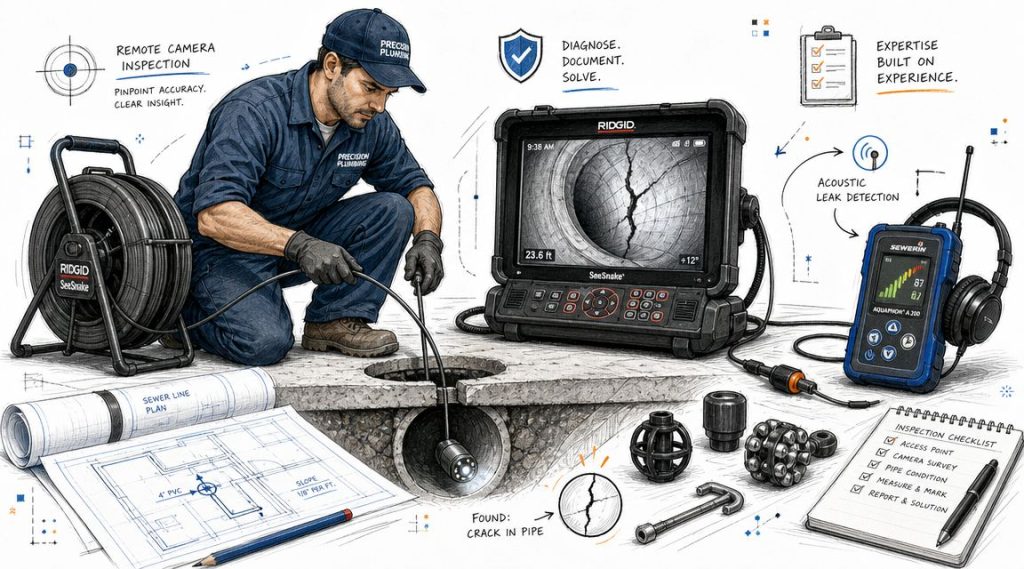
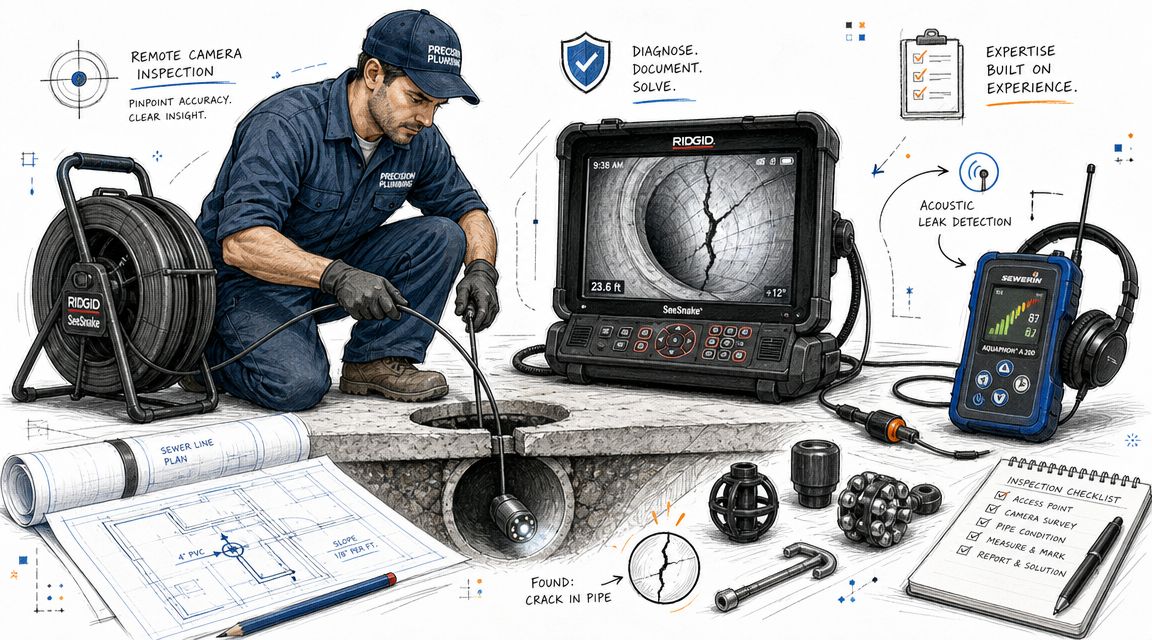
A plumber typically accesses the system through a cleanout or another suitable entry point and feeds a sewer camera into the line. The camera shows what's happening inside the pipe in real time.
That matters because under-slab problems can look similar from the surface. A homeowner may report slow drains and odors, but the cause could be cracking, root intrusion, corrosion, scale, a belly in the line, a separation at a joint, or a collapsed section. The camera distinguishes one from another.
For homeowners who want that first step done properly, sewer camera inspection service is the right starting point before any repair plan is priced.
Locating turns video into a plan
The video tells you what the defect is. Locating tells you where it is.
A technician uses locating equipment above ground to track the camera head and mark the pipe path, depth, and exact trouble spot. That's how a crew can tell whether the failure sits under a bathroom slab, near the edge of the foundation, or beyond the house in the yard.
Those details shape the repair strategy. A break just outside the footprint of the house is a different project from a damaged line directly beneath finished tile in the middle of a kitchen.
What the inspection is looking for
A solid diagnostic visit should answer a few practical questions:
- Is the pipe still structurally passable? That affects whether trenchless rehabilitation is even on the table.
- Is the damage isolated or widespread? One bad section and a failing run are not the same decision.
- Where is the best access point? Existing cleanouts can reduce disruption.
- Are there multiple contributing issues? A line can have corrosion, roots, and poor slope at the same time.
If a contractor wants to talk replacement before showing you what the camera found, slow the job down.
A homeowner should come away with more than a verbal description. The best inspections give clear findings, marked locations, and a repair recommendation that matches the actual pipe condition, not a one-size-fits-all sales pitch.
Traditional vs Trenchless Sewer Replacement Methods
Many homeowners face a common challenge. They know the sewer under the slab has failed. What they don't know is whether they're facing jackhammers inside the house or a more targeted trenchless fix.
Both methods have a place. Neither is automatically right.
Traditional slab cutting
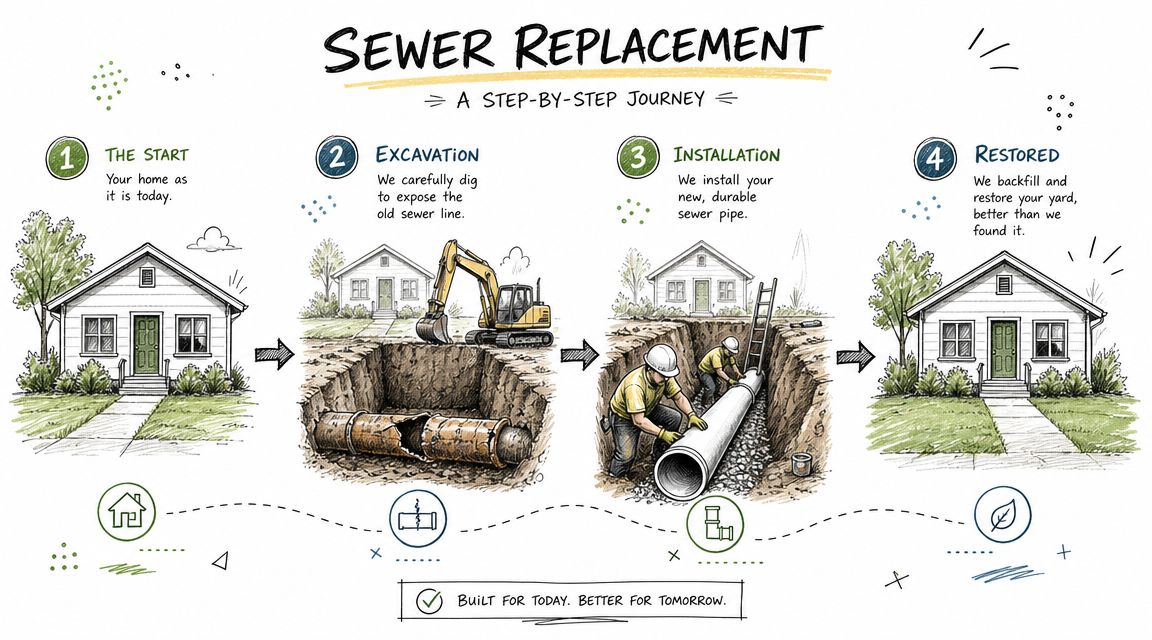
Traditional replacement means opening the slab to reach the damaged line. Crews mark the path, remove flooring as needed, cut or jackhammer the concrete, excavate below the slab, remove the failed pipe, install new piping, backfill properly, and then re-pour concrete. After that, finish restoration still has to happen.
It's proven and direct. If a pipe is badly collapsed, severely offset, or otherwise beyond rehabilitation, physical replacement may be the only responsible option.
The downside is disruption. Noise, dust, temporary loss of room use, concrete work, and finish repair are part of the job.
Trenchless lining and bursting
The major shift in under-slab sewer work has been toward trenchless rehabilitation, especially cured-in-place pipe, or CIPP. When the existing line is still mostly intact, CIPP creates a continuous epoxy pipe within a pipe and is typically 30 to 50 percent less expensive than full dig-and-replace once concrete, flooring, and restoration are included, according to NuFlow's under-slab repair guidance.
That same guidance notes another practical advantage. CIPP can often be installed and cured in about 2 hours, while conventional excavation can take several days plus additional curing and restoration time for the slab and finishes.
Pipe bursting is another trenchless option in some situations. Instead of lining the old pipe, it pulls a new pipe through along the same route. But not every under-slab layout is a good candidate, and access still matters.
What works and what doesn't
Trenchless sounds attractive because it usually is less invasive. But it's not magic.
It works best when the pipe still has enough shape and continuity to accept rehabilitation. It does not solve every condition. A heavily collapsed line, severe offset, or structurally unsound run may still need excavation and replacement.
Traditional replacement is more disruptive, but it gives direct access and lets the plumber correct pipe layout, bedding, and connections in a way no liner can.
The right method depends less on what you want to avoid and more on what the camera shows the pipe can actually support.
Slab Sewer Repair Method Comparison
| Factor | Traditional (Slab Cutting) | Trenchless (Lining/Bursting) |
|---|---|---|
| Access | Requires opening the slab over the pipe | Often uses existing access points or limited access |
| Disruption inside the home | High. Concrete demolition and finish repair are common | Lower when the pipe condition allows it |
| Best use case | Collapsed, offset, or badly failed pipe | Mostly intact pipe with cracks, small gaps, or deterioration |
| Timeline | Plumbing work can take several days, plus concrete and finish restoration | Installation can be much faster in suitable conditions |
| Restoration burden | Usually significant | Usually reduced |
| Control over pipe geometry | Highest. Full replacement allows full correction | Limited by existing route and condition |
The real trade-off homeowners should focus on
The biggest mistake I see in these conversations is treating the pipe as the only cost. Under a slab, the pipe often isn't the whole story. Access and restoration often drive the decision.
If the line runs under tile, hardwood, cabinets, or a finished basement area, demolition changes the budget and the daily life of the household. In occupied homes and commercial spaces, downtime matters almost as much as the plumbing itself.
That's why sewer line replacement under slab has changed so much over time. Homeowners are no longer deciding only by pipe length or material. They're deciding by access, restoration scope, and how much disruption the property can tolerate.
What to Expect During Your Sewer Replacement Project
Most homeowners handle this better once they know the order of events. The project feels less overwhelming when you can see what happens first, what happens next, and what work may fall outside the plumbing scope.
Inspection and proposal
The job starts with diagnosis, then a written plan. The proposal should identify the damaged area, recommended repair method, likely access points, and what restoration is or isn't included.
If permits are required in places like Cobb County, Cherokee County, North Fulton, or Forsyth County, that should be addressed before the work starts. Homeowners should ask who is pulling the permit and who is scheduling required inspections.
Preparing the home
Before work begins, the crew may ask you to clear furniture, rugs, stored items, or vehicles from the affected area. If the access point is inside, dust protection and path protection matter.
Utility of the bathrooms or drains may also be limited during parts of the project. That's normal. What matters is getting a clear explanation before the first tool comes out.
A few practical questions to ask:
- Which rooms will be affected
- Will water service or drain use be interrupted
- Is the access point inside, outside, or both
- Who handles concrete patching
- Who handles flooring, paint, trim, or cabinet restoration if needed
The repair itself
The work phase depends on the chosen method.
With traditional excavation, expect concrete cutting, excavation, pipe replacement, testing, backfill, and slab patching. With trenchless work, the focus is more on access, cleaning or preparing the existing pipe, installation, cure or pull process, and final verification.
Current educational material on trenchless methods points out that faster installation is possible, but not every pipe qualifies. Heavily collapsed or offset lines may still require physical replacement, and tunneling can introduce added safety and settlement concerns, as discussed in this industry demonstration on trenchless under-slab repair limits.
Restoration and closeout
Plumbing contractors usually restore the pipe system and the immediate access area defined in the contract. That may include concrete patching. It may not include finish flooring, painting, cabinetry, or specialty trim work unless that is specifically written in.
Before work starts, get clear on the handoff point between plumbing repair and finish restoration.
A clean closeout should include testing, confirmation that the line is flowing, and an explanation of what was repaired. If the job involved a larger sewer line replacement under slab, ask for records you can keep with the house. That helps with future maintenance, resale, and insurance conversations.
Budgeting for Under-Slab Sewer Line Replacement
This is the question every homeowner asks early, even if they wait to say it out loud. Under-slab sewer work is expensive because it combines plumbing labor with demolition, access, excavation, and structural restoration.
There isn't one flat price that fits every house in Alpharetta, Canton, Cumming, or Johns Creek. But there is a clear market pattern. Under-slab work costs more than ordinary sewer replacement.
What current cost data shows
A 2025 HomeAdvisor estimate puts average sewer line replacement at $3,319, with a normal range of $1,388 to $5,323. When the line runs under a concrete slab, the estimate rises by an additional $300 to $350 per linear foot because crews must break concrete, access the pipe, and restore the slab afterward, according to HomeAdvisor sewer line replacement cost data.
That same source also reflects Angi cost data showing general sewer replacement at $60 to $250 per linear foot, while concrete-slab sections can reach $300 to $350 per linear foot.
Why the numbers climb so fast
The extra cost usually comes from factors homeowners don't see in a simple line-item mindset.
- Access difficulty: Reaching a pipe under finished floors is harder than reaching one in open ground.
- Concrete work: Cutting, removing, and restoring slab sections adds labor and materials.
- Excavation below the slab: Soil has to be removed and replaced correctly to support the new installation.
- Finish restoration: Flooring and interior surfaces often become part of the total project cost, even if another contractor completes that phase.
- Project complexity: Branch connections, depth, tight spaces, and limited access all push cost upward.
How to think about the budget
A good estimate should separate the plumbing scope from the restoration scope as clearly as possible. That lets you compare methods accurately.
For example, a traditional replacement may look straightforward on the plumbing side but become much more expensive once slab restoration and interior finishes are considered. A trenchless option may reduce those surrounding costs if the pipe condition allows it.
This is also where financing, coupons, or phased planning can help some homeowners manage the investment. The right approach depends on whether the failure is isolated, whether temporary measures are even reasonable, and whether the home can tolerate waiting.
The practical rule is simple. Don't compare bids by total price alone. Compare method, access plan, restoration obligations, and what conditions could change the final scope.
Hiring the Right Plumber in North Metro Atlanta
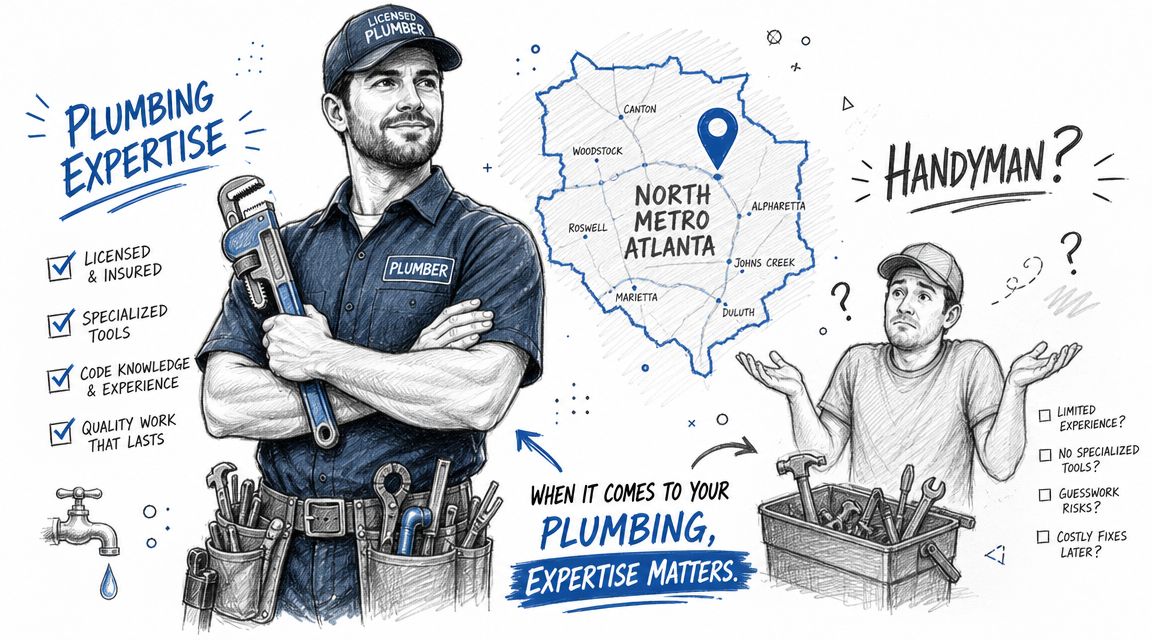
Under-slab sewer replacement is not handyman work. It takes code knowledge, diagnostic discipline, and enough field experience to know when a trenchless method is safe and when it isn't.
That matters even more in older homes and in areas where slab design, footing location, and soil movement complicate the job.
Why licensing and trade knowledge matter
ASPE guidance states that under-slab pipes need proper clearance from footings and should not be in direct contact with concrete. The same guidance notes 4 to 6 inches of clearance to column or grade-beam footings, and warns that direct contact creates failure risk because pipes and slabs move at different rates, as outlined by ASPE under-slab piping guidance.
That's the kind of detail a Master Plumber pays attention to. A bad under-slab repair can fail again not because the new pipe was defective, but because the installation ignored movement, bedding, and clearance.
Questions worth asking before you hire anyone
Ask direct questions and expect direct answers.
- Are you licensed and insured for this work
- Do you handle sewer camera inspection and locating
- Do you offer both excavation and trenchless options, or only one
- Who pulls permits and coordinates inspections
- What exactly is included in the restoration
- How much experience do you have with sewer line replacement under slab in occupied homes
Insurance matters too. Homeowners who want context on how plumbing contractors are typically insured can review this overview of The Ephraim Group plumbers insurance. It helps you ask better questions about liability coverage before work begins.
If you're comparing local contractors for the actual repair scope, sewer line repair and replacement service is one example of the kind of specialized service page that should clearly state whether a company handles inspection, repair, and replacement rather than only basic drain clearing.
What trust looks like on this kind of job
Trust isn't a slogan on sewer work. It looks like a plumber who can show you the problem, explain the options, and tell you plainly when a cheaper-looking shortcut is the wrong choice.
It also looks like restraint. If a line can be rehabilitated without tearing through the slab, that should be discussed. If the line is too far gone and needs excavation, that should be said just as clearly.
Common Questions About Under-Slab Sewer Repairs
Will homeowners insurance cover it
It depends on the policy and on what happened. Coverage for the failed pipe itself is often treated differently from coverage for resulting damage inside the home. If sewage or water affected finishes or belongings, documentation matters.
If contamination is involved after a backup, safe cleanup matters too. These effective sewage cleanup tips are useful for understanding immediate cleanup precautions before a restoration crew arrives.
Can we stay in the house during the repair
Sometimes yes, sometimes no. It depends on where the access is, how many drains are out of service, whether concrete must be opened inside the home, and whether there are active sanitation concerns. Trenchless work is often easier to live through. Interior slab cutting is far more disruptive.
Is repair better than full replacement
Sometimes. If the damaged area is limited and the rest of the line is in good shape, a targeted repair or rehabilitation may be sensible. If the inspection shows broader failure, a partial fix can turn into repeat work. The right answer comes from the condition of the whole run, not just the worst visible spot.
How long should the fix last
That depends on the method, the material, and the quality of installation. A well-executed repair should solve the existing failure without creating a new one through poor bedding, bad slope, or improper contact with the slab or footing.
What should I do right now if sewage is backing up
Stop using the affected fixtures. Keep people and pets away from contaminated areas. Don't keep flushing to “test” the line. Call a licensed plumber who handles sewer diagnostics and emergency response.
If you need a clear diagnosis and a realistic plan for sewer line replacement under slab in Acworth, Woodstock, Marietta, Alpharetta, Roswell, Canton, Cumming, Johns Creek, or nearby North Metro Atlanta communities, JMJ Plumbing can inspect the line, explain the repair options, and provide an on-site quote based on the actual condition of the pipe.